Bloody hell, it's cold today.
If next week isn't any warmer, I'm probably going to have to stop coming into work by moped. The roads are getting icier, and it becomes extremely dodgy to be navigating them on two wheels at any speed.
Also the wind chill factor resulting from driving into freezing cold air at 30mph is considerable. I'm rather fond of the sensation of having fingers, and tend to get unnerved when I lose it.
This means getting up annoyingly even earlier than I do usually and taking a train from near home to Bristol Temple Meads, and then a bus out to the vicinity of St Brad's, which is not fun. But at least I can do it without (much) danger of frostbite.
18 November 2005

16 November 2005
Stuff Update
I'm not ignoring you, I've just been busy. Not with anything of any interest, mind you -- just busy. I have a books-related post (or at least, a mental note to write a books-related post) which I'll be putting up after the weekend so that it doesn't inadvertently reveal a friend's birthday present, but in the meantime...
Food: very nice veggie mezze (also available in vegan) from the café attached to the Tobacco Factory theatre -- a place we need to investigate more thoroughly, in a nearby region of Bristol which we also need to investigate more thoroughly. (It also contains, for instance, at least two other interesting-looking eateries, one of which the manager at Casa Caramba recommended to us, and a decent delicatessen which sold us cheese and beer.)
Beer: Bath Ales's organic Wild Hare from the deli, and at the Tobacco Factory some good and very local stuff from the Bristol Beer Factory, which I'd not tasted before. The Golden ale was good, but the one I liked best with the food was the Red, not listed on the site. (I'm developing something of a partiality for red ales, in fact. Mmm, mellow yet flavoursome.)
Books: Cock and Bull by Will Self. I'm alternating between finding it addictively enjoyable and too appallingly self(ho ho)conscious for words. Less compelling than The Quantity Theory of Insanity, although with more creative deployment of rude words. I was amused by the reference to the protagonist's [highlight whitespace to read, but please not if you're easily offended] "cuntal area". I'm also enjoying Simon's Doctor Who book, The Time Travellers.
TV:
1. The West Wing Season Six is a distinct improvement on the dreary Season Five, but it has a way to go before it reaches the heights of Seasons One to Four, and is hampered by having to play (presumably partly actor-directed) games of musical chairs with the White House staff and their posts.
2. Just finished Buffy Season Two -- and yes, the conclusion to Becoming is astonishingly moving and effective, but the two-parter's still not flawless. Too much of the climax relies on the staple fantasy plot device of "Look, that's just how it's fated to be, OK?", while Angel[us]'s motivation for wanting to bring on armageddon needs some exploration in light of Spike's sensible aversion to the idea. Plus Kendra is killed off more because the writers have realised she's a bit hopeless and want to introduce Faith instead, than for any proper narrative reason. Still a bloody good story, though.
3. Good grief, Rome's not much cop, is it?
I think that about covers it.
Food: very nice veggie mezze (also available in vegan) from the café attached to the Tobacco Factory theatre -- a place we need to investigate more thoroughly, in a nearby region of Bristol which we also need to investigate more thoroughly. (It also contains, for instance, at least two other interesting-looking eateries, one of which the manager at Casa Caramba recommended to us, and a decent delicatessen which sold us cheese and beer.)
Beer: Bath Ales's organic Wild Hare from the deli, and at the Tobacco Factory some good and very local stuff from the Bristol Beer Factory, which I'd not tasted before. The Golden ale was good, but the one I liked best with the food was the Red, not listed on the site. (I'm developing something of a partiality for red ales, in fact. Mmm, mellow yet flavoursome.)
Books: Cock and Bull by Will Self. I'm alternating between finding it addictively enjoyable and too appallingly self(ho ho)conscious for words. Less compelling than The Quantity Theory of Insanity, although with more creative deployment of rude words. I was amused by the reference to the protagonist's [highlight whitespace to read, but please not if you're easily offended] "cuntal area". I'm also enjoying Simon's Doctor Who book, The Time Travellers.
TV:
1. The West Wing Season Six is a distinct improvement on the dreary Season Five, but it has a way to go before it reaches the heights of Seasons One to Four, and is hampered by having to play (presumably partly actor-directed) games of musical chairs with the White House staff and their posts.
2. Just finished Buffy Season Two -- and yes, the conclusion to Becoming is astonishingly moving and effective, but the two-parter's still not flawless. Too much of the climax relies on the staple fantasy plot device of "Look, that's just how it's fated to be, OK?", while Angel[us]'s motivation for wanting to bring on armageddon needs some exploration in light of Spike's sensible aversion to the idea. Plus Kendra is killed off more because the writers have realised she's a bit hopeless and want to introduce Faith instead, than for any proper narrative reason. Still a bloody good story, though.
3. Good grief, Rome's not much cop, is it?
I think that about covers it.
11 November 2005
Fed
Ah well, I guess it was inevitable at some point: somebody's syndicated Peculiar Times as a LiveJournal feed.
As far as I can make out, new posts only appear in part, with a link here, so it's probably not going to deprive this site of readers. One thing I would mention, though, is that I often edit posts heavily in the first half hour or so after I post them here, sometimes adding whole paragraphs as afterthoughts. I believe it's the case that an LJ feed only archives the first version of a post... so if you find the extract on the syndicated feed consists of an apparently complete but shorter-than-usual post, then you may wish to check the link anyway, to make sure that hasn't been supplemented with extra juicy text.
As far as I can make out, new posts only appear in part, with a link here, so it's probably not going to deprive this site of readers. One thing I would mention, though, is that I often edit posts heavily in the first half hour or so after I post them here, sometimes adding whole paragraphs as afterthoughts. I believe it's the case that an LJ feed only archives the first version of a post... so if you find the extract on the syndicated feed consists of an apparently complete but shorter-than-usual post, then you may wish to check the link anyway, to make sure that hasn't been supplemented with extra juicy text.
10 November 2005
...Because Proper Tea is Theft
More in an attempt to keep my hand in than anything else, I've just sent three mini-pitches in to a company that's launching a range of "well-written [...] pulp" SF and fantasy novels set in a quartet of all-new shared universes[1]. I've been having some fun seeing just how pulpy I could make them and remain convinced that I could produce something good. Obviously I don't know whether the publishers will be interested, but if they are... well, the pay's very decent.
I don't want to end up getting inextricably associated with shared-world writing, though, so I'd probably be writing under a pseudonym. Which means there probably won't be any big announcements here.
On the other hand, if I was writing another novel I don't think I could keep the fact quiet on this blog without completely making things up -- which I don't want to do, as one of its purposes is to let friends I rarely see know how I'm getting on. So, if these publishers do want to commission me (and of course they may well not), expect a certain amount of equivocating and vagueness about what I'm writing at the moment.
I do need to get back into writing properly, though. It's been too long since I did anything creative -- not since I finished "The Long Midwinter" back in June, in fact. Lack of coffee hampers me (and God, I hate hate hate hate HATE mint tea[2]), but I need at least to show willing before once again embracing that particular crutch.
[1] Given a certain understanding of "all-new", that is.
[2] On the other hand, Twinings' orange, mango and cinnamon blend is surprisingly decent. Or possibly I'm just cracking up.
I don't want to end up getting inextricably associated with shared-world writing, though, so I'd probably be writing under a pseudonym. Which means there probably won't be any big announcements here.
On the other hand, if I was writing another novel I don't think I could keep the fact quiet on this blog without completely making things up -- which I don't want to do, as one of its purposes is to let friends I rarely see know how I'm getting on. So, if these publishers do want to commission me (and of course they may well not), expect a certain amount of equivocating and vagueness about what I'm writing at the moment.
I do need to get back into writing properly, though. It's been too long since I did anything creative -- not since I finished "The Long Midwinter" back in June, in fact. Lack of coffee hampers me (and God, I hate hate hate hate HATE mint tea[2]), but I need at least to show willing before once again embracing that particular crutch.
[1] Given a certain understanding of "all-new", that is.
[2] On the other hand, Twinings' orange, mango and cinnamon blend is surprisingly decent. Or possibly I'm just cracking up.
07 November 2005
Mitchell, Priest and Mo[o]re
I've been getting more time to read recently with B. at work in the evenings, which means I've now finished David Mitchell's Cloud Atlas, Christopher Priest's The Glamour and Alan Moore's V for Vendetta as well.
[NB: What follows shall contain spoilers. Not Invented Here and others who don't want to read details about Cloud Atlas may wish to skip this entry.]
Cloud Atlas is a clever, intricate, substantial read, and also thoroughly entertaining. As mentioned previously, it's structured as a series of nested novellas, with multiple connections between and across them; the primary conceit being that the protagonist of each story encounters in some form the story of the previous protagonist. The outermost novella, which starts and closes the book, is therefore the earliest, set in the Pacific islands in the 1840s, whereas the central, undivided narrative is that of the final collapse of what may be civilisation's last remnant, also on a Pacific island hundreds of years hence. The novel's setting thus comes virtually full circle, but only by way of 1930s Belgium, 1970s California, 2000s England and vaguely-2100s Korea.
This allows for some wonderfully effective stylistic pyrotechnics, as each separate narrative is told not only in its own extremely distinctive voice, but also in an identifiable genre: nineteenth-century sea tale, epistolary novel, crime thriller, contemporary satire, futuristic dystopia and finally post-apocalyptic. Each section has its own distinct language and vocabulary, with the two future settings developing their own rich and unique dialects only partially indebted, like the settings themselves, to existing science fiction.
The novel has an indignant and vocal sense of a history where injustice and oppression are rife, from capitalist expoitation by Victorian missionaries, to the enslavement of genetically-engineered "fabricants", to the heartless incarceration of the elderly in contemporary Britain. Mitchell's theme is the urge for power and the self-destructive lengths to which it will drive both individuals and societies -- including, on the largest scale, human civilisation itself. There's a strong suggestion that the individual protagonists are in fact the same reincarnated soul, forging similar relationships and making equivalent choices from one era to another: that said, there's also the suggestion that some of the stories are fictional rather than historical in relation to one another, and in particular that the future segments could be the product of the present-day protagonist's stroke-induced delirium.
It's the kind of book which demands an obsessive (and fannish) nitpicking to tease out the relationships between its stories: what, for instance, is the significance of the comet birthmark? The repeated motif of falls from bridges or balconies? The messy romantic breakups? The Cloud Atlas Quartet? The words "hydra" and "slooshed"? Are characters other than Ewing / Frobisher / Rey / Cavendish / Sonmi / Meronym also reincarnated -- and are those six actually the same person, or is the author playing a trick on us? Who is "fictional" and who is "real"? Is the 1970s crime novel segment deliberately bad, or is this just a product of the voice that Mitchell is pastiching?
Ultimately, the novel functions as a historical thesis drawn from a wide compendium of exploitation and compassion, incarceration and escape -- the contrary urges which underpin all our behaviours, savage and civilised alike. I keep changing my mind as to whether or not it counts as SF.
On which note, The Glamour may have a stab at justifying its central conceit of "naturally invisible" people in terms of hardwired social behaviours, negative hallucination, post-hypnotic suggestion and the like, but in fact it is -- as the climax definitively proves -- a work of magic realism emerging from the SF tradition. Indeed this description seems to cover all the Priest novels I've read so far: The Prestige with its late-Victorian stage magicians using the emergent marvel of electricity to perform the impossibilities it once seemed to promise; The Separation with its dreamlike (and possibly dreamed-into-existence) ambiguities about the true outcome of the Second World War; and A Dream of Wessex with the virtual reality which becomes, thanks to its participants' emotional investment, reality itself.
I also suspect that at some point Mr Priest may have been involved in a love triangle with a nice middle-class young woman and her monstrously manipulative ex-boyfriend, who may just possibly have had the power to bend reality to his will. It's just a hunch.
The novel is compelling and sophisticated, blending the theme of literal invisibility (the "glamour" of the title, with its wide range of potential applications to human social relations) with those of our reconstructed memories of the past, and of our interaction with time and landscape. The final twist, which brings all of these elements together in an unhappy ending which effectively redefines all that we've read so far, is unsettling and beautiful.
All of which was marred for me by the annoyingly half-arsed attempt to bring the text "up to date". The Glamour was published in 1984, yet the copyright page bears the ugly legend "© 1984, 1985, 1996, 2005", suggesting the successive amendments which have managed to turn it into a huge mess. Nominally the characters own computers, spend euros when abroad and have at least heard of mobile phones, but every so often the story's original 1980s reality makes an Ubik-like attempt at reasserting itself with a reference to sending a telegram, or to the "flickering orange digits" on a petrol-pump. More seriously, the characters' actions and decisions take no account of the existence of the internet, mobiles or even answering machines, making a nonsense of, if not the plot, at least many of its constituent events.
This is particularly irritating because it's so utterly unnecessary. Why on earth do the publishers imagine anyone would object to reading a novel set in the '80s?
I see that The Extremes is similarly "© 1998, 2005", which makes me somewhat less eager to read it. At least seven years isn't too huge a gap, but I really hope Gollancz don't do this to all of Priest's older works -- the Soviet-inflected future of A Dream of Wessex, for instance, would end up looking particularly silly.
V for Vendetta is set in 1997-98, and I would really prefer it if that wasn't changed for the forthcoming film version, thank you very much. It's a distinctively Thatcher-era vision of the dystopian future, with a near-miss nuclear apocalypse leading to a fascist takeover of England, where all the gays, blacks and other subversives are neatly expunged in concentration camps, and the barmy neo-christian dictator bears certain startling similarities to Chief Constable James Anderton. (I couldn't help noticing that it had almost exactly the same plot as Frank Miller's supposedly groundbreaking The Dark Knight Returns, as well.)
The book suggests that the only way a society like this can be overturned is to tear it all down and begin again from the beginning: an argument with considerable historical justification, but one which makes for deeply uncomfortable reading, as the terrorist protagonist in his Guy Fawkes costume murders his way through the upper echelons of government, blowing up several London landmarks and psychologically brutalising his young female companion along the way.
V for Vendetta was Moore's earliest attempt at an ongoing series, and compared with the flawless virtuosity of a work like Watchmen, his lack of experience does show. Nevertheless, many of his trademark devices are already present: games with the panel layouts; dialogue with double or triple meanings; echoes of previous images and dialogue; songs both original and found which comment chorically upon the action; and extensive use of poetical quotations. Plus of course an unsettling yet charismatic superantihero.
For anyone who's enjoyed Moore's later work (and frankly who's read it and hasn't?), it is an essential read. I'm certainly glad I got round to it at last.
[NB: What follows shall contain spoilers. Not Invented Here and others who don't want to read details about Cloud Atlas may wish to skip this entry.]
Cloud Atlas is a clever, intricate, substantial read, and also thoroughly entertaining. As mentioned previously, it's structured as a series of nested novellas, with multiple connections between and across them; the primary conceit being that the protagonist of each story encounters in some form the story of the previous protagonist. The outermost novella, which starts and closes the book, is therefore the earliest, set in the Pacific islands in the 1840s, whereas the central, undivided narrative is that of the final collapse of what may be civilisation's last remnant, also on a Pacific island hundreds of years hence. The novel's setting thus comes virtually full circle, but only by way of 1930s Belgium, 1970s California, 2000s England and vaguely-2100s Korea.
This allows for some wonderfully effective stylistic pyrotechnics, as each separate narrative is told not only in its own extremely distinctive voice, but also in an identifiable genre: nineteenth-century sea tale, epistolary novel, crime thriller, contemporary satire, futuristic dystopia and finally post-apocalyptic. Each section has its own distinct language and vocabulary, with the two future settings developing their own rich and unique dialects only partially indebted, like the settings themselves, to existing science fiction.
The novel has an indignant and vocal sense of a history where injustice and oppression are rife, from capitalist expoitation by Victorian missionaries, to the enslavement of genetically-engineered "fabricants", to the heartless incarceration of the elderly in contemporary Britain. Mitchell's theme is the urge for power and the self-destructive lengths to which it will drive both individuals and societies -- including, on the largest scale, human civilisation itself. There's a strong suggestion that the individual protagonists are in fact the same reincarnated soul, forging similar relationships and making equivalent choices from one era to another: that said, there's also the suggestion that some of the stories are fictional rather than historical in relation to one another, and in particular that the future segments could be the product of the present-day protagonist's stroke-induced delirium.
It's the kind of book which demands an obsessive (and fannish) nitpicking to tease out the relationships between its stories: what, for instance, is the significance of the comet birthmark? The repeated motif of falls from bridges or balconies? The messy romantic breakups? The Cloud Atlas Quartet? The words "hydra" and "slooshed"? Are characters other than Ewing / Frobisher / Rey / Cavendish / Sonmi / Meronym also reincarnated -- and are those six actually the same person, or is the author playing a trick on us? Who is "fictional" and who is "real"? Is the 1970s crime novel segment deliberately bad, or is this just a product of the voice that Mitchell is pastiching?
Ultimately, the novel functions as a historical thesis drawn from a wide compendium of exploitation and compassion, incarceration and escape -- the contrary urges which underpin all our behaviours, savage and civilised alike. I keep changing my mind as to whether or not it counts as SF.
On which note, The Glamour may have a stab at justifying its central conceit of "naturally invisible" people in terms of hardwired social behaviours, negative hallucination, post-hypnotic suggestion and the like, but in fact it is -- as the climax definitively proves -- a work of magic realism emerging from the SF tradition. Indeed this description seems to cover all the Priest novels I've read so far: The Prestige with its late-Victorian stage magicians using the emergent marvel of electricity to perform the impossibilities it once seemed to promise; The Separation with its dreamlike (and possibly dreamed-into-existence) ambiguities about the true outcome of the Second World War; and A Dream of Wessex with the virtual reality which becomes, thanks to its participants' emotional investment, reality itself.
I also suspect that at some point Mr Priest may have been involved in a love triangle with a nice middle-class young woman and her monstrously manipulative ex-boyfriend, who may just possibly have had the power to bend reality to his will. It's just a hunch.
The novel is compelling and sophisticated, blending the theme of literal invisibility (the "glamour" of the title, with its wide range of potential applications to human social relations) with those of our reconstructed memories of the past, and of our interaction with time and landscape. The final twist, which brings all of these elements together in an unhappy ending which effectively redefines all that we've read so far, is unsettling and beautiful.
All of which was marred for me by the annoyingly half-arsed attempt to bring the text "up to date". The Glamour was published in 1984, yet the copyright page bears the ugly legend "© 1984, 1985, 1996, 2005", suggesting the successive amendments which have managed to turn it into a huge mess. Nominally the characters own computers, spend euros when abroad and have at least heard of mobile phones, but every so often the story's original 1980s reality makes an Ubik-like attempt at reasserting itself with a reference to sending a telegram, or to the "flickering orange digits" on a petrol-pump. More seriously, the characters' actions and decisions take no account of the existence of the internet, mobiles or even answering machines, making a nonsense of, if not the plot, at least many of its constituent events.
This is particularly irritating because it's so utterly unnecessary. Why on earth do the publishers imagine anyone would object to reading a novel set in the '80s?
I see that The Extremes is similarly "© 1998, 2005", which makes me somewhat less eager to read it. At least seven years isn't too huge a gap, but I really hope Gollancz don't do this to all of Priest's older works -- the Soviet-inflected future of A Dream of Wessex, for instance, would end up looking particularly silly.
V for Vendetta is set in 1997-98, and I would really prefer it if that wasn't changed for the forthcoming film version, thank you very much. It's a distinctively Thatcher-era vision of the dystopian future, with a near-miss nuclear apocalypse leading to a fascist takeover of England, where all the gays, blacks and other subversives are neatly expunged in concentration camps, and the barmy neo-christian dictator bears certain startling similarities to Chief Constable James Anderton. (I couldn't help noticing that it had almost exactly the same plot as Frank Miller's supposedly groundbreaking The Dark Knight Returns, as well.)
The book suggests that the only way a society like this can be overturned is to tear it all down and begin again from the beginning: an argument with considerable historical justification, but one which makes for deeply uncomfortable reading, as the terrorist protagonist in his Guy Fawkes costume murders his way through the upper echelons of government, blowing up several London landmarks and psychologically brutalising his young female companion along the way.
V for Vendetta was Moore's earliest attempt at an ongoing series, and compared with the flawless virtuosity of a work like Watchmen, his lack of experience does show. Nevertheless, many of his trademark devices are already present: games with the panel layouts; dialogue with double or triple meanings; echoes of previous images and dialogue; songs both original and found which comment chorically upon the action; and extensive use of poetical quotations. Plus of course an unsettling yet charismatic superantihero.
For anyone who's enjoyed Moore's later work (and frankly who's read it and hasn't?), it is an essential read. I'm certainly glad I got round to it at last.
Four of a Kind
A while ago, a LiveJournal friend pointed out (in a friends-only post, sadly, so I can't link to it here) that there should be crossover slash fiction pairing bisexual time-travelling action-hero Captain Jack from Doctor Who (and forthcoming spinoff Torchwood) with camp eyelinered pirate Captain Jack Sparrow from Pirates of the Carribean.
Inevitably, another friend pointed out almost immediately that there is.
Today's challenge is to locate or write a metatextual coupling between shy, closeted episcopalian Father Jack from Six Feet Under and, erm, Father Jack from Father Ted.
Inevitably, another friend pointed out almost immediately that there is.
Today's challenge is to locate or write a metatextual coupling between shy, closeted episcopalian Father Jack from Six Feet Under and, erm, Father Jack from Father Ted.
06 November 2005
Fungicidal Urges
Biochemically speaking, fungi are closer to animals than they are to plants. I find the squeaking noises mushrooms make whilst frying indescribably disturbing.
Took advantage of B.'s single day off this week yesterday to go into town together and do some shopping. B. finally got round to spending an Oil and Vinegar token left over from leaving her last job, while my birthday money was used very satisfyingly to purchase Anansi Boys, V for Vendetta and Six Feet Under Season Three, which I'm looking forward to reading and / or watching soon. (Revised Amazon wish list here, for anyone reading this who might be planning to buy me a Christmas present.) A very late lunch at the Boston Tea Party was followed by a trip to see The Curse of the Were-Rabbit, which was almost deserted as nearly everyone else was out watching fireworks.
This classic of lapinthropic terror was highly entertaining, although I felt that stretching a Wallace and Gromit story out to an hour and a half was pushing the limits of the format. (Plus there were rude bits -- belching, nudity and more than one off-colour pun -- which I don't remember from the earlier films in the series.) As ever, the real charm and humour lay in the hugely inventive visual jokes rather than in the dialogue, although there are excellent voice performances from Helena Bonham Carter et al.
(Certainly the film is streets, and arguably whole motorway junctions, ahead of the banal rubbish which the cinema had selected as a supporting feature, presumably on the grounds that people who go to see animated films can't possibly be expected to have any taste.)
Speaking of Six Feet Under...
[OK, hang on, SPOILERS here if you haven't seen it...]
...the final episode, Everyone's Waiting, which aired on E4 last Wednesday, was truly phenomenal right from the opening scene when, instead of the death which has begun every episode so far, we were surprised with a birth. OK, so there's an argument for saying that the story was a little rushed, with the ever-dysfunctional Fisher family sorting out their individual and corporate issues in the space of an hour and a half's screentime, but still... the scene around the family dining-table, where all the surviving Fishers and ex-Fishers, disparate and unconventionally-connected though they are, come together as a family at last to toast the memory of their beloved son / stepson / husband / father / brother / uncle / brother-in-law Nate, moved me more than anything else I've watched for quite a while. And the final montage, where we follow the family into the future, was just phenomenal.
The series has always been about mortality, so it's fitting that it ends by showing us the deaths of all the major characters... but what other mainstream series would finish with tableaux set at various points during the next eighty years, and make a fair stab at appropriately futuristic design-work for all of them, even though most last only a few seconds?
B.'s back at work today, and not expected home till some mad time like 11:30 tonight, so I'm at home frying mushrooms among other things. If you use little enough oil, a huge plateful is only around 50 calories, and the whiny little buggers are delicious.
Took advantage of B.'s single day off this week yesterday to go into town together and do some shopping. B. finally got round to spending an Oil and Vinegar token left over from leaving her last job, while my birthday money was used very satisfyingly to purchase Anansi Boys, V for Vendetta and Six Feet Under Season Three, which I'm looking forward to reading and / or watching soon. (Revised Amazon wish list here, for anyone reading this who might be planning to buy me a Christmas present.) A very late lunch at the Boston Tea Party was followed by a trip to see The Curse of the Were-Rabbit, which was almost deserted as nearly everyone else was out watching fireworks.
This classic of lapinthropic terror was highly entertaining, although I felt that stretching a Wallace and Gromit story out to an hour and a half was pushing the limits of the format. (Plus there were rude bits -- belching, nudity and more than one off-colour pun -- which I don't remember from the earlier films in the series.) As ever, the real charm and humour lay in the hugely inventive visual jokes rather than in the dialogue, although there are excellent voice performances from Helena Bonham Carter et al.
(Certainly the film is streets, and arguably whole motorway junctions, ahead of the banal rubbish which the cinema had selected as a supporting feature, presumably on the grounds that people who go to see animated films can't possibly be expected to have any taste.)
Speaking of Six Feet Under...
[OK, hang on, SPOILERS here if you haven't seen it...]
...the final episode, Everyone's Waiting, which aired on E4 last Wednesday, was truly phenomenal right from the opening scene when, instead of the death which has begun every episode so far, we were surprised with a birth. OK, so there's an argument for saying that the story was a little rushed, with the ever-dysfunctional Fisher family sorting out their individual and corporate issues in the space of an hour and a half's screentime, but still... the scene around the family dining-table, where all the surviving Fishers and ex-Fishers, disparate and unconventionally-connected though they are, come together as a family at last to toast the memory of their beloved son / stepson / husband / father / brother / uncle / brother-in-law Nate, moved me more than anything else I've watched for quite a while. And the final montage, where we follow the family into the future, was just phenomenal.
The series has always been about mortality, so it's fitting that it ends by showing us the deaths of all the major characters... but what other mainstream series would finish with tableaux set at various points during the next eighty years, and make a fair stab at appropriately futuristic design-work for all of them, even though most last only a few seconds?
B.'s back at work today, and not expected home till some mad time like 11:30 tonight, so I'm at home frying mushrooms among other things. If you use little enough oil, a huge plateful is only around 50 calories, and the whiny little buggers are delicious.
01 November 2005
Wildthyme on Topic
Well, obviously I chose finishing the web updates over videos and beer. The annotations to my short story "Minions of the Moon" in Wildthyme on Top are now available online, with extensive wittering from me on the subjects of Renaissance alchemy, cosmology and astrology, Elizabethan drama, classical myth, utopian science fiction, transvestitism, nanotechnology and popular music.
As with the annotations to Of the City of the Saved..., they're intended as a bit of fun to flesh out the reading experience, rather than as an essential component of it. As with them, you'll need to beware spoilers if you've not yet read the story itself.
Enjoy.
As with the annotations to Of the City of the Saved..., they're intended as a bit of fun to flesh out the reading experience, rather than as an essential component of it. As with them, you'll need to beware spoilers if you've not yet read the story itself.
Enjoy.
Older Than Jesus...
...Yes, I'm 34 today.
You know you're getting older when the founder of your religion starts looking young. I bet Confucians don't have this problem.
The pre-anniversary meal at Casa Caramba was very nice indeed, although there wasn't the range of veggie food we were used to at Casa Mexicana, and the works of Abba were being played rather more incessantly and indefatigably than we'd ideally have wished. (It turns out that my previous entry was a little misleading: while Casa Caramba was indeed opened by the owners of Casa Mexicana, in much the same way that Cambridge University was founded from Oxford, it seems that both have been under their own management for a few years now.) If you get the chance to try exactly one Mexican restaurant in Bristol, it still has to be the original Casa, I'm afraid.
So far, my birthday has only brought me the present from my parents-in-law, who've very kindly provided the 2006 Writer's Handbook and Doctor Who: The Shooting Scripts. Since B.'s promised me the DVD box set when it comes out, and my own parents' present hasn't reached me yet, and most of the other people I know are too jaded by my own hopeless birthday-remembering skills to get me anything, that's probably the lot for now.
Oh, hang on. I did get an inflatable "earth from space" globe, complete with luminescent cityglow, as an early present from H., M. and C. the other weekend. That was rather fab.
B.'s working late tonight, and indeed most of this month, so it'll probably be beer and videos for me this evening. Or I suppose I could finish working on my web updates.
You know you're getting older when the founder of your religion starts looking young. I bet Confucians don't have this problem.
The pre-anniversary meal at Casa Caramba was very nice indeed, although there wasn't the range of veggie food we were used to at Casa Mexicana, and the works of Abba were being played rather more incessantly and indefatigably than we'd ideally have wished. (It turns out that my previous entry was a little misleading: while Casa Caramba was indeed opened by the owners of Casa Mexicana, in much the same way that Cambridge University was founded from Oxford, it seems that both have been under their own management for a few years now.) If you get the chance to try exactly one Mexican restaurant in Bristol, it still has to be the original Casa, I'm afraid.
So far, my birthday has only brought me the present from my parents-in-law, who've very kindly provided the 2006 Writer's Handbook and Doctor Who: The Shooting Scripts. Since B.'s promised me the DVD box set when it comes out, and my own parents' present hasn't reached me yet, and most of the other people I know are too jaded by my own hopeless birthday-remembering skills to get me anything, that's probably the lot for now.
Oh, hang on. I did get an inflatable "earth from space" globe, complete with luminescent cityglow, as an early present from H., M. and C. the other weekend. That was rather fab.
B.'s working late tonight, and indeed most of this month, so it'll probably be beer and videos for me this evening. Or I suppose I could finish working on my web updates.
29 October 2005
Stripping Railway Stations of Their Context (and, in Some Cases, Function)
B.'s working this weekend, so I got up early and nabbed a lift into Bath so I could investigate the Surreal Spaces exhibition at the Victoria Gallery, which we saw advertised on Monday.
The reproductions on the website sadly don't do the artist's work justice: the canvases are lucid and fantastically detailed, and the image they've used to headline the exhibition, of curious people peering down at Bath from the height of some colossal imaginary viaduct, is breathtaking when seen up close. Philip Bouchard isn't someone I'd heard of previously (and nor has Wikipedia, although Art.com sells a single poster of a painting which wasn't in the exhibition), but he has an eye for architecture and the way it looks in certain lights which is quite uncanny. In Bath, the viaduct is still lit golden-pink by the setting sun while the city below is in near-darkness, an effect which is outrageously beautiful.
The exhibition was a small one -- apart from Bath there were perhaps ten full-sized pieces (plus a handful of vignettes, which were for sale and looked to have had a lot less care taken over them). My favourites were the fantastical blendings of familiar (yet impressive) architecture with unfamiliar landscape, so that, for instance, St Pancras Station stands in all its gothic glory amidst a rolling countryside of hills and lakes, with a lone steam-train trundling into it from another viaduct.
I found the more self-consciously surrealistic elements of his paintings -- giant chess-pieces, bodies of water becoming curtains, split-level horizons and the like -- pretentious and a little tired, given the kinds of things Magritte was doing back in the 1920s, but still, the man has real talent.
I wandered around Bath for a while in search of second-hand bookshops, but found that they were mostly either pants or priced way out of my range. (I did pick up cheap copies of Justina Robson's Mappa Mundi and Will Self's Cock and Bull , though.) I also scouted out the farmer's market, held on Saturdays in the disused Green Park railway station to the west of the city, which sells all sorts of goodies including Daisy farmhouse cheeses.
The bastard train company had decided not to run any bastard trains today, so I got a bus back to Bristol. Since then I've been having a late lunch and reading more of the incredibly complex, layered and intraconnected Cloud Atlas (over three-quarters of the way through now, so expect a review at some point soonish).
When B. comes back, we'll be going out for yet another meal (probably the last in a while, though, as her workload goes ballistic during the next month), in honour of my imminent birthday (have I mentioned before that it's my birthday this Tuesday? And that my Amazon wish list is here?), at Casa Caramba in Clifton. We've not been there before, but we're well familiar with its parent establishment, Casa Mexicana, which was just five minutes' walk from our previous house and whose food was gorgeous beyond belief. So, looking forward to that.
The reproductions on the website sadly don't do the artist's work justice: the canvases are lucid and fantastically detailed, and the image they've used to headline the exhibition, of curious people peering down at Bath from the height of some colossal imaginary viaduct, is breathtaking when seen up close. Philip Bouchard isn't someone I'd heard of previously (and nor has Wikipedia, although Art.com sells a single poster of a painting which wasn't in the exhibition), but he has an eye for architecture and the way it looks in certain lights which is quite uncanny. In Bath, the viaduct is still lit golden-pink by the setting sun while the city below is in near-darkness, an effect which is outrageously beautiful.
The exhibition was a small one -- apart from Bath there were perhaps ten full-sized pieces (plus a handful of vignettes, which were for sale and looked to have had a lot less care taken over them). My favourites were the fantastical blendings of familiar (yet impressive) architecture with unfamiliar landscape, so that, for instance, St Pancras Station stands in all its gothic glory amidst a rolling countryside of hills and lakes, with a lone steam-train trundling into it from another viaduct.
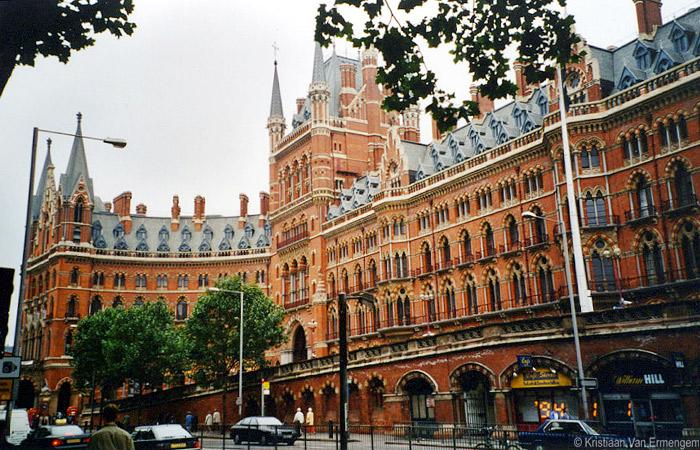
I found the more self-consciously surrealistic elements of his paintings -- giant chess-pieces, bodies of water becoming curtains, split-level horizons and the like -- pretentious and a little tired, given the kinds of things Magritte was doing back in the 1920s, but still, the man has real talent.
I wandered around Bath for a while in search of second-hand bookshops, but found that they were mostly either pants or priced way out of my range. (I did pick up cheap copies of Justina Robson's Mappa Mundi and Will Self's Cock and Bull , though.) I also scouted out the farmer's market, held on Saturdays in the disused Green Park railway station to the west of the city, which sells all sorts of goodies including Daisy farmhouse cheeses.
The bastard train company had decided not to run any bastard trains today, so I got a bus back to Bristol. Since then I've been having a late lunch and reading more of the incredibly complex, layered and intraconnected Cloud Atlas (over three-quarters of the way through now, so expect a review at some point soonish).
When B. comes back, we'll be going out for yet another meal (probably the last in a while, though, as her workload goes ballistic during the next month), in honour of my imminent birthday (have I mentioned before that it's my birthday this Tuesday? And that my Amazon wish list is here?), at Casa Caramba in Clifton. We've not been there before, but we're well familiar with its parent establishment, Casa Mexicana, which was just five minutes' walk from our previous house and whose food was gorgeous beyond belief. So, looking forward to that.
28 October 2005
Nothing but Talk
Don't say I never do anything for you.
The transcript of my talk for Greenbelt on "The Spirituality of Doctor Who" is now up at www.infinitarian.com. It's taken me several days of listening to the the damn thing on cassette, reaching out with my right hand to press the "stop" switch every twelve words or so and then typing, so forgive me if I'm feeling grimly satisfied rather than delighted. I've included the question-and-answer session (or as much of it as fitted onto the tape, and therefore as much as was actually recorded) on the grounds that it was rather interesting.
As a bonus extra I've redesigned my Greenbelt pages to match the colours of the 2005 logo, and added a copy of the accompanying article which you've probably already read at surefish.co.uk. I've also comprehensively updated the reading list accompanying last year's talks so that all the links go through my Amazon Associates account.
The usual caveat applies when reading the talk: it will, I hope, be readable by anybody with an interest in Doctor Who, but it was written with a specific audience in mind, hence the references to "we as Christians" and "most of us at Greenbelt", and the assumptions I've made about the listener's own beliefs. Non-woolly-liberal-Guardian-reading Christians and those of non-Christian faith backgrounds alike are going to have to forgive me for this, I'm afraid.
I hope you all find the talk of interest anyway.
The transcript of my talk for Greenbelt on "The Spirituality of Doctor Who" is now up at www.infinitarian.com. It's taken me several days of listening to the the damn thing on cassette, reaching out with my right hand to press the "stop" switch every twelve words or so and then typing, so forgive me if I'm feeling grimly satisfied rather than delighted. I've included the question-and-answer session (or as much of it as fitted onto the tape, and therefore as much as was actually recorded) on the grounds that it was rather interesting.
As a bonus extra I've redesigned my Greenbelt pages to match the colours of the 2005 logo, and added a copy of the accompanying article which you've probably already read at surefish.co.uk. I've also comprehensively updated the reading list accompanying last year's talks so that all the links go through my Amazon Associates account.
The usual caveat applies when reading the talk: it will, I hope, be readable by anybody with an interest in Doctor Who, but it was written with a specific audience in mind, hence the references to "we as Christians" and "most of us at Greenbelt", and the assumptions I've made about the listener's own beliefs. Non-woolly-liberal-Guardian-reading Christians and those of non-Christian faith backgrounds alike are going to have to forgive me for this, I'm afraid.
I hope you all find the talk of interest anyway.
25 October 2005
Invasion of the Tiny People
Had a fantastic, if rather child-heavy, weekend, with a visit from our rarely-seen expat friends H. and M. together with their very lovely cosmic / sybilline offspring C.
After their arrival on Saturday afternoon the five of us made a trip to the zoo where we met our equally old (but Bristol-resident) friends M. and R., plus offspring. We saw an (also very appealing) five-month-old baby gorilla, but no lions (they were at the vet's) or penguins -- as, annoyingly, the penguin coast closed half an hour before the zoo did. This was frustrating, but the buddhaesque placidity of the capybara was as calming as ever.
Young C. is nearly two, and very sweet-natured and affectionate, as well as obvoiusly having a very active mental life. Having been put to bed at 7ish she remained entirely silent for the rest of the evening, allowing us adults to get on with a very pleasant meal (including late replacement cheesecake) and a rather staggering amount of bottled beer. Much amicable conversation and general catching-up ensued.
On Sunday eight-ninths of the previous day's complement met up at Zerodegrees for more food and beer, before H. and M. had to be on their way. My goddaughter E.'s little brother L. spilled my beer all over my good jacket, but he's too young for this to be held against him. (I'm planning on waiting till he's about twelve, then lying in wait with a cricket bat.)
On Monday my parents were in Bath, and took B. and me to the rather decent Bathtub Bistro for yet more food and beer, which was extremely kind of them. Admittedly it's not Demuth's, but the veggie food was very good, with the banana, coconut and rum trifle particuarly recommended.
This week I'm off on half-term, and have spent most of today banging my head against much-needed updates to the website. So far these have been mostly invisible (except for the review pages for Peculiar Lives and Wildthyme on Top), but there's been a lot of behind-the-scenes revamping. All the links to my books, for instance, should now go through Amazon associates, and many of the files have changed their names (so if you link to a specific page at www.infinitarian.com, you're probably going to need to check the link and update it).
I've also made a start on transcribing the Greenbelt talk (utterly mind-numbing though the task is), and have given a moment's thought to the annotations I promised ages ago to accompany "Minions of the Moon". So with luck, there may be some more interesting content coming later in the week or at the weekend.
Oh, and Cloud Atlas is very good so far. I think that's everything.
After their arrival on Saturday afternoon the five of us made a trip to the zoo where we met our equally old (but Bristol-resident) friends M. and R., plus offspring. We saw an (also very appealing) five-month-old baby gorilla, but no lions (they were at the vet's) or penguins -- as, annoyingly, the penguin coast closed half an hour before the zoo did. This was frustrating, but the buddhaesque placidity of the capybara was as calming as ever.
Young C. is nearly two, and very sweet-natured and affectionate, as well as obvoiusly having a very active mental life. Having been put to bed at 7ish she remained entirely silent for the rest of the evening, allowing us adults to get on with a very pleasant meal (including late replacement cheesecake) and a rather staggering amount of bottled beer. Much amicable conversation and general catching-up ensued.
On Sunday eight-ninths of the previous day's complement met up at Zerodegrees for more food and beer, before H. and M. had to be on their way. My goddaughter E.'s little brother L. spilled my beer all over my good jacket, but he's too young for this to be held against him. (I'm planning on waiting till he's about twelve, then lying in wait with a cricket bat.)
On Monday my parents were in Bath, and took B. and me to the rather decent Bathtub Bistro for yet more food and beer, which was extremely kind of them. Admittedly it's not Demuth's, but the veggie food was very good, with the banana, coconut and rum trifle particuarly recommended.
This week I'm off on half-term, and have spent most of today banging my head against much-needed updates to the website. So far these have been mostly invisible (except for the review pages for Peculiar Lives and Wildthyme on Top), but there's been a lot of behind-the-scenes revamping. All the links to my books, for instance, should now go through Amazon associates, and many of the files have changed their names (so if you link to a specific page at www.infinitarian.com, you're probably going to need to check the link and update it).
I've also made a start on transcribing the Greenbelt talk (utterly mind-numbing though the task is), and have given a moment's thought to the annotations I promised ages ago to accompany "Minions of the Moon". So with luck, there may be some more interesting content coming later in the week or at the weekend.
Oh, and Cloud Atlas is very good so far. I think that's everything.
24 October 2005
Lemon and Honey Cheesecake
225g digestive biscuits
115g butter (unsalted)
360 ml clear honey
450g cream cheese (Philadelphia ideally)
280ml double cream
3 lemons
Crush biscuits. Mix together in bowl with butter and 120ml honey. Microwave for 3 minutes at full power, stirring occasionally. Pour and spread out in some kind of receptacle. Place in fridge or freezer to chill.
Mix cream, cream cheese, the remaining 240ml honey and the juice of the 3 lemons (also the zest if you can be bothered) in a bowl. Taste extensively to ensure honey / lemon balance is correct, and adjust as necessary. When base is chilled, spoon mixture over it, spread evenly and refrigerate to set.
Garnish with, I don't know, mint leaves possibly. Serve and eat.
I can't emphasise enough the extent to which, if you attempt to substitute low fat cream cheese for the Philadelphia, this recipe DOES NOT SODDING WORK.
115g butter (unsalted)
360 ml clear honey
450g cream cheese (Philadelphia ideally)
280ml double cream
3 lemons
Crush biscuits. Mix together in bowl with butter and 120ml honey. Microwave for 3 minutes at full power, stirring occasionally. Pour and spread out in some kind of receptacle. Place in fridge or freezer to chill.
Mix cream, cream cheese, the remaining 240ml honey and the juice of the 3 lemons (also the zest if you can be bothered) in a bowl. Taste extensively to ensure honey / lemon balance is correct, and adjust as necessary. When base is chilled, spoon mixture over it, spread evenly and refrigerate to set.
Garnish with, I don't know, mint leaves possibly. Serve and eat.
* * *
I can't emphasise enough the extent to which, if you attempt to substitute low fat cream cheese for the Philadelphia, this recipe DOES NOT SODDING WORK.
20 October 2005
Maps and Atlases
I've finished A Dream of Wessex, and very good it is too. The fact that it's an earlier work than the other Christopher Priest novels I've read is reasonably obvious -- the prose isn't quite so polished, and the dialogue in particular sounds at times as if the characters are reciting textbooks -- but it's still outstanding in the depth and texture of its imagination.
It seems that Priest in 1977 still considered himself as a science fiction writer, rather than in the "mainstream with S.F. devices" niche he's come to occupy since. A Dream of Wessex is still fine character-based S.F., with an obvious New Wave influence in its presentation of a future which in many respects resembles the past, has little by way of distinctive or innovative technology, and which while definitively a neurologically-induced consensual hallucination is also very possibly real. My absolute favourite aspect of this future is the titular "Wessex" -- not merely a devolved English region, but actually an island, formerly the Devon and Cornwall peninsula, following the cataclysmic twenty-first-century inundation of most of Dorset and Somerset. The future sequences are set in coastal Dorchester, at the mouth of the Blandford Passage. Which is the kind of imaginative conceit that really appeals to me, I don't know why.
(Speaking of which, I know that when I was very young the local library in Lancing had a truly amazing book of maps of imaginary places. I don't suppose Priest's then recently-created Wessex was among them, but Hardy's may well have been. The book certainly covered Barsoom and Oz and Atlantis and Pern and any number of other fictional places, almost none of which I'd previously heard of (though I imagine Middle-Earth and Narnia must have been in there too), and all of which I found endlessly fascinating. Does anyone recognise the book I'm talking about here?)
Since I recently succumbed to the temptation to buy the uniform editions of The Glamour and The Extremes to go with my The Prestige and The Separation, I'm sure I'll be sampling more Priest in the near future.
I've now embarked upon Cloud Atlas by David Mitchell, which is fascinating so far. The book as a whole is structured as six nested and cross-linked narratives, set in successive historical periods from the mid-nineteenth century to a post-apocalyptic future, which is a glorious idea. I'm nearing the end of the second half-novella, set in 1931, and have found the historical pastiche every bit as enjoyable as I expect to find the S.F. chapters later on.
It seems that Priest in 1977 still considered himself as a science fiction writer, rather than in the "mainstream with S.F. devices" niche he's come to occupy since. A Dream of Wessex is still fine character-based S.F., with an obvious New Wave influence in its presentation of a future which in many respects resembles the past, has little by way of distinctive or innovative technology, and which while definitively a neurologically-induced consensual hallucination is also very possibly real. My absolute favourite aspect of this future is the titular "Wessex" -- not merely a devolved English region, but actually an island, formerly the Devon and Cornwall peninsula, following the cataclysmic twenty-first-century inundation of most of Dorset and Somerset. The future sequences are set in coastal Dorchester, at the mouth of the Blandford Passage. Which is the kind of imaginative conceit that really appeals to me, I don't know why.
(Speaking of which, I know that when I was very young the local library in Lancing had a truly amazing book of maps of imaginary places. I don't suppose Priest's then recently-created Wessex was among them, but Hardy's may well have been. The book certainly covered Barsoom and Oz and Atlantis and Pern and any number of other fictional places, almost none of which I'd previously heard of (though I imagine Middle-Earth and Narnia must have been in there too), and all of which I found endlessly fascinating. Does anyone recognise the book I'm talking about here?)


Since I recently succumbed to the temptation to buy the uniform editions of The Glamour and The Extremes to go with my The Prestige and The Separation, I'm sure I'll be sampling more Priest in the near future.
I've now embarked upon Cloud Atlas by David Mitchell, which is fascinating so far. The book as a whole is structured as six nested and cross-linked narratives, set in successive historical periods from the mid-nineteenth century to a post-apocalyptic future, which is a glorious idea. I'm nearing the end of the second half-novella, set in 1931, and have found the historical pastiche every bit as enjoyable as I expect to find the S.F. chapters later on.
Exhausting, But Not Exhaustive
I've also, just this lunchtime, finished The Battle for God. Very, very interesting work on Karen Armstrong's part, which has given me the (probably rather unwise) impression that I understand fundamentalist monotheisms considerably better than I used to. It's obvious that in most respects the book barely scratches the surface, but for an overview of the historical contexts and backgrounds of the modern fundamentalist movements in Judaism, Christianity and Islam it's both impressive and weighty. It managed to make me feel rather sympathetic towards Ayatollah Khomeini, which I can't say is something I ever expected to happen.
Armstrong's book draws out a number of patterns in the way fundamentalisms have manifested themselves in various cultures: she observes that fundamentalism usually emerges among groups who feel themselves to be in danger of extinction from the forces of secularism; that it often involves a withdrawal from "the world" into sacred enclaves; but that initially at least it defines itself in opposition, not to that secular world, but to more liberal groups within the same faith who seek to make accommodations with that world. The experience of having suffered repression (and it's "experience" that's important here, not always fact) generates in many fundamentalist movements a desire to repress others in turn. Armstrong makes the further pertinent point that the rise of fundamentalism has in many situations entailed a resounding defeat for the actual values of traditional religion, which are generally rather conscientious about promoting virtues such as peacefulness, compassion and altruistic love.
The book's main flaw is its incompleteness, inevitably so given its publication in 2000. People, movements and events who don't even get a mention include the Taliban, the World Trade Center attacks, George W. Bush, Osama bin Laden, al-Qa'eda and the London and Bali bombings. A revised and updated edition would seem to be due, but would probably also be disturbingly out of date as soon as it was published.
I remember that in her Greenbelt seminar Armstrong spoke rather surprisingly of the rise in the U.K. of what she called "a fundamentalist secularism", which I'd have been interested to read about. It's a comment I've only heard before from hardline christian conservatives who (in a fine example of experiencing not-necessarily-factual repression) appear to think that secular society's valuing of tolerance is compromised by its refusal to let them live in a theocracy of their own devising. I imagine that Armstrong must have something rather more rigorous in mind, and I'd have liked to know more what she meant by it: certainly one can see how secularist culture in the U.K. might feel itself somewhat embattled by the current wave of christian-flavoured imperialism emanating from the U.S.
This, though, isn't in the book either. Still, what's there is informative and fascinating, and I'd heartily recommend it to anyone (with a month's reading time on their hands) who wants to understand better some of the more disturbing cultural tendencies which the current century has inherited from its predecessor.
Armstrong's book draws out a number of patterns in the way fundamentalisms have manifested themselves in various cultures: she observes that fundamentalism usually emerges among groups who feel themselves to be in danger of extinction from the forces of secularism; that it often involves a withdrawal from "the world" into sacred enclaves; but that initially at least it defines itself in opposition, not to that secular world, but to more liberal groups within the same faith who seek to make accommodations with that world. The experience of having suffered repression (and it's "experience" that's important here, not always fact) generates in many fundamentalist movements a desire to repress others in turn. Armstrong makes the further pertinent point that the rise of fundamentalism has in many situations entailed a resounding defeat for the actual values of traditional religion, which are generally rather conscientious about promoting virtues such as peacefulness, compassion and altruistic love.
The book's main flaw is its incompleteness, inevitably so given its publication in 2000. People, movements and events who don't even get a mention include the Taliban, the World Trade Center attacks, George W. Bush, Osama bin Laden, al-Qa'eda and the London and Bali bombings. A revised and updated edition would seem to be due, but would probably also be disturbingly out of date as soon as it was published.
I remember that in her Greenbelt seminar Armstrong spoke rather surprisingly of the rise in the U.K. of what she called "a fundamentalist secularism", which I'd have been interested to read about. It's a comment I've only heard before from hardline christian conservatives who (in a fine example of experiencing not-necessarily-factual repression) appear to think that secular society's valuing of tolerance is compromised by its refusal to let them live in a theocracy of their own devising. I imagine that Armstrong must have something rather more rigorous in mind, and I'd have liked to know more what she meant by it: certainly one can see how secularist culture in the U.K. might feel itself somewhat embattled by the current wave of christian-flavoured imperialism emanating from the U.S.
This, though, isn't in the book either. Still, what's there is informative and fascinating, and I'd heartily recommend it to anyone (with a month's reading time on their hands) who wants to understand better some of the more disturbing cultural tendencies which the current century has inherited from its predecessor.
Prophecy Girl
Somewhat less cerebrally, B. and I have started rewatching Buffy the Vampire Slayer from the beginning. In the absence of The West Wing (we're waiting for our usual suppliers to finish with their Season 6 box set so that they can lend it to us), we've been getting through it rather quickly. We finished Season One over the weekend, have already worked our way through the first appearances of Spike, Drusilla, Oz and Jonathan, and last night completed a rather unenviable double-bill of Inca Mummy Girl and Reptile Boy.
I'm enjoying revisiting these old episodes, and particularly seeing the younger versions of the characters with the knowledge of what they'll grow into later. There's either a lot of incredibly clever foreshadowing, or else the later production teams were constantly rewatching old episodes in search of good lines to follow up on. It's bringing home to me, however, how much of the respect generally paid to the early seasons is based on nostalgia, rather than on a sober assessment of worth.
Many fans will tell you that this series -- like The X-Files, Babylon 5 et al -- was never as good again after Season Three. Most of these early episodes, however, suffer from serious problems of pacing, tone and in some cases acting. The later seasons may never have quite recaptured the same engaging spark, but they were a hell of a lot more polished and professional at almost every level. It isn't just the characters who mature.
I'm enjoying revisiting these old episodes, and particularly seeing the younger versions of the characters with the knowledge of what they'll grow into later. There's either a lot of incredibly clever foreshadowing, or else the later production teams were constantly rewatching old episodes in search of good lines to follow up on. It's bringing home to me, however, how much of the respect generally paid to the early seasons is based on nostalgia, rather than on a sober assessment of worth.
Many fans will tell you that this series -- like The X-Files, Babylon 5 et al -- was never as good again after Season Three. Most of these early episodes, however, suffer from serious problems of pacing, tone and in some cases acting. The later seasons may never have quite recaptured the same engaging spark, but they were a hell of a lot more polished and professional at almost every level. It isn't just the characters who mature.
18 October 2005
Midwinter
Anyone who's been obsessively checking www.infinitarian.com despite the lack of updates during the past three months will have noticed that I've put up a blurbette for my Doctor Who short story "The Long Midwinter", to accompany the new cover image for Short Trips: The History of Christmas.
To save the rest of you the trouble of clicking on that link, here's the text:
To save the rest of you the trouble of clicking on that link, here's the text:
The Doctor’s TARDIS has brought him to celebrate Christmas in many strange times and places, but few have been more alien than Yesod – a brown dwarf world orbiting the double sun of Kether-Tiphereth, where limbless children dance in the gas-currents and many-armed elders tell stories of a vanished past.This one isn't a villanelle or anything clever, it's just the label which tells you what's inside the tin. If it makes the contents sound intriguing, then for heaven's sake buy the book.
Yet the Yesodites have their own midwinter rituals, even though the Long Midwinter comes only once in five generations. The Doctor and his friends will soon discover that millions of years in the future, trees and gifts and midwinter fires have taken on a very different significance...
This story features the eighth Doctor, Gemma and Samson.
Come Clean
Today I am entirely brain-dead, having spent the entirety of Saturday, Sunday and Monday tidying the house, filing away or shredding huge piles of paper, recycling newspapers and magazines, scrubbing surfaces, polishing sinks, mopping the kitchen floor, dusting and hoovering, and washing any piece of fabric which isn't actually nailed down.
For various reasons, the time and energy B. and I have available for cleaning activities never remotely approaches our limitless capacity to leave stuff lying about the place, shed dead skin cells and accumulate random pieces of paper. And the cats discard fur almost constantly, and never seem at all interested in running a hoover around after themselves.
For this reason, under normal circumstances, our house is neither the tidiest nor the cleanest I've ever seen. Today it's up there with the best of them, which makes me feel both proud and immensely knackered.
The occasion for this unprecedented housepride is the forthcoming visit of our very old friends (in the sense of the chronological duration of our friendship, not of their actual age) H. and M., presently of Southern California, whom I mentioned seeing at a recent wedding, whom we haven't spent time with properly in two years and who bring with them to Bristol a serious dust allergy and a rather-less-than-two-year-old daughter, both of which we felt warranted a certain amount of concern on our part.
Very much looking forward to seeing them, now that that somewhat nightmarish aspect of the preparation's out of the way.
For various reasons, the time and energy B. and I have available for cleaning activities never remotely approaches our limitless capacity to leave stuff lying about the place, shed dead skin cells and accumulate random pieces of paper. And the cats discard fur almost constantly, and never seem at all interested in running a hoover around after themselves.
For this reason, under normal circumstances, our house is neither the tidiest nor the cleanest I've ever seen. Today it's up there with the best of them, which makes me feel both proud and immensely knackered.
The occasion for this unprecedented housepride is the forthcoming visit of our very old friends (in the sense of the chronological duration of our friendship, not of their actual age) H. and M., presently of Southern California, whom I mentioned seeing at a recent wedding, whom we haven't spent time with properly in two years and who bring with them to Bristol a serious dust allergy and a rather-less-than-two-year-old daughter, both of which we felt warranted a certain amount of concern on our part.
Very much looking forward to seeing them, now that that somewhat nightmarish aspect of the preparation's out of the way.
14 October 2005
Advent and Arrival
 Big Finish have released the cover and short story details for Short Trips: The History of Christmas, which includes my story "The Long Midwinter". It should be out for the beginning of December, and will make an ideal Christmas present (for, you know, anyone who enjoys reading Doctor Who fiction). You may spot from the contents list that there are 25 stories -- why not use it as an Advent calendar[1]?
In surprisingly related news, I've also managed to obtain a copy of the recording of my Greenbelt talk on The Spirituality of Doctor Who, which means that it's now only a matter of time (and a fair bit of work, but don't worry yourselves about that) until I have a transcript available to put with last year's talks at my website. No promises, but it should be up within a couple of weeks.
[1] If, you know, you enjoy reading Doctor Who fiction.
12 October 2005
"Don't Touch the Ring, Vic!"
B. and I weekended at a vicarage in Oxford in order to attend the awrc-brightybot wedding, which was very fine.
Saturday started in a bit of a panic, as I'd discovered the night before that absolutely all my posh clothes had been bought originally for a substantially fatter man, including my own wedding suit (which it had at one point been a goal of my diet to be able to fit into again). This meant that our route to Oxford had to take in the Cribbs Causeway shopping mall, in search of an outfit that wouldn't look like it'd been borrowed from an unusually tasteful and stylish clown. I now own a surprisingly outspoken purple-striped shirt, an ironic black corduroy jacket, and a pair of black denim jeans identical to my other pairs of black denim jeans, but designated for partywear. Hurrah.
The service, when we got there, was traditional Anglican, enlivened by well-chosen hymns and some very impressive readings read by their authors. It was the first wedding I'd attended where the officiating priest (our host at the aforementioned vicarage) was a friend of my own generation, which made the event a bit more special... although the fact that both he and the bride had been in our comedy troupe, Cruel and Unusual Punishment, kept giving me the fleeting and surreal impression that I was watching my friends perform a wedding sketch. This was seemingly confirmed when the bride and groom finally processed out to Sousa's "Liberty Bell", better known as the theme from Monty Python's Flying Circus.
There were plenty of people there who I hadn't seen for ages, including two very good friends who vanished off to California a couple of years years ago and appear to have acquired a daughter while out there, whom it was really lovely to see again.
I had a lovely time generally, in fact, although foolishly I got drunk too early at the reception and ended up having to take some time out during it -- apologies to anyone I therefore didn't get to see enough of. It was the first time I'd drunk wine in any quantity since managing to shed nearly a quarter of my body-weight (which I guess is probably an even higher proportion of my squishy-wine-absorbing-bits-weight), and it seems I'm not as familiar with my alcohol capacity as I once was (oh yes I was). I wonder now, vaguely, if this is a problem amputees have as well.
Thoroughly decent wine, though (plus some good beer if I'd only had been able to face it by that point), and the meal was also very nice. Sunday morning was spent pleasantly with various friends at the venerable Oxford institution of George and Davis's Ice Cream Café, progressing to a wander on Port Meadow and a pint in the Perch before coming home.
I'm wearing a black shirt today. I haven't been able to fit into it since 1996.
Saturday started in a bit of a panic, as I'd discovered the night before that absolutely all my posh clothes had been bought originally for a substantially fatter man, including my own wedding suit (which it had at one point been a goal of my diet to be able to fit into again). This meant that our route to Oxford had to take in the Cribbs Causeway shopping mall, in search of an outfit that wouldn't look like it'd been borrowed from an unusually tasteful and stylish clown. I now own a surprisingly outspoken purple-striped shirt, an ironic black corduroy jacket, and a pair of black denim jeans identical to my other pairs of black denim jeans, but designated for partywear. Hurrah.
The service, when we got there, was traditional Anglican, enlivened by well-chosen hymns and some very impressive readings read by their authors. It was the first wedding I'd attended where the officiating priest (our host at the aforementioned vicarage) was a friend of my own generation, which made the event a bit more special... although the fact that both he and the bride had been in our comedy troupe, Cruel and Unusual Punishment, kept giving me the fleeting and surreal impression that I was watching my friends perform a wedding sketch. This was seemingly confirmed when the bride and groom finally processed out to Sousa's "Liberty Bell", better known as the theme from Monty Python's Flying Circus.
There were plenty of people there who I hadn't seen for ages, including two very good friends who vanished off to California a couple of years years ago and appear to have acquired a daughter while out there, whom it was really lovely to see again.
I had a lovely time generally, in fact, although foolishly I got drunk too early at the reception and ended up having to take some time out during it -- apologies to anyone I therefore didn't get to see enough of. It was the first time I'd drunk wine in any quantity since managing to shed nearly a quarter of my body-weight (which I guess is probably an even higher proportion of my squishy-wine-absorbing-bits-weight), and it seems I'm not as familiar with my alcohol capacity as I once was (oh yes I was). I wonder now, vaguely, if this is a problem amputees have as well.
Thoroughly decent wine, though (plus some good beer if I'd only had been able to face it by that point), and the meal was also very nice. Sunday morning was spent pleasantly with various friends at the venerable Oxford institution of George and Davis's Ice Cream Café, progressing to a wander on Port Meadow and a pint in the Perch before coming home.
I'm wearing a black shirt today. I haven't been able to fit into it since 1996.
11 October 2005
Serenity
Well, it ain't a Western.
That, I think, was my only major disappointment with the film. The way the Firefly TV series demonstrated its renegade ethos and its frontier politics by adopting that particular historical genre's trappings was pretty much the most glorious thing about it (aside from the sheer quality and intelligence of scripts and acting, of course) . Not every episode of Firefly could be counted as a Western, admittedly, but it's as much the dominant mode of the show as space opera is.
Serenity, by contrast, is space-opera pure, albeit an unusually dark and disturbing example. The only Western elements come during the first half hour or so, and mostly in the form of scenery. Which is a loss, I think, especially since it also means it can't use the theme song that was so perfect for the T.V. series: the nearest we get is the rather apologetic instrumental version at the end of the closing credits. It certainly wouldn't have worked as a theme for the kind of movie Serenity turns out to be, but it's still a shame.
Never mind. The film we have may not be everything a Firefly movie could have been, but it is quite marvellous nonetheless.
NB: Specifics follow. If you're trying to avoid spoilers for Serenity (and it's well worth doing -- I knew practically nothing about the film before I watched it, and it certainly gained a hell of a lot of impact from the fact), then you won't want to read the rest of this entry. If you haven't seen the film yet but aren't trying to avoid spoilers particularly, be warned you'll be getting very full ones here...
The movie does an excellent job of reintroducing the setting, characters and as much backstory as necessary for the cinema audience (the friend whom R. and M. had brought with them to our showing was a Firefly virgin, and found the story entirely unconfusing) without this becoming too obtrusive for the seasoned viewers. Clever touches, like the way the opening sequence implies that the Serenity crew were directly involved in springing River from her imprisonment, and the way Book is introduced as an old friend who's sheltered the crew rather than as a former traveller on Serenity, simplify said backstory for the newcomers without actually compromising the series' continuity.
In fact, the opening sequence is enormously clever, segueing between locations and settings as it shifts the focus from one character and narrative strand to another, but linking them all in a succession of reveals: the illustrated history of the Alliance turns out to be a hologram young River's teacher is showing to her class[1]; the lesson itself turns out to be a fugue experienced by the adult River during her conditioning; her subsequent rescue by Simon turns out to be another hologram being watched months later by the Alliance Operative; and finally a classic "I wonder where she is now?" hook leads us to Serenity and her crew, although we don't learn of the fugitives' presence among them until everybody else has been introduced. It's a virtuoso piece of storytelling, and Whedon at his best.
Subsequent scenes show us, in short order, the crew's criminal lifestyle, River's telepathy and the ever-present danger of the bestial posthuman Reavers. The only exception to the general smoothness of this quite extensive universe-building is, ironically, the rather clunky introduction of "Mr Universe", the techno-fetishist media savant who seems to have wandered in from the cyberpunk movie next door. It's necessary for him to be mentioned early on so that he doesn't seem quite such a deus ex machina at the climax, but he remains a very obvious plot device.
The film has a strong narrative momentum, as the conflicts with the Operative, River's escalating instability, and even the reintroductions of Book and Inara, lead the crew inexorably towards the Reavers, Miranda and the revelation of just how horribly totalitarian the supposedly benevolent Alliance is capable of being. (All the same, there are plot holes here, too. Why was the whole Miranda experiment apparently being run without any kind of observation, so that the Alliance had to send an investigator later on? Why did the Reavers ever leave Miranda, rather than simply staying there and murdering each other? Why isn't the crew's first thought when cornered by Reavers to find a way to activate River, who is their only possible weapon against them? All of these are mendable by a moment's speculation on the part of a forgiving fan, but irritating nevertheless when they could have been given script fixes.)
On the whole, though, the plot is consistent and thought-through. Indeed, there was rather too much plot for my taste -- it's at character and dialogue that Whedon really excels, and I would have preferred the film to have incorporated some quieter moments, in which both would have had the space to unfurl a little.
As it is, the large ensemble cast which was such a strength of Firefly is rather an impediment to a plot-heavy two-hour movie -- a problem that's often visible (among the many others) in the Star Trek films. Even with the reduction of Book's part to two brief scenes, and the perfectly justified removal of Inara for much of the action, several of the characters remain radically underused.
The antagonist, by contrast, is very well explored (and acted, by the phenomenal Chiwetel Ejiofor). His conviction that in fighting for the Alliance's "better world" he has become "a monster" with no place in that imagined utopia makes him one of the most convincing portraits of fanaticism I've yet seen. As hero, Mal too is drawn in considerable depth (and played to perfection as ever by Nathan Fillion), although the reasons for his hatred of the Alliance are relegated to a minor detail of his background.
It's characters like Kaylee and Inara who, despite Whedon's best attempts to give them functions in the plot, seem like spare appendages. This is unfortunately also true of Wash, which is a desperate shame: those of us who remember his and Zoë's relationship from the TV series will feel her loss so very much harder than the newcomers, who could be forgiven for missing the fact that the two of them are married.
For this reason, Wash's death seems at first to be an arbitrary attention-grabbing move, misjudged because (as with Anya's death in the final episode of Buffy) there's no time for the characters or the audience to react to it. In fact, though, it's a masterstroke: coming after Book's far more obviously heroic death (and in concert with my diligent spoiler-avoidance), it convinced me that any or all the characters might die at any moment -- the kind of trick which can only be pulled off once, but which is essential for the final sequence, where it really looks as if Mal is going to bring down the Alliance only by sacrificing his and his crew's lives[2]. (In the end, of course, he does neither, which is a far more plausible resolution.) And there is emotional response, although delayed, on Zoë's part, in the marvellous subtext to her (I think) final line about Serenity's spaceworthiness: "She's tore up real bad, but she'll fly true."
Indeed, it's in the little touches, the dialogue especially, that the humanity of this movie shines through. Mal's response to the Operative's complaint that innocent people are dying above them, "That's truer than you know," does more to humanise the Reavers and remind us of their horrifying plight than any number of Star Trek befriending-the-enemy episodes could. I also found it enormously moving that, in the very late memorial scene, the crew have set up a fourth plinth, uninscribed, decorated with a Reaver spear, alongside those to their friends. I only wish there could have been room for more such moments among the (undeniably entertaining) fist-, gun- and spaceship-fights.
Serenity isn't everything I hoped for from a Firefly movie, by any means: while it may be by turns as funny, as characterful and as moving as the series, all of these are eventually subsumed in the need to tell a gripping story -- which, to be fair, it also does very well indeed. It is, however, a fantastically entertaining and intelligent couple of hours of S.F. cinema, and frankly the opportunities to say that about something are few and far between.
If there's a sequel, though, they need to make it a proper space Western. With cows.
[1] I actually found the spelling-out of the historical backstory, which in Firefly was only ever implied, fascinating in itself. Somehow, despite talk of "Inner Planets" and "Outer Moons", it had never really struck me that all of this was taking place in a single gigantic solar system, rather than on an interstellar scale. Of course, eschewing faster-than-light travel along with aliens, robots, time-travel, parallel universes, subspace beacons, beings of pure energy and spatial anomalies is perfectly in keeping with the series' scaled-back approach to its S.F. fundamentals, and this realisation adds something to the series for me.
[2] Whedon seems to have a point he wants to make about the futility and arbitrariness of death. For every Spike, Wesley or Book who goes out in a predictable blaze of glory, there's a Tara, Fred or Wash who dies shockingly and pointlessly. This may be true to life, but it's a terribly bleak thing to watch. Which isn't actually a contradiction, of course.
That, I think, was my only major disappointment with the film. The way the Firefly TV series demonstrated its renegade ethos and its frontier politics by adopting that particular historical genre's trappings was pretty much the most glorious thing about it (aside from the sheer quality and intelligence of scripts and acting, of course) . Not every episode of Firefly could be counted as a Western, admittedly, but it's as much the dominant mode of the show as space opera is.
Serenity, by contrast, is space-opera pure, albeit an unusually dark and disturbing example. The only Western elements come during the first half hour or so, and mostly in the form of scenery. Which is a loss, I think, especially since it also means it can't use the theme song that was so perfect for the T.V. series: the nearest we get is the rather apologetic instrumental version at the end of the closing credits. It certainly wouldn't have worked as a theme for the kind of movie Serenity turns out to be, but it's still a shame.
Never mind. The film we have may not be everything a Firefly movie could have been, but it is quite marvellous nonetheless.
NB: Specifics follow. If you're trying to avoid spoilers for Serenity (and it's well worth doing -- I knew practically nothing about the film before I watched it, and it certainly gained a hell of a lot of impact from the fact), then you won't want to read the rest of this entry. If you haven't seen the film yet but aren't trying to avoid spoilers particularly, be warned you'll be getting very full ones here...
The movie does an excellent job of reintroducing the setting, characters and as much backstory as necessary for the cinema audience (the friend whom R. and M. had brought with them to our showing was a Firefly virgin, and found the story entirely unconfusing) without this becoming too obtrusive for the seasoned viewers. Clever touches, like the way the opening sequence implies that the Serenity crew were directly involved in springing River from her imprisonment, and the way Book is introduced as an old friend who's sheltered the crew rather than as a former traveller on Serenity, simplify said backstory for the newcomers without actually compromising the series' continuity.
In fact, the opening sequence is enormously clever, segueing between locations and settings as it shifts the focus from one character and narrative strand to another, but linking them all in a succession of reveals: the illustrated history of the Alliance turns out to be a hologram young River's teacher is showing to her class[1]; the lesson itself turns out to be a fugue experienced by the adult River during her conditioning; her subsequent rescue by Simon turns out to be another hologram being watched months later by the Alliance Operative; and finally a classic "I wonder where she is now?" hook leads us to Serenity and her crew, although we don't learn of the fugitives' presence among them until everybody else has been introduced. It's a virtuoso piece of storytelling, and Whedon at his best.
Subsequent scenes show us, in short order, the crew's criminal lifestyle, River's telepathy and the ever-present danger of the bestial posthuman Reavers. The only exception to the general smoothness of this quite extensive universe-building is, ironically, the rather clunky introduction of "Mr Universe", the techno-fetishist media savant who seems to have wandered in from the cyberpunk movie next door. It's necessary for him to be mentioned early on so that he doesn't seem quite such a deus ex machina at the climax, but he remains a very obvious plot device.
The film has a strong narrative momentum, as the conflicts with the Operative, River's escalating instability, and even the reintroductions of Book and Inara, lead the crew inexorably towards the Reavers, Miranda and the revelation of just how horribly totalitarian the supposedly benevolent Alliance is capable of being. (All the same, there are plot holes here, too. Why was the whole Miranda experiment apparently being run without any kind of observation, so that the Alliance had to send an investigator later on? Why did the Reavers ever leave Miranda, rather than simply staying there and murdering each other? Why isn't the crew's first thought when cornered by Reavers to find a way to activate River, who is their only possible weapon against them? All of these are mendable by a moment's speculation on the part of a forgiving fan, but irritating nevertheless when they could have been given script fixes.)
On the whole, though, the plot is consistent and thought-through. Indeed, there was rather too much plot for my taste -- it's at character and dialogue that Whedon really excels, and I would have preferred the film to have incorporated some quieter moments, in which both would have had the space to unfurl a little.
As it is, the large ensemble cast which was such a strength of Firefly is rather an impediment to a plot-heavy two-hour movie -- a problem that's often visible (among the many others) in the Star Trek films. Even with the reduction of Book's part to two brief scenes, and the perfectly justified removal of Inara for much of the action, several of the characters remain radically underused.
The antagonist, by contrast, is very well explored (and acted, by the phenomenal Chiwetel Ejiofor). His conviction that in fighting for the Alliance's "better world" he has become "a monster" with no place in that imagined utopia makes him one of the most convincing portraits of fanaticism I've yet seen. As hero, Mal too is drawn in considerable depth (and played to perfection as ever by Nathan Fillion), although the reasons for his hatred of the Alliance are relegated to a minor detail of his background.
It's characters like Kaylee and Inara who, despite Whedon's best attempts to give them functions in the plot, seem like spare appendages. This is unfortunately also true of Wash, which is a desperate shame: those of us who remember his and Zoë's relationship from the TV series will feel her loss so very much harder than the newcomers, who could be forgiven for missing the fact that the two of them are married.
For this reason, Wash's death seems at first to be an arbitrary attention-grabbing move, misjudged because (as with Anya's death in the final episode of Buffy) there's no time for the characters or the audience to react to it. In fact, though, it's a masterstroke: coming after Book's far more obviously heroic death (and in concert with my diligent spoiler-avoidance), it convinced me that any or all the characters might die at any moment -- the kind of trick which can only be pulled off once, but which is essential for the final sequence, where it really looks as if Mal is going to bring down the Alliance only by sacrificing his and his crew's lives[2]. (In the end, of course, he does neither, which is a far more plausible resolution.) And there is emotional response, although delayed, on Zoë's part, in the marvellous subtext to her (I think) final line about Serenity's spaceworthiness: "She's tore up real bad, but she'll fly true."
Indeed, it's in the little touches, the dialogue especially, that the humanity of this movie shines through. Mal's response to the Operative's complaint that innocent people are dying above them, "That's truer than you know," does more to humanise the Reavers and remind us of their horrifying plight than any number of Star Trek befriending-the-enemy episodes could. I also found it enormously moving that, in the very late memorial scene, the crew have set up a fourth plinth, uninscribed, decorated with a Reaver spear, alongside those to their friends. I only wish there could have been room for more such moments among the (undeniably entertaining) fist-, gun- and spaceship-fights.
Serenity isn't everything I hoped for from a Firefly movie, by any means: while it may be by turns as funny, as characterful and as moving as the series, all of these are eventually subsumed in the need to tell a gripping story -- which, to be fair, it also does very well indeed. It is, however, a fantastically entertaining and intelligent couple of hours of S.F. cinema, and frankly the opportunities to say that about something are few and far between.
If there's a sequel, though, they need to make it a proper space Western. With cows.
[1] I actually found the spelling-out of the historical backstory, which in Firefly was only ever implied, fascinating in itself. Somehow, despite talk of "Inner Planets" and "Outer Moons", it had never really struck me that all of this was taking place in a single gigantic solar system, rather than on an interstellar scale. Of course, eschewing faster-than-light travel along with aliens, robots, time-travel, parallel universes, subspace beacons, beings of pure energy and spatial anomalies is perfectly in keeping with the series' scaled-back approach to its S.F. fundamentals, and this realisation adds something to the series for me.
[2] Whedon seems to have a point he wants to make about the futility and arbitrariness of death. For every Spike, Wesley or Book who goes out in a predictable blaze of glory, there's a Tara, Fred or Wash who dies shockingly and pointlessly. This may be true to life, but it's a terribly bleak thing to watch. Which isn't actually a contradiction, of course.
04 October 2005
Drink, Food and Games Update
These last two weekends I've continued my investigation of your human concept of "free time".
B. and I spent the last weekend of September in Guildford for a friend's birthday, which allowed for a visit to a rather nice pub where we drank a very decent range of Fuller's beers; a brief gawp at the gloriously ugly cathedral used for young Damien's abortive baptism scene in The Omen (thanks to Simon for bringing that connection to my attention); and a couple of rounds of Lupus in Tabula, a game requiring large numbers of players (and which could very easily be played without cards), which basically involves werewolves murdering innocent villagers and villagers lynching suspected werewolves in retaliation, thus demonstrating pack mentality very effectively.
Friday evening we celebrated B.'s passing of her Ph.D. viva with a trip to Glasnost, another of our favourite restaurants, which was recently bought up by its own chefs (and whose own website seems at the moment sadly defunct). When we first visited Glasnost five years or so ago, we were most impressed by the equitable balance between meat and vegetarian dishes. Slightly annoyingly this shortly changed to a three-way split between meat, vegetarian and fish, which means that the choice for proper vegetarians isn't nearly as wide as it used to be... but the food itself remains outstanding, as do the drinks, service, atmosphere and so on. What's more, the restaurant is within feasible walking-distance (if slightly challenging post-meal).
I had the camembert fondant for a starter, followed by a roasted red pepper lasagne and a blue poppyseed, lemon and lime cake. Lasagne is, of course, pretty much the most predictable thing a restaurant can offer a vegetarian, but this one was gorgeous. Glasnost also specialises in flavoured vodkas, so B. and I sampled the iced mint (delicious), the vanilla cream (creamy) and the pear drop (vile, as I should have remembered from last time. Oops.)
Then the weekend saw a reprise of our trip to the nice local pub with the Hopback beers and the cheeseboard, and a rematch at Risk Godstorm with R. and M. Some of the game's flaws mentioned in this review become more apparent on a second playing: namely, the Underworld isn't nearly as cool a game element as it thinks it is, and the gods themselves don't have sufficient incentive to get involved in fights with one another. We may need to tweak the rules accordingly on future occasions. Still remarkably good fun, though.
Tonight it's Serenity, which I'm looking forward to enormously, and then we're off to Oxford for the weekend to help consecrate the union of awrc and brightybot. I'm sure drink and food will flow plentifully, although perhaps there won't be quite so many games. (Mind you, we do need to give them a wedding present...)
B. and I spent the last weekend of September in Guildford for a friend's birthday, which allowed for a visit to a rather nice pub where we drank a very decent range of Fuller's beers; a brief gawp at the gloriously ugly cathedral used for young Damien's abortive baptism scene in The Omen (thanks to Simon for bringing that connection to my attention); and a couple of rounds of Lupus in Tabula, a game requiring large numbers of players (and which could very easily be played without cards), which basically involves werewolves murdering innocent villagers and villagers lynching suspected werewolves in retaliation, thus demonstrating pack mentality very effectively.
Friday evening we celebrated B.'s passing of her Ph.D. viva with a trip to Glasnost, another of our favourite restaurants, which was recently bought up by its own chefs (and whose own website seems at the moment sadly defunct). When we first visited Glasnost five years or so ago, we were most impressed by the equitable balance between meat and vegetarian dishes. Slightly annoyingly this shortly changed to a three-way split between meat, vegetarian and fish, which means that the choice for proper vegetarians isn't nearly as wide as it used to be... but the food itself remains outstanding, as do the drinks, service, atmosphere and so on. What's more, the restaurant is within feasible walking-distance (if slightly challenging post-meal).
I had the camembert fondant for a starter, followed by a roasted red pepper lasagne and a blue poppyseed, lemon and lime cake. Lasagne is, of course, pretty much the most predictable thing a restaurant can offer a vegetarian, but this one was gorgeous. Glasnost also specialises in flavoured vodkas, so B. and I sampled the iced mint (delicious), the vanilla cream (creamy) and the pear drop (vile, as I should have remembered from last time. Oops.)
Then the weekend saw a reprise of our trip to the nice local pub with the Hopback beers and the cheeseboard, and a rematch at Risk Godstorm with R. and M. Some of the game's flaws mentioned in this review become more apparent on a second playing: namely, the Underworld isn't nearly as cool a game element as it thinks it is, and the gods themselves don't have sufficient incentive to get involved in fights with one another. We may need to tweak the rules accordingly on future occasions. Still remarkably good fun, though.
Tonight it's Serenity, which I'm looking forward to enormously, and then we're off to Oxford for the weekend to help consecrate the union of awrc and brightybot. I'm sure drink and food will flow plentifully, although perhaps there won't be quite so many games. (Mind you, we do need to give them a wedding present...)
03 October 2005
Reading Update
I'm still working my way through The Battle for God by Karen Armstrong -- consistently interesting and informative, but also plain bloody long. Possibly I'm just out of practice as far as reading non-fiction goes, but I find it's taking up most of my reading energy.
Armstrong spends pretty much the first half of the book grounding the various late-nineteenth- and early-twentieth-century fundamentalist movements in Judaism, Islam and Christianity in those religions' intellectual histories since 1492. Which is amazingly thorough of her, but it does mean that it's quite some time before the book gets on to its supposed substance: I'm halfway through now, and it's only in the current chapter that she's started to talk about the christian movement from which "fundamentalism" takes its name. Mind you, it's told me a lot more about the history of post-Persian Iran, early settlement-era Israel / Palestine, and come to that christianity in the early United States, than I ever knew before.
One of Armstrong's more interesting premises is that knowledge in the pre-modern world could be separated into two distinct categories: logos, which was rational, factual truth of the kind science provides, with an immediate practical and progressive application; and mythos, the arena of faith, myth and poetry, where truths incapable of being expressed in factual terms were conveyed through parable, metaphor and story. She believes that we in the modern world have lost sight of mythos altogether, and have become incapable of understanding truth except in terms of logos: the fundamentalists among us are just those who struggle to hold onto religious truths in their entirety, but in a modern context feel obliged to interpret them as logoi -- hence, most blatantly, the reductionist and wilfully ignorant attempts to argue that Genesis is viable as a scientific account, but also any attempt to enact a religion's symbols literally as politics. It's fascinating stuff.
(She also considers that the emergence of revisionist pre-millenialism in late nineteenth-century American christianity -- Rapture prophecies and the like -- forms a religious parallel to the secular European genre of the future-war narrative, as seen in such works as The Battle of Dorking and indeed The War of the Worlds. Which is just fantastic.)
During the rest of my reading time, I've finished If on a winter's night a traveler by Italo Calvino. I enjoyed it for all the postmodern pyrotechnics (the book is about the experience of reading books, and about the book as a dialogue between author and reader, and is therefore told in the second person by a constantly-shifting narrator)... but actually, I found it less satisfying, and certainly less breathtakingly beautiful, than the only other Calvino I've read, Invisible Cities.
I thought at first the translator was different, but no, both books are translated by Wiliam Weaver. It must be the book itself which is, for some reason, rather less to my taste. Perhaps it's just that Invisible Cities, a collection of apparently unrelated descriptions of various fantastical cities as supposedly related by Marco Polo to Genghis Khan, makes only the most cursory of gestures towards having an actual narrative, whereas If on a winter's night a traveler, essentially an anthology of first chapters of novels, attempts to string them together with a coherent plot. The writing succeeds on many levels, and yet the plot reads as a fairly arbitrary mess: this is perhaps what drags it down.
Returning to my to-read list, I embarked last night on A Dream of Wessex by Christopher Priest -- surely overdue a reissue in the lovely new uniform editions Gollancz are bringing out of the author's work. I started it last night, and enjoyed it enough that I'm already nearly a quarter of the way through: it's a story of time-travel, in a sense, with a vividly-realised future which may or may not be illusory, and it shares with the other work of Priest's that I've read a strong sense of landscape and environment, related closely to the internal life of the protagonist. Like Kim Stanley Robinson, he's an author who creeps up on you and insinuates himself into your mind a favourite before you've really worked out what you consciously think about him.
If I seem to be selecting my favourite S.F. authors these days on the basis of their attitudes to geography... well, I'm just as much surprised by this as anybody else.
Armstrong spends pretty much the first half of the book grounding the various late-nineteenth- and early-twentieth-century fundamentalist movements in Judaism, Islam and Christianity in those religions' intellectual histories since 1492. Which is amazingly thorough of her, but it does mean that it's quite some time before the book gets on to its supposed substance: I'm halfway through now, and it's only in the current chapter that she's started to talk about the christian movement from which "fundamentalism" takes its name. Mind you, it's told me a lot more about the history of post-Persian Iran, early settlement-era Israel / Palestine, and come to that christianity in the early United States, than I ever knew before.
One of Armstrong's more interesting premises is that knowledge in the pre-modern world could be separated into two distinct categories: logos, which was rational, factual truth of the kind science provides, with an immediate practical and progressive application; and mythos, the arena of faith, myth and poetry, where truths incapable of being expressed in factual terms were conveyed through parable, metaphor and story. She believes that we in the modern world have lost sight of mythos altogether, and have become incapable of understanding truth except in terms of logos: the fundamentalists among us are just those who struggle to hold onto religious truths in their entirety, but in a modern context feel obliged to interpret them as logoi -- hence, most blatantly, the reductionist and wilfully ignorant attempts to argue that Genesis is viable as a scientific account, but also any attempt to enact a religion's symbols literally as politics. It's fascinating stuff.
(She also considers that the emergence of revisionist pre-millenialism in late nineteenth-century American christianity -- Rapture prophecies and the like -- forms a religious parallel to the secular European genre of the future-war narrative, as seen in such works as The Battle of Dorking and indeed The War of the Worlds. Which is just fantastic.)
During the rest of my reading time, I've finished If on a winter's night a traveler by Italo Calvino. I enjoyed it for all the postmodern pyrotechnics (the book is about the experience of reading books, and about the book as a dialogue between author and reader, and is therefore told in the second person by a constantly-shifting narrator)... but actually, I found it less satisfying, and certainly less breathtakingly beautiful, than the only other Calvino I've read, Invisible Cities.
I thought at first the translator was different, but no, both books are translated by Wiliam Weaver. It must be the book itself which is, for some reason, rather less to my taste. Perhaps it's just that Invisible Cities, a collection of apparently unrelated descriptions of various fantastical cities as supposedly related by Marco Polo to Genghis Khan, makes only the most cursory of gestures towards having an actual narrative, whereas If on a winter's night a traveler, essentially an anthology of first chapters of novels, attempts to string them together with a coherent plot. The writing succeeds on many levels, and yet the plot reads as a fairly arbitrary mess: this is perhaps what drags it down.
Returning to my to-read list, I embarked last night on A Dream of Wessex by Christopher Priest -- surely overdue a reissue in the lovely new uniform editions Gollancz are bringing out of the author's work. I started it last night, and enjoyed it enough that I'm already nearly a quarter of the way through: it's a story of time-travel, in a sense, with a vividly-realised future which may or may not be illusory, and it shares with the other work of Priest's that I've read a strong sense of landscape and environment, related closely to the internal life of the protagonist. Like Kim Stanley Robinson, he's an author who creeps up on you and insinuates himself into your mind a favourite before you've really worked out what you consciously think about him.
If I seem to be selecting my favourite S.F. authors these days on the basis of their attitudes to geography... well, I'm just as much surprised by this as anybody else.
Viewing Update
B. and I have recently been rewatching Firefly, in preparation for going to see Serenity this Thursday.
God, that was a good series, or rather the half of it they were allowed to make was. I hope the film is half as good, because if so it's going to be bloody amazing.
We took the unusual step (for us) of bothering to do a second rewatch with the DVD commentaries turned on: most are fun, although more by way of entertaining banter between various series luminaries (Nathan Fillion being particularly highlarious) than of actual critique. The most interesting by far is Joss Whedon's solo commentary on the final episode, Objects in Space, which delves into the writing process and the philosophy underlying the episode. Generally when people start quoting Sartre I remember my nineteen-year-old self and run a mile (not that I actually read Sartre at nineteen, so much as believing that I looked good in black jackets and polo-necks), but Whedon says some very interesting things about Objects in Space as an existentialist text. It's well worth listening to if you have the boxed set.
In unrelated news, people will tell you that The West Wing -- once the smartest, most mature and intelligent thing on American T.V. -- went badly downhill once series creator Aaron Sorkin left under a narcotic cloud. You may well be tempted to dismiss them as televisual snobs: after all, the series has so much going for it. How could it suffer so badly from the absence of one man?
As someone who's now very nearly at the end of season 5, the first after Sorkin's departure, I can tell you that those people, despite their unattractive air of knowing far more than you do about things like film stock and camera angles, are quite correct. Season 5 is, by the standards of what's gone before, really poor. There's still the occasional good episode, but they're only as good as the feebler episodes of the first four seasons (which were still pretty good television, admittedly).
There's a huge reduction in intelligence, both in the scripts and in the presumed audience, and a shift of focus from the politics (which were always fascinating) to the characters' emotional lives (much duller, especially since those lives seem suddenly to have become cliched and soapish). Even the politics begins to tend towards melodrama, with nuance and ambiguity replaced by grand declarative gesture. It's terribly disappointing.
On the plus side, though, I think I now understand Mulholland Drive. It's all about lesbians.
God, that was a good series, or rather the half of it they were allowed to make was. I hope the film is half as good, because if so it's going to be bloody amazing.
We took the unusual step (for us) of bothering to do a second rewatch with the DVD commentaries turned on: most are fun, although more by way of entertaining banter between various series luminaries (Nathan Fillion being particularly highlarious) than of actual critique. The most interesting by far is Joss Whedon's solo commentary on the final episode, Objects in Space, which delves into the writing process and the philosophy underlying the episode. Generally when people start quoting Sartre I remember my nineteen-year-old self and run a mile (not that I actually read Sartre at nineteen, so much as believing that I looked good in black jackets and polo-necks), but Whedon says some very interesting things about Objects in Space as an existentialist text. It's well worth listening to if you have the boxed set.
In unrelated news, people will tell you that The West Wing -- once the smartest, most mature and intelligent thing on American T.V. -- went badly downhill once series creator Aaron Sorkin left under a narcotic cloud. You may well be tempted to dismiss them as televisual snobs: after all, the series has so much going for it. How could it suffer so badly from the absence of one man?
As someone who's now very nearly at the end of season 5, the first after Sorkin's departure, I can tell you that those people, despite their unattractive air of knowing far more than you do about things like film stock and camera angles, are quite correct. Season 5 is, by the standards of what's gone before, really poor. There's still the occasional good episode, but they're only as good as the feebler episodes of the first four seasons (which were still pretty good television, admittedly).
There's a huge reduction in intelligence, both in the scripts and in the presumed audience, and a shift of focus from the politics (which were always fascinating) to the characters' emotional lives (much duller, especially since those lives seem suddenly to have become cliched and soapish). Even the politics begins to tend towards melodrama, with nuance and ambiguity replaced by grand declarative gesture. It's terribly disappointing.
On the plus side, though, I think I now understand Mulholland Drive. It's all about lesbians.
29 September 2005
Dream-Life
At some point during the night before last, B. and I must have decided to adopt some more cats, because several came to stay with us in the hope of being chosen, including the Evil Cat belonging to one of our neighbours (who keeps invading our house in real life and eating all our cats' food). One of them had avocado-coloured fur and was called Kiwi, presumably after the fruit. Another was a tortoiseshell cat, with an actual tortoise-shell.
Last night, two students were asking my permission to have sex in the library. I explained that, while a bit of discreet fumbling might be allowable, they were under no circumstances to get naked, which they seemed to feel was an acceptable compromise.
Other parts of me may not be working so well since I put the coffee-drinking on hold, but I'm sleeping an awful lot better.
Last night, two students were asking my permission to have sex in the library. I explained that, while a bit of discreet fumbling might be allowable, they were under no circumstances to get naked, which they seemed to feel was an acceptable compromise.
Other parts of me may not be working so well since I put the coffee-drinking on hold, but I'm sleeping an awful lot better.
28 September 2005
Bath Night
B. and I had a very pleasant evening in Bath last Thursday, going for the first time in absolute ages both to one of our favourite restaurants and to the theatre.
Demuth's is, I'm fairly sure, the best purely vegetarian restaurant I've ever been to, with a marvellous selection of mouth-watering foods assembled from all over the place. There's art on the walls (including, on this occasion, something which appeared to have once been an aeroplane door, but was now painted to look rather like a rug), the staff are lovely and there's a calming no-mobiles policy.
Admittedly it's not cheap, but fortunately our recent diet has succeeded in reducing our joint appetites sufficiently that we were able to share the amount of food which one of us would once have eaten. (Of course, we don't then get the variety of being able to share two dishes in each course, but you can't have everything.)
We chose the "sunshine mediterranean mezze", which included some extremely good houmous and a wonderful feta-and-sesame pie. This we accompanied with some excellent sweet potato and halloumi kebabs (a starter which doesn't appear to be on that version of the menu), good organic beer, three-seed bread and a bowl of green olives (the only component which was disappointing, being a bit bland and oddly watery). We finished with Demuths' famous vegan chocolate fudge cake, served with soya ice cream, which is, frankly, incredibly gorgeous.
We then hurried to the Theatre Royal to see Otherwise Engaged by Simon Gray -- a playwright who I knew almost nothing about, but who evidently knows his stuff.
Otherwise Engaged appears for the first hour or so to be a light comedy of a pretty familiar pattern, as the mildly put-upon but terribly witty hero (here even called Simon -- a bit of a giveaway as far as being the writer's mouthpiece is concerned) copes with the comic incursions of various friends and relatives into his planned evening alone with Wagner. The first act ends with an unsettling revelation, and the second then proceeds to deconstruct the whole setup, demonstrating that behind his imperturbable façade Simon is actually a complete shit, whose life is in the process of going hopelessly and irrecovably off the rails. It's elegantly disturbing, and has at best a mitigatedly miserable ending as Simon condescends to share his Wagner with his old friend Geoff, suggesting some hope of feeling his way towards an actual connection with another human being.
Again, the two of us were constrained by budget, and had picked the cheapest seats in the house... which, in an interesting sidelight on the way society's changed during the past couple of centuries, are actually located in the private boxes at the very front of the theatre. The very adequate reason for their cheapness is that they were designed with the visibility of the occupants in mind rather than that of the stage, so that the angle obliges one to lean over the balustrade like a gargoyle in order to see anything at all... which I think Richard E. Grant found offputting on occasion.
My neck ached for all the next day, but while our stork's-eye view may not have been quite what the director had in mind, we were unusually close to the actors -- the tops of their heads, at least -- and got the full benefit of their performance while they were actually in view. (I particularly appreciated this during the scene where one of the characters spends several minutes with her top off. Certain establishments would have made me pay good money for that alone.)
Simon was played splendidly by Grant, on form throughout -- being a drily charming but terribly reserved upper-class scoundrel is, of course, the thing he does best, but here he did it very well indeed. His comic delivery was impeccable, with many of the jokes riding on his inflection alone. (He had the two of us in stitches just folding up a handkerchief, although admittedly this was because he made Simon do it in exactly the same way I always do, and appear just as neurotic as a result.)
Anthony Stewart Head was somewhat less good as Geoff; but as a foul-mouthed, drunken newspaper reporter (albeit one who went to Oxford and enjoys Wagner) he was playing rather beyond his usual character range. He was still very entertaining, and the rest of the cast (none of whose names I have to hand, unfortunately) all turned in respectable performances.
Plus there was organic ice cream, on the rather dubious grounds that we probably hadn't had too many calories yet. We've decided that, if these are the delights Bath has to offer, we really must try to sample them more often.
Demuth's is, I'm fairly sure, the best purely vegetarian restaurant I've ever been to, with a marvellous selection of mouth-watering foods assembled from all over the place. There's art on the walls (including, on this occasion, something which appeared to have once been an aeroplane door, but was now painted to look rather like a rug), the staff are lovely and there's a calming no-mobiles policy.
Admittedly it's not cheap, but fortunately our recent diet has succeeded in reducing our joint appetites sufficiently that we were able to share the amount of food which one of us would once have eaten. (Of course, we don't then get the variety of being able to share two dishes in each course, but you can't have everything.)
We chose the "sunshine mediterranean mezze", which included some extremely good houmous and a wonderful feta-and-sesame pie. This we accompanied with some excellent sweet potato and halloumi kebabs (a starter which doesn't appear to be on that version of the menu), good organic beer, three-seed bread and a bowl of green olives (the only component which was disappointing, being a bit bland and oddly watery). We finished with Demuths' famous vegan chocolate fudge cake, served with soya ice cream, which is, frankly, incredibly gorgeous.
We then hurried to the Theatre Royal to see Otherwise Engaged by Simon Gray -- a playwright who I knew almost nothing about, but who evidently knows his stuff.
Otherwise Engaged appears for the first hour or so to be a light comedy of a pretty familiar pattern, as the mildly put-upon but terribly witty hero (here even called Simon -- a bit of a giveaway as far as being the writer's mouthpiece is concerned) copes with the comic incursions of various friends and relatives into his planned evening alone with Wagner. The first act ends with an unsettling revelation, and the second then proceeds to deconstruct the whole setup, demonstrating that behind his imperturbable façade Simon is actually a complete shit, whose life is in the process of going hopelessly and irrecovably off the rails. It's elegantly disturbing, and has at best a mitigatedly miserable ending as Simon condescends to share his Wagner with his old friend Geoff, suggesting some hope of feeling his way towards an actual connection with another human being.
Again, the two of us were constrained by budget, and had picked the cheapest seats in the house... which, in an interesting sidelight on the way society's changed during the past couple of centuries, are actually located in the private boxes at the very front of the theatre. The very adequate reason for their cheapness is that they were designed with the visibility of the occupants in mind rather than that of the stage, so that the angle obliges one to lean over the balustrade like a gargoyle in order to see anything at all... which I think Richard E. Grant found offputting on occasion.
My neck ached for all the next day, but while our stork's-eye view may not have been quite what the director had in mind, we were unusually close to the actors -- the tops of their heads, at least -- and got the full benefit of their performance while they were actually in view. (I particularly appreciated this during the scene where one of the characters spends several minutes with her top off. Certain establishments would have made me pay good money for that alone.)
Simon was played splendidly by Grant, on form throughout -- being a drily charming but terribly reserved upper-class scoundrel is, of course, the thing he does best, but here he did it very well indeed. His comic delivery was impeccable, with many of the jokes riding on his inflection alone. (He had the two of us in stitches just folding up a handkerchief, although admittedly this was because he made Simon do it in exactly the same way I always do, and appear just as neurotic as a result.)
Anthony Stewart Head was somewhat less good as Geoff; but as a foul-mouthed, drunken newspaper reporter (albeit one who went to Oxford and enjoys Wagner) he was playing rather beyond his usual character range. He was still very entertaining, and the rest of the cast (none of whose names I have to hand, unfortunately) all turned in respectable performances.
Plus there was organic ice cream, on the rather dubious grounds that we probably hadn't had too many calories yet. We've decided that, if these are the delights Bath has to offer, we really must try to sample them more often.
The Secret Masonic Handbag
OK, so this isn't the post I intended to make next -- that ought to be arriving later this evening. But it is something that struck me as rather intriguing.
I catalogue all the theology-related books here at the library, which is sometimes interesting and sometimes very much not. It does, however, mean that I'm the catch-all cataloguer for those very few books we order in relating to religions other than christianity,which is why earlier today I was flicking through Nevill Drury's Magic and Witchcraft: From Shamanism to the Technopagans, a broad history of magical theory and practice in human civilisation.
(A brief digression at this point: I don't, sadly, believe in the actual efficacy of magic -- let alone "magick" -- but I do find the theory fascinating. The symbolic schemas which people have constructed to interpret the world with the intention of influencing it can be enormously revealing about the way the human mind itself is made. I don't exclude science from this, although obviously I have opinions as to its effectiveness as compared with those of these rival systems.
This is why, as its readers can't have failed to notice, my short story "Minions of the Moon" draws extensively on medieval and renaissance alchemy and astrology: it's also why those who pay attention when The History of Christmas comes out -- or, of course, who've read this blog entry in the meantime -- may well spot names and ideas drawn from the Kabbalah in "The Long Midwinter". Give me time, and I'll almost certainly end up writing something based on the Tarot as well.)
Anyway. Flicking through the book, and specifically the chapter on Freemasonry, I was immediately struck by reproductions of three masonic "tracing boards" from 1819. (Tracing boards, as I've discovered since, are used as some kind of visual aid in masonic initiation rites. For some reason Drury calls them "training boards", which doesn't give me huge confidence in his scholarship, but I digress again.)
After some diligent work-avoidance I've managed to track down images of these same three boards on the web (click to see larger versions):
 Now, the reason these caught my eye is because as a student -- in common with a great many students -- I was a big fan of the work of René Magritte, the Belgian surrealist painter. (Yes, that's right, with the apples and the bowler hats.)
My immediate reaction on seeing the images out of context was that they had to be Magrittes: the po-faced illustrative style used to depict bizarre and eclectic assortments of objects, thus imbuing them with portentous significance, seemed like the work of no other artist I know (with the possible exception of Paul Delvaux). Compare the masonic images with Magritte's Personal Values, The Difficult Crossing or especially The Reckless Sleeper.
They're nothing to do with him, of course, as I discovered when I read the caption -- they come from Britain and predate him by eighty years.
Now, I'm no art historian, and I certainly haven't made a study of Magritte specifically, but I'm not aware of any suggestion that he had masonic connections. I seem to remember that it was part of the surrealists' approach to take the style of earlier Symbolist painters and strip it of content, replacing the supposedly meaningful symbols with random junk or the flotsam of the subconscious, as an absurdist or psychoanalytic statement... but I've never been aware of any suggestion that the symbology of Freemasonry played any part in inspiring this.
The similarity, though, is irresistible. Is it possible that Magritte, or someone in his family, had been a Freemason, and that his visual style was influenced by coming across some of these tracing boards early on in his career? Or is this just the kind of meaningless coincidence he would have loved?
It's enabled me to waste most of today fairly effectively, anyway.
I catalogue all the theology-related books here at the library, which is sometimes interesting and sometimes very much not. It does, however, mean that I'm the catch-all cataloguer for those very few books we order in relating to religions other than christianity,which is why earlier today I was flicking through Nevill Drury's Magic and Witchcraft: From Shamanism to the Technopagans, a broad history of magical theory and practice in human civilisation.
(A brief digression at this point: I don't, sadly, believe in the actual efficacy of magic -- let alone "magick" -- but I do find the theory fascinating. The symbolic schemas which people have constructed to interpret the world with the intention of influencing it can be enormously revealing about the way the human mind itself is made. I don't exclude science from this, although obviously I have opinions as to its effectiveness as compared with those of these rival systems.
This is why, as its readers can't have failed to notice, my short story "Minions of the Moon" draws extensively on medieval and renaissance alchemy and astrology: it's also why those who pay attention when The History of Christmas comes out -- or, of course, who've read this blog entry in the meantime -- may well spot names and ideas drawn from the Kabbalah in "The Long Midwinter". Give me time, and I'll almost certainly end up writing something based on the Tarot as well.)
Anyway. Flicking through the book, and specifically the chapter on Freemasonry, I was immediately struck by reproductions of three masonic "tracing boards" from 1819. (Tracing boards, as I've discovered since, are used as some kind of visual aid in masonic initiation rites. For some reason Drury calls them "training boards", which doesn't give me huge confidence in his scholarship, but I digress again.)
After some diligent work-avoidance I've managed to track down images of these same three boards on the web (click to see larger versions):
 Now, the reason these caught my eye is because as a student -- in common with a great many students -- I was a big fan of the work of René Magritte, the Belgian surrealist painter. (Yes, that's right, with the apples and the bowler hats.)
My immediate reaction on seeing the images out of context was that they had to be Magrittes: the po-faced illustrative style used to depict bizarre and eclectic assortments of objects, thus imbuing them with portentous significance, seemed like the work of no other artist I know (with the possible exception of Paul Delvaux). Compare the masonic images with Magritte's Personal Values, The Difficult Crossing or especially The Reckless Sleeper.
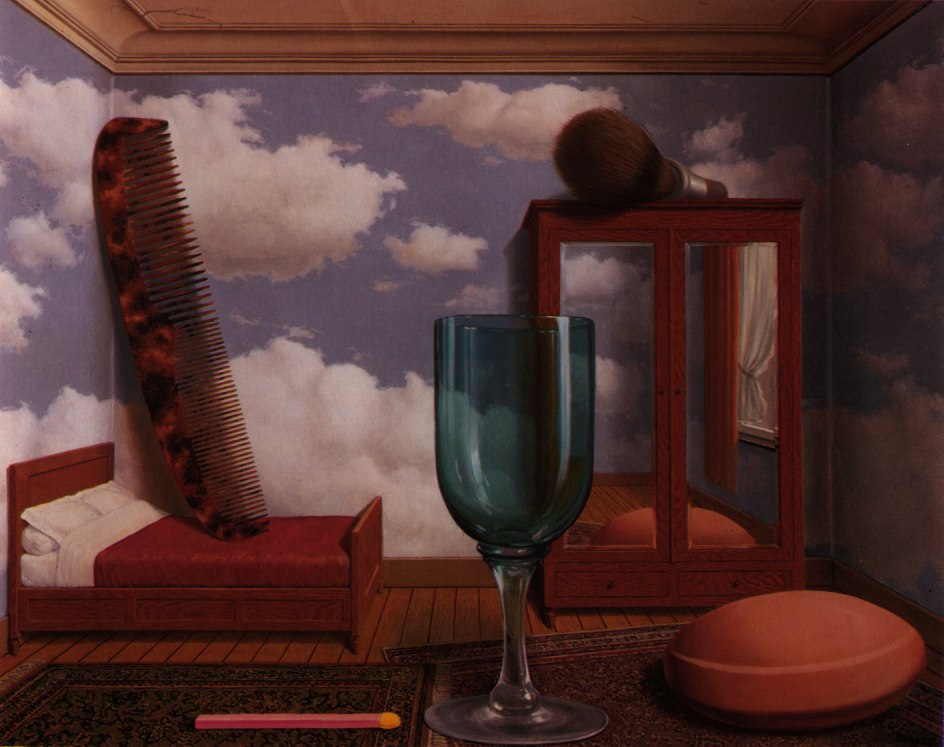
They're nothing to do with him, of course, as I discovered when I read the caption -- they come from Britain and predate him by eighty years.
Now, I'm no art historian, and I certainly haven't made a study of Magritte specifically, but I'm not aware of any suggestion that he had masonic connections. I seem to remember that it was part of the surrealists' approach to take the style of earlier Symbolist painters and strip it of content, replacing the supposedly meaningful symbols with random junk or the flotsam of the subconscious, as an absurdist or psychoanalytic statement... but I've never been aware of any suggestion that the symbology of Freemasonry played any part in inspiring this.
The similarity, though, is irresistible. Is it possible that Magritte, or someone in his family, had been a Freemason, and that his visual style was influenced by coming across some of these tracing boards early on in his career? Or is this just the kind of meaningless coincidence he would have loved?
It's enabled me to waste most of today fairly effectively, anyway.
26 September 2005
Momentary Hiatus
Things have gone even more busy than usual here just at present, even more so as I was away over the weekend. There are some definite things I want to say going back as far as Thursday, but I'm not going to be able to get them posted for a little while yet. The same goes for giving well-deserved replies to recent comments.
Apologies for the delay, and watch this space...
Apologies for the delay, and watch this space...
23 September 2005
More Thought, More Play
I know I'm developing a slightly farcical habit of plugging every new venture by Thoughtplay, but What Should I Read Next? is a very clever and elegant idea. It's essentially a huge database of books which have been enjoyed by people, on the basis of which it recommends titles to other people. If you tell it you've liked something from (say) the list of books I've entered, it assumes you're more likely to enjoy the other things on my list... which, since mine is somewhat eclectic, may be a little rash, but fortunately it has everybody else's lists to work from as well.
The more books you tell it you like, the more astute its recommendations will, in theory, become. They should also get more accurate as more people use it, so do go and enter some titles and see what it comes up with.
It seems rather keen that I should read Timothy Mo.
The more books you tell it you like, the more astute its recommendations will, in theory, become. They should also get more accurate as more people use it, so do go and enter some titles and see what it comes up with.
It seems rather keen that I should read Timothy Mo.
17 September 2005
Lettuce Prey
Somebody or something appears to have stolen four small lettuces from our back garden. They were the only thing that was planted there, as opposed to growing wild and unfettered and alarmingly tangled-together... but they were in clear sight, and now they've gone.
The cats don't eat lettuce, and I'd rather not have to imagine our neighbours sneaking into our garden in search of salad ingredients while we're out, so if anyone knows of any urban wildlife or other city-based phenomenon that can remove all above-ground traces of a leafy vegetable without a trace, then I'd be grateful to hear about it.
The cats don't eat lettuce, and I'd rather not have to imagine our neighbours sneaking into our garden in search of salad ingredients while we're out, so if anyone knows of any urban wildlife or other city-based phenomenon that can remove all above-ground traces of a leafy vegetable without a trace, then I'd be grateful to hear about it.
Fandom and Fundamentalism
I promised some comments on The Cambridge Companion to Science Fiction, which I haven't yet supplied despite finishing the thing a week ago. I plead caffeine deprivation.
It's actually a really good introduction to the critical study of science fiction, although it wasn't entirely clear to me whether it was intended for readers versed in critical theory but ignorant of the genre, or vice versa, or neither. Of the chapter-length essays (20 of them altogether, contributed by a pleasing mix of academics and practicing S.F. authors), some spray critical jargon all about the place while others don't. Some assume complete ignorance of S.F. texts and tropes, others don't. I'm not entirely sure who the target audience is, but in a "something for everyone" way, the book probably works.
I do take issue with the central assumption of the (otherwise rather good) historical chapters -- that S.F. only really existed once it had been formulated as a genre, and that the tradition of authors not usually identified as S.F. authors (such as Shelley, Wells, Huxley, Orwell, Atwood, Niffeneger) writing books with recognisably S.F. elements has been marginal to its development at best. This seems to me to place altogether too much emphasis on issues of form (including those imposed by marketing considerations) rather than content.
It's a position that tends to be taken by readers and fans of the American school, who like to locate the genre's origins in the pulp magazines of the 1920s through to '40s... a theory which is, frankly, wrong. Those magazines formulated a particular perception of the genre, one which has been heavily influential in U.S. criticism (and has, I have to say, been immeasurably damaging to S.F.'s public image), but no more than that.
S.F. is, at root, a European and specifically a British phenomenon: as Brian Aldiss argues in Trillion Year Spree, the basic conceptualisation was present as early as Frankenstein, and the ideas and images of S.F. continued for some time to receive their fullest development in the tradition of the British intellectual novel, specifically the "scientific romance". This idea -- that we invented the class of fiction, loaned it to the Americans for a while, then claimed it back some time in the late '60s after they'd made a complete balls-up of it -- makes for a far more satisfying grand narrative, I feel.
But back to the book. Most of the essays have a number of very interesting things to say, and many of them (particularly Wendy Pierson's "Science Fiction and Queer Theory" and Joan Slonczewski and Michael Levy's "Science Fiction and the Life Sciences") succeeded in both recommending some very worthwhile-sounding texts I hadn't heard about before, and getting me thinking seriously about things I might want to do in my own S.F.
Ken Macleod is particularly interesting on "Politics and Science Fiction", and wins the award for the most humble S.F. author among the contributors for mentioning that...
One thing I didn't appreciate was seeing John Clute -- a critic I admire greatly -- disparaging T.V. tie-in fiction in terms which betray the kind of snobbery many mainstream literary critics reserve for S.F. itself [1]. O.K., so in many cases Clute isn't wrong, but some acknowledgement that this is, in most cases, a marketing decision rather than something intrinsically and inherently true of all spin-off fiction, wouldn't have gone amiss.
There's also some evidence of slightly sloppy editing, with identical information often being mentioned twice within a few pages. (Gary K. Wolfe, for instance, probably didn't need to mention on p97 of "Science Fiction and its Editors" that the Hugo Awards are named after "editor and publisher Hugo Gernsback", as I'd already assimilated the information when he told me it on p96.)
I'm nitpicking. The book is, as I say, a great introduction to the critical study of S.F., and I enjoyed reading it. I can see why it won a Hugo of its own.
I've moved on now to reading Karen Armstrong's hefty history of fundamentalism, The Battle for God, which has been fascinating so far. She talks about the expulsion of the Jews from Spain in 1492 as part of the earliest project to construct a recognisably modern state, thus laying the foundations for much of the global political map we see today... and makes the interesting point that:
Does all this sound too highbrow? I've been reading Doctor Who books as well, if that's any help.
[1] I was particularly amused that the language of this claim is irresistibly reminiscent of that of unrepentant T.V. tie-in author Lawrence Miles:
It's actually a really good introduction to the critical study of science fiction, although it wasn't entirely clear to me whether it was intended for readers versed in critical theory but ignorant of the genre, or vice versa, or neither. Of the chapter-length essays (20 of them altogether, contributed by a pleasing mix of academics and practicing S.F. authors), some spray critical jargon all about the place while others don't. Some assume complete ignorance of S.F. texts and tropes, others don't. I'm not entirely sure who the target audience is, but in a "something for everyone" way, the book probably works.
I do take issue with the central assumption of the (otherwise rather good) historical chapters -- that S.F. only really existed once it had been formulated as a genre, and that the tradition of authors not usually identified as S.F. authors (such as Shelley, Wells, Huxley, Orwell, Atwood, Niffeneger) writing books with recognisably S.F. elements has been marginal to its development at best. This seems to me to place altogether too much emphasis on issues of form (including those imposed by marketing considerations) rather than content.
It's a position that tends to be taken by readers and fans of the American school, who like to locate the genre's origins in the pulp magazines of the 1920s through to '40s... a theory which is, frankly, wrong. Those magazines formulated a particular perception of the genre, one which has been heavily influential in U.S. criticism (and has, I have to say, been immeasurably damaging to S.F.'s public image), but no more than that.
S.F. is, at root, a European and specifically a British phenomenon: as Brian Aldiss argues in Trillion Year Spree, the basic conceptualisation was present as early as Frankenstein, and the ideas and images of S.F. continued for some time to receive their fullest development in the tradition of the British intellectual novel, specifically the "scientific romance". This idea -- that we invented the class of fiction, loaned it to the Americans for a while, then claimed it back some time in the late '60s after they'd made a complete balls-up of it -- makes for a far more satisfying grand narrative, I feel.
But back to the book. Most of the essays have a number of very interesting things to say, and many of them (particularly Wendy Pierson's "Science Fiction and Queer Theory" and Joan Slonczewski and Michael Levy's "Science Fiction and the Life Sciences") succeeded in both recommending some very worthwhile-sounding texts I hadn't heard about before, and getting me thinking seriously about things I might want to do in my own S.F.
Ken Macleod is particularly interesting on "Politics and Science Fiction", and wins the award for the most humble S.F. author among the contributors for mentioning that...
Communal utopias are paradoxically, and endemically, deficient in their provision for public debate. My own [...] is no exception....before going on to spend half a paragraph in explaining what his Fall Revolution novels were trying to do. Prize for the contributor who succeeds in appearing the most egotistical has to go to Slonczewski, who I hadn't even heard of previously, but whose co-written chapter mentions her own S.F. no fewer than six times in eleven pages, lengthily discussing one novel in particular as a counterpart to Dune. (An honorable mention goes to Gwyneth Jones, who in "The Icons of Science Fiction" refers to S.F. published since her debut novel as "post-Divine Endurance print fiction".)
One thing I didn't appreciate was seeing John Clute -- a critic I admire greatly -- disparaging T.V. tie-in fiction in terms which betray the kind of snobbery many mainstream literary critics reserve for S.F. itself [1]. O.K., so in many cases Clute isn't wrong, but some acknowledgement that this is, in most cases, a marketing decision rather than something intrinsically and inherently true of all spin-off fiction, wouldn't have gone amiss.
There's also some evidence of slightly sloppy editing, with identical information often being mentioned twice within a few pages. (Gary K. Wolfe, for instance, probably didn't need to mention on p97 of "Science Fiction and its Editors" that the Hugo Awards are named after "editor and publisher Hugo Gernsback", as I'd already assimilated the information when he told me it on p96.)
I'm nitpicking. The book is, as I say, a great introduction to the critical study of S.F., and I enjoyed reading it. I can see why it won a Hugo of its own.
I've moved on now to reading Karen Armstrong's hefty history of fundamentalism, The Battle for God, which has been fascinating so far. She talks about the expulsion of the Jews from Spain in 1492 as part of the earliest project to construct a recognisably modern state, thus laying the foundations for much of the global political map we see today... and makes the interesting point that:
The Spanish Inquisition was not an archaic attempt to preserve a bygone world; it was a modernising institution, employed by the monarchs [Ferdinand and Isabella] to create national unity.It was, in fact, an attempt to create a monolithic state of the kind we in the 21st century would describe as totalitarian. Since Armstrong's central thesis is that fundamentalism forms a response to a faith community coming under what it perceives as persecution by modernising, secular forces, it's an interesting starting-point for the book to take.
Does all this sound too highbrow? I've been reading Doctor Who books as well, if that's any help.
[1] I was particularly amused that the language of this claim is irresistibly reminiscent of that of unrepentant T.V. tie-in author Lawrence Miles:
If any form of sf may be said to have become fatally indistinguishable from the media- and consumption-ridden world we live in, and incapable of differing from that world in any useful sense, then the spin-off is that form.That's Clute, but it could so easily have been a quote from About Time 5. Were they separated at birth? I think we should be told.
Subscribe to:
Posts (Atom)