...I really need to update this blog more often.
I was expecting to be writing a report on Saturday's Bristol Beer Festival today -- I've got my tasting notes and everything, and I really need to use them before everything I drank falls out of my head.
(Er, metaphorically. It didn't do that in literal terms, thank heavens.)
But then Arthur C. Clarke died, and I spent this morning expecting that I'd be blogging instead about his books, their influence on my life -- which has been substantial -- and on the world.
Which I would have done. Only when I got home from work I got an email offering to pay me for writing something along these lines... only obviously not here. So what I've actually been doing this afternoon is writing the wittily-entitled "2008: A Space Obituary", which should be appearing at an internet near you after the Bank Holiday weekend.
I'll try to catch up here tomorrow. But -- and this is also somewhat crucial -- I actually succeeded in doing some proper creative writing late last week, with characters and descriptions and stuff. Given how rare that's been recently, if I can manage to carry on with that tomorrow, it may have to take precedence over telling you all about my exciting adventures with beer. Fun though those were.
19 March 2008

25 February 2008
I've Got You Under My Skin
Call me a shameless future-slut... but if this is the Mark of the Beast, I want to be Left Behind.
The tattoo display communicates wirelessly to other Bluetooth devices - both in the outside world and within the same body. Although the device is always on (as long as your blood´s flowing), the display can be turned off and on by pushing a small dot on the skin.That is so cool. Or maybe I just haven't watched enough David Cronenberg films to realise.
21 February 2008
Goodness, has it really?
As long as that? Blimey.
I'm actually having grave trouble writing anything at all at the moment, not just posting here. Possible reasons for this might include:
This is why I'm rather glad I've managed to spend today writing a column for Surefish (and on only three coffees, too), even if it does retread some rather familiar ground for anyone who's heard me witter on about my thesis. It isn't this one about TV's Heroes, which as it happens has just gone up today -- some editorial rescheduling at Surefish has meant that that one's been waiting in the pipeline a little while. (I didn't really need to write the next column today at all, in fact, but since I seemed to be making actual progress with it I thought I ought to press on.)
So what else have I been doing recently? Well, consuming various bits of culture, pop- and otherwise, in diverse media. There'll be too many to list, but they include:
I also, last weekend, met up with a cluster of friends whom I love a great deal and get far too sentimental about, together with assorted partners and a baby, to eat food, drink too much and talk random nonsense. Sadly B. was working at the weekend and couldn't come. The whole thing was thoroughly lovely, though, and put me in a far mellower mood after the weekend than I was at the end of last week. Or, unfortunately, this one.
I've also been listening to the Walkman I acquired at (though not for) Christmas. Now I've got over the "My god, it's the soundtrack to my life!" response which comes from stalking about the place with non-diegetic music sounding in your ears, I'm finding it's a good way of consuming the CDs of random audio drama I have lying about the place, as well as discovering quite how limited my music collection is. Recommended.
I'm actually having grave trouble writing anything at all at the moment, not just posting here. Possible reasons for this might include:
- natural idleness
- extended post-Christmas lassitude
- busyness at work
- mild depression
- my caffeine dependency reaching the point where coffee no longer has any actual stimulant effect.
This is why I'm rather glad I've managed to spend today writing a column for Surefish (and on only three coffees, too), even if it does retread some rather familiar ground for anyone who's heard me witter on about my thesis. It isn't this one about TV's Heroes, which as it happens has just gone up today -- some editorial rescheduling at Surefish has meant that that one's been waiting in the pipeline a little while. (I didn't really need to write the next column today at all, in fact, but since I seemed to be making actual progress with it I thought I ought to press on.)
So what else have I been doing recently? Well, consuming various bits of culture, pop- and otherwise, in diverse media. There'll be too many to list, but they include:
- Alan Moore's brilliant and hilarious The Black Dossier -- the latest in his League of Extraordinary Gentlemen series -- which is about multiple characters from different fictional universes, including that of Dracula, spying in post-Big-Brother Britain in the 1950s.
- Kim Newman's clever and mildly disturbing Andy Warhol's Dracula -- a a follow-up, though not a particularly recent one, to his Anno Dracula series -- about multiple characters from different fictional universes, including that of Dracula, hanging out with Andy Warhol in New York in the 1970s.
- Paul Magrs' very fine and splendid Something Borrowed -- the sequel to the equally fine and splendid Never the Bride -- about multiple characters from different fictional universes, including that of Dracula, meeting up at a B&B in Whitby in the present day.
- Newtons Sleep, the sixth (or seventh, or eighth, depending how you're counting) Faction Paradox novel and the first from new publishers Random Static. Which is just great, and which I should probably also say more about here soon.
- Iain M. Banks's Matter, which is fun so far, although if you've read the previous Culture novels it's rather noticeably more of the same. Still, there's a lot of incredibly detailed and imaginative worldbuilding, which it's always worth reading Banks-the-S.F.-writer for.
- Cloverfield, which is very clever and interestingly done, but not actually all that entertaining to watch, which is a bit of an oversight. It's rather lucky that they do keep the monster offscreen for most of the time, because when you actually see it it's a bit rubbish. (It also gave me terrible motion sickness, which has been happening more recently. I suspect this is the current cinematic trend towards low-tech verisimilitude, rather than my advancing age, but if it carries on I'm going to have to take travel-sickness pills before going to the cinema, which is silly.)
- Penelope. Christina Ricci -- whom the plot requires to be repulsively ugly -- is sexier as a pig-faced woman than I'd have imagined possible.
- Ashes to Ashes. That Keeley Hawes really isn't John Simm, is she?
- Torchwood, which, while more consistent this season, will have to do an awful lot of arse-gearing before I start feeling it's actually worth my while watching it. (That said, and presumably just to keep me paying attention, the episode Adam was blindingly good.)
I also, last weekend, met up with a cluster of friends whom I love a great deal and get far too sentimental about, together with assorted partners and a baby, to eat food, drink too much and talk random nonsense. Sadly B. was working at the weekend and couldn't come. The whole thing was thoroughly lovely, though, and put me in a far mellower mood after the weekend than I was at the end of last week. Or, unfortunately, this one.
I've also been listening to the Walkman I acquired at (though not for) Christmas. Now I've got over the "My god, it's the soundtrack to my life!" response which comes from stalking about the place with non-diegetic music sounding in your ears, I'm finding it's a good way of consuming the CDs of random audio drama I have lying about the place, as well as discovering quite how limited my music collection is. Recommended.
26 January 2008
Scotch - Wahey!
I'm feeling somewhat sluggish this morning, following a celebration last night with friends of the 249th birthday of Robert Burns, the most renowned of all Scottish poets who aren't William McGonagall.
As is traditional, the event involved haggis, tatties and neeps, readings of Burns's poetry and copious quantities of whisky. In deference to the fact that we're all middle-class urban English cultural tourists, the haggis was vegetarian, the potatoes and swede roasted rather than bashed, and the poetry read out in a variety of painful imitations of Scottish accents (except for Seamus Heaney's "A Birl for Burns", for which an Irish accent was felt to be more appropriate). It was thoroughly good fun -- the Quorn-based pseudo-haggis, homemade by B., being a particular triumph -- and the whisky at least included a wide range of thoroughly genuine Scottish single malts. Mm, Talisker.
All of which (together with our entirely spurious inclusion among the readings of MacGonagall's immortal The Tay Bridge Disaster), made me speculate about the possibility of a MacGonagall Night supper, involving the foulest whiskies available, dramatised readings, a recreation of MacGonagall's legendary performance as Macbeth, and plates of peas for throwing purposes. But it's probably been done.
As well as being an obvious way of preserving meat through the winter months, haggis is also an excellent stomach-liner, as are the carbohydratey vegetables which accompany it. So I don't feel too rough this morning, despite the many whiskies.
I'm now pondering the extent of Burns's literary reputation, and especially Wikipedia's claim that "He is regarded as a pioneer of the Romantic movement and after his death became an important source of inspiration to the founders of both liberalism and socialism." Clearly Burns was and remains pivotal to the development of both Scottish poetry and Scots-language poetry. Having studied most of the major English Romantics, though, I've a strong suspicion that the rest of this is a patriotic exaggeration.
Burns remains best known for his pithier lyrics: the sentimental ones, like "Auld Lang Syne" and "A Red, Red Rose"; the humorous ones, like the Addresses to haggises and mice; and of course the patriotic ones, like "Scots Wha Hae". While it's true that the English pioneers of Romanticism, Wordsworth and Coleridge, started off like Burns, writing pastoral, lyrical poetry with an emphasis on folklore and rural traditions, they were hardly unique in this. What's more, both soon progressed to longer, weightier works like The Prelude and Biographia Literaria, and it's these which herald the emergence of English Romanticism as an intellectual movement -- everything before that was just pootling about in fields.
Although Burns certainly shared many of Wordsworth's and Coleridge's political and social convictions, too much of his time was taken up with practical farm work, learning to dress flax and knocking up all the women he could get his hands on (not a big concern for his English Romantic contemporaries, but one which their successors Byron, Keats and Shelley would throw themselves into with great enthusiasm), to produce any works of parallel significance. Burns's most sustained accomplishment is "Tam O'Shanter" -- a short pseudo-epic about an encounter with witches, which is essentially a prolonged drunken anecdote. Albeit quite a funny one.
Burns was splendid at what he did, of course, but I remain to be convinced that what he did would be considered so highly if it wasn't for Scottish national pride. Not, I have to admit, that I'd relish arguing the point with a well-informed Scot.
As is traditional, the event involved haggis, tatties and neeps, readings of Burns's poetry and copious quantities of whisky. In deference to the fact that we're all middle-class urban English cultural tourists, the haggis was vegetarian, the potatoes and swede roasted rather than bashed, and the poetry read out in a variety of painful imitations of Scottish accents (except for Seamus Heaney's "A Birl for Burns", for which an Irish accent was felt to be more appropriate). It was thoroughly good fun -- the Quorn-based pseudo-haggis, homemade by B., being a particular triumph -- and the whisky at least included a wide range of thoroughly genuine Scottish single malts. Mm, Talisker.
All of which (together with our entirely spurious inclusion among the readings of MacGonagall's immortal The Tay Bridge Disaster), made me speculate about the possibility of a MacGonagall Night supper, involving the foulest whiskies available, dramatised readings, a recreation of MacGonagall's legendary performance as Macbeth, and plates of peas for throwing purposes. But it's probably been done.
As well as being an obvious way of preserving meat through the winter months, haggis is also an excellent stomach-liner, as are the carbohydratey vegetables which accompany it. So I don't feel too rough this morning, despite the many whiskies.
I'm now pondering the extent of Burns's literary reputation, and especially Wikipedia's claim that "He is regarded as a pioneer of the Romantic movement and after his death became an important source of inspiration to the founders of both liberalism and socialism." Clearly Burns was and remains pivotal to the development of both Scottish poetry and Scots-language poetry. Having studied most of the major English Romantics, though, I've a strong suspicion that the rest of this is a patriotic exaggeration.
Burns remains best known for his pithier lyrics: the sentimental ones, like "Auld Lang Syne" and "A Red, Red Rose"; the humorous ones, like the Addresses to haggises and mice; and of course the patriotic ones, like "Scots Wha Hae". While it's true that the English pioneers of Romanticism, Wordsworth and Coleridge, started off like Burns, writing pastoral, lyrical poetry with an emphasis on folklore and rural traditions, they were hardly unique in this. What's more, both soon progressed to longer, weightier works like The Prelude and Biographia Literaria, and it's these which herald the emergence of English Romanticism as an intellectual movement -- everything before that was just pootling about in fields.
Although Burns certainly shared many of Wordsworth's and Coleridge's political and social convictions, too much of his time was taken up with practical farm work, learning to dress flax and knocking up all the women he could get his hands on (not a big concern for his English Romantic contemporaries, but one which their successors Byron, Keats and Shelley would throw themselves into with great enthusiasm), to produce any works of parallel significance. Burns's most sustained accomplishment is "Tam O'Shanter" -- a short pseudo-epic about an encounter with witches, which is essentially a prolonged drunken anecdote. Albeit quite a funny one.
Burns was splendid at what he did, of course, but I remain to be convinced that what he did would be considered so highly if it wasn't for Scottish national pride. Not, I have to admit, that I'd relish arguing the point with a well-informed Scot.
Work in Progress
Apply this rule after the message arrivesThis now works about 50% of the time. 'Casino' was removed from the roster after it filtered out a mailing-list discussion of the recent James Bond film.
Where the Subject line contains 'cock' or 'penis' or 'rolex' or 'replica' or 'fuck' or 'stick' or 'watches' or 'schlong' or 'erectile' or 'sexy' or 'phallus' or 'bodypart' or 'dick' or 'pharmacy' or 'erection' or 'viagra' or 'cialis' or 'tabs' or 'willy' or 'pen!s' or 'medication' or 's'e'xual' or 'sexual' or 'loser' or 'giant' or 'FDA' or 'OEM' or 'pill' or 'length' or 'organ' or 'shlong' or 'masculinity' or 'masculine' or 'pleasurable' or 'pleasure' or 'lover' or 'girlfriend' or 'boner' or 'd'ick' or 'di'ck' or 'dic'k' or 'love wand' or 'ejaaculation' or 'gambling' or 'poker' or 'herbal' or 'pharma' or 'repl1ca' or 'hero' or 'phalli' or 'inches' or 'anatrim'
Move it to the Spam folder
09 January 2008
The Elseworld, the Flesh and the Devil
Yes, sorry, that last entry was a bit dull, wasn't it? I've been rather dim-witted at work this week as well.
I'm still trying to persuade my brain and body that Christmas is over, and that I really am expected to be functioning as normal at the moment, rather than lounging around reading, sleeping and watching TV. Also that there are no mince pies or chocolate decorations left, because I've eaten them all.
Never mind. Surefish have put up my latest column, written back in December, about alternative history and what it might tell us about christianity. Read it and let me know what you think.
A slightly more interesting allotheological question than the one I ask here, "What if Jesus had never been crucified?" would (unless, of course, you're a boringly conservative penal substitutionary atonement fan) be "What if Jesus had never been an adult?".
Infant mortality in first-century Palestine was shockingly high, not to mention that a successful conception is absolutely no guarantee you'll end up being born. Many doctrines of the atonement hold that Christ's incarnation, with an optional side-order of death and suffering, were sufficient for the salvation of humanity -- but what if this happened and no-one knew about it, because the saviour had perished from diphtheria, saving the world in the process, while two weeks old?
Er. That probably won't be of much interest to most of you, but it's the kind of thing I sometimes think about (along with "What if Jesus had been born Persian, say, or indeed Roman?", "What if Jesus had used his powers for evil and become a supervillain?" and "Mm, I could really do with a mince pie".) This doesn't necessarily mean anyone else has to take any notice, at least until I put it in a novel or something.
...and now, inevitably, I'm imagining what that middle one would look like as a comic, with rival Roman and Jewish teams of superheroes (The Centurion and Kid Caesar, Simon Magus and the Wandering Jew) vying for the privilege of taking down Messiahman and his Disciples of Doom. I need to go and clean my brain out now.
Oh look, a badger!
I'm still trying to persuade my brain and body that Christmas is over, and that I really am expected to be functioning as normal at the moment, rather than lounging around reading, sleeping and watching TV. Also that there are no mince pies or chocolate decorations left, because I've eaten them all.
Never mind. Surefish have put up my latest column, written back in December, about alternative history and what it might tell us about christianity. Read it and let me know what you think.
A slightly more interesting allotheological question than the one I ask here, "What if Jesus had never been crucified?" would (unless, of course, you're a boringly conservative penal substitutionary atonement fan) be "What if Jesus had never been an adult?".
Infant mortality in first-century Palestine was shockingly high, not to mention that a successful conception is absolutely no guarantee you'll end up being born. Many doctrines of the atonement hold that Christ's incarnation, with an optional side-order of death and suffering, were sufficient for the salvation of humanity -- but what if this happened and no-one knew about it, because the saviour had perished from diphtheria, saving the world in the process, while two weeks old?
Er. That probably won't be of much interest to most of you, but it's the kind of thing I sometimes think about (along with "What if Jesus had been born Persian, say, or indeed Roman?", "What if Jesus had used his powers for evil and become a supervillain?" and "Mm, I could really do with a mince pie".) This doesn't necessarily mean anyone else has to take any notice, at least until I put it in a novel or something.
...and now, inevitably, I'm imagining what that middle one would look like as a comic, with rival Roman and Jewish teams of superheroes (The Centurion and Kid Caesar, Simon Magus and the Wandering Jew) vying for the privilege of taking down Messiahman and his Disciples of Doom. I need to go and clean my brain out now.
Oh look, a badger!

06 January 2008
6 / 366
Happy New Year, belatedly, to whoever's reading this. Hope you have a splendid time in 2008, and that it brings you everything you might conceivably desire. (Unless you're a U.S. Republican, in which case I'm sorry, but no.)
"2008" in a mirror looks very much like "BOOS". We'll be in a better position to assess the numerological significance of this later in the year.
Since I last posted here, I've flitted around the country like a moth in bloody great Doc Martens, visiting various relatives, in-laws and friends for Christmas and New Year, then spent a week or so recovering from same.
I'm very pleased with various presents, and most weightily with the Compact Oxford English Dictionary, a four-way joint birthday-Christmas gift from my and B.'s parents. It's basically the full twelve volumes of the O.E.D. scrunched up small enough to fit into a single book, plus a magnifying glass. It's enormous and splendid, and has already told me that I was lied to long ago about the etymology of "marmalade". Hurrah.
Very happy also to have got Paul Magrs' Something Borrowed and Twin Freaks, Kim Newman's Andy Warhol's Dracula plus various other books and DVDs of Casino Royale, The Fountain (which I've still not seen, though I love Π) and the outstanding Children of Men. I've also obtained, though non-christmatically, a shiny new Sony MP3man which I need to learn to use, and the utterly splendid League of Extraordinary Gentlemen Black Dossier... bringing to three the number of sequels to successful modern multitextual crossovers of nineteenth-century novel characters which I've acquired in the past fortnight.
Last night B. and I went to see The Golden Compass, which I wish had spent a tenth as much effort getting its script right as it evidently did on its (mostly superlative) special effects. The very obvious attempts to emulate successful recent movies (the spoken introduction telling us about the last remainingRing alethiometer; the rubbish stardust-visionary effect when Lyra uses the same; the casting of Christopher Lee as a sinister old man and the last-minute recasting of Ian-McKellen-by-the-numbers as Iorek Byrnison), together with the deliberate ironing-out of anything contentious Philip Pullman might have had to say about religion, have turned his remarkable visionary parable into a thoroughly generic children's fantasy film.
I particularly enjoyed the visuals accompanying that opening narration, where the contrast between worlds was shown by first presenting the Radcliffe Camera surrounded by modern office-blocks to show our world rooted in reality, and then dissolving into the whimsical fantasy world by replacing these with the buildings which are actually bloody there. I can only imagine the derision with which the Oxford audiences would have reacted to that one.
Thanks to the maniacity of December I've fallen badly behind on writing and on updating this blog. I've rather signally failed to stick to my resolution for 2007 of reading a book a week and blogging about them -- the last time I wrote about what I'd been reading it was early November, and even then I left a couple out. I'll try to rectify this in the next few weeks.
Meanwhile, I'm back to work tomorrow, for the first time this year. Hurrah for Bank Holidays which fall on my working days and prevent me having to take unmanageable amounts of leave.
Enjoy the year. I'll try to blog again before the end of it.
"2008" in a mirror looks very much like "BOOS". We'll be in a better position to assess the numerological significance of this later in the year.
Since I last posted here, I've flitted around the country like a moth in bloody great Doc Martens, visiting various relatives, in-laws and friends for Christmas and New Year, then spent a week or so recovering from same.
I'm very pleased with various presents, and most weightily with the Compact Oxford English Dictionary, a four-way joint birthday-Christmas gift from my and B.'s parents. It's basically the full twelve volumes of the O.E.D. scrunched up small enough to fit into a single book, plus a magnifying glass. It's enormous and splendid, and has already told me that I was lied to long ago about the etymology of "marmalade". Hurrah.
Very happy also to have got Paul Magrs' Something Borrowed and Twin Freaks, Kim Newman's Andy Warhol's Dracula plus various other books and DVDs of Casino Royale, The Fountain (which I've still not seen, though I love Π) and the outstanding Children of Men. I've also obtained, though non-christmatically, a shiny new Sony MP3man which I need to learn to use, and the utterly splendid League of Extraordinary Gentlemen Black Dossier... bringing to three the number of sequels to successful modern multitextual crossovers of nineteenth-century novel characters which I've acquired in the past fortnight.
Last night B. and I went to see The Golden Compass, which I wish had spent a tenth as much effort getting its script right as it evidently did on its (mostly superlative) special effects. The very obvious attempts to emulate successful recent movies (the spoken introduction telling us about the last remaining
I particularly enjoyed the visuals accompanying that opening narration, where the contrast between worlds was shown by first presenting the Radcliffe Camera surrounded by modern office-blocks to show our world rooted in reality, and then dissolving into the whimsical fantasy world by replacing these with the buildings which are actually bloody there. I can only imagine the derision with which the Oxford audiences would have reacted to that one.

Thanks to the maniacity of December I've fallen badly behind on writing and on updating this blog. I've rather signally failed to stick to my resolution for 2007 of reading a book a week and blogging about them -- the last time I wrote about what I'd been reading it was early November, and even then I left a couple out. I'll try to rectify this in the next few weeks.
Meanwhile, I'm back to work tomorrow, for the first time this year. Hurrah for Bank Holidays which fall on my working days and prevent me having to take unmanageable amounts of leave.
Enjoy the year. I'll try to blog again before the end of it.
21 December 2007
If It Wasn't for December, I Wouldn't Have Any Embers
Inevitably, this month has been spent largely in preparing for the forthcoming santaic rituals, and I've had very little time for blogging, or indeed for writing anything other than our Christmas cards. (I have managed another Surefish column, but that won't be up till January.)
I trust that "Sol Invictus" will partially remedy this lack, although a few of you will have seen it already last year. Those of you I send cards to should be receiving this year's story, "Polarity", shortly -- the rest of you will have to wait till December 2008.
Much of today has been spent rushing around manically, distributing presents and buying supplies for the forthcoming jollities. (I've never actually visited the Bristol Beer Factory before, but it turns out to be the only place one can actually buy kegs of their beer. Not that there's a brewery shop or anything -- I wandered in and found a chap in overalls, who was kind enough to stop putting mash into vats with a great big scoop and sell me some.)
In other, unrelated Christmas news... look, Kylie with a Dalek! Her dress may be minimal in scope, but at least she kept it on, unlike certain 1970s Doctor Who companions I could mention (and who'll appear fairly swiftly if you type "katy manning dalek" into Google Images).
Forgetting Christmas for the moment (as if such a thing were possible)... Elizabeth II may now be Britain's oldest monarch, but she won't be our longest-lived head of state for a few years yet. That honour goes to, of all people, Richard Cromwell, who succeeded his father as Lord Protector when he was 31, ruled for a disastrous eight months in 1658-59, then lived on in obscurity until the age of 85. If longevity in our rulers is a thing to be celebrated, than All Hail Tumbledown Dick.
Finally, the new word for worldbuilding an alternative history is whatification. Pass it on, and use it at all available opportunities.
And a Merry Christmas to all of you at home.
I trust that "Sol Invictus" will partially remedy this lack, although a few of you will have seen it already last year. Those of you I send cards to should be receiving this year's story, "Polarity", shortly -- the rest of you will have to wait till December 2008.
Much of today has been spent rushing around manically, distributing presents and buying supplies for the forthcoming jollities. (I've never actually visited the Bristol Beer Factory before, but it turns out to be the only place one can actually buy kegs of their beer. Not that there's a brewery shop or anything -- I wandered in and found a chap in overalls, who was kind enough to stop putting mash into vats with a great big scoop and sell me some.)
In other, unrelated Christmas news... look, Kylie with a Dalek! Her dress may be minimal in scope, but at least she kept it on, unlike certain 1970s Doctor Who companions I could mention (and who'll appear fairly swiftly if you type "katy manning dalek" into Google Images).

Forgetting Christmas for the moment (as if such a thing were possible)... Elizabeth II may now be Britain's oldest monarch, but she won't be our longest-lived head of state for a few years yet. That honour goes to, of all people, Richard Cromwell, who succeeded his father as Lord Protector when he was 31, ruled for a disastrous eight months in 1658-59, then lived on in obscurity until the age of 85. If longevity in our rulers is a thing to be celebrated, than All Hail Tumbledown Dick.
Finally, the new word for worldbuilding an alternative history is whatification. Pass it on, and use it at all available opportunities.
And a Merry Christmas to all of you at home.
Sol Invictus
A cheerily pagan Midwinter's tale for you all. This is the one which went out with last year's Christmas cards. You can also read it on my website.
SOL INVICTUS
The card read: To Dick and Mel – Yuletide Greetings from Jez and Sandy. The design on the front depicted a trestle-table garishly laden with seasonal delicacies, a giant log burning in a grate behind.
The painted food’s profusion and glazed stickiness made Melissa feel faintly queasy.
‘Who on earth are Jez and Sandy?’ she asked her husband at breakfast, as she passed him the marmalade. ‘And do they really call you Dick?’
‘Never heard of them,’ said Richard, accepting the jar. He glanced from his newspaper to his watch. He was always wary of being drawn into a conversation when he had to catch the train. Apparently reassured, he added, ‘And no, not if they’ve got any sense. No-one’s called me Dick since school.’
‘Well, they know our name and address. We’ll have to send them one back. Did we meet them in Marrakech?’
Their overfed labrador, Boris, trundled into the room. He lay down heavily beside Richard, who absently tickled the dog’s ears as he bit into his toast.
‘Don’t think so,’ he said. ‘Wasn’t that Gerry and Alex?’
Melissa was relieved. ‘Well, there you are, then. Jez must be short for Gerry, and Alex and Sandy are both short for Alexander. Or do I mean Alexandra? Which one of them was which?’
‘No idea,’ Richard replied, immersed again in his newspaper. He didn’t seem remotely curious as to why Gerry/Jez and/or Sandy/Alex might address Melissa as ‘Mel’. She was ‘Lissa’ to close friends, and ‘Lizzie’ to her parents and sister. Only Richard himself ever called his wife ‘Mel’, and that was in the same abstracted tone in which he called Boris ‘boy’.
‘I think we’ve got a new postman,’ she murmured.
Richard glanced at his watch again. Boris began to snore. Melissa put the card up on the mantelpiece.
* * *
She caught a glimpse of him the next morning, in the early cold-and-grey of late December. He looked very young, and wore a uniform she hadn’t seen before. She wasn’t sure whether his red cap was part of the outfit or something more festive. It didn’t look like a Father Christmas hat, but she knew that folklore and traditions changed from generation to generation.
‘Yo! Saturnalia,’ read Richard reluctantly, when she showed him the card she’d picked out of the pile. ‘What’s that supposed to mean?’
‘Saturnalia? It was a Roman festival, I think,’ Melissa answered. She flipped the card closed to show a pile of traditional-looking carved toys – dice, tops, wooden soldiers. ‘What they used to have at midwinter, instead of Christmas.’
Melissa read a lot. It was one of the few things there were to do while all the commuters were at work. Their Kent village might be quiet, the station unmanned and the post office about to close, but somehow they still warranted a little rural library. Melissa suspected an elderly, wealthy relative’s influence on some county councillor or other.
‘Bloody funny thing to say,’ Richard grumbled, collecting a fresh slice from the toaster. ‘Who’s it from?’
‘Marcus, apparently.’
‘Mark at work?’ He cast around for the butter, which Melissa passed to him.
‘I thought he was just Mark,’ she said. ‘But darling, it’s addressed to “Richard and Debbie”.’
Richard dropped his butter-knife on the floor. Boris, startled from his torpor by the clatter, gave a reproachful yelp.
‘Debbie’s your secretary, isn’t she?’ Melissa felt slightly aggrieved.
‘Mark must have got the two of you mixed up,’ said Richard, busying himself with the hunt for a fresh knife. ‘Head in the clouds, that one.’
‘I remember,’ Melissa said. ‘I worked for him for two years. You’d think he’d remember my name.’
When they’d been married, she and Richard had agreed there wasn’t a lot of point in her carrying on at the office. Richard could support them both on an accountant’s salary: she’d benefit from the leisure time. Melissa had never been particularly bright or gifted, and the arrangement had seemed to make reasonable sense at the time.
Of course, she’d had some expectations then which life, and Richard, had never quite fulfilled. Still, she couldn’t complain. It would have been rather churlish under the circumstances.
‘Oh, don’t mind him,’ said Richard. ‘Dopy as hell, Mark. Marcus. Whatever his name is.’
Melissa put the card in the middle of the mantelpiece, next to Jez and Sandy’s Yuletide greetings.
* * *
On the Friday, the postman brought the biggest pile of Christmas cards yet.
They were predictable enough for the most part: trees and stars, robins and lambs, Santas and Jesuses. All the usual reminders of hope, of birth and well-filled bonhomie amidst the bleak and hungry emptiness of winter. All except one were from the same familiar names.
The picture on the front of the exception was a stylised diagram of earth and sun, indicating exactly how midwinter solstice happened in the northern hemisphere. Citizens! the printed matter read. Fraternal Greetings on the occasion of the Hibernal Festival.
‘Must be a joke,’ said Richard, when she showed him. ‘You know, “Happy Politically Correct Christmas” sort of thing.’ He sounded doubtful.
‘It isn’t very funny,’ she said.
‘No.’ He peered uneasily at his watch, then out of the window at the driving rain. ‘It’ll take me longer to get to the station today.’
The postman had been just a smudge that morning, black coat and scarlet cap against the sleety dawn.
‘Hang on,’ said Richard, his early-morning synapses catching up with him. ‘Let me see that one again.’
Melissa passed it over. She was surprised he’d been paying that much attention.
‘To Lissa and Guy,’ read Richard. ‘Who the bloody hell’s Guy?’ He sounded quite cross.
‘I’ve no idea,’ Melissa said quietly.
Guy was an old, old boyfriend. He’d been her first really serious crush, and some years later her first lover. The two of them had talked for a while about settling down together, but then he’d gone away to university and found somebody on his newly-acquired intellectual level.
They’d both been very young. She still thought of him sometimes.
Staring at the signature Richard added, ‘And who’s Britannica?’
‘I’ve no idea,’ she repeated, truthfully. She was sure she’d have remembered someone called that. ‘Like you said, darling, it must be a joke.’
‘Well, it’s not bloody funny,’ he repeated. ‘If I find out who’s sending these damn things…’
‘You’d better hurry,’ said Melissa. ‘Your train’s nearly due.’
She put the card up later, after he left. The tiny golden sun shone brightly, between the polished toys of Saturnalia and the glazed meats of Yule.
* * *
The next morning, the Saturday, she was waiting for him.
He was no more than a boy, fifteen or sixteen at most. He wore a tunic, and a cloak against the midwinter cold. Its black, fur-trimmed interior sparkled with stars.
His face was Mediterranean with a hint of the Middle East, and his red cap was buoyed up on a tide of dark curls.
Grinning, he showed her two stiff envelopes. She took the one addressed to her, and opened it.
Dear Lissa, Guy and Felix, it began. It wished the three of them a happy Lux Arturi, and expressed the hope that Brigida would make their lands and family fertile during the coming year.
Melissa had always liked the name Felix. Richard hated it. It had been one of the last things the two of them had disagreed about with any degree of joy or passion. That had been a year or so after their wedding, before the miscarriage.
She read the signature. Though not the name of anyone she knew, it was a name she recognised. She looked up into the postman’s grinning face, ruddy and glowing in the leaden English winter.
‘Thank you,’ she told him. ‘I’m ready now.’
Taking the second card, she closed the door behind her, and slid it in softly through the letterbox. Inside the house Boris growled gently, then subsided into sleep.
The young man spread his cloak wide, welcoming her into its summer warmth.
* * *
When Richard got up later, hungry, craving coffee, Melissa was gone. Probably to the shops, he thought. Typical. Why hadn’t she gone yesterday, when he was at work?
He needed breakfast. The doormat held a single card, addressed to him alone. He opened it with a butter-knife he found on the kitchen floor.
The picture was of a young boy hatching out of an egg, although it might perhaps have been a rock. Sunbeams poured from the child like honey. He wore a red cap, and a cloak the colour of the summer night.
Hail Richard (and Boris), he read. A very merry Mithras-tide to you and your household. All the best, Guy, Lissa and Felix. He stared at it for a while.
Then he threw it in the bin, and started looking for the frying-pan.
© Philip Purser-Hallard 2006.
06 December 2007
Bard Humbug
I've spent some of today writing a short story for B. and me to send out with our Christmas cards. I started this tradition in 2006, and last year's story (a midwinter fantasy called "Sol Invictus") should be appearing at my website at some point between now and Christmas itself. I may as well post it here as well.
If you need entertaining in the meantime, you can always read my latest column about dystopias at Surefish.
Today I've also been scouting out Christmas presents online, including the latest Arden Shakespeare for our goddaughter E.'s collection. We've been giving her a play every birthday and Christmas since she was born, making (Antony and Cleopatra) her thirteenth (and E. herself, of course, six). We calculate that, including the poems and sonnets, there's an adequate supply of Shakespeare to last her until her twentieth birthday, following which we can make the whole library redundant by giving her the Complete Shakespeare for Christmas 2021.
Obviously we're having to be judicious about this. On the one hand, we want to be able to give her some of the interesting plays when she's old enough to appreciate them. On the other hand, when she reaches an age to take an interest in a long-dead verse playwright, we don't want her to look through the selection she's got and realise that most of them are frankly rubbish.
With the best Will in the world (ho ho), not many teenagers these days read Timon of Athens or Pericles, Prince of Tyre for pleasure, and the few who do are probably as disturbed by the obsession with father-daughter incest as amused by Pericles' Pythonesque description of fish as "the finny subject of the sea".
So, we've been trying to alternate the interesting (A Midsummer Night's Dream, Macbeth, The Tempest, Romeo and Juliet, The Merchant of Venice, Henry V, Antony and Cleopatra) and less-interesting (Richard II, The Merry Wives of Windsor, Henry IV Parts One and Two, Pericles, The Comedy of Errors) plays, as well as keeping up a vaguely even balance of the genres.
We have two lists, of Good and Not Good plays, each title colour-coded according to whether it's a Tragedy, a Comedy, a History or the one of difficult-to-categorise Last Plays. (Identifying Good Histories has been a bit of a challenge, of course. Once you've done Henry V and Richard III you're a bit stuck.)
She may, of course, have to study some of the plays at school or college, which might mean we have to alter our plans. Some plays we're keeping back for specific life-stages: Hamlet is obviously an ideal gift for a moody teenager who hates their parents, while Titus Andronicus -- a cheerful tale of murder, rape, revenge, mutilation and cannibalism -- seems ideal for her Goth phase.
I wonder slightly whether I should be revealing future plans for presents on a blog which is archived indefinitely. While a six-year-old is unlikely to be browsing the web in search of people she knows, a sixteen-year-old might well be.
On the other hand, I rather suspect E. will have better things to do in 2017 than reading ten-year-old blog posts by her 46-year-old godfather. As for 415-year-old plays by a 450-year-old playwright... well, the jury's still out on that one.
If you need entertaining in the meantime, you can always read my latest column about dystopias at Surefish.
Today I've also been scouting out Christmas presents online, including the latest Arden Shakespeare for our goddaughter E.'s collection. We've been giving her a play every birthday and Christmas since she was born, making (Antony and Cleopatra) her thirteenth (and E. herself, of course, six). We calculate that, including the poems and sonnets, there's an adequate supply of Shakespeare to last her until her twentieth birthday, following which we can make the whole library redundant by giving her the Complete Shakespeare for Christmas 2021.
Obviously we're having to be judicious about this. On the one hand, we want to be able to give her some of the interesting plays when she's old enough to appreciate them. On the other hand, when she reaches an age to take an interest in a long-dead verse playwright, we don't want her to look through the selection she's got and realise that most of them are frankly rubbish.
With the best Will in the world (ho ho), not many teenagers these days read Timon of Athens or Pericles, Prince of Tyre for pleasure, and the few who do are probably as disturbed by the obsession with father-daughter incest as amused by Pericles' Pythonesque description of fish as "the finny subject of the sea".
So, we've been trying to alternate the interesting (A Midsummer Night's Dream, Macbeth, The Tempest, Romeo and Juliet, The Merchant of Venice, Henry V, Antony and Cleopatra) and less-interesting (Richard II, The Merry Wives of Windsor, Henry IV Parts One and Two, Pericles, The Comedy of Errors) plays, as well as keeping up a vaguely even balance of the genres.
We have two lists, of Good and Not Good plays, each title colour-coded according to whether it's a Tragedy, a Comedy, a History or the one of difficult-to-categorise Last Plays. (Identifying Good Histories has been a bit of a challenge, of course. Once you've done Henry V and Richard III you're a bit stuck.)
She may, of course, have to study some of the plays at school or college, which might mean we have to alter our plans. Some plays we're keeping back for specific life-stages: Hamlet is obviously an ideal gift for a moody teenager who hates their parents, while Titus Andronicus -- a cheerful tale of murder, rape, revenge, mutilation and cannibalism -- seems ideal for her Goth phase.
I wonder slightly whether I should be revealing future plans for presents on a blog which is archived indefinitely. While a six-year-old is unlikely to be browsing the web in search of people she knows, a sixteen-year-old might well be.
On the other hand, I rather suspect E. will have better things to do in 2017 than reading ten-year-old blog posts by her 46-year-old godfather. As for 415-year-old plays by a 450-year-old playwright... well, the jury's still out on that one.
25 November 2007
But Scully's the Sceptic...
Last night, while B. and I were playing a board game, our cat Scully leapt suddenly and violently out of her basket, looking terrified. We assumed she'd had a nightmare (we're fairly sure that both cats experience something like dreaming, although at what level it's difficult to tell), but she spent the rest of the evening very unhappy.
This morning she was still spooked, refusing to be stroked, cowering when she walked and hiding behind things. She's started calming down a bit now (and a phone call to the vet established that there's probably nothing physically wrong), but she's still quite nervous.
This spontaneous reaction of terror to something non-existent sounds a lot like the behaviour of animals which pet-owners describe when they suspect their houses are haunted. I'm not a believer in ghosts (see footnote [1] for a more nuanced statement about this), and we've lived here for over three years without encountering anything else out of the ordinary. In any case, Mulder remains completely at ease. Which makes me suspect what these owners are describing is, in fact, an unusual but mundane cat behaviour.
What's odd -- and might well strike a cat-owner as evidence of something quite out of the ordinary -- is that it's so out of character. Scully doesn't get this upset when something traumatic has actually happened, like going to the vet's. She's normally self-confident, vocal and demanding of attention to an extent that borders on the tyrannical. Whatever it was the poor love thinks happened, it must have been terribly distressing.
[1] When I say I don't believe in ghosts, I'm not professing a strong disbelief in them. I do disbelieve, on theological as well as common-sense grounds, that spirits of the dead wander the Earth seeking closure with their children or hiding other people's socks, but I'm open to the idea that some of the phenomena which have been labelled as ghosts have an objective existence.
They may be as-yet-unrealised products of known scientific laws, or result from causes science has yet to categorise. There's an outside chance they may be symptoms of a large-scale seam of irrationality in the universe which science as currently constituted wouldn't be equipped to cover. However, Occam's Razor means I'm hardly going to adduce as-yet-unknown phenomena to explain something which, however unexpected, is explicable by a known and loved cat suddenly going a bit dappy.
This morning she was still spooked, refusing to be stroked, cowering when she walked and hiding behind things. She's started calming down a bit now (and a phone call to the vet established that there's probably nothing physically wrong), but she's still quite nervous.
This spontaneous reaction of terror to something non-existent sounds a lot like the behaviour of animals which pet-owners describe when they suspect their houses are haunted. I'm not a believer in ghosts (see footnote [1] for a more nuanced statement about this), and we've lived here for over three years without encountering anything else out of the ordinary. In any case, Mulder remains completely at ease. Which makes me suspect what these owners are describing is, in fact, an unusual but mundane cat behaviour.
What's odd -- and might well strike a cat-owner as evidence of something quite out of the ordinary -- is that it's so out of character. Scully doesn't get this upset when something traumatic has actually happened, like going to the vet's. She's normally self-confident, vocal and demanding of attention to an extent that borders on the tyrannical. Whatever it was the poor love thinks happened, it must have been terribly distressing.
[1] When I say I don't believe in ghosts, I'm not professing a strong disbelief in them. I do disbelieve, on theological as well as common-sense grounds, that spirits of the dead wander the Earth seeking closure with their children or hiding other people's socks, but I'm open to the idea that some of the phenomena which have been labelled as ghosts have an objective existence.
They may be as-yet-unrealised products of known scientific laws, or result from causes science has yet to categorise. There's an outside chance they may be symptoms of a large-scale seam of irrationality in the universe which science as currently constituted wouldn't be equipped to cover. However, Occam's Razor means I'm hardly going to adduce as-yet-unknown phenomena to explain something which, however unexpected, is explicable by a known and loved cat suddenly going a bit dappy.
24 November 2007
Three Things about The Prisoner
A.
One of the three non-fiction books I didn't have time to review last time I posted book-related stuff here was Fall Out: the unofficial and unauthorised guide to The Prisoner, by Alan Stevens and Fiona Moore, which I read... er, back in Septemberish, I think.
I said then that, of the three, one was good, one very good and one quite stunningly good. This was the good one.
Despite my evident obsession with The Prisoner I don't claim to have read all the available factual books about the series... but excepting the Scriptbooks (which are a special case, obviously) this is probably the best of the ones I've read.
(It's certainly deeper than The Prisoner: a television masterpiece by Alain Carrazé and Hélène Oswald, the first book about the series I ever read, which is pretty, glossy and almost entirely uninformative. Most of it consists of a detailed summary of the episodes, with occasional script extracts. I can only assume the French didn't have video recorders in 1992.)
I'd heard great things about Stevens' and Moore's Blake's Seven guide (which, being almost entirely unfamiliar with and indifferent to Blake's Seven, I haven't read myself), and may accordingly have set my expectations a little high. I'd have preferred rather more analysis and less of a summary of the (undeniably entertaining) behind-the-scenes soap opera of McGoohan's single-handed struggle against everybody else who worked on the series ever, but never mind -- it's a fine treatment of the subject matter.
As well as the in-depth episode guides and analyses, there are some good (if short) essays on aspects of the series: the vexed question of the "correct" episode order, a piece on the series' treatment of gender, sexuality and ethnicity, some analysis of the baffling figure of Number 1 and the like. There's also some excellent introductory material, setting The Prisoner in its cultural context rather in the manner of the About Time series. It also gets points for dealing with the Prisoner apocrypha: the original novels (including the recent, and excellent, The Prisoner's Dilemma, the 1980s comics (whose late-Cold-War peculiarities it has some fun with), and the unmade scripts and story pitches included in the Scriptbooks.
It's not the towering work of intellectual analysis the show has been crying out for for throughout the past 40 years, but it's well worth a read.
B.
I'm still enjoying my 40th anniversary Prisoner DVDs. The picture quality is gloriously crisp and sharp, enabling me to read text (on the ID cards Number 6 gets handed in Arrival, for instance) that I never even knew was there.
The extras include a rather splendid documentary full of interviews with writers, behind-the-scenes people and surviving cast members (with the exception, naturally, of Patrick McGoohan, who's always preferred to coast along on a surfboard of enigma rather than tell people what he actually meant by anything).
One thing that stuck in my mind from the documentary was Vincent Tilsley, the scriptwriter of The Chimes of Big Ben, taking about his later, more inglorious Prisoner episode, Do Not Forsake Me Oh My Darling, and in particular explaining why it's such rubbish. (You'll note that Jonny Morris, who wrote the BBC episode guide I'm linking to here, disagrees that it's rubbish. This is because, entertaining though his reviews are, every single one of his opinions are deeply wrong. Except about The Girl Who Was Death, which is indeed the best episode of the series.)
I've talked before about -- and speculated, I suspect rather unjustly, about McGoohan's part in -- the alterations which were made to this script between writing and broadcast. There's no denying, though, that the premise is a fundamentally lame one. Tilsley states that his reason for falling back on such a hackneyed plot device as recasting the central character via mind-swap machine was that he was told to write a Prisoner story with neither Patrick McGoohan nor Portmeirion in it, and panicked.
Personally, I'd say there was a much more interesting story to be told with those constraints: invert the premise of the series, to show an outsider attempting to break into the Village.
One of the Prisoner's old adversaries, a spy from the other side of the Iron Curtain, is trying to track him down. This spy has found evidence that his Soviet masters are opearating a secret hidden facility where ex-agents from both sides are held against their will, brainwashed and tortured. The spy is appalled by this treatment of his fellows, but has been warned off any interference by his masters. He now wants to bring this to the attention of the West, and is attempting to locate the most trustworthy and honourable of his opponents, the man we know as Number 6.
However, all his attempts to make contact with the man lead him, inevitably, to the very facility whose existence he's discovered. By now he strongly suspects that East and West are co-operating in order to run the prison camp -- perhaps indeed that there's a high-level conspiracy on both sides to maintain the status quo. Eventually deciding to spring Number 6 from the facility, he locates it in the middle of nowhere and breaks in... only for us to realise that he hasn't found the Village after all, but a completely different-looking facility with the same setup. Now he's there, of course, he can never leave -- except that the agency behind the Village has determined that his personal relationship with Number 6 could be very useful to them, and offer him a turn at being Number 2. We leave him pondering his stark choice: whether to become a warder -- or a prisoner...
Of course, this sort of one-off episode is something culty drama series do all the time these days -- see for instance the highly Prisoneresque Babylon 5 episode The Corps Is Mother, the Corps Is Father -- so I have the advantage of chronology.
But even so -- a mind-swap machine? Give me a break.
C.
Random stream-of-consciousness alert: I've never been convinced by any of the religious readings of The Prisoner, as despite McGoohan's well-documented Catholicism, there's barely any hint at such a reading being remotely plausible. (There's a metaphorical reference in The Chimes of Big Ben to church doors obstructing freedom -- though whether freedom is to be found inside or outside the church is left altogether ambiguous -- and a vaguely crucifixish pose struck by the Prisoner whilst being beaten up in Free for All. That's about it.)
Fall Out (the book), though, makes a halfway decent argument for the idea that Number 1 in Fall Out (the episode) being God. Or something.
If such a reading were to make any sense, it would have to be a Gnostic one, I think, with Number 1 representing the fallen demiurge who's made the Village in his own image and who is confused by the Villagers with the true God of whom the identical-looking Prisoner is a representative. Number 6 himself would therefore be a saviour from outside the created order, come not to bring peace but a machine-gun, liberating the few individuals capable of true enlightenment.
Or something.
On the other hand, this could well be my usual obsessions showing through. After all, pretty much all SF's Gnostic, according to my thesis... and that doesn't seem very likely really, does it?
One of the three non-fiction books I didn't have time to review last time I posted book-related stuff here was Fall Out: the unofficial and unauthorised guide to The Prisoner, by Alan Stevens and Fiona Moore, which I read... er, back in Septemberish, I think.
I said then that, of the three, one was good, one very good and one quite stunningly good. This was the good one.
Despite my evident obsession with The Prisoner I don't claim to have read all the available factual books about the series... but excepting the Scriptbooks (which are a special case, obviously) this is probably the best of the ones I've read.
(It's certainly deeper than The Prisoner: a television masterpiece by Alain Carrazé and Hélène Oswald, the first book about the series I ever read, which is pretty, glossy and almost entirely uninformative. Most of it consists of a detailed summary of the episodes, with occasional script extracts. I can only assume the French didn't have video recorders in 1992.)
I'd heard great things about Stevens' and Moore's Blake's Seven guide (which, being almost entirely unfamiliar with and indifferent to Blake's Seven, I haven't read myself), and may accordingly have set my expectations a little high. I'd have preferred rather more analysis and less of a summary of the (undeniably entertaining) behind-the-scenes soap opera of McGoohan's single-handed struggle against everybody else who worked on the series ever, but never mind -- it's a fine treatment of the subject matter.
As well as the in-depth episode guides and analyses, there are some good (if short) essays on aspects of the series: the vexed question of the "correct" episode order, a piece on the series' treatment of gender, sexuality and ethnicity, some analysis of the baffling figure of Number 1 and the like. There's also some excellent introductory material, setting The Prisoner in its cultural context rather in the manner of the About Time series. It also gets points for dealing with the Prisoner apocrypha: the original novels (including the recent, and excellent, The Prisoner's Dilemma, the 1980s comics (whose late-Cold-War peculiarities it has some fun with), and the unmade scripts and story pitches included in the Scriptbooks.
It's not the towering work of intellectual analysis the show has been crying out for for throughout the past 40 years, but it's well worth a read.
B.
I'm still enjoying my 40th anniversary Prisoner DVDs. The picture quality is gloriously crisp and sharp, enabling me to read text (on the ID cards Number 6 gets handed in Arrival, for instance) that I never even knew was there.
The extras include a rather splendid documentary full of interviews with writers, behind-the-scenes people and surviving cast members (with the exception, naturally, of Patrick McGoohan, who's always preferred to coast along on a surfboard of enigma rather than tell people what he actually meant by anything).
One thing that stuck in my mind from the documentary was Vincent Tilsley, the scriptwriter of The Chimes of Big Ben, taking about his later, more inglorious Prisoner episode, Do Not Forsake Me Oh My Darling, and in particular explaining why it's such rubbish. (You'll note that Jonny Morris, who wrote the BBC episode guide I'm linking to here, disagrees that it's rubbish. This is because, entertaining though his reviews are, every single one of his opinions are deeply wrong. Except about The Girl Who Was Death, which is indeed the best episode of the series.)
I've talked before about -- and speculated, I suspect rather unjustly, about McGoohan's part in -- the alterations which were made to this script between writing and broadcast. There's no denying, though, that the premise is a fundamentally lame one. Tilsley states that his reason for falling back on such a hackneyed plot device as recasting the central character via mind-swap machine was that he was told to write a Prisoner story with neither Patrick McGoohan nor Portmeirion in it, and panicked.
Personally, I'd say there was a much more interesting story to be told with those constraints: invert the premise of the series, to show an outsider attempting to break into the Village.
One of the Prisoner's old adversaries, a spy from the other side of the Iron Curtain, is trying to track him down. This spy has found evidence that his Soviet masters are opearating a secret hidden facility where ex-agents from both sides are held against their will, brainwashed and tortured. The spy is appalled by this treatment of his fellows, but has been warned off any interference by his masters. He now wants to bring this to the attention of the West, and is attempting to locate the most trustworthy and honourable of his opponents, the man we know as Number 6.
However, all his attempts to make contact with the man lead him, inevitably, to the very facility whose existence he's discovered. By now he strongly suspects that East and West are co-operating in order to run the prison camp -- perhaps indeed that there's a high-level conspiracy on both sides to maintain the status quo. Eventually deciding to spring Number 6 from the facility, he locates it in the middle of nowhere and breaks in... only for us to realise that he hasn't found the Village after all, but a completely different-looking facility with the same setup. Now he's there, of course, he can never leave -- except that the agency behind the Village has determined that his personal relationship with Number 6 could be very useful to them, and offer him a turn at being Number 2. We leave him pondering his stark choice: whether to become a warder -- or a prisoner...
Of course, this sort of one-off episode is something culty drama series do all the time these days -- see for instance the highly Prisoneresque Babylon 5 episode The Corps Is Mother, the Corps Is Father -- so I have the advantage of chronology.
But even so -- a mind-swap machine? Give me a break.
C.
Random stream-of-consciousness alert: I've never been convinced by any of the religious readings of The Prisoner, as despite McGoohan's well-documented Catholicism, there's barely any hint at such a reading being remotely plausible. (There's a metaphorical reference in The Chimes of Big Ben to church doors obstructing freedom -- though whether freedom is to be found inside or outside the church is left altogether ambiguous -- and a vaguely crucifixish pose struck by the Prisoner whilst being beaten up in Free for All. That's about it.)
Fall Out (the book), though, makes a halfway decent argument for the idea that Number 1 in Fall Out (the episode) being God. Or something.
If such a reading were to make any sense, it would have to be a Gnostic one, I think, with Number 1 representing the fallen demiurge who's made the Village in his own image and who is confused by the Villagers with the true God of whom the identical-looking Prisoner is a representative. Number 6 himself would therefore be a saviour from outside the created order, come not to bring peace but a machine-gun, liberating the few individuals capable of true enlightenment.
Or something.
On the other hand, this could well be my usual obsessions showing through. After all, pretty much all SF's Gnostic, according to my thesis... and that doesn't seem very likely really, does it?
Orpheus in the Underwear
Apparently, scholars of the life and career of the Parisian composer Jacques Offenbach frequently confess to longing for a really contentious theory to arise about his work -- one that will generate article after article debating its merits -- so that someone can finally refer to "the controversial theory that dogs Offenbach".
...At least, I assume they do. I know I would.
...At least, I assume they do. I know I would.
09 November 2007
Webfondlings
Meanwhile, my indefatigable attempts to colonise an ever-decreasing percentage of the exponentially widening world Web have resulted in the following:
- My latest Surefish column, about Future Church History. (I'm predictably pleased with the sub-headings, although I'll admit to stealing one of them from here.)
- A sympathetic review of Nobody's Children, which ends by imagining me as part of a progenitive parenting threesome along with Jon Blum and Kate Orman. I don't know which of us should be more disturbed at that.
Books Update: Gold and Brown (Baxter likes one)
Let me start by apologising for that truly appalling title. I'm sorry. I'm so sorry...
So, what have I been reading in the surprisingly lengthy expanse of time since my last book update? Quite a lot really. Blimey.
Let's get that horrible pun out of the way first:
Carter Beats the Devil by Glen David Gold was nice, but not great. I'd have enjoyed it more if I'd read it before, rather than after, Michael Chabon's The Amazing Adventures of Kavalier and Clay. The authors are friends, and their books are engaged in much the same project of reinventing the American adventure novel, but with a contemporary political outlook and vastly increased literary panache.
Both are set in a major U.S. city during specific decades of the 20th century; both deal with issues of love and rivalry and oppression and belonging. Both feature real historical characters and events, but fictionalise them heavily. Both have a stage magician as the central character, and his younger gay relative as a sidekick.
Carter Beats the Devil does all of these things well, but Kavalier and Clay does them consummately. As I seem to remember saying about following David Mitchell's Cloud Atlas with his earlier Ghostwritten, if I'd gone from the latter to the former it would have felt like I was ascending from the heights of excellence to a zenith of genius, whereas doing it the other way round felt like a bit of a letdown, really. Ah well.
Eric Brown's Approaching Omega's been sitting on my shelf for a couple of years now, since I found it hanging around in a secondhand bookshop. Unfortunately it was a letdown after the other Telos publishing originals I've read. In particular, coming right after the literary banquet of Daniel O'Mahony's Force Majeure (see below) it tasted of takeaway pizza, competently constructed but to a terribly familiar template.
Approaching Omega is formulaic hard S.F., where the maintenance team aboard a generation starship start to act (and worse still, talk) like hardened space marines the moment danger threatens, because that's how People In Space behave (and talk). It deals with interesting issues -- if you hybridise human beings with A.I., where does the human end and the machine begin? -- but in a facile way, albeit with one mildly interesting twist. Stephen Baxter's quoted on the back cover as saying "Brown is at the height of his powers", which makes me wonder what his earlier books were like. (Reasonably numerous, apparently.)
I love Samuel R. Delany's work, but a little of his intense and densely-textured prose goes a long way. I've only read a few of his books over the years, and I still haven't had the courage to tackle the gargantuan, Finnegans Wake-ish Dhalgren. Babel-17 is one I missed out when I first discovered Delany and have only recently gone back to.
It's less impressive than some of his later works, but not by much. The characters are vivid and their predicament fiendishly clever, but some of the space-opera background -- well-drawn and detailed as it is -- feels a little formulaic. What's more, unlike some of the other Delany books I've read it's simply using the formula rather than (apparently) deconstructing it.
Groundbreakingly for S.F. at the time, the plot revolves around linguistics, which it treats in much the same way as earlier S.F. treats the hard sciences -- taking the then-popular Sapir-Whorf hypothesis and extrapolating from it an extreme conceptual scenario designed to distort the boundaries of the reader's worldview. Its linguistics feel a little antiquated now, as does its proto-cyberpunk, but that's only because of how things have moved on since then.
The Anubis Gates by Tim Powers is a book I first read when it came out, at which time I was twelve or so. I was surprised how much of it I remembered, and by how well it stood up to my memory of it. In retrospect it's obviously a first novel -- it crams in too many disparate clever things, there are some awkward moments in the writing and the American author never seems quite comfortable with his London milieu -- but there remain some excellent ideas, vivid descriptions and compelling adventure narrative, and a surprisingly coherent magical scheme which works itself out mostly in hints and allusions rather than direct exposition.
Reginald Hill's The Death of Dalziel is a well-written police procedural, relying (perhaps slightly too heavily) on the charm of the characters he's created in his 20-odd previous Dalziel and Pascoe novels. This one revolves somewhat fantastically around a British anti-Islamic terrorist organisation known as "the Templars", which I thought at first was a cop-out allowing the liberal Hill to deal with contemporary issues without offending Islamic sensibilities. Actually, though, it works as a rather clever way of engaging the reader's sympathy with the terrorist mindset, suggesting that terrorists are people whose understandable, rather mundane concerns are radicalised by their extreme life-experiences.
I noted approvingly some months ago that the range of Doctor Who tie-in novels was showing some hints of returning to its former impressive heights, with the announcement of works by Paul Magrs and Mark Michalowski, among others. Subsequent commissions have called this trend into some doubt, but it's still splendid that we have Magrs's whimsically Ballardian Sick Building and Michalowski's biological hard-S.F. novel Wetworld in the range.
Sick Building combines some familiar Magrsian tropes -- a wintry landscape full of fantastical beasts, a young man's troubled relationship with his parents, a villain motivated by possessive love who talks like someone's auntie -- with a take on The Tempest which makes Forbidden Planet look conventional. It's at the lightweight end of Magrs's output, which has certainly included more serious and meatier fare. The eructation-driven climax read almost like a self-consciously silly embracing of New Who's occasional CBeebie-ish excesses -- which, being written by Magrs, it very likely was.
Wetworld's a maturer piece, and one which pays some real interest to the science underpinning its SF world. Where Sick Building, by an author who's written children's books as well as (sometimes very) adult ones, could have been accused of talking down to its readers, Wetworld takes it for granted that they'll be interested in adult stuff like xenobiology and the politics of survival. It's still enormous fun, though, with Michalowski's sympathy for his characters and sometimes wicked wit fleshing out the sturdy framework into one of the best new-series novels yet.
Both authors nail the characters of the tenth Doctor and Martha right through the ears, which I appreciated greatly. I'm not a huge fan of David Tennant's portrayal of the Doctor, but divorced from his actual presence, the three-year-old's attention span and manic logorrhoea are rather endearing. And Martha's fab, of course.
The best work of fiction I've read recently, though, was Force Majeure by Daniel O'Mahony -- an alumnus of the Doctor Who novel ranges from back when they were good. Despite the terribly generic cover, this short novel (or maybe it's a longish novella) reads like a hybrid of Jorge Luis Borges and Christopher Priest, presenting a beautifully-envisaged, yet clearly unreal, Latin American city apparently founded in prehistory by dragons, intersecting with the forces of 21st-century capitalism.
As with some of O'Mahony's earlier works, it's not entirely clear what happens in the book and what doesn't, but the descriptions of what may or may not have happened are beautiful and disturbing. His knack of making us sympathise with unlikeable characters is also to the fore.
It's not O'Mahony's best work -- that would still be his Doctor Who novella The Cabinet of Light -- but it's a brilliant excursion, and it makes me positively salivate for his forthcoming Faction Paradox novel, Newtons Sleep.
Finally (for now), Ken MacLeod's The Human Front is a fun alternative-history novella about a post-WWII world where the U.S.A.F.'s experimental flying saucer didn't crash at Roswell in 1947, but gave rise to a whole new generation of anti-gravity bombers with which America attempts, disastrously, to win the Cold War. As usual with MacLeod's books it's full of left-wing political theory, humanised by a questionable yet sympathetic central character, and ends in a firework-burst of S.F. cleverness. It's even published back-to-back with another novella, so (if I was feeling exceptionally optimistic) I could even give Eric Brown another try.
That's the fiction I've read since August. The non-fiction is another story (as it were), but in the interests of keeping the blog up-to-date (and not having this post fester in my blogspot directory for further months) I'll cover those books later. Suffice it to say that I've read three of them recently, one of which was good, one very good and one quite stunningly good. To find out what they were, watch this space.
So, what have I been reading in the surprisingly lengthy expanse of time since my last book update? Quite a lot really. Blimey.
Let's get that horrible pun out of the way first:
Carter Beats the Devil by Glen David Gold was nice, but not great. I'd have enjoyed it more if I'd read it before, rather than after, Michael Chabon's The Amazing Adventures of Kavalier and Clay. The authors are friends, and their books are engaged in much the same project of reinventing the American adventure novel, but with a contemporary political outlook and vastly increased literary panache.
Both are set in a major U.S. city during specific decades of the 20th century; both deal with issues of love and rivalry and oppression and belonging. Both feature real historical characters and events, but fictionalise them heavily. Both have a stage magician as the central character, and his younger gay relative as a sidekick.
Carter Beats the Devil does all of these things well, but Kavalier and Clay does them consummately. As I seem to remember saying about following David Mitchell's Cloud Atlas with his earlier Ghostwritten, if I'd gone from the latter to the former it would have felt like I was ascending from the heights of excellence to a zenith of genius, whereas doing it the other way round felt like a bit of a letdown, really. Ah well.
Eric Brown's Approaching Omega's been sitting on my shelf for a couple of years now, since I found it hanging around in a secondhand bookshop. Unfortunately it was a letdown after the other Telos publishing originals I've read. In particular, coming right after the literary banquet of Daniel O'Mahony's Force Majeure (see below) it tasted of takeaway pizza, competently constructed but to a terribly familiar template.
Approaching Omega is formulaic hard S.F., where the maintenance team aboard a generation starship start to act (and worse still, talk) like hardened space marines the moment danger threatens, because that's how People In Space behave (and talk). It deals with interesting issues -- if you hybridise human beings with A.I., where does the human end and the machine begin? -- but in a facile way, albeit with one mildly interesting twist. Stephen Baxter's quoted on the back cover as saying "Brown is at the height of his powers", which makes me wonder what his earlier books were like. (Reasonably numerous, apparently.)
I love Samuel R. Delany's work, but a little of his intense and densely-textured prose goes a long way. I've only read a few of his books over the years, and I still haven't had the courage to tackle the gargantuan, Finnegans Wake-ish Dhalgren. Babel-17 is one I missed out when I first discovered Delany and have only recently gone back to.
It's less impressive than some of his later works, but not by much. The characters are vivid and their predicament fiendishly clever, but some of the space-opera background -- well-drawn and detailed as it is -- feels a little formulaic. What's more, unlike some of the other Delany books I've read it's simply using the formula rather than (apparently) deconstructing it.
Groundbreakingly for S.F. at the time, the plot revolves around linguistics, which it treats in much the same way as earlier S.F. treats the hard sciences -- taking the then-popular Sapir-Whorf hypothesis and extrapolating from it an extreme conceptual scenario designed to distort the boundaries of the reader's worldview. Its linguistics feel a little antiquated now, as does its proto-cyberpunk, but that's only because of how things have moved on since then.
The Anubis Gates by Tim Powers is a book I first read when it came out, at which time I was twelve or so. I was surprised how much of it I remembered, and by how well it stood up to my memory of it. In retrospect it's obviously a first novel -- it crams in too many disparate clever things, there are some awkward moments in the writing and the American author never seems quite comfortable with his London milieu -- but there remain some excellent ideas, vivid descriptions and compelling adventure narrative, and a surprisingly coherent magical scheme which works itself out mostly in hints and allusions rather than direct exposition.
Reginald Hill's The Death of Dalziel is a well-written police procedural, relying (perhaps slightly too heavily) on the charm of the characters he's created in his 20-odd previous Dalziel and Pascoe novels. This one revolves somewhat fantastically around a British anti-Islamic terrorist organisation known as "the Templars", which I thought at first was a cop-out allowing the liberal Hill to deal with contemporary issues without offending Islamic sensibilities. Actually, though, it works as a rather clever way of engaging the reader's sympathy with the terrorist mindset, suggesting that terrorists are people whose understandable, rather mundane concerns are radicalised by their extreme life-experiences.
I noted approvingly some months ago that the range of Doctor Who tie-in novels was showing some hints of returning to its former impressive heights, with the announcement of works by Paul Magrs and Mark Michalowski, among others. Subsequent commissions have called this trend into some doubt, but it's still splendid that we have Magrs's whimsically Ballardian Sick Building and Michalowski's biological hard-S.F. novel Wetworld in the range.
Sick Building combines some familiar Magrsian tropes -- a wintry landscape full of fantastical beasts, a young man's troubled relationship with his parents, a villain motivated by possessive love who talks like someone's auntie -- with a take on The Tempest which makes Forbidden Planet look conventional. It's at the lightweight end of Magrs's output, which has certainly included more serious and meatier fare. The eructation-driven climax read almost like a self-consciously silly embracing of New Who's occasional CBeebie-ish excesses -- which, being written by Magrs, it very likely was.
Wetworld's a maturer piece, and one which pays some real interest to the science underpinning its SF world. Where Sick Building, by an author who's written children's books as well as (sometimes very) adult ones, could have been accused of talking down to its readers, Wetworld takes it for granted that they'll be interested in adult stuff like xenobiology and the politics of survival. It's still enormous fun, though, with Michalowski's sympathy for his characters and sometimes wicked wit fleshing out the sturdy framework into one of the best new-series novels yet.
Both authors nail the characters of the tenth Doctor and Martha right through the ears, which I appreciated greatly. I'm not a huge fan of David Tennant's portrayal of the Doctor, but divorced from his actual presence, the three-year-old's attention span and manic logorrhoea are rather endearing. And Martha's fab, of course.
The best work of fiction I've read recently, though, was Force Majeure by Daniel O'Mahony -- an alumnus of the Doctor Who novel ranges from back when they were good. Despite the terribly generic cover, this short novel (or maybe it's a longish novella) reads like a hybrid of Jorge Luis Borges and Christopher Priest, presenting a beautifully-envisaged, yet clearly unreal, Latin American city apparently founded in prehistory by dragons, intersecting with the forces of 21st-century capitalism.
As with some of O'Mahony's earlier works, it's not entirely clear what happens in the book and what doesn't, but the descriptions of what may or may not have happened are beautiful and disturbing. His knack of making us sympathise with unlikeable characters is also to the fore.
It's not O'Mahony's best work -- that would still be his Doctor Who novella The Cabinet of Light -- but it's a brilliant excursion, and it makes me positively salivate for his forthcoming Faction Paradox novel, Newtons Sleep.
Finally (for now), Ken MacLeod's The Human Front is a fun alternative-history novella about a post-WWII world where the U.S.A.F.'s experimental flying saucer didn't crash at Roswell in 1947, but gave rise to a whole new generation of anti-gravity bombers with which America attempts, disastrously, to win the Cold War. As usual with MacLeod's books it's full of left-wing political theory, humanised by a questionable yet sympathetic central character, and ends in a firework-burst of S.F. cleverness. It's even published back-to-back with another novella, so (if I was feeling exceptionally optimistic) I could even give Eric Brown another try.
That's the fiction I've read since August. The non-fiction is another story (as it were), but in the interests of keeping the blog up-to-date (and not having this post fester in my blogspot directory for further months) I'll cover those books later. Suffice it to say that I've read three of them recently, one of which was good, one very good and one quite stunningly good. To find out what they were, watch this space.
Wye, O Wye
Since my last update here I've had a birthday (my 36th, although I prefer to think of it as two eighteenth birthdays rolled into one) and a weekend away wallowing in second-hand bookshops at Hay-on-Wye. I've also read any number of books, reviews of which should be arriving shortly in a mammoth update of more or less everything I've read since August.
The birthday was happy, as these things are traditionally supposed to be, with presents of DVDs from parents and spouse and an Amnesty International T-shirt from my in-laws (which is more welcome than you might imagine, especially since they're holding on to my real present until Christmas). The DVDs from B. included Edge of Darkness, which I've heard a lot about but never seen, so I'm looking forward to a great deal.
Mum and Dad gave me the 40th anniversary Prisoner DVD boxed set, a welcome upgrade to the rather dog-eared 25th anniversary VHS boxed set which I've been watching on and off for the past one-and-a-half decades. The picture quality is gorgeously crisp, there's an hour and a half documentary full of interviews (Peter Wyngarde seems to be the only surviving Number 2 who hasn't turned fat, having opted instead to look astonishingly like Ben Kingsley), PDFs of the scripts, commentaries and all kinds of goodies including the original edit of Arrival. I'm thrilled with the whole thing.
The weekend in Hay was really lovely: relaxing insofar as we were staying in a lovely B&B and had nothing more strenuous to do than wander aimlessly round bookshops and cafés; tiring in that there were -- as you may have gathered -- rather a lot of bookshops to be wandered aimlessly around in our two days there. I believe we visited 20, and came back with some 42 books, not counting presents:
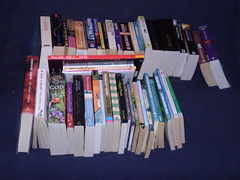
(The top row's mine, the bottom row B.'s. The ones in between we agreed to buy between us.)
Some of these are titles I'd been looking for for a while; some I'd vaguely heard of and looked interesting; some just caught my eye serendipitously in the shops. Some will be useful for reference purposes; some will tell me profound things about the human condition; some will be fun.
Of the bookshops, by far the most impressive is the colossal Hay Cinema Bookshop, filling four enormous warehouse-like rooms (well, former cinema screens, but it amounts to the same thing) on two floors with all the literature, history, cultural studies, theology and the like you could possibly dream of seeing assembled in one place (though they're admittedly a bit thin on the sciences). S.F. alone (or rather S.F. and Fantasy, because in reality you're never allowed to browse S.F. alone) takes up half a dozen sets of floor-to-ceiling shelves. Equally huge is the stock of the older and more rambling (but also rather smellier and less well-organised) Richard Booth's Bookshop.
The ones where I bought the most stock were probably (if I'm identifying them correctly from the map) The Sensible Bookshop, which had S.F. and mainstream fiction trailing up and down its staircase like a comet's tail, and the optimistically-named The Bookshop, a Bookends subsidiary which combines decent-quality secondhand stuff with remaindered copies of books you actually want to buy, at very reasonable prices. (Admittedly, the staff there have never heard of feminism. Quite literally, as B. discovered when asking after a Germaine Greer she was wanting.) The most pleasant bookshop to be in -- just in case you're wanting further recommendations -- was probably Addyman's Annexe.
Browsing in secondhand bookshops is, I think, one of the closest approaches one can make to Heaven in this life. Or perhaps I just need to get out more. Either way, it was a gloriously relaxing way to spend a weekend.
I've already read the tenth book from the left in my row above (and will be blogging about it shortly -- it's Ken MacLeod's The Human Front, which is one of the ones I'd been looking for for ages), and got stuck well in to the fourth and eleventh, Vikram Seth's The Golden Gate and Richard Morgan's Altered Carbon. Both are set in San Francisco, oddly enough, but in rather different time periods. They're otherwise staggeringly different. I'll tell you more about them later.
(Bizarrely, Hay-on-Wye is now twinned with Timbuktu. I wish I could tell you more about this, but I can't. I approve on general principles, though.)
The birthday was happy, as these things are traditionally supposed to be, with presents of DVDs from parents and spouse and an Amnesty International T-shirt from my in-laws (which is more welcome than you might imagine, especially since they're holding on to my real present until Christmas). The DVDs from B. included Edge of Darkness, which I've heard a lot about but never seen, so I'm looking forward to a great deal.
Mum and Dad gave me the 40th anniversary Prisoner DVD boxed set, a welcome upgrade to the rather dog-eared 25th anniversary VHS boxed set which I've been watching on and off for the past one-and-a-half decades. The picture quality is gorgeously crisp, there's an hour and a half documentary full of interviews (Peter Wyngarde seems to be the only surviving Number 2 who hasn't turned fat, having opted instead to look astonishingly like Ben Kingsley), PDFs of the scripts, commentaries and all kinds of goodies including the original edit of Arrival. I'm thrilled with the whole thing.
The weekend in Hay was really lovely: relaxing insofar as we were staying in a lovely B&B and had nothing more strenuous to do than wander aimlessly round bookshops and cafés; tiring in that there were -- as you may have gathered -- rather a lot of bookshops to be wandered aimlessly around in our two days there. I believe we visited 20, and came back with some 42 books, not counting presents:
(The top row's mine, the bottom row B.'s. The ones in between we agreed to buy between us.)
Some of these are titles I'd been looking for for a while; some I'd vaguely heard of and looked interesting; some just caught my eye serendipitously in the shops. Some will be useful for reference purposes; some will tell me profound things about the human condition; some will be fun.
Of the bookshops, by far the most impressive is the colossal Hay Cinema Bookshop, filling four enormous warehouse-like rooms (well, former cinema screens, but it amounts to the same thing) on two floors with all the literature, history, cultural studies, theology and the like you could possibly dream of seeing assembled in one place (though they're admittedly a bit thin on the sciences). S.F. alone (or rather S.F. and Fantasy, because in reality you're never allowed to browse S.F. alone) takes up half a dozen sets of floor-to-ceiling shelves. Equally huge is the stock of the older and more rambling (but also rather smellier and less well-organised) Richard Booth's Bookshop.
The ones where I bought the most stock were probably (if I'm identifying them correctly from the map) The Sensible Bookshop, which had S.F. and mainstream fiction trailing up and down its staircase like a comet's tail, and the optimistically-named The Bookshop, a Bookends subsidiary which combines decent-quality secondhand stuff with remaindered copies of books you actually want to buy, at very reasonable prices. (Admittedly, the staff there have never heard of feminism. Quite literally, as B. discovered when asking after a Germaine Greer she was wanting.) The most pleasant bookshop to be in -- just in case you're wanting further recommendations -- was probably Addyman's Annexe.
Browsing in secondhand bookshops is, I think, one of the closest approaches one can make to Heaven in this life. Or perhaps I just need to get out more. Either way, it was a gloriously relaxing way to spend a weekend.
I've already read the tenth book from the left in my row above (and will be blogging about it shortly -- it's Ken MacLeod's The Human Front, which is one of the ones I'd been looking for for ages), and got stuck well in to the fourth and eleventh, Vikram Seth's The Golden Gate and Richard Morgan's Altered Carbon. Both are set in San Francisco, oddly enough, but in rather different time periods. They're otherwise staggeringly different. I'll tell you more about them later.
(Bizarrely, Hay-on-Wye is now twinned with Timbuktu. I wish I could tell you more about this, but I can't. I approve on general principles, though.)
24 October 2007
Yaroo! Cave! Etc
You won't see me getting nostalgic here about my old alma mater, the minor-with-pretensions-to-major public school Lancing College.
This is because, while my all-fees-paid scholarship placement there certainly benefitted me in the long run, it's only on balance over my five years of attendance there that I could say I enjoyed it more than I hated it. I made some good friends (all of whom I then lost touch with completely), and I owe a great deal to certain teachers, but the school as a whole... pfft.
Boarding-schools (not that I ever boarded, thank God, or I would have gone mental) are hermetic subcultures, geographically isolated, with limited channels to the outside world. Considered as speech-communities, their language can evolve in some peculiar and baroque ways.
For a while I've been thinking that it might be a service to philology (albeit a minor service, probably performed in a tiny rural church at 11 o'clock at night according to a scandalously misprinted prayer-book all copies of which were supposedly burned in 1762) if I documented some of the weirder slang that was in currency at the school between 1985 and 1990. Preferably before it all falls out of my head, as much of it has done already.
What follows, then, is a brief dictionary of (what I remember of) Lancing College slang of the late 1980s, with notes.
Some of this language was doubtless transitory, some perennial enough that I'm sure it must survive today. A lot of it's also self-evidently ridiculous, which is why it's hilarious to remember my contemporaries (and, to be scrupulously fair, me) using it in all seriousness as part of our adolescent dominance-rituals. What knobs we were.
I may well add to this as more words come to me. If you were at Lancing during the relevant period and have (somehow) found your way here, do feel free to comment with further examples.
[Edit 6/12/2007 to add "rip" and "twos".]
[1] The School Marshal during my early years at Lancing was a huge, terrifying man who died tragically and heroically on holiday, saving his fellow-passengers from the capsize of the Herald of Free Enterprise. I couldn't stand him, but that's scarcely the point.
This is because, while my all-fees-paid scholarship placement there certainly benefitted me in the long run, it's only on balance over my five years of attendance there that I could say I enjoyed it more than I hated it. I made some good friends (all of whom I then lost touch with completely), and I owe a great deal to certain teachers, but the school as a whole... pfft.
Boarding-schools (not that I ever boarded, thank God, or I would have gone mental) are hermetic subcultures, geographically isolated, with limited channels to the outside world. Considered as speech-communities, their language can evolve in some peculiar and baroque ways.
For a while I've been thinking that it might be a service to philology (albeit a minor service, probably performed in a tiny rural church at 11 o'clock at night according to a scandalously misprinted prayer-book all copies of which were supposedly burned in 1762) if I documented some of the weirder slang that was in currency at the school between 1985 and 1990. Preferably before it all falls out of my head, as much of it has done already.
What follows, then, is a brief dictionary of (what I remember of) Lancing College slang of the late 1980s, with notes.
Some of this language was doubtless transitory, some perennial enough that I'm sure it must survive today. A lot of it's also self-evidently ridiculous, which is why it's hilarious to remember my contemporaries (and, to be scrupulously fair, me) using it in all seriousness as part of our adolescent dominance-rituals. What knobs we were.
- amphi, n. The school amphitheatre, used for open-air drama and illicit smoking.
- dodds, n. A clumsy person. (An eponym, obviously. During my time at Lancing it was gradually giving way to barclay, n., after a particularly unfortunate classmate of mine.)
- dossage, n. Relaxation, laziness. (Etymology obvious, and I'm surprised it isn't in wider use.)
- foetus, n. A stupid or useless person. (Used as a general all-purpose insult with truly astonishing ubiquity. Quite how this state of affairs first arose, I couldn't even begin to speculate.)
- glip, v. Masturbate (of a male). n. (Male) masturbation, semen. (Onomatopoeic, presumably, although to be honest I'd rather not think about it. I don't think the possibility of female masturbation really figured as a concept for any of us, except presumably the sixth-form girls.)
- glip-rag, n. Handkerchief etc used to clean up after masturbation.
- grove, n. Toilet. (This one was historic -- none of my contemporaries actually used it. The only people who did were a few nostalgically-minded masters who found the equally pastoral-sounding "bog" aesthetically troubling.)
- Head Man, n. Headmaster (or school principal, for those of you who were born after 1980 / in the United States and have never read The Beano. This is another one the masters used more than the pupils.)
- herman, n. Person with ginger hair. (As clear an illustration of metonymy as I've ever seen. The word originally applied to a boy nicknamed "Herman" because of his close physical resemblance to Herman Munster -- a resemblance which his ginger hair marred only slightly. Before long, however, it was assumed that gingerness was the defining characteristic of a "herman", and the Munster connection was forgotten entirely. I heard this applied to petite, pretty redheaded girls.)
- irrelevant, adj. Keeping a low profile, and therefore unlikely to be widely recognised. (Not knowing someone in your year was usually a major social faux pas, so I suspect the cool kids made this one up to mean it wasn't bad when they did it.)
- juvie, n., adj. (Person showing signs of being) marginally more immature than oneself at a particular moment.
- pitt, n. Study-bedroom. (This one was in official use, and had probably been so since the first such rooms were adopted at the school. It was always spelt with the double "t", suggesting that the etymology wasn't the obvious one.)
- prole (also proll), n. Member of the working classes, particularly the support staff. (This wasn't, of course, unique to Lancing, but it was shockingly universal among the pupils there. More interesting than the simple fact of its use were the limits of the same: the school librarian, for example, an educated, clearly patrician man, was never a "prole" -- although nor was the School Marshal, a distinctly working-class ex-army N.C.O. dragooned into instilling some semblance of discipline into the pupils[1]. That may just be because we were too scared of him, though. Groundskeepers, cleaners, kitchen staff, people who served you in shops, students at state schools -- all of these were "proles".)
- rip, v. Mock, tease, ridicule. (For some reason outsiders were always surprised to discover that our use of "ripping" differed from that current at Malory Towers in the 1940s.)
- ronnie, n. Short person. (A somewhat less extreme parallel to herman (q. v.), since being short was at least one of the characteristics which the history master nicknamed "Ronnie" shared with Ronnie Corbett, rather than one of the few which distinguished them.)
- smeggy, adj. Smelly, disinclined to wash. (Derivation obvious, and deeply unpleasant.)
- square, n., adj. (One who is) hard-working and clever, and thus not cool. (I can only assume that "square" had been applied to overly conformist pupils in the late 60s, and had shifted its focus since then.)
- twos, n. See below.
- vegetable, n. One who fails to enjoy, or does very little, exercise. (This, like "square", was usually applied to me.)
- wicked, adj. Ugly. (Used of boys who were considered hideously, fantastically grotesque, and any girl who wasn't a potential supermodel.)
I may well add to this as more words come to me. If you were at Lancing during the relevant period and have (somehow) found your way here, do feel free to comment with further examples.
[Edit 6/12/2007 to add "rip" and "twos".]
[1] The School Marshal during my early years at Lancing was a huge, terrifying man who died tragically and heroically on holiday, saving his fellow-passengers from the capsize of the Herald of Free Enterprise. I couldn't stand him, but that's scarcely the point.
23 October 2007
ParaGnomeAsia
I saw an advert today for a digital imaging firm called picselation. There's such a thing as trying just a little bit too hard.
12 October 2007
Confound their Knavish Tricks
One of the things I've spent the past couple of weeks doing has been "researching" (in that very specialist 2000s sense of "reading stuff on Wikipedia about"[1]) the British royal family, in service of an as-yet-unrevealed project.
Vaguely interesting things I've stumbled across (none of which are in any sense revelatory, and many of which you may know already, but which were either news to me or things I'd never fully realised before) include the following...
[1] And while I'm rambling on pretty much at random -- we all know that "1960s", "1970s" etc denote particular decades, but is there any simple term that refers specifically to the first decade of the 21st century, rather than potentially to the entire century or indeed millennium? The nearest I can get is "twenty-noughties", but that manages to be simultaneously ugly and twee. ("1900s" has a similar problem, but at least you can only go 90 years wrong with that one.)
Vaguely interesting things I've stumbled across (none of which are in any sense revelatory, and many of which you may know already, but which were either news to me or things I'd never fully realised before) include the following...
- While the present royal family may possibly be distant descendants of the Anglo-Saxon kings (in the sense that by now, pretty much anyone living in the British Isles could be descended from them), their best claim to the throne of England relies on the fact that the illegitimate grandson of Ethelred the Unready's brother-in-law happened to have a bigger army than Edward the Confessor's brother-in-law. Hmm.
- When a monarch who's previously been deposed but not killed comes back for a rematch and wins, the subsequent retaking of power is called a "readeption". Or at least it was once.
- While Henry VII may have been a Good Thing in that he ended all that tedious bitching between the Yorks and the Lancasters, his best claim to the throne was his descent by a dubiously legitimate route from Edward III's younger son John of Gaunt. Gaunt's children by his mistress, Katherine Swynford, were retroactively legitimised by the Pope (though specifically barred from the succession) when the two married late in life, in a move which was widely regarded as dodgy. (Henry then sensibly married Elizabeth of York, the older sister of the Princes in the Tower, ensuring that his own heirs were direct descendants of both York and Lancaster lines.)
- The Stuart kings after Charles I, and later the Jacobite "pretenders" to the throne (the disinheriting of several perfectly rightful monarchs on the grounds of their religion being yet another area where the current incumbents' claims to the monarchy can be seen as a little ropy) were directly descended from the Medicis of Florence, Charles' queen Henrietta Maria being the daughter of Maria de Medici and Henry IV of France.
- And speaking of France...
- Louis XV, who came to the throne at the age of four, was succeeded 72 years later by his own five-year-old great-grandson. How often does that sort of thing happen, eh?
- For the last six generations of the Bourbon monarchy in France, the male heirs were all called "Louis" and their wives some variant of "Marie". Someone really didn't have much imagination.
- The two current claimants to the French throne (both perfectly legitimate, except for that small matter of France being a republic these days) are Louis XX and Henry VII.
- Grand Duchess Anastasia Romanov (of "nearly as many impersonators as Elvis" fame) was Elizabeth II's second cousin once removed. Somehow I'd never realised that before. It means the Queen's first cousin twice removed is a Russian Orthodox saint, and also probably shagged Rasputin. Funny how these things work out.
- the great-nephew of Edward "Nazi sympathiser" VIII;
- the great-to-the-fifth-grandson of Mad King George;
- the great-to-the-11th-nephew of Charles "Off with his head!" I;
- the first cousin 15 times removed of Bloody Mary;
- the great-to-the-15th-nephew of Henry "I'm 'Enery the Eighth I am" VIII;
- the great-to-the-17th-nephew of Richard "A horse! Aaaaaaayyy horse!" III;
- the great-to-the-21st-grandson (by two different routes) of Edward "Poker time!" II;
- the great-to-the-24th-grandson of Bad King John;
- the great-to-the-26th-grandson of the Empress Matilda;
- and the great-to-the-28th-grandson of the aforementioned William the Bastard.
[1] And while I'm rambling on pretty much at random -- we all know that "1960s", "1970s" etc denote particular decades, but is there any simple term that refers specifically to the first decade of the 21st century, rather than potentially to the entire century or indeed millennium? The nearest I can get is "twenty-noughties", but that manages to be simultaneously ugly and twee. ("1900s" has a similar problem, but at least you can only go 90 years wrong with that one.)
10 October 2007
Oops
I see it's been nearly a month since I last posted here. A combination of two weekends spent away seeing family and friends, and starting a more senior job at work, have left me playing catch-up during my spare time. (And all the Facebook Scrabble probably hasn't helped either.)
Proper updates should be emerging in the forthcoming days. In the meantime, my latest Surefish column continues some of the musings from nearly a month ago, especially those here.
Sorry.
Proper updates should be emerging in the forthcoming days. In the meantime, my latest Surefish column continues some of the musings from nearly a month ago, especially those here.
Sorry.
Subscribe to:
Posts (Atom)