21 December 2005

Season's Shriekings

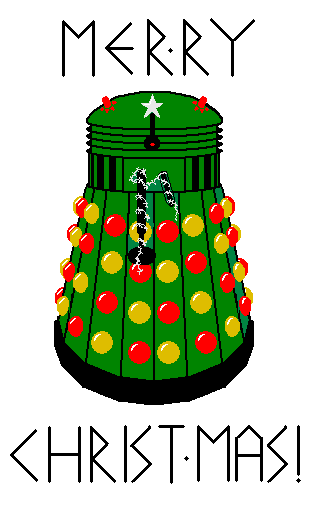
Some of you will have seen this before -- B. and I used it as a Christmas e-card a couple of years ago -- but it seems appropriate:

Click for a larger image.

I won't have regular web access now until after New Year, so any updates which do materialise before 2006 will be brief ones.

A very happy Christmas, or religious or secular festival of choice, to you all.

Draconian Measures

In a review (not yet online) of this book in the latest Fortean Times, eminent cryptozoologist Dr Karl Shuker uses the magnificent word "dracontological".

I had thought that the Greek for "dragon" was simply "δρακος", as in the constellation Draco, and had deduced that therefore the word for the simple study of dragons ought to be "dracology", leading me to believe that "dracontology" must be the study of the existence of dragons, by analogy with "ontology". Sadly, I then remembered that the constellation names are all Latin, and that the Greek for "dragon" is actually "δρακων", so that "dracontology" is simply the word for dragon-study.

All of which preamble allows me to mention my personal favourite work of dracontology, Peter Dickinson's The Flight of Dragons, a marvellously loopy book which weighs all the available mythological evidence (the mask-like face, the flaming breath, the affinity with water), couples it with the crucial fact that dragons as described and depicted would have been too heavy to fly, and comes to the remarkable conclusion that dragons were actually the only examples in nature of lighter-than-air flight. Their biochemistry was geared up to producing hydrogen with which they inflated their flotation chambers to take to the air, steering with their obviously-too-small wings and burning the gas off in huge exhalations of flame when they needed to lose altitude.

Dickinson's theory, in which he charts how the traditional legendary dragon might have evolved from dinosaurs and survived to live contemporaneously with early humanity, is never particularly serious but always completely convincing -- a fabulous combination, which held me utterly entranced when I first read the book at the age of twelve. He even explains how their (evidently highly unstable) biochemistry would have tended to consume their entire bodies after death, explaining the otherwise troubling lack of dragon fossils.

The ex-library hardback copy I now own I acquired about ten years ago, but the edition listed at Amazon is evidently a modern re-release. I'd recommend it highly for any twelve-year-olds you may know who are obsessed with evolution and mythology. There may even still be time to get it as a Christmas present.

20 December 2005

The Lion, the Witch and the Hypercritical Audience Member

And so to the main business of this blog today: picking holes in the current disnetic adaptation of C.S. Lewis's children's fantasy novel The Lion, the Witch and the Wardrobe.

First things first. It has to be said -- indeed, it probably can't be said emphatically enough -- that this film could have been far, far, far, far, far worse. The real-world sequences are not, for instance, updated to the present day or moved to Illinois. There are no songs. The Pevensie children are permitted to retain their English accents, and even more impressively so are nearly all the Narnian characters they encounter. Much of Lewis' dialogue, and almost all of the incidents the book describes, are transferred to the screen more or less intact (although one wonders, cynically, whether the Father Christmas scene would have made it had it not been such a heaven-sent merchandising opportunity). Even the child actors are rarely painful to watch, although there are occasions.

For those of us who worried that Disney would give us a wisecracking Buddy Aslan dispensing New Age wisdom in the voice of, ooh, let's say Eddie Murphy, this is not the film we dreaded.

In broad brushstrokes it is, in fact, remarkably well-done. Visually it holds up well, evoking a vivid landscape which corresponds with that described in the book. The CGI wavers a little when depicting some of the real-world animals -- the rhinos are particularly unconvincing -- but works very well when evoking mythical creatures such as centaurs or phoenixes. There are more chase-, battle- and general action-scenes than in the book, but that's entirely reasonable given the differing demands of literary and cinematic media, and both the larger rôles for Mr and Mrs Beaver and the complete interpolation of characters such as the brave Fox and the minotaur and centaur generals make perfect scriptic sense.

The updating of the childrens' language, and the strenuous spelling-out of anything (christian symbolism excepted) which threatens to remain a subtext, are a good deal more annoying, but understandable in a film written for contemporary children. Even the battle scenes' obvious indebtedness to Peter Jackson's Lord of the Rings trilogy is conscionable, although something new would naturally have been more interesting.

But. Oh dear, but but but.

Opening the film with a sequence featuring Luftwaffe bombers over Finchley may have been intriguing as these things go (and comparable in its way to the brilliant beginning of Wilde, which momentarily fools you into thinking you've walked into a Western screening next door), but it immediately provoked a sinking feeling in me[1]. Had the film proceeded to cut from the skies over London to the four Pevensies in the countryside, as a scene-setting exercise explaining just why children were being evacuated in the first place, then this approach could still have worked. Instead, it segues into the air-raid action-sequence of the family taking refuge in its bomb shelter, and Peter having to rescue the errant Edmund, who has gone back into the house to collect a photo of his father.

This introduces us directly to three of the cardinal errors in the film.

Firstly, it obscures the very clear contrast in the book between the children's dreary, mundane lives as evacuees and their thrilling adventures in Narnia. It's clear, in fact, that 1940s London would be just as capable of providing them with excitment and opportunities for heroism as Narnia is. Later, the film treats rural England as a quaint enchanted kingdom in its own right, with heritage-centre scenery and steam-trains, twee costumes and performances and a general sense that this is a place where anything, up to and including magic wardrobes, might be found. The children's lives in the Professor's house should be as drab and oppressive as those of, say, the children in The Others, but the studio simply can't resist disneying the place up until it resembles Peter Pan.

Secondly, the sequence compromises the way Narnia changes the children, and Peter in particular. Peter isn't a hero until he is called upon to be one: his feeling of responsibility for his brother and sisters is absolutely genuine, but untried by any real adversity or danger. He grows in Narnia, and his slaying of the wolf Maugrim to protect Susan is the point where he becomes an adult, or -- as Lewis would presumably have put it -- a man.

The film attempts to make this point through the entirely cack-handed scene on the iced-over river, where Peter is given an altogether-too-explicit moment of choice, which goes on far too long, and opts for what one might consider a creatively pacifist solution rather than killing Maugrim on the spot. The idea is presumably to demonstrate Peter's growth by showing him dithering here, then decisively killing the wolf later on in the film... but since we've already seen him displaying physical bravery in rescuing his brother, the message ceases to be about taking adult responsibility and becomes "When you're grown-up, you'll realise that sometimes it's necessary to kill people". (Or, I suppose, "wolves", not that I find that very much more palatable.)

Thirdly, Edmund. Edmund is the book's triumph, and one of Lewis's greatest achievements in fiction: a character who freely chooses a petty evil over loyalty to his family, and who pays the price in terms of guilt, if not of blood-sacrifice -- but, crucially, with whom the reader can sympathise throughout. In the book, he's motivated, obviously not by an appetite for Turkish Delight, but by dislike and envy of Peter, and specifically of his brother's popularity and authority among their sibling social circle. In the film this is mangled by hints that he feels the absence of his father more keenly than his siblings, and that all he needs to sort him out is actually a stronger authority figure -- which he finds, as do all the (non-evil) characters, in Aslan. His treachery, for which he should be fully responsible, is trivialised as adolescent confusion brought on by an absent father-figure.

In the book, when Aslan reunites Edmund with his siblings, admonishing them, "there is no need to talk to him about what is past," Edmund apologises solemnly to each of them, and they all shake hands. It's a bit of an English moment, admittedly, but a powerful one. In the film, there's no need for him to apologise. He's just a crazy mixed-up kid.

So far then, the message which has come through in the film might be summarised as follows:
1. England is quaint and magical, and the sort of place you might want to go on vacation, when there isn't a war on.
2. Sometimes you have to slaughter your enemies, and to think otherwise is immature.
3. Kids need their dads, or else they may turn for guidance to unsuitable older women, and who knows where that may lead.

So much for the first ten minutes.

I'm being flippant, naturally, but I have some serious problems with the presentation of the children's characters, and with the underlying politics. Perhaps my biggest issue connects to point 2 above -- the utter lack of any glimpse of blood.

When Peter kills Maugrim in Lewis' book, his sword is "all smeared with the Wolf's hair and blood". When Edmund is injured in the final battle, he is "covered in blood, his mouth was open, and his face a nasty green colour". Lewis is not squeamish about presenting violence, and more importantly its consequences. His Father Christmas has understandable reservations about handing over weapons to children.

I'm not suggesting that Lewis was any kind of pacifist -- he definitely wasn't. But he took war seriously, having served in one himself, and did his utmost in his books to teach children that they ought to do likewise.

The film, on the other hand, is positively blithe. We don't see Peter's befouled sword, or Edmund's wound, or even any evidence of the death-blow the Witch has dealt to Aslan. Even the German air raid is merely very loud, rather than harmful to anybody's health. The final battle -- quite unlike the brutal affairs in The Lord of the Rings -- seems to proceed in the manner of a play-fight, without death-blows or gaping wounds or severed limbs or gushing gore: the nearest we get are the positively hygienic (and, in most cases, temporary) demises of those whom the Witch turns to stone. (I'm guessing the shattered griffins might present a problem, but it's not one we ever see.) Here, War is Fun. Even the girls get to join in.

The film is faithful to the text -- remarkably so. But in even a direct reading of any text, one interprets it. The film of The Lion, the Witch and the Wardrobe brings to its reading of Lewis a 21st-century-American popular agenda about which I can't help but feel profoundly uneasy.

The novel The Lion, the Witch and the Wardrobe is atypical among the Narnia books, in rather the same way that The Hobbit is an atypical Middle-Earth book. Compared with the later books it's simplistic, lacking in both the creative complexity and the imaginative coherence of the world Lewis later builds up. Stylistically, too, the author's finding his feet, talking down to his readers far more than he will in later volumes. Although Edmund's moral struggle is internalised, it has none of the depth of the dark night of doubt experienced by Eustace and Jill in The Silver Chair, or the complexities of good faith married to bad religion in The Last Battle.

It is, in a word, the easiest of the Chronicles of Narnia to adapt for children and get right. I have the unpleasant suspicion that, as these film adaptations continue, they'll veer further from the text of each of the books, while parting company ever more definitively from their spirit.


[1] It also got me thinking along the lines of "What if the White Witch got into England through the wardrobe, and teamed up with the Nazis to take over the world?", which I don't think can be what the scriptwriters had in mind.
Ooh, Look...

...I'm being cited in a radical christian site's coverage of the reported anti-war elements in the Christmas Doctor Who special, The Christmas Invasion.

Sentences You Don't Hear Very Often, #47

"I'm glad your trousers dyed your phone purple, so that we can tell the difference."

19 December 2005

The Christmas Anticipation

Urgh. I ate far too much yesterday. "Far too much" these days meaning much less, of course, than it used to -- something I do tend to forget when the opportunity to consume large amounts of food presents itself. B. and I had a very nice pre-Christmas lunch with our goddaughter, her parents and little brother, followed by a kind of open-house thing at our place, with much mulling of wine and fizzing of bucks, and more nibble food than our guests could reasonably be expected to consume by themselves, hence the troubled state of my digestive organs this morning.

Term finished, for me at least, on Friday, which is pleasing as work's been getting rather gruelling just recently. All the inevitable pre-Christmas panicking seems to be reasonably under control, with all the presents for our families covered and only our aforementioned goddaughter and a couple of stray friends still to buy for. Christmas cards are sent, cat-visitors during our visits to parents and in-laws are arranged, and we even seem to have somewhere to go for New Year's Eve, and people to go there with.

I ought really to be getting on with some writing before we go away, but after midweek I'll not be getting much change to access the web until after New Year, so instead I'm taking advantage of the opportunity to catch up with my blogging. Make the most of the next couple of days' updates -- they'll be the last of any substance until 2006.

My head is full of Christmas earworms, but fortunately they're mostly Medieval carols. They were still annoying when I was trying to get to sleep at 6 o'clock this morning, though.

TV Roundup

Of the three TV series I'm in the process of watching or rewatching currently...

Buffy, moving now into the endgame of Season Three, continues to be ace, interspersing some of the series' very best individual episodes (The Zeppo, Doppelgangland, Earshot) with a character-focused arc story (Faith's journey to the dark heart of Slayerhood) just as compelling as that of Season Two -- although, granted, its seriousness is weakened somewhat by the reset-button resolution of that season's aftermath. It helps that Faith is possibly my favourite character in the Buffy universe, ushered by Eliza Dushku's consummate acting through this compellingly believable moral descent and her later redemption. (Plus, of course, she's sex on legs.) But if Buffy tails off (and the matter's arguable), it's certainly hasn't started doing it yet.

The West Wing is a hell of a lot better in Season Six (two more episodes left to go) than in was in Five, although it's achieved this largely by shifting the emphasis altogether away from the Bartlet administration itself and onto the inevitable succession battle. I still miss the era when it was entirely about speech-writing, but there's some very decent stuff on offer here.

I'm finding the programme's attitude to the Republicans particularly intriguing: having fielded an obvious joke candidate against Bartlet in Season Four's second-term elections, this time the writers have decided to pit the Democratic candidate against a Republican nominee who's every bit as implausibly idealised as Bartlet himself -- and is, moreover, played by archetypal counterculture rebel Hawkeye Pierce off M.A.S.H.

This is presumably designed to suggest in Season Seven that Congressman Santos is being given a real run for his money[*], but it's beginning to backfire: as someone who lives on the same planet as the United States, I think I'd prefer to have the capable and honest Vinick in charge, rather than the frankly shambolic Santos. (Either of them, of course, would be far preferable to the chimp chap running the place in the real world, who bears a more than passing resemblance to the aforementioned joke candidate.)

Rome remains utter drivel, relying more and more heavily on implausible coincidence to throw the spurious and unnecessary everyman characters Pullo and Vorenus into the thick of every historical situation, and serving up the same unpleasant splurge of cod-shakespearean diction and 21st-century banality in the dialogue. Apart from the stunning visual texture and a half-decent performance (yes, about half I'd say) by Ciarán Hinds as Caesar, this series has virtually nothing to offer. Even on the most basic level, none of the later sex scenes have lived up to the full-frontal promise of the pilot.

I've been wondering, too, what Rome fanfic is like. I presume there's no shortage of Pullo / Vorenus slash, but has anybody yet written a crossover where they meet Asterix and Obelix?

Come to think of it, a cameo from Gérard Depardieu would liven up the series no end.


[*] OK, so strictly speaking I don't actually know at this point that the Democrat nominee's going to be Santos. But come on.

Sequel Hunter

Telos Publishing have announced that their Time Hunter series of mystery-fantasy-supernatural-S.F.-time-travel-thrillers will be coming to an end next year with the eleventh book in the series, Child of Time by George Mann. I've said before that Time Hunter is an excellent series, with strong central characters, a flexible format and a number of outstanding titles, with my own contribution to the range, Peculiar Lives, being by no means their best[*].

This is a big shame, but of course Telos have to make decisions based on business considerations. Unlike their Doctor Who novellas, though (which were quite simply the best Doctor Who series that there has ever been, in any medium), I don't think the Time Hunter books will be going out of print at any point soon.

Still, you could do a great deal worse than taking advantage of Telos's timely special offer on the first five books in the series, which include my personal favourites The Clockwork Woman and Kitsune.


[*] Although it is, I should emphasise, still bloody good.

Tripping Shortly

I've finally finished reading The History of Christmas, working my way through it a few stories at a time, and it's rather good.

You would, of course, expect me to say that given that I've been encouraging you to buy a copy for months, but I'd recommend you particularly to Simon Bucher-Jones's "The Thousand Years of Christmas" (one of the more overtly S.F. stories in the collection, and a very fine one) Kate Orman's "Nobody's Gift" (Aztec midwinter rituals and psychometry), Joff Brown's "Danse Macabre" (aliens gatecrash a Venetian ball in honour of Lord Nelson), Jonathan Clements' "Ode to Joy" (the Doctor chats to a Japanese fox-spirit) and Matthew Sweet's curtain-raiser "The Lampblack Wars" (distilled Victoriana). Eddie Robson's "Not in My Back Yard" draws on more Doctor Who knowledge (specifically of the New Adventures Virgin Publishing produced during the '90s) than many readers will be bringing to the volume, but is also splendid.

In a cunning Advent-inspired selling-tactic, the book has 24 seasonally-themed stories, and is longer than any previous Doctor Who short story collection from Big Finish. It also finishes with my "The Long Midwinter", a story about midwinter festival celebrations on a brown dwarf in a binary star-system. This is the last time I'm going to tell you to buy the book.

In only slightly related news, I'm reviewing Back in Time: a Thinking Fan's Guide to Doctor Who for surefish: it's a critical book on (mostly) the 2005 series from a christian perspective, although a rather different one from mine. I'm not going to say what I think of the book, mostly because I haven't finished it yet, but I'll let you know when the review appears.

13 December 2005

In Passing...

A bunch of schoolgirls on the bus this morning were ostracising one of their number for not knowing who Bob Marley was.

Sometimes, I think there might be hope for the world.

11 December 2005

Due to Circumstances Beyond Our Control...

Because of various extrinsic factors with which I won't bore you, I'm going to have to scale down activity on this blog, at least for a while. I'll still be posting, but almost certainly less often. Which is a shame, probably more for me than it is for you.

The reviews of Anansi Boys and Pattern Recognition are going to have to be put on hold for a while.

I'm going to be away for a couple of weeks or so over Christmas anyway, mind you, so this may not make all that much difference at first. I'm not sure how long the situation will persist, but it's clearly not ideal and I'm hoping it's susceptible to resolution at some point.

Sorry to be so opaque about this. (And no, it's not another writing commission, unfortunately.)

07 December 2005

Books: Interim Report

Short Trips: The History of Christmas has now arrived. It's a lovely rich cranberry colour, and has stories by some splendid people. Mine, "The Long Midwinter", is a kabalistic hard-S.F. Doctor Who piece with a seasonal twist. Buy, read and enjoy.

No time as yet for a proper review of Anansi Boys or Pattern Recognition... but I'm now reading Perdido Street Station, and bugger me if China Miéville isn't every bit as implausibly good as everybody always says he is. (I must admit I was confused in that I thought he was a science-fiction writer, whereas Perdido Street Station -- and, apparently, his other works -- is clearly urbanised, industrialised fantasy. But still, astonishing stuff.) So that's another one I'll need to try and do justice to when I've finished it, although at 867 pages that's not going to be any time soon either.

Aliens of London

A couple of days mostly off work have dispelled the snot in my brain to the extent that I can now think straight, or at least put words in an order that somewhat resembles a legible sentence. So, here's the (mammoth and exhaustive) critical write-up I promised following B.'s and my weekend in London:

Thursday: Left work and headed for Bristol Temple Meads, whence to London Paddington, Tottenham Court Road Tube station and The Fitzroy Tavern, the Bloomsbury pub where, for reasons long since vanished in the shiny metal corridors of history, London-based Doctor Who fans traditionally meet on the first Thursday of each month.

This was the first time I'd been, and I had a splendid, if bewildering, time meeting large numbers of people with whom I'd only ever corresponded by email, including such editors of mine as Simon and Lawrence. (Actually, Lawrence and I had met before about six years ago, but he was being a bit vague at the time and doesn't seem to have formed any memories of the event.) Talked writing, Doctor Who and S.F. in general with various people and generally had a thoroughly enjoyable time. I'm likely to go back the next time work (specifically, work in Bristol on Friday mornings) allows.

At closing time I proceeded from the Tavern to my sisters-in-law's flat in Borough, where B. was staying, and joined her in their spare bed.

Friday: We got up late and went to the riotous assembly of food-and-drink stallage that is Borough Market. There we breakfasted lavishly in an all-you-can-eat bread-and-jam café (very possibly, now I come to think of it, the only all-you-can-eat bread-and-jam café) then wandered around saying "Mmmm" at various things. We bought chocolate truffles, exciting dried fruit and (predictably) an exciting selection of bottled real ales from Utobeer, which I'm looking forward to trying once I'm able to taste things again. The only reason we didn't buy any, or indeed all, of the cheese on offer was that we had no way to keep it cool until we got back to Bristol.

Friday and Saturday nights we were staying at a hotel (the Ramada Hyde Park, if you're desperate to know), courtesy of Tesco's iniquitous but helpful customer-bribery tokens. The hotel was decent enough -- big bed, OK shower, adequate breakfast -- but getting our bags across London was considerably less fun. Still, that afternoon we checked in, wandered around the immediate area a little and then headed for The Victoria, a Fuller's pub which had been recommended to us by, and where we'd arranged to meet, various ex-DougSoc types including dogrando, Juliet and Silk.

The pub itself was nice enough, with some interesting Victorian prints (including a very sentimental one of Victoria, Albert and the kids in some kind of bower), standard city-pub food including nachos, and a strangely curtailed range of beer including, absurdly, no London Pride. Still, we had a splendid time chatting and drinking, so hurrah again for vaguely S.F.-inspired social groupings.

Saturday: After consuming large quantities of hotel breakfast (always important when it's all been paid for beforehand), we headed out to two exhibitions we'd particularly wanted to see whilst in the metropolis: The Science of Aliens at the Science Museum and Forgotten Empire: The World of Ancient Persia at the British Museum.

The former was rather disappointing -- for the most part, it recycled stuff which could be found in any documentary or "young adult" factual book on Outer Space and / or Science Fiction Films (the only thing it was rather fun to be up close to was a life-size model of the Alien Queen, which kept roaring loudly).

By far the most interesting section -- which we'd read about in a Fortean Times article -- was a room devoted to speculative xenoecology, where scientists had extrapolated alien ecosystems for a pair of theoretical planets, Blue Moon and Aurelia. (The results are apparently also available in glorious CGI-vision in a Channel 4 documentary, which we missed entirely when it was on telly and which, idiotically, the museum shop wasn't selling.) This room was spectacular, with vast horizontal touchscreen-benches simulating the ecosystems in dynamic real-time, tappable icons and menus providing further information about the organisms and their interaction. It wasn't really worth the entrance price, though, especially when the DVD exists.

Forgotten Empire was altogether classier, with a vast number of artefacts from ancient Persia, one of those cultures which modern history tends to ignore and which always fascinate me. (One piece of text made the important point that, while relations with the Persian Empire were an ongoing and defining concern in the history of the ancient Greeks, to the Persians Greece was merely a barbaric and not-very-interesting land somewhere on their borders. Until that Alexander chap came along, of course.) At its height, the Empire stretched from Thessalonika to Pakistan, Khazakstan to Libya, incorporating dozens if not hundreds of peoples and cultures and -- obviously -- nicking all their gold to build great big palaces in Persepolis.

It's the kind of thing I love to learn about, but there's a limit to how much you can understand through even the most well-captioned artifacts. (I probably need to read a book.) There was very little about Zoroastrianism, for instance, although in its influence on later monotheistic religions it may well be Persia's most enduring legacy in the world. (I was fascinated to learn that, when he "liberated" Babylon, Cyrus the Great paid his respects to the local creation deity Marduk, rather in the manner of the Romans appeasing the Gallic gods. Not as monotheistic as all that, then.)

Probably the most impressive objects were the huge chunks of architecture from the royal palaces, including a great big segment of pillar, a couple of giant stone friezes which easily rivalled the Elgin Marbles, and a gold paw the size of a microwave oven, originally part of a lion on the same scale.

Once we'd finished with the Persians, we paid a desultory visit to the Aztec and Bronze Age sections of the Museum -- before heading back into S.F. geek mode for a visit to the huge new Forbidden Planet on Shaftesbury Avenue, where we admired my books and bought several other people's.

By that point we were knackered, so we finished the day with a quiet meal at the Mahal Restaurant just round the corner from the hotel. Delicious Indian-fusion food, quite different from the one-size-fits-all menus you get in most Indian restaurants (in Bristol, at least -- perhaps the typical London palate is more sophisticated). Being a cheese freak I particularly enjoyed the feta samosas and paneer dopiaza, while B. had a kind of curry tortilla thing called a "frankie". The onion bhajis were also particularly good.

Sunday: Again, we got up late and ate too much breakfast. We didn't have all that much time left in London, but we managed a wander through Kensington Gardens, visiting the ducks and Peter Pan, and spent a while at the Serpentine Gallery. They had a fairly weird exhibition themed around sleep and dreams, which had the big advantage of providing beds to lie on, assuming you didn't mind being treated as a work of art by the other punters.

In the afternoon we lugged our luggage all the way to Richmond -- which again wasn't nearly so much fun -- visited B.'s Granny and picked up the car which B. had left there. Thence back to Bristol via the M4.

Fun, manic, sociable, comfortable, intellectual, romantic, beery, foody, geeky, arty, sleepy: almost everything I look for in a weekend away. We need to do it all again sometime.

05 December 2005

In Summary, Unsummery

Went to London. Had a nice time. Returned with hideous cold, which is currently preventing the effective operation of my brain and which it's been pointed out may well have been contracted by standing outside a pub in the freezing rain with a decreasing number of dogged Doctor Who fans.

Will go into more detail about the first two sentences of the above when the effects of the third have receded.

01 December 2005

Origamitron

My geek concealant's wearing thin.
MY BOSS: I'm just going down to Admin, to fold these leaflets into three with the machine-that-folds-things-into-three.

ME: [Quite sincerely] Does it really? How exciting!

[Long pause.]

MY BOSS: Right then. [Goes.]
I'm off to London until Sunday now, to meet with sundry people and do the sight-seeing thing with B. I'll tell you all about it when I get back, but in the meantime I probably won't be reading my email, and certainly won't be updating here.

Be good while I'm gone.

29 November 2005

A Number of Entirely Disparate Things

My self-enforced caffeine fast is nearly at an end now. Come Thursday I will once again be permitted tea (which I almost certainly won't bother with, in the normal run of things), chocolate (which I most certainly shall) and, of course, coffee, which at present the jury's still out on. If it turns out that I still can't write without the stuff, then obviously it's a necessity. If it turns out that I now can (and I'm going to give it a good try), then I shall reserve it for special occasions, like when I'm having to stay up late or be socially vivacious beyond the call of duty, and subsist for the rest of the time on decaff.

I need, of course, to make the experiment in the first place. So far -- apart from these blog entries, which I realise aren't necessarily evidence of anything -- I've managed an idea and a page-long plot synopsis for a novel. I clearly need to attempt something more substantially creative than that, involving the extensive manufacturing of actual prose. Still, there's no shortage of speculative projects (plus one rather more definite thing) which I've been meaning to get round to for ages now.

One thing I have discovered over the past three months is that ginseng, ginkgo biloba and omega-3 oils, while quite possibly splendid and healthful things in themselves, do not in any capacity substitute for caffeine. The only thing which substitutes for caffeine, so my contact at the local health food shop tells me, is something else with caffeine in it, which isn't a terribly useful piece of information.

This morning I came into work by bus and train, as the Met Office was warning of severely icy roads in, among many, many other places, Bristol. Since being here I've been phoned by our burglar alarm to let me know it's been set off. This is almost certainly the result of a cat fight (as it has been on the previous 20 or 30 times this has happened), but on this occasion I can't moped home to check, which is distressing me at present. Still, never mind.

Had a very pleasant weekend with B., taking advantage of the fact that after her nightmarish November she no longer has to work on Sundays. We scouted out the route of a pub crawl we're thinking of holding around the pub-rich Hotwells district of Bristol. We easily found five hostelries within short walking distance of one another which offer a fine selection of real ales, including The Bag O'Nails which boasts up to seven guest ales (and whose name, fabulously, is supposed to be derived from "bacchanalia"), and Bath Ales's The Merchant's Arms, where I lingered lovingly over a pint of Festivity, their gorgeously flavoursome dark rum porter.

(And from researching those links, I now see that the 2006 Bristol Beer Festival has finally been scheduled. Hurrah. Right, I'm going to get organised about inviting people down for that as well.)

We followed our beer with the Advent Service at St Mary Redcliffe, the church which seems to serve Bristol in the capacity of a cathedral (in terms of being big, popular and resolutely High Anglican) despite the fact that Bristol has a perfectly decent Church of England cathedral at its disposal. My taste in worship is fairly eclectic, but for an Advent service, complete with minor-key hymns and candles against the dark and cold of a winter night, it's difficult to beat high-church Anglicanism. I'm going to make a real effort to go back there for their Nine Lessons and Carols on the 18th.

Meanwhile, I've started -- and, because it's so bloody good, something like nearly finished -- Pattern Recognition, William Gibson's non-SF thriller. It's absolutely enthralling, and also conceptually astonhishing as Gibson's cyberpunk aesthetic -- originally intended as a metaphor for the disorientation and alienation of commodified modern living -- is applied directly, and without imaginative prophylaxis, to the real world.

I'm surprised to see most of the reviews at Amazon being so negative about it (although I suppose it might yet turn out anticlimactic). A full review may well follow at some point, although Anansi Boys is still ahead of it in the queue.

No sign of The History of Christmas as yet.

Experiment

There is an itch: somewhere on your body, on your skin, a nagging twinge in need of the attention of an abrasive fingernail. It might be on your shoulder, or your hip, or in the pit of your knee. It could be anywhere. It sits in the shadow of your awareness, but as soon as your attention is drawn to it, the knowledge of it becomes inescapable.

Give it a good scratch. That's right. There, that's better, isn't it?

Yes.

...Except that you have started thinking now about itches, and they never come alone. As soon as one is worried away by scratching, you become conscious of another, somewhere else. Your earlobe, perhaps, your ankle, or your instep. Insteps are the worst. You have to take your foot right out of your shoe to scratch them, and then you have the agony of tickling yourself with every grating nail-stroke.

But this itch, too, is susceptible to easy resolution. Scratch it away. Mm, yes, that's good.

Except...

At any time -- at every moment of the day and night -- your skin is sending you these itches from a dozen or more sites across your body: nose, ankle, nipple, wrist, the crevice of your armpit, the small of your back, each with their own unique niggling sensations. They slip beneath the threshold of your consciousness. Sometimes they provoke unaware responses from your fingers, sometimes not. They are no trouble to you at all.

Unless, of course, something calls your particular attention to them.

25 November 2005

Weathering It

I was up at bloody 6:15 am this morning, aware that there'd been some severe weather warnings for nearby counties, and worried (despite the fact that the worst the Met Office had predicted for us here in Bristol was light rain) that there might be overnight snow or ice which would make it distinctly unsafe to take the moped to work.

It's generally a really bad idea to propel yourself along wet, slippery, unstable surfaces at speed on two wheels, and when the weather gets untenable I generally take the 7:01 train from our nearby branchline station to Bristol Temple Meads, then a bus to work. This morning there was no need to do that: when I checked outside the house at 6:50 there was no ice or frost and it clearly hadn't snowed overnight. What's more, the Met Office was now claiming that Bristol could expect happy sunny skies throughout the day.

Hurrah, I thought, aware that this meant I had another twenty-five minutes before I needed to take the bike to work.

Twenty minutes later -- and thus nine minutes after the local train had left -- I stepped out of the house into a bloody snowstorm. The damn stuff was coming down out of the sky in huge weltering blobs, lathering the ground like the runoff from some Olympian shampooing session.

This is England (I thought) for God's sake, not Newfoundland! It doesn't snow in November. Snow threatens to come during the last two weeks of December, actually arrives in the first week of January in time for everyone to say what a shame it was that we didn't have a white Christmas, and then buggers off again for the year apart from two freak flurries in the middle of February.

Now this had happened I didn't know what to think any more.

I had to get the bus into town -- which involved standing in an open-plan bus "shelter" next to a snogging couple and getting fresh snow blown in my face -- and then another bus out to St Brad's -- which involved sitting directly in front of a man who was ranting with disturbing eloquence at his ex-girlfriend over the phone and occasionally thumping the window -- and arrive later than usual at work -- which involved running around and panicking to get everything sorted out in time for the library to open at 8:30.

By that time, of course, the snow had stopped, and the clear and sunny skies which we've been enjoying since then had set in. In fact the adverse weather lasted for precisely the duration of my usual motorcycle journey to work.

I could have got here sooner if I'd just waited for the damn snow-shower to finish, and then left on the bloody moped.

Although admittedly I would have then skidded and died on the recently snow-greased roads, so it mightn't have been such a good plan.

24 November 2005

Depprivation

B. and I have been ludicrously tired recently, B. from her current sustained and hectic stint at work and me from looking after her and picking up the slack at home, so last Saturday was reasonably low-key -- a trip to another nice local café (too local to have a website), a return visit to the deli and a trip to the cinema to see The Libertine in the evening.

Never having seen the play, all we knew about the film was that Johnny Depp was playing the Earl of Rochester, famous among Eng. Lit. undergraduates the world over for writing dead rude poems about shagging and stuff, so we were expecting rather more of an hilarious historical romp than we got. There are indeed some funny bits (notably the musical performance of Rochester's satirical poem "Signior Dildo"), but Depp's portrayal of an individual in the progressively degenerate, humiliating and hideous late stages of syphilis -- reconstructed with enthusiastic realism by the makeup artists -- isn't exactly a barrel of laughs. It goes without saying that Depp's performance is mesmerising, and John Malkovitch as Charles II was pretty bloody good as well... but The Libertine is very much not a cheery film, and individuals fixated on Depp's physical beauty go to see it at their own particular risk.

Oh, and there's an awful lot of swearing, too. What with that and reading Cock and Bull I feel as if I've encountered more incidences of the paired c-words this week than during any equivalent prior period.

I think the review of Anansi Boys may have to wait for a time when I'm not so exhausted -- possibly next week sometime, when B.'s hard stint at work has finally ended. In preparation for the much-anticipated The Christmas Invasion, I may also update the recently quiescent Parrinium Mines with reactions to such events in the Doctor Who world as the 2005 season DVD boxed set, the recent Children in Need special and the sad end of the proper Doctor Who novels.

However, all of this needs to wait until I have the time. We'll be spending most of this weekend recovering -- including meeting up for lunch with our goddaughter and her family at the Tobacco Factory on Saturday -- then on Thursday next week we're off for a long weekend in London, consorting (and possibly, depending on circumstances, cavorting) with sundry sisters-in-law, Doctor Who fans and ex-DougSoc members.

Other than all that (and some mild but hardly conclusive expressions of interest in the pseudonymous pulp novel I was talking about a while ago) not a vast amount's been going on here. I do, however, have intelligence that Short Trips: The History of Christmas is now in release, which is good news. I'm looking forward to getting my copies through the post, and if you've pre-ordered it (and if not, why not?) then so should you be.

21 November 2005

Birthday Presents: Final Roundup

From B.: The Doctor Who "First Series" boxed set, finally out today.

From my little brother and sister-in-law: Battery-operated sonic screwdriver, hurrah.

From B.'s parents: The Writer's Handbook 2006 and Doctor Who: The Shooting Scripts.

From B.'s granny and my aunt-uncle combo: Money and a book token, which I cannily exchanged at Borders for Anansi Boys and V for Vendetta.

From R., M.(1), E. and L.: 300 Beers To Try Before You Die.

From H., M.(2) and C.: A splendid Earth ball.

From my beloved parents: A smart new denim jacket, ideal for my requirements in all particulars save that of having been designed to fit a moderately buxom woman. It's too small for B., so this one's going to have to be exchanged at Christmas.


Last Monday I went to Neil Gaiman's book-signing at Waterstone's, in order for him to sign a copy of Anansi Boys for me and one as a birthday present for M.(1) (which was exchanged on Friday evening for the compendium of beers mentioned above.) Anansi Boys is wonderful and great fun, and ought to be getting its promised writeup on this blog at some point really soon now.

(Gaiman also signed my copy of Good Omens at last, meaning that the Terry Pratchett signature which it acquired some thirteen years ago now finally has company and a punchline. He's a perfectly charming man, and also one who now owns a copy of Of the City of the Saved..., although if he ever gets the time to read it I'll be astonished.)

300 Beers To Try Before You Die is a thing of beauty, laid out according to beer styles, with a description (and usually a photo) of each beer, a flag to tell you which nation it comes from, and space for your own tasting notes. There are even little tick-boxes next to the entries in the index, so that you can tell which ones you've already tried. You can tell it's designed for CAMRA members: it's difficult to imagine how it could be better laid out to please beer geeks. Needless to say, I love it.

By my reckoning I've tried 43 of the beers in question already, and I'm not dead yet. Of course those are mostly the British ones: there are a surprising number from the U.S. and Australia, as well as the more obvious German, Belgian and Czech offerings. Obviously more foreign travel is indicated, if I'm going to live up to my obligations.