18 April 2011

Twelfths and Quarters

I'm working on a book review post. Honestly I am.

In the meantime, on with the plugging. Here's the updated cover of A Romance in Twelve Parts, due from Obverse Books on 31 May:


Note the rather lovely use of the blended-case font last used back in 2003-04 by Mad Norwegian for the titles of This Town Will Never Let Us Go and Of the City of the Saved....

You may also wish to speculate about what kind of animal that skull might belong to.

In other Obverse news, Stuart Douglas has recently announced a really exciting new venture -- periodical anthology series, the Obverse Quarterly, aimed at genre fans with eclectic tastes. Subscribers will receive four marvellously eclectic collections of short stories each year. (Individual titles can be bought separately, but as far as I can see the quirky mixture of styles and sources is part of the charm.)

The first four volumes are:
  • a collection of original horror stories edited by up-and-coming author Johnny Mains;
  • a volume of spin-off stories featuring Iris Wildthyme's Mexican wrestler pal Señor 105, edited by his creator Cody Quijano-Schell and featuring several of the same splendid contributors as A Romance in Twelve Parts;
  • a reprint of the short stories of Fitz James O'Brien, an early author of proto science fiction who even I've never got round to reading;
  • a collection of new stories featuring the classic pulp villain Monsieur Zenith the Albino, edited by Stuart and featuring stories from Paul Magrs, George Mann and -- deep breath -- Michael Moorcock.
All of which sound fantastic in their respective ways. The only one of those which doesn't immediately appeal to me is the horror anthology, but the pricing structure cleverly means it's £1.97 cheaper to subscribe to a year's worth of titles than to buy three individual ones.

I should clarify that I've no personal investment in any of these four volumes (although I've hopes of becoming involved in future years, naturally) -- I just think that this is a fascinating project for a contemporary small press to be embarking on, and want to publicise it as widely as I can. Which means telling all of you lovely people about it.

30 March 2011

A Romantic Autopsy

It's taken a little while, but Obverse Books have made the first of their Faction Paradox short story collections, A Romance in Twelve Parts, available for preorder at their website. As I may possibly have mentioned before, this anthology contains my 10,000-word sequel to Of the City of the Saved..., "A Hundred Words from a Civil War".

(It's also on Amazon, although there "Twelve" appears to be spelt "Twleve".)

Obverse have also announced the ISBN -- a thrilling 9780956560544 -- and a provisional cover image (as yet without the title added), which looks like this:


The list of stories is also included, to whit:
  • Alchemy - James Milton
  • Holding Pattern - Scott Harrison
  • Storyteller - Matt Kimpton
  • Gramps - Jon Dennis
  • Mightier than the Sword - Jay Eales
  • The Story of the Peace - Ian Potter
  • Print the Legend - Daniel O'Mahony
  • Nothing Lasts Forever - David N Smith and Violet Addison
  • Library Pictures - Stuart Douglas
  • Now or Thereabouts - Blair Bidmead
  • Tonton Macoute - Dave Hoskin
  • A Hundred Words from a Civil War - Philip Purser-Hallard
Daniel and Ian are among the best authors I know, and Matt, Jon, Blair, Dave -- actually, sod it, nearly all the other authors -- have contributed excellent stuff to previous collections including Obverse's Iris Wildthyme range. The book's going to be fab, and you should buy it.

As if you needed an extra inducement, I'm told that Iris herself features in Stuart's story, her first appearance in a Faction Paradox book since pp165-67 of Interference volume 2, very nearly twelve years ago.

Official word is now that A Romance in Twelve Parts will see publication on 31 May. When I have more information on that, I'll apprise you of it.

09 March 2011

Degrees of Separation

My word, you have all been patient.

The latest word is that publication of Faction Paradox: A Romance in Twelve Parts, initially scheduled for last month, is now expected in April. Final tweaks to my story are being made this week.

So, here's the last of my pre-prepared deleted scenes. In the alternative universe where ‘A Hundred Words from a Civil War’ was published without the guest contributions, this drabble would have acted as a bridge between a scene set in Paynesdown District and one set in the Romuline District:.
     The persistent rain of Paynesdown forms a case-study for the potential weaponisation of the City’s gigaclimate being undertaken by meteorologists from Rullish District University, one of the students in whose Physics Department is secretly accumulating nuclear material at the behest of a cult whose restrictive views on the nature, definition and exclusive right to continued existence of ‘Chromosomal Humanity’ have led to their investigation by a Civil Intelligence Agent, whose partner was recently murdered using contact poison supplied by a neuro-bokor who is practicing experimental zombification processes on a consignment of slaves purchased from mercenaries from the Romuline District, where:
...a bunch more stuff happens. To find out what, you'll have to read the story itself once the book's published.

I'm hoping to do more bloggery shortly -- I very much want to review Ben Aaronovitch's Rivers of London and Kim Stanley Robinson's Galileo's Dream, and possibly the film version of Never Let Me Go, which I managed in an uncharacteristically toddler-free moment to see -- but for the moment toddlercare, work and the non-series novel I'm very, very, very slowly writing are pressing rather too insistently.

11 February 2011

'Road Lines'

What is the secret of the British ‘road lines’?

Across Britain, narrow lines can be observed at the edges of many roads. They occur close against the kerbside and parallel to it, on both major and minor highways. They occur singly or in pairs, appearing to be marked out in something similar to yellow paint. They range from two or three metres to many kilometres in length.

Where do the ‘road lines’ come from? Who makes them? What is their significance? Do they have a meaning -- and if so who, is intended to understand?

Millions of British motorists pass the ‘road lines’ in their cars each day, parking on them to visit the shops or pick their children up from school. None of them has the slightest clue as to the meaning of the mystery beneath their tyres.

02 February 2011

Cowboys and Indians

I'm beginning to suspect that Obverse Books' original plan to publish Faction Paradox: A Romance in Twelve Parts this month may have been a tiny bit optimistic, and thus that my (no doubt annoyingly) persistent trailing of the book since October may have been premature. Obverse are a highly competent, not to mention lovely, small press, but the precedent for anyone managing to publish Faction Paradox books when they say they will hasn't been glorious, to say the least.

Nevertheless... here's the penultimate specimen of the eleven "Deleted Scenes" from my short story, "One Hundred Words from a Civil War":
     Once, the tribes of Mesara Plains Park sent their strongest, bravest young males to become bodyguards in the households of the rich. Now Mesara has been designated a Collateral Reservation, administered by a Sheriff from nearby Samraja District.
     The Mesarans are, to all intents and purposes, minotaurs, their human DNA ancestrally mingled with that of a proud species of bovinoid warriors. They do not accept subjugation willingly. Nor, now, is there any occupation for their restless youth.
     A troupe of them has surrounded the wagon-train bearing a gaggle of Samraji Civil servants. They brandish traditional axes and utter bloodcurdling bellows.
I'm not sure what I'll do after the next one. Possibly -- and I emphasise that this is contingent on my finding the time, energy and concentration span -- I'll make up some more, and carry on doing so until the book's published.

16 January 2011

The Adventure of the Anagrammatic Algebraist

I'm beginning to suspect, if I'm to keep this blog going at all, that I need to learn the art of writing pithy but substantial posts, rather than great long screeds which lay out my every passing thought on a topic.

As a first stab at that, here are brief(ish) reviews of the most recent pair of books I've read:

* * *

Surface Detail by Iain M. Banks: The latest of Banks' loosely-linked Culture sequence, this combines enjoyably labyrinthine politics with giant space-opera battle and some serious philosophising. The necessarily murky foreign relations of a utopian society are, as ever, highlighted even while the setting itself is evoked with confidence and style.

The new element here is a corollary to an idea I've used in my own writing, of a highly technological society building its own Heaven where its citizens can survive after death. In the Culture universe, we learn, many civilisations have also built Hells in which the uploaded souls of their dead can suffer eternal torment in retribution for perceived misdeeds in life. It's an effectively nasty -- and as far as I'm aware original -- idea, and Banks is just the author to deplore it whilst still having some sadistic fun. (Indeed, a couple of passages suggest that these Hells should themselves be considered artworks in just this vein, as if Dante or Bosch -- or the Banks of Complicity and its ilk -- had worked in the arena of actual experience, rather than in depictive media.)

I suspect most sincere believers in the Christian Hell would see this as an obscene usurpation of God's prerogatives, and the novel didn't work very hard to convince me otherwise. There's also almost no indication of what most of the souls in the Hells have done to be consigned there: although a few are political prisoners, one presumes that many must be guilty of crimes which Banks and the reader would join their parent societies in decrying. Still, Surface Detail's Hells are, fairly uncomplicatedly, a metaphor for fundamentalist religion in general, and going into fictional doctrinal detail would have detracted from that.

It's a highly entertaining novel, but doesn't quite face up to the challenge it sets itself. And some of the Culture material feels very much as if it's re-exploring familiar ground -- an impression which one continuity-based revelation (in literally the last two words of the novel) does little to dispel.

* * *

Zero History by William Gibson: The conclusion to the rather startlingly named "Bigend Trilogy", in which Gibson turns essentially the same sensibility as created his science fiction works on the unadulterated contemporary world. Shockingly, I see that I never properly reviewed either Pattern Recognition or Spook Country, though I did praise them in passing here and there. Both are outstanding, and if you've enjoyed Gibson's SF I'd urge you to seek them out.

Zero History is as gorgeously written as ever, the information-dense prose nonetheless elegantly inventive and enthralling, the characters -- most notably the genially appalling capitalist anti-hero Hubertus Bigend -- convincingly drawn and detailed. As with Pattern Recognition and (the suspiciously similarly-named) Count Zero, one plot strand concerns a typically Gibsonian quest to track down the creator of some mysterious anonymous art -- in this case a "secret brand" of designer clothing. Although I do find discussion of fashion rather wearying, I enjoyed the branding motif in Pattern Recognition, and there's an entire thesis to be written about the parallels between these three realistic novels and the Sprawl trilogy.

Although ostensibly far more closely connected to Spook Country, with which it shares its two point-of-view characters, than to Pattern Recognition, it does a very clever thing with the structure of the trilogy, which I'd better conceal with whitespace (highlight to read): When Hollis Henry, the retired rock-musician protagonist of Spook Country, eventually meets the designer in question, she turns out to be logo-averse Cayce Pollard, whom we last saw performing a parallel quest some seven years earlier in Pattern Recognition.

Unfortunately, the anonymous-designer plot strand is rather perfunctorily resolved, and insufficiently well-integrated with the main plotline (which relates to the commercial rivalry between Bigend and a rogue operator for, erm, the contract to design clothing for the U.S. military). There's also a McGuffin which may be the nearest equivalent to a deux ex machina in a modern mainstream novel, but which equally seems to come out of nowhere. The book's a fantastic read, but ultimately I felt not quite as satisfying a novel as its two predecessors.

* * *

I've a couple of short-story anthologies to read next (both in series I've previously contributed to), but the next novel on my list is Rivers of London, a fantasy-police-procedural by the magnificently talented, and heretofore hopelessly undervalued, Ben Aaronovitch. I mention this mostly because I'm amused by the coincidence -- his two full-length Doctor Who novels draw heavily on the works of Gibson and Banks respectively -- but I'm looking forward to it enormously.

Finally, in a similar spirit of brevity, and in keeping with the mention of the police... here's one more teaser (the ninth of eleven, if I'm not mistaken) for my forthcoming short story "A Hundred Words from a Civil War" in Obverse Books's Faction Paradox anthology, A Romance in Twelve Parts:
     ‘Who was he?’ The investigator wears a greatcoat and muffler. ‘Apart from being a Remake, an academic and a closet gay, obviously. And taking his phobia of Tube travel as read.’
     ‘Remake?’ Inspector Inshaller stammers. ‘No, he was a maths lecturer. Dr Roamers-Jay.’
     ‘Oh, typical,’ he sneers. Hologlyphs in various alphabets and number-systems orbit his camelish face. ‘Someone’s leaving me a trail of dead Moriartys, and none of them are mine.’
     ‘Erm,’ Inshaller says. ‘No offence, but when we hired the Great Detective Agency, we were expecting someone a bit more...’
     ‘Heritage? Yeah,’ he sighs. ‘I get that a lot.’
The book's due out in the spring. Ordering details will appear here as soon as I have them myself.

03 January 2011

Twenty eleven, forty, twelve, one hundred

2011 will be the year I turn 40. That really doesn't seem feasible, somehow. I remember a time when I thought that any year with two nines in it sounded thrillingly futuristic.

Anyway, B. and I have spent the past week-and-a-half gadding about the country in the traditional manner, only this time with a toddler in tow to help keep things astonishingly overcomplicated. (One happy by-product of the necessary extensive disruption to said toddler's routine is that he now accepts sleeping in a cot that's across the other side of the room from our bed, rather than strapped to it, as being normal. This represents progress.)

Among the spoils of this Christmas's festive present exchange with our relatives are complete boxed sets of the incomparable and timeless Twin Peaks and the two best BBC sitcoms of the past decade, Outnumbered and The Thick of It. (OK, so that last one's technically B.'s.) Also Kim Stanley Robinson's Galileo's Dream, which sounds rather akin to James Blish's earlier biographical-novel-about-a-scientific-revolutionary-with-SF-visionary-scenes, Doctor Mirabilis.

New Year's Eve was beset and blighted by various illness afflicting B and our proposed guests, meaning that we spent the evening alone and went to bed at 10:30ish. There were far fewer fireworks let off in our immediate neighbourhood this inter-year midnight than last, which I approve of from the point of view of the environment and my sleep, though it's probably economically telling.

2011 is also the year in which the first Faction Paradox short-story anthology, A Romance in Twelve Parts, is due to be published by Obverse Books, including "A Hundred Words from a Civil War", the official sequel to my novel Of the City of the Saved.... I'm certainly looking forward to it more than I am the longevitudinal milestone I mentioned earlier. You may be too, in which case you may like to see another teaser in the form of a deleted drabble:
     A dragon hisses and snaps at its handler, tail thrashing, hungry for flesh. The hobbits are going to war against the ogres.
     The diminutive Citizens of Erbor District’s island margins have always had troubled relations with the beetle-browed giants of the uplands. These thickset Homo antecessor Citizens were once a culture of cannibals, and have gazed hungrily at their tiny Homo floresiensis neighbours since long before the collapse of invulnerability. Now they grind the hobbits’ bones to make their bread.
     In retaliation, the floresians have been domesticating the marshlands’ vicious monitor lizards.
     The dragon-handlers’ charges trudge onwards towards the foothills.
There, I've even annotated it with hyperlinks for you. Happy New Year.

20 December 2010

Stella Maris

If you're a regular reader, you'll know that every year since 2006 I've written a Christmas story to send out to friends with our Christmas cards. A year later (so that it feels to the friends in question as if they're at least a little bit special), I archive them here and on the short stories page of my website.

(When there are enough of them, I might try to get them all published as a slim volume. I have a killer title all ready, provided nobody else uses it in the next 20 or so years.)

Past years' stories can be found here:
  • Sol Invictus (2006): A midwinter tale about a couple who receive Christmas cards from alternative universes.
  • Polarity (2007): A prose poem about polar opposites.
  • Blitzenkrieg (2008): A story about the unexplored possibilities of certain Christmas technologies.
2010's story is a cyberpunk retelling of an old Christmas classic, but you'll have to wait for December 2011 to get a chance to read it. Unless you're on my Christmas card list, obviously.

In the meantime, here's Stella Maris (2009), a story I can best describe as a revisionist Nativity.
STELLA MARIS
by Philip Purser-Hallard


     I had a cold coming on.

     Not ideal for such a long journey, especially a religious pilgrimage. It wouldn’t have been appropriate to approach a newborn god sneezing and spluttering, now would it? Not altogether the etiquette on these occasions.

     No... no dear, there’s no reason why you should, when I haven’t told you yet. So be a darling and pour me a mug of wine – no, the amphora with the scarab, the other stuff’s dreadful – and I’ll do so directly.

     That’s better. Now, where was I?

* * *

     Ah, yes – leaving the Temple at Philae, doing my utmost to suppress the rebellion in my sinuses, and heading north to where our astrologers assured us a new incarnation of Horus would be born, probably. They thought it would be Horus, anyway, although it could have been Osiris. Or Ra. Or even Khepri. One of those gods who die and are reborn, anyway. The point being, for us, that he was going to be born at all.

     That’s our department, you see – pregnancy and birth and motherhood. It’s very much within the remit of the priesthood of Isis.

     I was eight, I think. Or was I nine? No older than that – a young slip of a neophyte. It was a great honour to be the High Priestess’s handmaiden, and to be accompanying her to meet this tiny prodigy.

     We travelled the length of the Nile by boat, de-barqueing at Memphis and boarding a Syrian galley bound for Palestine. All the way down the delta and out into the sea, the star was there – a bright lantern in the sky, ahead of us and to starboard. You didn’t have to be an astrologer to notice it, I promise you.

     From Jaffa we joined a party travelling overland, climbing up towards the mountains, and the capital nestling in the foothills.

     Judaea wasn’t a Roman province in those days, not in the formal sense. Instead there was a client king, who had a reputation as a bit of a tyrant. We didn’t want to attract his attention, and it’s not in the nature of the priestesses of Isis to act discreetly. So we skirted Jerusalem and headed south, for where the star burned brightest.

     ‘All this was once ours, you know,’ the High Priestess said, though probably not to me. She wasn’t one for conversation with the novices. ‘The pharaohs ruled it, fifteen dynasties ago. The people here are descended from runaway slaves. They called this town Bit-Lahmi then.’

     I don’t know why she thought it was worth making a fuss about. Every empire in the East seems to have occupied the place at one time or another, before the Romans marched in and kicked sand over everything in their usual way.

     They were enforcing some kind of local census – as Romans do – but even so most of the visitors to the town were foreigners. From Ethiopia to Arabia, Alexandria to Babylon, every civilisation with astrologers seemed to have sent its representatives to rub shoulders under the pale portentous light of that star. The first people we met were a bevy of drunken Greeks, arguing with some po-faced soothsayers over whether it was Apollo or Dionysus who’d be putting in an appearance.

     The taverns were heaving, of course, and so were the inns. While the High Priestess attempted to parley up accommodation for our seven-strong party, I got talking to a group from Benares, beyond the Indus, who were convinced our little godling would be an avatar of somebody called Shiva.

     Eventually the innkeeper, realising that our coin was better than most, evicted a wild-bearded man who looked as if he’d been trying to pay with twigs. His Latin was horrible, and I gathered only that he was a druid from the northern fringes of the world.

     Even so, the innkeeper said, he could house three of us at the most. The High Priestess insisted on keeping a handmaid, so I was permitted to stay along with the Temple’s senior midwife, whose expertise she thought it best to keep at hand. Our four companions turned wearily back for Jerusalem.

* * *

     It was a complete washout, of course – there was no newborn god. The only baby born under that star was little Yeshua, whose parents were only in town for the census. They were a nice enough couple, Yosef and Miryam, though he was quite a bit older than she was. Accommodation being so limited they’d ended up sleeping in the stables at our inn, and our midwife helped out with the birth, just because somebody had to.

     The High Priestess came down to meet him, just in case, but found to her disgruntlement that he looked entirely ordinary. ‘What kind of god has a human head?’ she grumbled.

     I had a sneezing fit then, startling poor baby Yeshua. I passed it off as hay fever from all the straw.

     The High Priestess gave him a toy to play with – a little wooden pendant of our Lady that he clutched in his tiny fist. The stable was full of shepherds for some reason, and I think she was embarrassed at being shown up in front of them.

     Because by that time the Persians had arrived, and were handing over gifts of their own.

     There were three of them – priests of that dreary dualist sect they have over there, the Zoroastrians. Their deity’s very abstract, and the idea of a god being born was more or less anathema to them. They’d assumed they were coming to pay their respects to a new king, a baby destined to become the next Darius or Alexander or Julius, and bring the rest of us under Judaean rule. They wanted to start currying favour early.

     Little Yeshua being – despite all the visible evidence – the only available candidate, they decided be must be the one, and handed over the tribute they’d brought. It was some inappropriate tat or other, I forget.

     I got talking to one of the boys who looked after their camels. I’ve always been gregarious. (Now I think about it, it’s possible I was a little older than nine.) ‘You’re late,’ I told him teasingly. Oddly enough, my cold seemed to have cleared up completely. ‘All the other astrologers have been in town for days.’

     ‘Yeah, well,’ he laughed (I think we were speaking Greek). ‘Their nibs had to go to Jerusalem first, didn’t they? They thought the king would be born there. Everyone said King Herod had sons already, but of course they knew best. I said, “Hey boss, the star’s up that way, look!” but they didn’t listen.’

     ‘They went to Herod on the way here?’ I said. ‘And told him they were looking for a successor of his, but not one of his sons? That wasn’t very wise of them.’

     The Zoroastrians had peed Herod off royally, of course, excuse my Massalian. Within the week his soldiers had orders to round up all the children in the entire region, and – well, as I said, he wasn’t a very nice man.

     You just can’t trust monotheists. What kind of zealot puts all their eggs in one basket anyway?

     By then we were heading home. The High Priestess had decided to give up, return to Philae and execute her pick of the astrologers. The midwife and I had both got rather fond of little Yeshua, though, and we didn’t like to leave him in Judaea with Herod on the rampage. So we persuaded the family to come back to Egypt with us.

* * *

     All this was a long time ago, of course. The three of them lived in Thebes for a while, but they never really settled – they were rather strait-laced, really, and I think some of our Temple’s rites made them uncomfortable. After a year or two, when Miryam was pregnant again, they moved back to Judaea and I lost track of them.

     I hear things, though. These days Alexandria’s full of disciples from some newfangled sect. Sober-faced Greeks, mostly, who talk as if a god was born in Bethlehem that night – the son of that terribly angry deity they worship in Judaea. For some reason, they don’t seem very keen on women. I’m not at all sure why – by all accounts, their prophet surrounded himself with them.

     If it was him, poor Yeshua came to a terrible end. I can’t bear to think about it.

     They don’t remember us, of course. They have some vague recollection that he spent his infancy around here, but all the credit for that goes to his father. He had a vision, they say. It would be rather too embarrassing, I expect, to admit that the family were smuggled out by devotees of a foreign fertility cult, and women at that.

     Of all the astrologers, philosophers, priests and charlatans who were in town that night, the only ones these people mention are those Zoroastrian magi. Of course, this new sect has a lot in common with their religion – they both worship a solitary ‘good’ god and reject his evil enemy – so getting the Zoroastrians’ blessing must seem like something of a coup. The mother-goddess of the Egyptian pantheon, probably not so much.

     Even so, it was us who saved their little messiah, and those three men who very nearly got him killed. Those three foolish men.

     Actually, dear, I’d be glad of another top-up.


© 2009 Philip Purser-Hallard
A thoroughly merry festival of the birth of Horus to one and all.

18 December 2010

Nazis vs The Mummy

The inexorable imminence of the Midwinter festivities means I'm fairly unlikely now to have time for blogging of substance until 2011, with one exception: I do have a Christmas story, "Stella Maris", lined up to publish here and on the website for Midwinter Day.

This means that the following is the last time this year you'll be teased about my forthcoming drabblectic epic "A Hundred Words from a Civil War":
     ‘How long did this take to build?’ Gerhardt gazes into the dark maw the sappers have exposed.
     ‘It’s pre-Resurrection,’ Kurt replies. ‘The Pharaohs woke in replicas of the tombs they had built to house them in the afterlife.’
     Two of the stormtroopers jog ahead into the passageway.
     ‘So when this Sethnakht redied, they simply sealed him in?’
     Kurt shrugs.
     ‘And now the Deputy Mayor...’
     ‘Wants him dug up again, yes. She feels that he may represent –’
     An inhuman roar emerges from the broken stone. A bandaged figure lurches forward, brandishing a limp, uniformed body.
     ‘– a threat,’ Kurt concludes.
Sethnakht was real, as it happens. Where most pharaonic dynasties traced their ancestries back to Osiris and Horus, Sethnakht's twentieth dynasty claimed Set as their divine ancestor. This may or may not provide a clue as to the cause of Deputy Mayor Parallaxia's concerns.

No Bloody Hood

Birthday present update: As well as penetrating nearly halfway into Surface Detail, I've now listened to all those Eurythmics CDs and watched all the DVDs I hadn't already seen, as well as Doctor Who series 5, which I had.

I'd love to write a detailed, considered appreciation both of that series (the best since... erm, actually, possibly ever, to my mind, thanks to the thoughtful brilliance of both showrunner and lead actor), and of season 2 of the excellent True Blood as well. I'm still hoping I might manage to in the New Year... but since Christmas has all but engulfed me in its tinselly, tentacular embrace, it's much quicker and easier laying into something rubbish.

While I'm obviously grateful to my parents for buying it for me when asked and thus expanding my collection of adaptations of the Robin Hood legend, the 2010 Robin Hood film certainly fits the bill. It's a stupid, formulaic period action-adventure achieving nothing notable or original except to ignore completely every single facet of the source material in favour of telling a completely different story about another character entirely. (OK, so there's a thirty-second sequence halfway through where "Robin" and his pals -- including, for no apparent reason, their village friar -- prevent a wagon from taking away the village's taxes in grain. They wear hoods during it. AND THAT'S IT.)

Utterly derivative though the plot is, the historical absurdity of everything in the film after about the halfway point is simply staggering. SPOILERS (highlight to read): Robin is, supposedly, the son of a stonemason who wrote a prototype Magna Carta some 40 years early and persuaded an army of barons to sign up to it before it was rejected (presumably by Henry II, although the film doesn't really go into that) and he was executed. His son -- now a yeoman archer who's discovered that he can effortlessly imitate a knight, thus bringing him into direct contact with his old man's aristocratic contacts -- ends up leading a popular uprising (again consisting mostly of barons), who blackmail the treacherous King John into apparently supporting the revived charter before they all go off to fight a completely nonexistent French invasion. Including, stupidly, Marian. Who apparently dies so Russell Crowe can do some emoting, but is fine again at the end.

The film has the occasional good idea -- Robin as a traumatised ex-crusader, Marian as a middle-aged widow -- but without exception they're good ideas first used in other adaptations, and aren't wielded with any kind of deftness or even consistency. Some commentators have claimed to find allegorical support for the cretinous US Tea Party movement in the film's presentation of unjust taxation under the Plantagenets, but I honestly think they give it credit for far more in the way of basic coherence than it achieves. Its chief political message appears to be that the French are basically evil, and you shouldn't trust Kings who have pointy black beards either.

Even as someone who actually quite liked Ridley Scott's unpopular earlier Crusade-based epic, Kingdom of Heaven, I was just appalled by this one.

03 December 2010

Rastafarians vs Conquistadors

You may have noticed that this blog has a redesigned template. I'm not sure about it, to be honest, but at least it doesn't look as if it still thinks it's 2005.

I've finally completed my list of birthday presents by getting into town and picking up Surface Detail by Iain M. Banks, his eighth (or possibly ninth) novel set in the Culture universe. It's about technological afterlives, which means I'm only four chapters in, and most of the characters seem to be dead already.

Ah well, I'm not really one to talk there. Speaking of which, I expect you'll be wanting another of these:
     The City is both Zion and Babylon.
     Zion, because it is a world in which every man can be himself, free from the chains of his first life. In the City, the Emperor Haile Selassie has ceased to deny his godhood and lives (like his contemporaries Hirohito and Philip Mountbatten) surrounded by his worshippers.
     Babylon, because of who’s in charge.
     The white man is coming for Ras Tafari. Mounted conquistadors trample the streets of Menelik District, towards the Grand Palace.
     The locals rally under the flag of the Lion of Judah, to defend the King of Kings from his oppressor.
I'm hoping it won't be too much longer before I can give you a link where you can buy Faciton Paradox: A Romance in Twelve Parts. In the meantime, here's Obverse Books again.

28 November 2010

A Few Flapping, Shredded Ends of Creativity

I dreamt last night I was watching a '70s horror film with a premise I found fairly disturbing: A faith-healer who practiced laying-on of hands (it was clear that he was sincere about his gift, though not whether it actually worked) was kidnapped by satanists and turned into a carrier for the apocalyptic plagues mentioned in Revelation, so that everyone he touched, instead of being cured, became infected.

I don't remember any more of the plot, but the idea freaked me out. If anyone wants to use it for anything, feel free -- I want rid of it.

This latest deleted scene from "A Hundred Words from a Civil War", on the other hand, is © me 2010 and you can't have it.
     In every instant a million wounds, a thousand deaths, are inflicted on Oluseyi Hive. Oluseyi feels the agony of them all, absorbs and transcends them. Its enemy, Nishizawa Hive, is assuredly suffering as well.
     Each moment Oluseyi’s distributed intelligence implements a hundred strategies, considers and rejects ten thousand more. Subverted components among the enemy’s stratified, highly specialised military fight fervently for Nishizawa, transmitting their knowledge back to Oluseyi all the while.
     Meanwhile, Oluseyi’s builders and troglodytic burrowers delve ever further into the base-substrate, carving out fortified nurseries for the fertile castes. In some form, Oluseyi will survive any possible defeat.
I may also have finished this year's story for sending out with our Christmas cards -- previous ones are archived here. (Well, only from 2006, when I started writing them, to 2008 -- but 2009's "Stella Maris", which I was particularly pleased with, will be appearing both there and here at some point during Advent.)

Given the extreme difficulty I've been experiencing in finding the necessary coincidence of time, energy and concentration-span to write in the well-over-a-year since the birth of young R., this is a bigger achievement than it sounds.

17 November 2010

Mokkameth and the Wight

Hmm. It would be fair to say that the three deleted drabbles I've posted so far to trail my forthcoming City of the Saved short story in Faction Paradox: A Romance in Twelve Parts have been a bit abstract and static. This hasn't really been giving an accurate picture of what the story's like. So here's an action sequence:
     The wight stares at its severed arm. ‘You’ll pay for that, sonny,’ it promises.
     It grabs Mokkameth’s wrist, twisting his sword away, pressing his palm against the livid stump of its shoulder.
     Mokkameth’s fingertips sink into the wight’s flesh. His arm begins to lose sensation as its skin blanches, the pallor of the wight’s hide seeping quickly across his own brown pigment.
     The paleness reaches Mokkameth’s shoulder, a hold loosens within – and the wight withdraws new-built fingers, leaving behind a clean and puckered wound.
     ‘You’re so lucky that wasn’t my head, sunshine,’ it growls, shaking its stolen biceps into place.
These will all be going on the website eventually, naturally. In the meantime, I've updated the microfiction page.

07 November 2010

'39

In the last week I've entered my fortieth year of life, which is... disconcerting. Well, terrifying, really, if I allowed it to be. Fortunately, for the next 358 days I'm still in my late 30s, so I can remain in denial regarding that particular milestone for now.

I did, however, get given lots of lovely things by my friends and family, mostly (though not exclusively) in Digital Versatile Disc format. Things which I now own which I didn't a week ago today include:
  • True Blood seasons 1 and 2: Very fine work of post-Buffy vampire revisionism from the genius who brought us Six Feet Under, Alan Ball.
  • Robin Hood (2010): The latest media version of the Sherwood legend, directed by Ridley Scott. No, I haven't seen it yet, and yes, it got some pretty bad reviews, but I'm collecting different interpretations.
  • Forbidden Planet: Somehow I never owned this seminal SF film, a B-movie rewrite of The Tempest. Now I do.
  • The Nightmare Man: Weird but impressive BBC occult-SF-whodunnit from 1981, from one of the best scriptwriters and one of the best directors of old-stye Doctor Who.
  • The Flipside of Dominick Hide: Another slice of classic 80s BBC weirditude, which I've not yet managed to watch. It's supposed to be a time-travel romance.
  • The Science of Battlestar Galactica by Patrick Di Justo and Kevin Grazier: probably not somehting I'd have bought for myself, so it's all the more gratifying to be given it by my goddaughter and family.
  • Sweet Dreams (Are Made of This), Be Yourself Tonight, Revenge and Savage by Eurythmics: One of my favourite bands ever, whose work I've nonetheless never got round to collecting on CD. (No, really. I had tapes.)
I'm expecting the outstanding (in two senses) 2010 season of Doctor Who any day now, as well. I also have a Waterstones token, which I have every intention of spending on either this or this.

It's about time I blogged another of the deleted scenes from my forthcoming drabbleplex, "A Hundred Words from a Civil War". Here goes, then:
     Stormance and Limptrace Districts face one another across the River Runn, a medium-sized watercourse with a width similar to that of the Pacific Ocean. Long-term economic rivals, they have recently become deadly enemies.
     When one District (it hardly matters which) launches an atomic strike against the other, the devastation generates a ripple which gains power as it crosses the river, slamming into the opposite bank with much of the force of the original detonation.
     Those who survive the tsunami’s impact succumb afterwards to compromised cholera bacteria carried by a refugee from distant Keltoria District.
     In the City, everybody is connected.

27 October 2010

Chaka George Edward

Even I would never have had the chutzpah to append 100 words of my own fiction to that previous entry. So here's the second of eleven teasers / deleted scenes / unused drabbles from my short story "A Hundred Words from a Civil War", to be published in Obverse Books's forthcoming Faction Paradox: A Romance in Twelve Parts.
     The City’s Southwest fringes belong to the survivors of one brief skirmish between time-active powers back in the universe. Its tangential contact with European civilisation was short-lived but, for these people, defining.
     Thus:
     Once, the pilot smuggled Wessexite spies across the borders of the Northumbrian Workers’ Republic. Now she awaits an evacuation order. The erstwhile Tin Emirs of al-Kernow have employed Skræling berserkers from the Greenlander Realms to fight against His Majesty’s Third Assegais.
     Next to the pilot sits Chaka George Edward, formerly Emperor of Great Britain and Zululand. His parents, Cetawayo and Victoria, remember only their conventionally recorded lives.

"All this and more, cock."

Pop quiz: what do the following high-profile British writers all have in common?OK, so virtually everyone who's still reading this blog will know the answer. (Is anyone who isn't a Doctor Who fan still reading this?) Click the links below to find out which Doctor Who story they wrote, and in what medium:It's an impressive roll-call -- all the more so when you add in the writers I left out because it would make the answer altogether too obvious, like Paul Magrs, Paul Cornell, Russell T. Davies and Steven Moffat.

Of all of those, only Adams and Moore (both of whom did their Who writing at the start of their careers) inspire anything like the same awe in me as the two elder statesmen of British science fiction who've become the latest additions to the above list: Let's just take a minute to absorb that, shall we? Brian freaking Aldiss and Michael motherloving Moorcock, whose writing careers each started the best part of a decade before the first broadcast of An Unearthly Child, have recently published their first Doctor Who stories.

If literary SF is a little too subcultural for you to have a proper grip on it (...well, you should still know of Aldiss and Moorcock via their highly-respected mainstream fiction, but...), the nearest analogy to the statement this makes about the series' current cultural capital would be if, say, Martin Amis and Salman Rushdie were to write Coronation Street tie-in books.

I'm really not exaggerating.

Aldiss's contribution is, admittedly, a slight thing -- a two-part short story, "Umwelts for Hire", published in what's effectively an annual pitched at roughly Young Adult level and embarrassed with the title Doctor Who: The Brilliant Book 2011[1]. It's a very Aldissian read, though: concerned with dreams and therapy, meditatively paced, conveying its action allusively through austere but evocative writing.

A churlish critic might argue that it didn't particularly need to be a Doctor Who story, with the Doctor's part being that of any thoughtful protagonist, but its refusal to conform to lazy fan expectations is part of its quality. Evil goes unpunished, enigmas remain unresolved, and the climax -- inasmuch as there is one in such a quiet piece -- is the implicit redemption of a minor villain. It's utterly at odds with the fast, bold, colourful storylines of the current series, and all the more wonderful for it.

Moorcock's The Coming of the Terraphiles -- a full-scale hardback novel visibly marketed with the view that the words "Michael Moorcock" on a book are just as much of a draw as the words "Doctor Who" -- is fast, bold and colourful. Indeed, it reads quite breathlessly at times, as if it were written in a tearing hurry in one draft, but by a genius. Which is quite likely to be true.

Moorcock's career has effortlessly embraced high and low art, and The Coming of the Terraphiles links his Doctor Who source material with all kinds of other British popular culture, from Robin Hood to P.G. Wodehouse, from sea-tale and space-opera to public-school cricketing story. Indeed, the mishmash is part of the point, the "Terraphiles" of the title being sincere but hilariously confused Ancient Earth reconstructionists of the distant future, whose hybrid of cricket, archery and tourneys has become the galaxy's most popular sport.

The novel is unapologetic about its series affiliations, foregrounding the Doctor and Amy Pond throughout, and making conspicuous use of the rhinocerid alien Judoon, with whom Moorcock's obviously rather taken. (There are also some nicely quirky references to the Daleks and the Time Lords.) Equally though, it's a Moorcock book through and through, part of his massive, multi-million-word Multiverse / Eternal Champion saga. (In particular, there's a character called Captain Cornelius, a space-pirate who wears iron commedia dell'arte masks, whose original conception suggests some interesting connections between the vaguely messianic characters in Moorcock's and the Doctor's universes.)

Admittedly everything Moorcock's written has been tied to this gigantic metaseries one way or another, but the connections here are explicit and inextricable, to the extent that Moorcock has actually recommended The Coming of the Terraphiles to a reader as a source for some of the background informing his series work. From the point of view of Doctor Who continuity, this is a sabretooth amongst the pigeons, upsetting huge swathes of the established history, physics and metaphysics of the Doctor's universe, but from the point of view of even a casual Moorcock fan[2] it's a thing of glory, beauty and wonder.

In plot terms, the novel is pretty much bonkers, with entirely new elements, characters and ideas cropping up nearly every chapter, apparently at random. The ideas are huge, intricate and very silly, and their wild profligacy would keep most writers of the standard post-2005 Doctor Who tie-in range in book proposals for a decade. While the plot manages to be recognisably pulpish (which is also to say, given Moorcock's habitual concerns, archetypally mythic) it also mostly eschews Doctor Who cliche in various refreshing ways.

If I had to choose one aspect of this book to improve, it would be allowing Moorcock to work with a Doctor he was already familiar with, rather than having to learn the character of Matt Smith's eleventh Doctor. I love Smith's mercurial portrayal, and Moorcock writes him well, but I can imagine that a version of this book with William Hartnell's Doctor in central position could be utterly majestic.

Rumour has it that The Coming of the Terraphiles is the first in a series of weightier Doctor Who novels written by high-profile authors, marketed at a rather more literary audience (and inspired, rumour suggests, by Sebastian Faulks's James Bond novel). Rumour even goes as far as hinting that the next name to be added to the roll-call might be that of Stephen Baxter.

While I might prefer such known Doctor Who fans as, say, China Miéville or Michael Chabon -- perhaps even Christopher Priest, who made a number of abortive attempts to write scripts for the TV series in the 70s and 80s -- I can only applaud the vision involved, and hope it's given as free a rein as possible for future titles.

[1] By long-standing convention, annuals and their equivalents are named after the year following their release, even when (as in this instance) their content relates almost exclusively to the current year's output from the parent entity. I think it's an effort to make the more gullible buyer feel they're getting in ahead of everyone else.
[2] I've actually read a very small proportion of Moorcock's vast output: two books of the Cornelius Quartet, the wonderful Dancers at the End of Time trilogy (brief review here) and, long ago in my adolescence, the Nomad of the Time Streams trilogy and the Jerry Cornell comedy-spy diptych. I have literally never read an Elric novel.

10 October 2010

Publicity (Self- and Other-)

1. Other-

Quite apart from not actually posting here for weeks, I've not done nearly enough to publicise the fact that my brother Nick has self-published a novel which seems to be gaining some approving reviews among fans of the kind of novel it is.

I don't really enjoy the idea of zombies, in the usually understood modern sense. I've no problem (other than credibility, obviously) with the idea of a vodou bokor raising the dead to act as his or her slave -- that kind of zombi I'm perfectly at ease with. It's the contagion-and-pandemic model of contemporary zombiedom which frankly gives me the screaming willies. I've always had a phobia of plague, and the idea of a horde of unwitting, pathetic carriers who don't realise how a pathogen has modified their behaviour terrifies me far more than any mere cadaver risen from the grave.

(Oddly enough, I'm perfectly at ease with the contagion model of vampirism. Indeed, I've happily written about it. Vampires are usually highly selective about whom they recruit to their ranks, however, which leads me to suspect that it's epidemics and pandemics which really terrify me, and not disease per se.)

All of which means I haven't actually read Breaking News: An Autozombiography. I should have, but I almost certainly never will. However, as I say, people who have read it seem to have liked it, so if you're less squeamish than I am about the whole concept you may well like it too. I'm sorry not to be able to provide a less pusillanimous endorsement.

2. Self-

I've just sent off a final submitted draft of my 10,000-word epic short story, "A Hundred Words from a Civil War", to be published in Obverse Books's forthcoming Faction Paradox anthology Faction Paradox: A Romance in Twelve Parts. It is, as you may by now have gathered, a full-on sequel to my Faction Paradox novel Of the City of the Saved..., and I'm immoderately pleased with it.

For reasons which may eventually become clear, I've written eleven additional drabbles which won't form part of the final drabbleplex, but which I will be putting up on my website. I may as well post them here too, as occasional teasers from now until the book's eventual publication date. Meet Mnaea Marla:
     Mnaea Marla lies beneath the rubble, clutching the grenade. The enemy are searching the building. It’s only a matter of time. Her left arm is a useless crumpled thing, and both her legs are broken.
     Worst of all, her left head is dead, caved in bloodily under a falling brick. No surgeon can bring back that unique consciousness – her aggravating twin, her friend and lover, her conscience and tempter. They can never be together again now, except in death – death, and the hope of further resurrection.
     The enemy are close now. Marla primes the grenade, kisses herself goodbye, and waits.
(These alternative / deleted scenes are all one-offs with no link to the main story, so you're not missing out by not having the context.)

The book's out in February, supposedly. I'll try to post the other ten drabbles by then. It should force me to blog something every so often, at least.

3. Oh, and...

...There are, incidentally, zombies in "A Hundred Words from a Civil War". But not contagious ones.

12 September 2010

A Hundred Words

Quick note, because I need to go and help put the baby to bed:

I've updated my website with a new Faction Paradox page, and with a blurb-of-sorts for "A Hundred Words from a Civil War", my short story in Obverse Books' forthcoming Faction Paradox anthology, Faction Paradox: A Romance in Twelve Parts.

The blurb takes the form of a hundred-word title, and it goes like this:
A HUNDRED WORDS FROM A CIVIL WAR...
     ...being an Account of the War between the Citizens of the City of the Saved, fought with Potent Weaponry in the aftermath of the Manfold Incursion; including the Suppression of the Gods, the Mission of the Starship Paramount, the Military Campaigns of Melicia Clutterbuck, Ph.D., and Certain Actions on the part of the Rump Parliament of Faction Paradox, with a full history of the Events at the Bonehall Metalith; featuring Romans, Clones, Hermaphrodites, Assassins, Pirates, Posthumans, Vampires, Werewolves, Ghosts, Zombies, Detectives, Giants, Popes, Admirals, Cavemen, Dinosaurs, Baron Frankenstein and a cast of Undecillions.
Let's hope that serves to intrigue the potential reader, eh?

12 August 2010

Faction Drabbleplex

Yes yes, I've been looking after a baby (or, as it now appears, a one-year-old proto-toddler) for the past four months, so haven't had time to update my blog. And yes, I am indeed coming back to it now because I've got a forthcoming piece of published writing to promote.

So I'm a lazy self-publicist. It's not as if anyone else is going to be arsed to publicise me, is it?

Anyway. What's happened since March?

...Oh, various things. The child Smith turned out to be a damn good choice of eleventh Doctor, figureheading the best season of Doctor Who since the departure in 2005 of the blessed St Christopher. The UK general election appears to have resulted in, approximately, the Ewoks becoming the Emperor's trusted henchmen. The second and third episodes of Sherlock pissed away the premise of the very brilliant first at an alarming rate. I've reread Bruce Sterling's highly influential (on me, anyway) Schismatrix, and found its brilliance undiminished. Fantom Films are releasing three more titles in their series of Time Hunter talking-book CDs, raising hopes that they'll be releasing my Peculiar Lives in this format at some point soon.

And Obverse Books -- publishers of Iris Wildthyme and the Celestial Omnibus among other titles -- have announced that they've got a licence to publish Faction Paradox short stories, and that they damn well intend to use it.

Specifically, in February next year Obverse will be publishing Faction Paradox: A Romance in Twelve Parts. It will feature my longish short story "A Hundred Words from a Civil War", which I've been writing for the past few weeks in gaps between serving Her Majesty's government as a junior manager on the Death Star Project and being used as a climbing-frame by a tiny screeching dervish.

(In answer to the question perhaps two of you are asking -- no, it's not literally a hundred words long. It's a drabbleplex, a word which I made up just last week to describe the kind of thing it is. Just as a drabble is a piece of fiction consisting of exactly 100 words, so a drabbleplex is a piece of fiction consisting of exactly 100 drabbles.)

I'll have to update my website properly at some point soon with details of this. In the meantime, consider yourselves provisionally informed.

28 March 2010

Some Days It Saves Time Just to Hate Everybody

If I ever discard the mutant remnants of my christian faith, abjure my God and admit to the world "Yes, you were right, I've been following a stupid fairy story and what's more I knew that all along, I'm so sorry I wasted your time with it and incidentally I take full personal responsibility for such atrocities as the Inquisition, the Crusades and Godspell..."

(Deep breath...)

...it won't be because of a realisation that the Bible doesn't describe scientific fact, because that's very, very obvious and I assimilated it into my faith a long, long time ago. It won't be due to the fact that textual transmission simply doesn't allow for the Bible to be the inspired Word of God in any consistent sense, because although I came to this realisation a fair while later, it was still a good decade ago, and my faith appears to have evolved to fit the modified mental niche that it created. It won't be thanks to a fear that by professing a moderate christianity I'm somehow empowering those who profess more dogmatic, fundamentalist and oppressive forms of the faith, because it's obvious to me that pulling out and abandoning Jesus' legacy to such people would empower them far more.

No, if I ever do apostasise myself it'll be because I'm so bloody tired of being stuck in the middle between the aforesaid extremists who make absurd politically motivated claims in my name, and the mostly reasonable atheists and agnostics who think it's fair to look at the behaviour of said extremists and tar the rest of us with a brush of idiocy.

Consider the first letter here, for example. In it, some men who hold unelected seats in the upper chamber of the national legislature by virtue of their position in the hierarchy of the state-established church sponsored by the monarch, complain that society discriminates against them because of their faith. I'm aware that Anglican bishops aren't usually the kind who come to mind when talking of the lunatic fringe, but note that slily casual reference to "Christian beliefs on marriage, conscience and worship" -- they're talking about their "right" to institutionalised homophobia.

You might think christians would be reconciled to powerlessness, given how the faith started, but 2,000 years of history have had their effect. In the minds of some, it seems that any erosion of the traditional power of christian authority to dictate the lives of others counts as persecution, however ludicrous this may look to outsiders. (Jonathan Bartley of Ekklesia has described the historical and political basis of this far better than I can.)

Those outsiders, of course, then think it's reasonable to make comments along the lines of "Not so nice when the bigot-boot's on the other foot, is it, Jesus-boy, eh? Eh? Ah!" and "Goodness me, what a lot of silly people these christians obviously are." Which, for those moderate christians who can entirely see their point but would rather not be poked with it ourselves, is terribly wearying.

(The less moderate atheists and agnostics are less moderate in their responses, of course. This can be hurtful and annoying, but there's still a gap between "hurtful and annoying comments which nobody makes much of a fuss about" and "culturally sanctioned persecution" which many of the christians in the early Roman Empire or the People's Republic of China would be able to help us explore.)

Certain parts of mainstream culture in the UK are all too happy to pounce on any possible instance of anti-christian "discrimination", while studiously ignoring discrimination against other faiths (or worse, portraying other faith groups' calls for inclusion as being themselves a form of anti-christian persecution). It's all too easy to add the words "...in our own country" onto the end of such complains, thus playing directly into the hands of the BNP.

In the end, churches in the UK are rarely the targets of hate crimes, unlike the mosques, synagogues and gurdwaras which the aforementioned BNP target. (When they are it's either due to long-held sectarian divisions within christianity itself, or because some psycho parishioner has a grudge against the vicar.)

Until I see a smoke-damaged church with "XTIANS OUT 666" scrawled on it, I'll feel that these bishops, and other christians giving voice to this kind of politically naive and damaging rhetoric, lack a basic sense of proportion.

15 March 2010

It's Not Real Fiction...

Frankly, I’m not sure what I think of ebooks.

I understand the convenience, of course: the portability not merely of single volumes but of entire libraries; the fact that said collections take up no more space in the house than a hard disk, rather than drastically reducing the cubic meterage of half the rooms in the house with stacks of dust-amassing shelves.

I admit to using the things occasionally myself – I’ve got a handful of books as text files sitting on the computer, including The Golden Bough and the Bible, which are more readily and helpfully searchable than the paper copies sitting on the shelf just behind my left elbow.

I can’t sit down and read one, though – my eyes get tired too quickly, I’m easily distracted by the other functions of whatever I’m reading them on, I skip too quickly down the non-page and miss important details. I just haven’t the knack and I’m guessing, at 38, that I’m unlikely to acquire it.

More fundamentally than that, though, I love books. Not texts. Books – with covers, font design, pagination, tangible size and weight, texture and smell and rustling whispery noises as the pages turn. I like my great shelves full of the things which I can stroke and pat and line up neatly. I like being able to browse, at home or in a library or bookshop – to select a title to read, buy or borrow based only partly on such data-susceptible factors as the author’s name, title, wordcount, publisher and price. I like the tangible quality of books, and unlike such quantifiable descriptors it’s fundamentally imponderable.

(Well, OK – as an SF author I have to concede that a perfect virtual reproduction of reality is theoretically possible, and within such a world might well choose to construct a library of recreated virtual volumes which one might then explore and read as if one were actually there. But it would seem a technically huge, startlingly pointless and spiritually arid exercise.)

I grew up in my parents’ house surrounded by books – first theirs and then mine – and for that reason I love them and associate them with comfort and security. More than the physical objects, though, I love the imagination, skill and knowledge that they represent. I strongly doubt that one could inculcate a child with that same love by showing them a directory full of text files, even displayed on such a snug and shiny technology as the Amazon Kindle.

On the other hand, if you want to purchase a digital rendition of my immortal prose, then I wouldn’t dream of stopping you. And if you do indeed feel this way, you may be interested to know that my Time Hunter novella Peculiar Lives is now available for $17.61 on the Kindle.

It won’t quite simulate the experience of reading a yellowing Penguin Science Fiction reprint of that original, posthumous volume by Erik Clevedon from 1951. But then, despite my hopeful aspirations, it never really did – even the hardback edition didn’t quite manage that dingy clothbound ex-library feel. If an ebook better fits your reading habits, then do please take advantage of the opportunity.

Personally I want my son to grow up loving the things I love, so while he’s young I won’t be exchanging for their megabyte equivalent the three or four thousand hardbacks and paperbacks which – rather inconveniently, I admit – occupy such a large proportion of our living-space.

(Incidentally, there’s still a reasonable chance that Peculiar Lives will also be released on CD at some point – Fantom Films are supposed to be announcing the next few titles in their range of Time Hunter audiobooks sometime next month. I’d expect those to be The Clockwork Woman, Kitsune and The Severed Man – two at least of which are thoroughly fabulous. It’s a hopeful sign, although it may oblige me to give you the benefit of my opinions on audiobooks.)

19 February 2010

Books Update: Woods, Banks, Burns, and Secret Horrors

My living-room's full of women and babies at the moment. And stray toys which squeak underfoot. And discarded food. If I hide up here long enough, they might go away.

I may also be able to bring you up to date on the books I've managed to finish since 10 January, because I know how much that sort of thing always interests you.

I asked for The Corner: a year in the life of an inner-city neighbourhood by David Simon and Edward Burns last birthday, as I suspect many readers have, expecting to get some insight into The Wire, the greatest and most close to platonic perfection of the 21st century's TV drama series to date. There is some of that -- mostly a good view of the scaffolding underlying the writers' creative processes, and in particular the raw materials used for creating some of their most memorable characters. But mostly this is a painstaking anatomical study of addiction, of despair, of grinding poverty and alienation, and of the occasional, heartbreakingly hard-earned, redemptive breakthrough.

It's a powerful piece of writing, and a tribute to the compassionate values which underlie liberal journalism at its best. But if you were depressed by the bleak view of human nature, and of inner-city Baltimore in particular, seen in The Wire -- where characters at least struggle against the inevitable, some of them from positions of remote nodding acquaintance with power -- well, you probably want to read something a bit cheerier and more pinkly fluffy than this. Dostoyevsky, say.
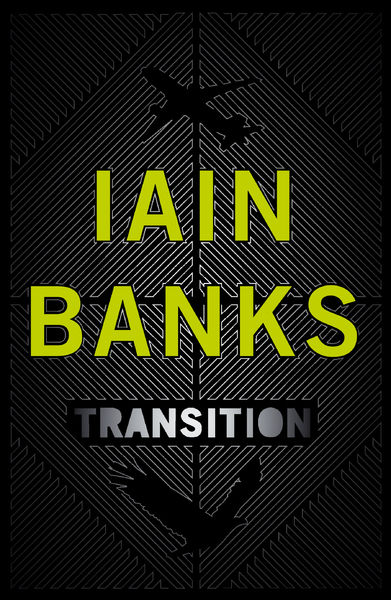
Transition is a science-fiction book by Iain Banks, and as such has been hailed as breaking down the barriers between Banks's "M" and "non-M" writing personas. This is a cosmetic readjustment at best. The "M." tag has attempted to label one specific, narrow portion of the spectrum through which Banks's work runs: from, on the one hand, realistic novels where multi-generational dysfunctional families interact in ways which illuminate broader global issues, to, on the other, sci-fi stories about robots and aliens and spaceships crashing and SHIT BLOWING UP. The former type could be written by a slightly geekier Ian McEwan, the latter by a literate E.E. 'Doc' Smith.

The books tagged with an "M." tend to be the most unambiguously space-operatic, with the occasional oddity such as the post-cyberpunk jargonplay of Feersum Endjinn or the allusive pseudo-Mediaevalism of Inversions. The "M.-less" books, on the other hand, are a ragbag of realism (Espedair Street, Whit, Dead Air, The Steep Approach to Garbadale), detective novel (The Crow Road, Complicity) and gothic conspiracy theory (The Wasp Factory, The Business), including a couple of post-apocalyptic futures (the frankly tedious Canal Dreams and A Song of Stone) and reality-warping fantasies (Walking on Glass, The Bridge) which would have looked quite at home with an "M." on them.

So it is with Transition. The premise may be that a shadowy conspiracy known as "the Concern" has been manipulating the diverse histories of many worlds across the multiverse to unknown, but presumed benevolent, ends... but underneath it all the story's about capitalism, religious fanaticism and cultural imperialism: in short, The Way We Live Now. SF at its best does illuminate the real world, of course, and much the same agenda is at work in Banks's Culture novels. As I say, this is a spectrum of shades, not an author turning his literary credentials (or indeed his imaginative faculties) on and off with a keystroke.

The book itself is awkwardly-shaped, its actual story amounting to little more than one extended capture-escape-capture-escape cycle, with most of the interesting material told in flashback. Unfortunately, two strands of this -- illustrating respectively capitalism and fanaticism -- are imperfectly integrated with the rest of the novel, being the first-person backstories of minor characters whose contributions to the plot are tangential at most. The sheer bulk of this material means that the central storyline relating to the Concern proper, the rebellion against it and the speculation as to its true agenda, feels perfunctory. There are some authentically Banksian edifices here (literally so sometimes, as with the palace hollowed out of one universe's Mount Everest by a long-dead Emperor of the World), but they don't appear to have been subjected to much city planning. If I were feeling uncharitable I'd say Transitions was a much shorter novel and two fundamentally plotless novellas, in search of a competent editor.

This is a shame, because the story of the Concern is a fascinating one, which could have been developed at far greater length and over a wider range of excitingly architected worlds. It even feels as if the author's keeping secrets from us. Why, for instance, is the chief rebel against the Concern occasionally referred to as "the younger Mrs Mulverhill" when an older woman of that name is never mentioned? Is there an unspoken connection between Mulverhill and Madame D'Ortolan, the Wicked Queen running the Concern? Why do their surnames suggest "mother" and "daughter", and if the reason is the obvious one why are their ages the wrong way round? It feels as if Banks knows the answers to these questions, and is teasing us -- perhaps with a sequel in mind, although he's not been one for the direct follow-up in the past. Unfortunately there's not enough of substance in the book to justify it spilling over in this way.

Transition is fun, nonetheless, and works on the basic level of a fix for the many of us long since addicted to Banks's work. But it continues a recent trend towards less coherent recycling of past themes and ideas, and the cosmetic novelty of its presentation fails in the end to disguise that.

The Panda Book of Horror ed Stuart Douglas and Paul Magrs is Obverse Books's follow-up to Iris Wildthyme and the Celestial Omnibus. There's no doubt that Obverse hit the ground running with The Celestial Omnibus, which although it sold modestly was near-universally acclaimed by those who read it (and coincidentally also contains my latest published fiction to date). The Panda Book of Horror, a sly parody of the old Pan Books of Horror Stories of the '70s, consolidates and improves on that success. Having a unifying theme tightens the volume up no end, and although I've never been a big reader of the horror genre I enjoyed those stories which attempt to follow it just as much as those which parody it with a rib-nudge and a cackle.

None of the stories are less than splendid, but the opening and closing numbers are particularly good: Ian Z. Potter's "The Unholy Ghost" features clever, very funny prose and an eye-watering last-minute plot twist, while Mark Clapham's "Channel 666" turns nostalgia TV into an all-too-convincing manifestation of Hell and follows up with an equally brilliant conclusion. My favourite story, though, was Matt Kimpton's "Shadows of the Time Before", which depicts an eldritch Lovecraftian universe of creeping horror and squamous decay, whose rugose inhabitants are appalled at the cheerful irruption of a boozy, shabby party-vixen like Iris Wildthyme into their lives.

That same Mark Clapham edited Secret Histories, the other book of short stories I've read this year. The unifying conceit of this one is that all the stories are told by the heroine -- Bernice Summerfield, of whom you'll certainly have heard me speak (and very likely seen me write). This collection's more of a piecemeal affair, although there's a rather notional through-plot and a few of the stories have closer links. Nonetheless, there's some fine writing here from Lance Parkin, Jim Smith (a sterling story featuring Bernice's old friend Mycroft Holmes), Jon Dennis and the increasingly inimitable Cody Schell. I think my favourite here was Mark Michalowski's elegantly evocative "The Illuminated Man", an everyday story of Edwardian circus folk.

(And yes... for the sake of full disclosure all the authors and editors I've mentioned with respect to these anthologies are friends of mine. Except Matt Kimpton, who I don't believe I know from Y-chromosomal Adam.)

Most recently, I've reread Mythago Wood by Robert Holdstock, who reminded me of its existence by dying last November. I remember reading it as a teenager and being wholly enthralled by the central conceit -- a stand of ancient woodland whose near-impenetrable interior opens tardistically into the vast forested landscape of the human collective unconscious, replete with unreconstructed archetypes. The central story is itself deliberately mythic, with two brothers in the 1940s falling out over a woman (albeit the archetypal form of a Brythonic folk-heroine) after the death of their father (who lives on in Freudian form in the forest as an ancient, murderous beast-god). I enjoyed revisiting it, and was reminded of one possible source of my fascination with stories where different periods of history and prehistory rub shoulders. The "mythago" characters we meet in this book range from World War I back to the last Ice Age.

I seem to remember I tried the sequel, Lavondyss, and didn't get on with it. Well, I'd only have been 16 or so. I might well try it again, although I'm slightly daunted by the fact that Holdstock seems to have squeezed out five more books in the series, the most recent being published last July. Still, in the "interminable series by authors I actually quite like" stakes, it can't possibly rival the Mars trilogy.

Collapsed Columns

I miss writing my columns on science fiction and faith for Surefish. They were a useful writing discipline and they allowed me to stretch my brain in a way I'm not doing so much these days. Plus they were a reliable source of monthly cash, which isn't trivial.

Partly because of this, and partly to help pay for the B&B accommodation we're inevitably going to need this year with a just-over-a-year-old-baby, I've put in a proposal to deliver two talks on SF-ish topics at Greenbelt this August. The 2010 Festival's theme is "The Art of Looking Sideways", which is as good a definition of speculative fiction as I've heard yet.

Both putative talks are the same kinds of thing I used to cover for Surefish (in fact I think I skimmed over both topics briefly in the course of the 25 columns), only obviously at rather greater length. (For a clue as to the subject-matter of one of them, read this post following last year's festival. You can even hear my spur-of-the-moment preparatory thinking during the questions at Kester Brewin's talk, if you pay to download it here. It's at exactly 50 minutes in, if you're bonkers enough.)

Assuming the organisers are interested in what I have to say -- and that they don't insist on exclusive rights to the material or anything -- I should be able to put up a transcript of both talks at some point, as I did with my earlier ones.

In the interest of appearing something vaguely resembling a competent professional when Greenbelt look into my credentials, I've updated my website so that the links to those columns actually work properly. Surefish changed all the indexing a while ago, and half the links fell off the map. (There's one I still can't find -- I think it may have been deleted, presumably by accident. I've put it up at the site instead, just to preserve it for that ever-hungry posterity who hound my every keystroke. In the long run I may do that with all of them -- I don't think Surefish are getting very much web-traffic that way any more.)