(What follows is a little bit of a rant, and a little bit of a sermon, and a quite a lot of a party political broadcast for the For Christ's Sake Get Some Perspective party. It starts off fulminating topically about events of the first few centuries A.D., but does become rather more relevant thereafter.
I'm sorry about that. A lot of this has been fermenting in my brain for quite some time now.)
Over the last few Wednesdays, B. and I have been attending our vicar and another vicar's course entitled A Bluffer's Guide to Heresy. So far we've covered Gnosticism, Marcionism and Pelagianism, and are due to be finishing off next week with the Donatists.
It's all good fun -- pop-theology done in an engaging, entertaining way without being in any sense dumbed down. Gnosticism is a subject I know something about, having written in my thesis about science fiction as a modern expression of Gnostic thought, and I enjoyed Simon and Paul's presentation on the subject.
I have some sympathy, to varying degrees, with all of these "heretical" positions. I suspect that Pelagius, in particular, is only considered a heretic because his opponent, Augustine, managed to convince the church he wasn't one. Of their two positions, Pelagius' idea that human beings are created capable of moral perfection seems merely over-optimistic, while Augustine's Manichean-influenced ideas of a fallen world and original sin -- and in particular his negativity towards sex and women -- have caused great harm to the later development of the church. It seems to me that the only reason Pelagius was a heretic and Augustine a saint is the familiar one of history being written by the victors.
Gnosticism I can see good arguments for in that the material world is clearly very imperfect, but have to reject insofar as my own religious experiences have been necessarily mediated through that same created world. Marcionism has a point in that some aspects of the Old Testament are, to say the least, questionable, but makes the mistake (an all too familiar one in a modern context, but rare at the time) of assuming that such scriptures are to be read as historical fact rather than as pointers towards spiritual truth.
Even as pointers towards spiritual truth, some aspects of the Old Testament are, in fact, questionable, which is why I believe that the Bible consists of a progressive series of variously imperfect revelations of God, rather than anything you could sensibly call "fact".
And yet...
Today I read this piece by Stephen Unwin in The Guardian. I haven't read Unwin's book, and I haven't read Richard Dawkins' book to which he's responding (although given that this seems to be the one where the good Professor finally comes out and says that I and all people of faith are delusional and dangerous, I should probably get round to it sooner or later).
This whole area is -- thanks to the indefatigable efforts of fundamentalists of all stripes in the politics of the the U.S., the Middle East, and increasingly here in the U.K. -- a blood-soaked, bomb-strewn minefield.
For the record, I see any kind of theocratic government by scriptural fiat as dangerous, deeply immoral and -- I'm a liberal christian, so I get to swear -- quite astoundingly fuckwitted.
What's more I fully agree with Dawkins, as quoted by Joan Bakewell, that the Bible is "a chaotically cobbled together anthology of disjointed documents", that "sucking up to God" is a poor rationale for moral behaviour and that Unwin's supposed proof of God's probable existence is "quite agreeably funny".
What dismays me is the polarisation expressed in the debate, visible not only in Dawkins' frequent fulminations but in the comments appended to that piece of Unwin's. Despite the visible and vocal presence -- in the U.K., the U.S. and indeed the Middle East -- of christians, jews, muslims and other people of faith who do not reject the truths of science, do not wish to see their particular interpretation of divine ethics enshrined in law, and in particular do not believe that the killing of innocents is an act which any sane form of faith can justify... despite the continual protests of these people against the sickening excesses of their co-religionists, Dawkins and his sympathisers persist in speaking and acting as if all religion, all faith is the enemy of humanity, rather than merely the religion and faith of unbearable mindless fuckwits.
I find this, to be frank, incredibly painful.
I also, needless to say, find painful the fact that apparently American christian fundamentalists are now training their children to believe themselves participants in a global religious war in which they may be called upon to give their lives for Jesus.
Great move, guys. Because what the world really needs just at this precise moment are more fanatical religious zealots prepared to die for their beliefs.
The problem -- or at least, a large part of that aspect of "the problem" which gives rise to this zero-tolerance attitude on all sides -- is precisely the inability to separate the realms of spiritual and factual truth which so beset poor Marcion (and to some extent Augustine, although I think his overly literal reading of Genesis arose more from his psychological hangups than vice versa).
Truths about "God" (and even the word is problematic) are allusive, symbolic and obscure, not because God is vague or shifting but because our only tools for discussing or conceptualising the divine have been evolved for talking and thinking about the experiential world which God exists beyond and outside. (Also "throughout", of course, but not in any way which can be physically quantified or even detected.)
All statements made about God, whether by believers or unbelievers, are therefore suspect. "There is no God but God" and "There is no God" both tell us important and valid things about the divine -- but to take either of them as fact is a grievous category error.
The ways in which this expresses itself in the politics of the U.S., Israel and Islamdom are perfectly clear, and reliably appalling. Unfortunately, Dawkins and his supporters, while not yet at the stage of blowing people up who disagree with them, are equally misled.
Dawkins can protest all he likes that (in Bakewell's words) "given proof he was wrong he would at once change his opinions". His difficulty with faith arises precisely from the fact that God does not exist as part of that realm about which science is better qualified than any to speak. As Dawkins' book presumably attempts to demonstrate, no proof of God's existence (or indeed probability) has yet been produced which was not intellectually flawed, nor can there ever be such a proof. "Proof", as Dawkins and indeed Anselm understand it, is simply not a concept which can apply.
When the divine demonstrates its own existence (which, as I've indicated, I faithfully believe it does), it isn't in a way which can be duplicated or falsified through scientific experiment. If Dawkins underwent a genuine spiritual experience of the kind which has been sufficient to commit so many believers in the history of the world to such diverse faiths, his worldview would force him to dismiss it as a random aberration of his brain chemistry -- ignoring that very qualitative, unquantifiable gap in the rational through which God manifests God's self.
(I sometimes suspect that Dawkins is a very spiritual man. I sometimes think that he longs desperately for God to intervene with a material proof of babelfishesque undeniability, to demonstrate beyond all possible doubt on Richard Dawkins' part that God is real. His berating of God, I sometimes feel, is the lament of a spiritual yearning which can never be satisfied within the material cage which his mind has constructed for itself.
I can't prove this either, of course.)
You may feel that, in arguing against the one group of zealots who aren't currently in control of vast arsenals of tanks, bombs and helicopters, or at least of specially-tailored clothing containing shrapnel and moderate quantities of triacetone triperoxide, I'm going -- like so many of the zealots who are in control of these things -- for the soft target. You would, of course, be quite correct.
Dawkins' confusion is forgivable in a world where the aforementioned unbearable mindless fuckwits persistently declare that God's existence can be proved with science and logic, that Genesis has anything whatsoever to tell us about the biological origin of species, that God regularly intervenes in history, politics and economics to ensure that good people prosper and wicked people founder -- that, not to put too fine a point on it, propositions which are quite evidently false in the real world are or should be part of the belief-systems of those who accept God.
Making God's existence incompatible with the world as our reason and our perception understand it: that, ladies and gentlemen, is one type of doctrine which I'd be very willing to dismiss as heresy.
29 September 2006

20 September 2006
Art Works
Speaking of Collected Works, as I just was, the cover has now been released, and can be viewed either here or at the Big Finish site.
(In the absence of Adrian Salmon, Big Finish's regular cover artist for the Bernice Summerfield books, it's been painted by Doctor Who comics artist Lee Sullivan. In general I rather prefer Salmon's heavily stylised artwork, as seen on A Life Worth Living amongst others, but Sullivan's seems better suited to the books' new all-white look. Hmm.)
There's still been no announcement of the story titles and full list of authors (the nine of us who've been listed so far are only half of the names you'll see on the contents page), which means I still can't put up my lovingly-prepared teaser text for my stories. When I can make that public, though, I'll point to it from here.
(In the absence of Adrian Salmon, Big Finish's regular cover artist for the Bernice Summerfield books, it's been painted by Doctor Who comics artist Lee Sullivan. In general I rather prefer Salmon's heavily stylised artwork, as seen on A Life Worth Living amongst others, but Sullivan's seems better suited to the books' new all-white look. Hmm.)
There's still been no announcement of the story titles and full list of authors (the nine of us who've been listed so far are only half of the names you'll see on the contents page), which means I still can't put up my lovingly-prepared teaser text for my stories. When I can make that public, though, I'll point to it from here.
Putting the Cartography Before the Horse
I've spent most of this past week worldbuilding -- creating a setting for a potential novel (not one I've actually got anyone interested in yet, I hasten to add), in painstaking geographical, historical, political and social detail.
I'm told this is one of my big strengths as a writer... and I'm inclined to agree that Of the City of the Saved... would be a considerably lesser work without the 20,000-odd words of notes I'd made on the City before I started writing it. I've tried to do similar work (to a lesser degree, obviously) for my various short stories, "Minions of the Moon" particularly, and I think it's paid off. It certainly led to my being asked by Nick Wallace, the editor of Collected Works, to design some background for that book.
I don't want to go into detail about this new setting, because it's a neat idea and I don't want people being "inspired" by it. But for most of the past week I've been painstakingly constructing (in Microsoft Paint, perversely enough) a map of Britain in the 22nd century, after some serious changes to the political landscape. It's not an approach I've used before, but I've found that as I've filled in the changed place-names and coloured in the various political entities, I've found a whole history unfolding in my head.
Of course, I don't actually have a story, plot or characters yet. But I've got a very exciting world to put them into when I manage to come up with some.
And -- if it should happen to become a bestselling sequence of novels and spawn a series of blockbusting films -- I'll have the licensed tie-in Risk board all worked out ready.
I'm told this is one of my big strengths as a writer... and I'm inclined to agree that Of the City of the Saved... would be a considerably lesser work without the 20,000-odd words of notes I'd made on the City before I started writing it. I've tried to do similar work (to a lesser degree, obviously) for my various short stories, "Minions of the Moon" particularly, and I think it's paid off. It certainly led to my being asked by Nick Wallace, the editor of Collected Works, to design some background for that book.
I don't want to go into detail about this new setting, because it's a neat idea and I don't want people being "inspired" by it. But for most of the past week I've been painstakingly constructing (in Microsoft Paint, perversely enough) a map of Britain in the 22nd century, after some serious changes to the political landscape. It's not an approach I've used before, but I've found that as I've filled in the changed place-names and coloured in the various political entities, I've found a whole history unfolding in my head.
Of course, I don't actually have a story, plot or characters yet. But I've got a very exciting world to put them into when I manage to come up with some.
And -- if it should happen to become a bestselling sequence of novels and spawn a series of blockbusting films -- I'll have the licensed tie-in Risk board all worked out ready.
My Top 5 DVDs of All Time
I wrote the following as a sample for a job I didn't get. It's the sort of thing many people seem to post on their blogs, so I thought I might as well offer it up for your edification.
It is, admittedly, somewhat constrained by the limited number of DVDs I've actually watched, and in particular bothered with the extras for.
My Top 5 DVDs of All Time
(in 50 words each)
Firefly: The Complete Series (4-disc boxed set)
Tragically cancelled before its time, Joss ‘Buffy’ Whedon’s space-opera Western was the cleverest, funniest, most stylish TV sci-fi in years. Experience all 14 episodes along with featurettes, deleted scenes, an outtakes reel that’s actually funny, and commentaries from actors and crew so witty, warm and articulate you’ll hate them. Glorious.
I Claudius (5-disc boxed set)
Roll over Rome – Derek Jacobi stars as the Emperor Claudius in ten hours of the greatest BBC drama ever made. Where else would you see Blackadder’s Nursie as a poisoner, or Christopher Biggins playing Nero? Features include documentaries, actors’ favourite scenes and an interactive genealogy of that nice Caesar family.
Jam (2-disc set)
Christopher Morris’ unnerving sketch comedy of dead babies and psychotic doctors comes complete with its fuzzier late-night remix, Jaaaaam. Each episode plays in yet another alternative format, such as a ‘ffwd version’ or ‘quadrilateral lava lamp version’. If you missed the day Kilroy lost his mind, then welcome… in Jam.
Minority Report (2-disc set)
Tom Cruise stars as a ‘pre-crime’ cop on the run, after being fingered as a future murderer. The extras disc goes overboard with design sketches, storyboards, biographies and no fewer than 17 featurettes, with menus in the film’s own hands-on interactive graphics style. The movie’s not at all bad, either.
Doctor Who: The Beginning (3-disc boxed set)
Sinister, giggling William Hartnell abducts two of his granddaughter’s teachers in his time-machine, in Doctor Who the way it was meant to be. These first three stories bring us cavemen, insanity and eerie machine-people called ‘Daleks’. The best of many bonuses brings long-deleted historical story Marco Polo to partial life.
It is, admittedly, somewhat constrained by the limited number of DVDs I've actually watched, and in particular bothered with the extras for.
My Top 5 DVDs of All Time
(in 50 words each)
Firefly: The Complete Series (4-disc boxed set)
Tragically cancelled before its time, Joss ‘Buffy’ Whedon’s space-opera Western was the cleverest, funniest, most stylish TV sci-fi in years. Experience all 14 episodes along with featurettes, deleted scenes, an outtakes reel that’s actually funny, and commentaries from actors and crew so witty, warm and articulate you’ll hate them. Glorious.
I Claudius (5-disc boxed set)
Roll over Rome – Derek Jacobi stars as the Emperor Claudius in ten hours of the greatest BBC drama ever made. Where else would you see Blackadder’s Nursie as a poisoner, or Christopher Biggins playing Nero? Features include documentaries, actors’ favourite scenes and an interactive genealogy of that nice Caesar family.
Jam (2-disc set)
Christopher Morris’ unnerving sketch comedy of dead babies and psychotic doctors comes complete with its fuzzier late-night remix, Jaaaaam. Each episode plays in yet another alternative format, such as a ‘ffwd version’ or ‘quadrilateral lava lamp version’. If you missed the day Kilroy lost his mind, then welcome… in Jam.
Minority Report (2-disc set)
Tom Cruise stars as a ‘pre-crime’ cop on the run, after being fingered as a future murderer. The extras disc goes overboard with design sketches, storyboards, biographies and no fewer than 17 featurettes, with menus in the film’s own hands-on interactive graphics style. The movie’s not at all bad, either.
Doctor Who: The Beginning (3-disc boxed set)
Sinister, giggling William Hartnell abducts two of his granddaughter’s teachers in his time-machine, in Doctor Who the way it was meant to be. These first three stories bring us cavemen, insanity and eerie machine-people called ‘Daleks’. The best of many bonuses brings long-deleted historical story Marco Polo to partial life.
14 September 2006
A Replicant or a Lesbian
I don't usually do news-story posts, but two items today have been so splendid I couldn't resist.
Firstly, the robotic head of Philip K. Dick has gone missing. The story's an absolute gift for a reporter who knows their stuff, as the Guardian journalist, who draws some lovely parallels with Dick's fiction, clearly does.
And the celestial body formerly known as Xena has been officially named Eris, after the Greek goddess of discord. The satellite previously called Gabrielle has been named after Eris' daughter, Dysnomia. "Δυσνομια" in Greek means, loosely, "lawlessness".
(Less obviously amusing is the news that Neanderthals seem to have died out a lot more recently than previously thought. I don't expect you to find that interesting particularly, but I do.)
Firstly, the robotic head of Philip K. Dick has gone missing. The story's an absolute gift for a reporter who knows their stuff, as the Guardian journalist, who draws some lovely parallels with Dick's fiction, clearly does.
And the celestial body formerly known as Xena has been officially named Eris, after the Greek goddess of discord. The satellite previously called Gabrielle has been named after Eris' daughter, Dysnomia. "Δυσνομια" in Greek means, loosely, "lawlessness".
(Less obviously amusing is the news that Neanderthals seem to have died out a lot more recently than previously thought. I don't expect you to find that interesting particularly, but I do.)
12 September 2006
Words and Pictures
Quick roundup of books and other media I've been experiencing in the last couple of weeks...
Books
I've now finished Pete Rollins' book How (Not) to Speak of God, which I'd recommend highly to anyone with a sincere interest in christian mysticism and how it relates to a contemporary urban context. I wouldn't go so far as to say it's changed my life, but it's furthered some of the changes which were taking place there anyway.
I also finished James Chapman's Inside the Tardis: The Worlds of Doctor Who, which was more of a disappointment. Chapman's forays into television history are very interesting (he's gleaned a lot of information about Doctor Who from the BBC archives, as well as biographical and other material relating to the main players in its development), but his criticism is rather pedestrian. It's not tainted by fan politics in the way I felt Kim Newman's was, but the comments on the individual stories rarely rise above the level of received opinion. I'd have preferred to read a full-length history of the TV programme, without the kind of commentary I can read by the bucketload on the web.
I'm still working my way through Something More and Ada or Ardor. Good though they both are (particular in the case of the Nabokov), I am rather hoping that I finish one of them soon, so I can move onto something a bit more lively.
TV
B. and I have been watching the first season of Frasier, after she found the videos going cheap on eBay. Despite the distracting laughter track (not present on the British broadcast unless I'm very much mistaken) I've been enjoying it a lot. There are occasional juddery episodes this season as the scriptwriters commit the Friends error of thinking that we care about the characters when they're not making jokes, but it remains by far the best U.S. sitcom I've ever seen.
The remarkable thing is how appalling the whole concept sounds on paper. It's a spinoff from Cheers, you see, with this neurotic psychiatrist -- and his brother, who's also a psychiatrist, and even more neurotic than he is! And their father's crusty and cantankerous, but keeps the family together with his homespun blue-collar wisdom. Plus there's a comedy English nurse! And a funny dog!
It ought to be absolutely dismal. Somehow, though, it ended up with scalpel-sharp, witty, character-driven scripts and some brilliant comedy performances.
Kelsey Grammar is uneven as Frasier himself -- good when the material's subtle, but pretty terrible when it requires him to ham it up. But Jane Leeves completely salvages Daphne by playing her entirely straight, as a working-class Mancunian whose naturalism anchors even the weirdest things the character's required to say and do. And David Hyde Pearce is incapable of opening his mouth as Niles -- in fact, it's rare to see him twitch a muscle -- without being chest-hurtingly hilarious. Even Moose the dog as Eddie the dog is impressively well-trained.
Film
The less said about M Night Shyamalan's The Lady in the Water the better, really. I actually rather enjoyed The Village and (until the last ten minutes) Signs, despite their being clearly not in the same class as The Sixth Sense and Unbreakable... but dear, oh dear.
The plot's arbitrary and free-associating (Shyamalan seriously seems to think that, because it's fantasy, he can make it up as he goes along, rather than having to state his ground-rules early on and stick to them), the characters are cardboard cutouts (and as for casting himself as the tortured, neglected genius whose writing will one day usher in a new era of peace and enlightenment...) and the ending abandons Shyamalan's trademark "Ooh, that's clever" (or, in the case of Signs, "Good grief, does he really think that's clever?") in favour of a resounding "Er... so is that it?".
There are two good ideas in the film: the monster that can lie completely flat and has grass growing from its back, and the bodybuilder (played by a thoroughly wasted Rico from Six Feet Under) who's developing only one side of his body. The former is swiftly abandoned in favour of generic evil-dog action, the latter is a throwaway with no relevance to the plot or anything else.
Very much not recommended.
What else? ...Oh yes, I watched Pitch Black for the first time the other day, and was favourably impressed.
It has a reputation as a rather dire no-brain action flick, which I don't think is warranted at all. Vin Diesel is intrinsically ridiculous, it's true, but his character has more than the standard one dimension, and some of the others even aspire to three. The cinematography's clever and textured, and the setting appears to have been worked out by someone with both a modicum of intelligence and an interest in serious S.F. (This may be explained, if Wikipedia's any guide, by the story being loosely based on Asimov's short story "Nightfall".)
There's even a positive Islamic character, whose journey of faith we're meant to sympathise with. It's difficult to imagine that happening in a big-budget action film these days.
So... surprisingly better than I expected. Although not good enough to give me any inclination towards watching the sequel.
Books
I've now finished Pete Rollins' book How (Not) to Speak of God, which I'd recommend highly to anyone with a sincere interest in christian mysticism and how it relates to a contemporary urban context. I wouldn't go so far as to say it's changed my life, but it's furthered some of the changes which were taking place there anyway.
I also finished James Chapman's Inside the Tardis: The Worlds of Doctor Who, which was more of a disappointment. Chapman's forays into television history are very interesting (he's gleaned a lot of information about Doctor Who from the BBC archives, as well as biographical and other material relating to the main players in its development), but his criticism is rather pedestrian. It's not tainted by fan politics in the way I felt Kim Newman's was, but the comments on the individual stories rarely rise above the level of received opinion. I'd have preferred to read a full-length history of the TV programme, without the kind of commentary I can read by the bucketload on the web.
I'm still working my way through Something More and Ada or Ardor. Good though they both are (particular in the case of the Nabokov), I am rather hoping that I finish one of them soon, so I can move onto something a bit more lively.
TV
B. and I have been watching the first season of Frasier, after she found the videos going cheap on eBay. Despite the distracting laughter track (not present on the British broadcast unless I'm very much mistaken) I've been enjoying it a lot. There are occasional juddery episodes this season as the scriptwriters commit the Friends error of thinking that we care about the characters when they're not making jokes, but it remains by far the best U.S. sitcom I've ever seen.
The remarkable thing is how appalling the whole concept sounds on paper. It's a spinoff from Cheers, you see, with this neurotic psychiatrist -- and his brother, who's also a psychiatrist, and even more neurotic than he is! And their father's crusty and cantankerous, but keeps the family together with his homespun blue-collar wisdom. Plus there's a comedy English nurse! And a funny dog!
It ought to be absolutely dismal. Somehow, though, it ended up with scalpel-sharp, witty, character-driven scripts and some brilliant comedy performances.
Kelsey Grammar is uneven as Frasier himself -- good when the material's subtle, but pretty terrible when it requires him to ham it up. But Jane Leeves completely salvages Daphne by playing her entirely straight, as a working-class Mancunian whose naturalism anchors even the weirdest things the character's required to say and do. And David Hyde Pearce is incapable of opening his mouth as Niles -- in fact, it's rare to see him twitch a muscle -- without being chest-hurtingly hilarious. Even Moose the dog as Eddie the dog is impressively well-trained.
Film
The less said about M Night Shyamalan's The Lady in the Water the better, really. I actually rather enjoyed The Village and (until the last ten minutes) Signs, despite their being clearly not in the same class as The Sixth Sense and Unbreakable... but dear, oh dear.
The plot's arbitrary and free-associating (Shyamalan seriously seems to think that, because it's fantasy, he can make it up as he goes along, rather than having to state his ground-rules early on and stick to them), the characters are cardboard cutouts (and as for casting himself as the tortured, neglected genius whose writing will one day usher in a new era of peace and enlightenment...) and the ending abandons Shyamalan's trademark "Ooh, that's clever" (or, in the case of Signs, "Good grief, does he really think that's clever?") in favour of a resounding "Er... so is that it?".
There are two good ideas in the film: the monster that can lie completely flat and has grass growing from its back, and the bodybuilder (played by a thoroughly wasted Rico from Six Feet Under) who's developing only one side of his body. The former is swiftly abandoned in favour of generic evil-dog action, the latter is a throwaway with no relevance to the plot or anything else.
Very much not recommended.
What else? ...Oh yes, I watched Pitch Black for the first time the other day, and was favourably impressed.
It has a reputation as a rather dire no-brain action flick, which I don't think is warranted at all. Vin Diesel is intrinsically ridiculous, it's true, but his character has more than the standard one dimension, and some of the others even aspire to three. The cinematography's clever and textured, and the setting appears to have been worked out by someone with both a modicum of intelligence and an interest in serious S.F. (This may be explained, if Wikipedia's any guide, by the story being loosely based on Asimov's short story "Nightfall".)
There's even a positive Islamic character, whose journey of faith we're meant to sympathise with. It's difficult to imagine that happening in a big-budget action film these days.
So... surprisingly better than I expected. Although not good enough to give me any inclination towards watching the sequel.
11 September 2006
Beer and Cards
I seem to end up saying this a lot, but I've been busy recently, despite having very little to show for it.
I've not achieved a great deal on the writing front -- I was rather pleased with the sentence "I am now more fully versed apropos oulipian increases", but that was in an email to a friend, so doesn't actually count. Certainly nobody's about to pay me for it.
The only thing I have been doing is going through the proofs of the rather splendid Collected Works -- more details of which should be appearing (both here and on my website) once Big Finish have announced the stories and the author lineup. It reads very nicely, though.
Otherwise, well...
The Organic Food Festival the Saturday before last was just as yummy as last year's, with the Harbourside entirely taken over by stallholders pressing their free samples of cheese, chocolate, wine, beer, bread, cake &cetera upon us in the hopes that we'd buy some of them. Which, in many cases, we did.
Last year I linked to all the products we'd bought. This year I've already forgotten some of the manufacturers, and for some reason the Soil Association aren't displaying their list of exhibitors as they did last year. But the deliciously creamy Daisy cheeses still succeeded in tempting us, along with cheeses from these and these lovely people. We also stocked up on chocolate and beer. (The Atlantic beers are nicer the darker they get -- the Blue is very tasty, but I wouldn't recommend the Gold unless you're a big fan of root ginger.)
One stallholder was selling zaatar, which we'd only seen / tasted previously on pizzas, at the splendid organic vegetarian pizza tent at Greenbelt. We bought some in order to conduct our own seasoning experiments: on the showing so far, you need to be surprisingly generous with the stuff to achieve the desired effect, but it's worth it. Mm.
We spent a very pleasant day at the festival, anyway, wandering around with our goddaughter E., her parents R. and M. and brother L., sampling food and watching a surreal bungee-dance performed by women in chicken costumes hiding in eggs suspended from a crane. (I think they were advertising eggs -- it wasn't particularly clear.) We headed back to their place (R. and M.'s, I mean, not the bungee chicken-women's) in the evening, for experimental pizza and good beer.
On Sunday B. and I experimented with the Settlers of Catan card game in an attempt to devise a way of simulating the Tournament game (which involves two players constructing their own decks out of the standard pack of cards and the five extension packs) without buying a full set of duplicates.
Obviously this involves randomising to some extent who has access to which cards, and a number of features (such as cards which can only be played by one of the two players) just don't crop up. Still, we managed a fairly satisfying game on that basis (B. won, as it happens, but we weren't playing "properly", so it doesn't count).
The technique needs fine-tuning, but it seems a reasonable substitute until such time as we feel it's worth buying a complete second set. Certainly, on the basis of what we were able to do on Sunday, the Tournament game has astonishingly wide-ranging and complex possibilities.
Other than that... it's mostly been annoying admin-type work, occasional free time to watch stuff on TV and read (see separate media update) and organising my birthday party for November. All frustratingly unproductive, although the party will be fun.
I've not achieved a great deal on the writing front -- I was rather pleased with the sentence "I am now more fully versed apropos oulipian increases", but that was in an email to a friend, so doesn't actually count. Certainly nobody's about to pay me for it.
The only thing I have been doing is going through the proofs of the rather splendid Collected Works -- more details of which should be appearing (both here and on my website) once Big Finish have announced the stories and the author lineup. It reads very nicely, though.
Otherwise, well...
The Organic Food Festival the Saturday before last was just as yummy as last year's, with the Harbourside entirely taken over by stallholders pressing their free samples of cheese, chocolate, wine, beer, bread, cake &cetera upon us in the hopes that we'd buy some of them. Which, in many cases, we did.
Last year I linked to all the products we'd bought. This year I've already forgotten some of the manufacturers, and for some reason the Soil Association aren't displaying their list of exhibitors as they did last year. But the deliciously creamy Daisy cheeses still succeeded in tempting us, along with cheeses from these and these lovely people. We also stocked up on chocolate and beer. (The Atlantic beers are nicer the darker they get -- the Blue is very tasty, but I wouldn't recommend the Gold unless you're a big fan of root ginger.)
One stallholder was selling zaatar, which we'd only seen / tasted previously on pizzas, at the splendid organic vegetarian pizza tent at Greenbelt. We bought some in order to conduct our own seasoning experiments: on the showing so far, you need to be surprisingly generous with the stuff to achieve the desired effect, but it's worth it. Mm.
We spent a very pleasant day at the festival, anyway, wandering around with our goddaughter E., her parents R. and M. and brother L., sampling food and watching a surreal bungee-dance performed by women in chicken costumes hiding in eggs suspended from a crane. (I think they were advertising eggs -- it wasn't particularly clear.) We headed back to their place (R. and M.'s, I mean, not the bungee chicken-women's) in the evening, for experimental pizza and good beer.
On Sunday B. and I experimented with the Settlers of Catan card game in an attempt to devise a way of simulating the Tournament game (which involves two players constructing their own decks out of the standard pack of cards and the five extension packs) without buying a full set of duplicates.
Obviously this involves randomising to some extent who has access to which cards, and a number of features (such as cards which can only be played by one of the two players) just don't crop up. Still, we managed a fairly satisfying game on that basis (B. won, as it happens, but we weren't playing "properly", so it doesn't count).
The technique needs fine-tuning, but it seems a reasonable substitute until such time as we feel it's worth buying a complete second set. Certainly, on the basis of what we were able to do on Sunday, the Tournament game has astonishingly wide-ranging and complex possibilities.
Other than that... it's mostly been annoying admin-type work, occasional free time to watch stuff on TV and read (see separate media update) and organising my birthday party for November. All frustratingly unproductive, although the party will be fun.
09 September 2006
By Grabthar's Hammer, What a Savings
Not that I'm intending to turn this blog into a running plug[*] or anything, but Amazon.co.uk inform me that "As someone who has purchased books by Simon (ed) Guerrier", I may be interested to know that Time Signature can currently be pre-ordered at a reduced price of £9.89 rather than £14.99.
Just thought I'd pass it on.
[*] "Running plug"? Hmm. Is that a mixed metaphor, or just a contradiction in terms?
Just thought I'd pass it on.
[*] "Running plug"? Hmm. Is that a mixed metaphor, or just a contradiction in terms?
04 September 2006
Phil explained abstractedly.
I've been having fun playing with Word's AutoSummarize feature. As the online help explains, this would appear to work by counting which words appear most often and then extracting in their entirety the sentences which contain the highest proportion of high-scoring words. As this response suggests, it's probably a better tool for checking a document's linguistic biases than for actually writing anything resembling an intelligible abstract.
Summarising my Guardian article in ten sentences produces the following:
The tool isn't very good at avoiding section headings (to get the above I had to cut out the title and the sidebar), and it seems to have a strong bias towards short sentences. Trimming "Sex Secrets of the Robot Replicants" to 20 sentences comes up with:
Annoyingly, the feature seems happy to repeat entire sentences. An attempt to put Of the City of the Saved... through it mostly produced a string of chapter headings reading "The City".
Summarising "The Long Midwinter" in 20 sentences gives us the hauntingly Beckettian:
My favourite, though, is "The Ruins of Time" in 20 sentences:
To read the rest of it, you'll have to wait until the book's released. Suffice it to say there's rather more to it than that.
Summarising my Guardian article in ten sentences produces the following:
On first reading a Philip K Dick novel, many people wonder what kind of twisted mind could come up with such ideas. The answer is a very twisted mind indeed - even when writing science fiction, Dick wrote from experience. Dick's insights into the true nature of reality were spectacular and varied. A break-in at Dick's house in 1971 – not altogether surprising given the proclivities of his recent house-guests – took on great personal significance. Now, for all we know, Dick might have been predisposed to such delusions whatever his lifestyle, but the drugs can't have helped – and Dick realised this. That March had been an eventful month for Dick. For the rest of his life, Dick was obsessed with explaining these events. Dick based his final novel, The Transmigration Of Timothy Archer, around his extraordinary life.The trouble with this is that it's deceptively coherent: it appears to be telling a connected story, but misleads in at least two important respects (The break-in didn't happen in March, and Transmigration is based around Bishop James Pike's life, not Dick's).
Dick's interpretation of his visions changed on an almost daily basis. It's not a theology that more conventional Christians would recognise, but Dick worked it through in detail.
The tool isn't very good at avoiding section headings (to get the above I had to cut out the title and the sidebar), and it seems to have a strong bias towards short sentences. Trimming "Sex Secrets of the Robot Replicants" to 20 sentences comes up with:
Jason frowned. ‘Jason has library books?’ Bernice asked, puzzled. Bernice frowned. This copy must be Jason’s own, she guessed. Benny closed the book and sat down gingerly on Jason’s rumpled, sweaty duvet....which is actually surprisingly fair, although I'm not sure how some of those sentences scored as highly as they did.
‘I’ll tell you why I ask,’ Benny told Jason later. ‘Benny, I can explain,’ Jason protested weakly. ‘Of course you can explain, Jason,’ she retorted. ‘You faked your academic credentials once,’ said Jason sulkily.
Bernice subsided, fuming.
‘Snotty-nosed cow,’ Jason said now. Benny rolled her eyes. Benny asked him. Jason appeared hurt. Jason told her.
Jason Kane
Jason was standing up. ‘To full Jason Kane standard, natch.’
‘Yeah, well,’ the nearest Jason concluded miserably.
Annoyingly, the feature seems happy to repeat entire sentences. An attempt to put Of the City of the Saved... through it mostly produced a string of chapter headings reading "The City".
Summarising "The Long Midwinter" in 20 sentences gives us the hauntingly Beckettian:
II. SamsonAgain, I'm not sure why "nimbus", "manyfold" and "Yesod" aren't in there, although at least it's correctly identified the main characters.
Samson Griffin’s suit itched.
‘Well then, Kebalau,’ the Doctor said. Samson’s eyes bulged. ‘Happy Midwinter Festival, Kebalau.’
The Doctor crossed his arms. It was my idea, Doctor. The Doctor frowned. Samson muttered.
Gemma frowned. V. The Doctor
The Doctor raised an eyebrow. The Doctor nodded sadly. Heskiu pulsed assent. The Doctor smiled softly. Trees of life, trees of knowledge, trees of good and evil... not to mention a midwinter festival. The Doctor struggled to understand. Heskiu began.
‘Nonsense,’ the Doctor said. Time passes.
My favourite, though, is "The Ruins of Time" in 20 sentences:
Ian considered. ‘Ian!’Or even better, in ten:
Barbara smiled. ‘Barbara!’
Susan asked. Barbara asked.
Ian protested. Ian sighed. Susan?’ said Vedirioi. Susan pouted. Susan looked back. Vedirioi spat. Susan shuddered. Ian groaned. Vedirioi paused. Susan was shocked. Horrified, Susan stood.
Ian demanded. Susan gasped. Ian muttered.
Ian considered. Susan asked. Ian protested. Ian sighed. Susan pouted. Susan shuddered. Ian groaned. Ian demanded. Susan gasped. Ian muttered.
To read the rest of it, you'll have to wait until the book's released. Suffice it to say there's rather more to it than that.
31 August 2006
Festival Blog: Day 3A
Still recovering from Greenbelt -- immense fun though it is, the persistent lack of sleep and constant need to wander aimlessly around the festival site destruct-testing your socks can have deleterious effects.
My reports from Greenbelt for Surefish are missing the actual, rather than speculative, events of my final day-and-a-bit of festival. So, after filing my copy for "Day 2" and (the entirely hypothetical) "Day 3", this is what I actually did:
1. Went back to the petting zoo, where B. and I cuddled a duckling and a guinea-pig, stroked a donkey and some goats and admired two pigs.
2. Spent a while listening to Reem Kalani at the main stage. Despite her astonishingly powerful voice, her wailing violin-accompanied singing was unexpectly soothing. Or maybe I was just very tired.
Hell
3. Attended Fundamentalism, Ikon's alternative worship (or rather "experiment in theodrama"). This was every bit as remarkable as I expected. Ikon's deliberately destabilising, questioning, deconstructionist approach to worship is oddly reassuring, in suggesting that God is present in doubt and absence as much as in faith and revelation. Some people (including, inevitably, some of its members) go so far as to describe the group's worship style as "pretentious", but its intellectual foundations are a good fit for my own current musings about God. And the group demonstrated that they're by no means humourless by picketing their own service with signs claiming that everyone involved was going to Hell.
I'm now reading Ikon founder Pete Rollins' book of theology, How (Not) to Speak of God, which I picked up at the Greenbelt bookshop. It is, again, remarkable. I may say more about it in due course.
3. Stopped briefly by a much less successful (read: "a bit bollocks, actually") experiment in "scripture meditation", then went to bed.
4. Got up early and went with B. to R. and J.'s wedding in Staffordshire. As I've said here this was generally lovely, but the high density of children in the congregation made it surprisingly difficult to hear what was going on. It was the first second wedding (as it were) of a friend that I've been to, and the minister (assuming I heard her correctly) said some very wise-seeming things about renewal, transformation and second chances.
Knob
R. and J. themselves were very happy, R. looking particularly gorgeous in a strapless silk wedding dress thing [1], and there were some people there it was lovely to see after so long. Unfortunately we had to scarper back to the festival after the Pimms and canapés, but our brief time there was very nice indeed.
5. Arrived back on site in time for the Othona Community's One World worship, which I came away having very mixed feelings about. On the one hand, I was delighted to find an even vaguely interfaith service at Greenbelt, which often seems to have a blind spot in its liberalism when it comes to learning from non-Christian faith traditions.
On the other hand, Othona's worship style seemed to revolve around improvisational chanting and interpretive body-movement, which I couldn't possibly participate in without feeling a complete knob [2]. This came as something of a disappointment, frankly.
6. FAFFED ABOUT and entirely failed to do any of the various other interesting things I could have done until about 8:30, when B. and I managed to stumble upon a very funny act by Paul Kerensa, who was on his way home from performing his comedy show Back to the Futon at the Edinburgh Festival. We particularly appreciated his account of being caught speeding at 88 mph in a DeLorean, and his use of (what he assured us was) his joint degree in Mathematics and Film Studies to prove that 99.6% of men were called Malcolm [3].
His warm-up act also had a joke which will entertain vigornian, if no-one else:
8. Slept in a tent. It's difficult to emphasise sufficiently what a huge achievement this was without sounding like a complete wimp, possibly for the obvious reason.
Suffice it to say that at Greenbelt in 1993 a combination of torrential rain, strong winds and calf-deep mud gave me such a horrendous experience of camping that I foreswore it, and Greenbelt itself, for the next ten years. Only the location of the modern festival at Cheltenham Racecourse, and the availability of bed-and-breakfast accommodation on a nearby student campus, succeeded in enticing me back.
Organic
Unfortunately, this year I'd booked my accommodation when I thought I'd have a job to get back to first thing on Tuesday morning, so when it became clear I could stay the Monday night, the only place available for actual sleepage was the tent B. was using.
The cramped space, muddy exterior and disturbing, almost organic softness of the walls caused me some minor palpitations, but I managed to sleep OK, which constitutes a personal milestone. It didn't persuade me not to B&B it next year, though.
9. Helped B. to pack up said tent, got a train home while she drove (there being no actual space for me in the car with all the camping gear), comforted two bereft cats and slept for not nearly long enough. Got up, went to bed and did the same again.
10. Typed this.
Now I'm going to eat some food, probably, watch some TV and go to bed again. With luck, I'll perhaps be not-tired-any-more in time for the Organic Food Festival on Saturday.
[1] R. was, incidentally, the bride.
[2] Ho ho, yes.
[3] Clue: His starting premises were "Malcolm X = 1992 film" and "X Men = 2000 film". You start by solving each equation for X...
My reports from Greenbelt for Surefish are missing the actual, rather than speculative, events of my final day-and-a-bit of festival. So, after filing my copy for "Day 2" and (the entirely hypothetical) "Day 3", this is what I actually did:
1. Went back to the petting zoo, where B. and I cuddled a duckling and a guinea-pig, stroked a donkey and some goats and admired two pigs.
2. Spent a while listening to Reem Kalani at the main stage. Despite her astonishingly powerful voice, her wailing violin-accompanied singing was unexpectly soothing. Or maybe I was just very tired.
Hell
3. Attended Fundamentalism, Ikon's alternative worship (or rather "experiment in theodrama"). This was every bit as remarkable as I expected. Ikon's deliberately destabilising, questioning, deconstructionist approach to worship is oddly reassuring, in suggesting that God is present in doubt and absence as much as in faith and revelation. Some people (including, inevitably, some of its members) go so far as to describe the group's worship style as "pretentious", but its intellectual foundations are a good fit for my own current musings about God. And the group demonstrated that they're by no means humourless by picketing their own service with signs claiming that everyone involved was going to Hell.
I'm now reading Ikon founder Pete Rollins' book of theology, How (Not) to Speak of God, which I picked up at the Greenbelt bookshop. It is, again, remarkable. I may say more about it in due course.
3. Stopped briefly by a much less successful (read: "a bit bollocks, actually") experiment in "scripture meditation", then went to bed.
4. Got up early and went with B. to R. and J.'s wedding in Staffordshire. As I've said here this was generally lovely, but the high density of children in the congregation made it surprisingly difficult to hear what was going on. It was the first second wedding (as it were) of a friend that I've been to, and the minister (assuming I heard her correctly) said some very wise-seeming things about renewal, transformation and second chances.
Knob
R. and J. themselves were very happy, R. looking particularly gorgeous in a strapless silk wedding dress thing [1], and there were some people there it was lovely to see after so long. Unfortunately we had to scarper back to the festival after the Pimms and canapés, but our brief time there was very nice indeed.
5. Arrived back on site in time for the Othona Community's One World worship, which I came away having very mixed feelings about. On the one hand, I was delighted to find an even vaguely interfaith service at Greenbelt, which often seems to have a blind spot in its liberalism when it comes to learning from non-Christian faith traditions.
On the other hand, Othona's worship style seemed to revolve around improvisational chanting and interpretive body-movement, which I couldn't possibly participate in without feeling a complete knob [2]. This came as something of a disappointment, frankly.
6. FAFFED ABOUT and entirely failed to do any of the various other interesting things I could have done until about 8:30, when B. and I managed to stumble upon a very funny act by Paul Kerensa, who was on his way home from performing his comedy show Back to the Futon at the Edinburgh Festival. We particularly appreciated his account of being caught speeding at 88 mph in a DeLorean, and his use of (what he assured us was) his joint degree in Mathematics and Film Studies to prove that 99.6% of men were called Malcolm [3].
His warm-up act also had a joke which will entertain vigornian, if no-one else:
Q: Why are pirates called pirates?7. Went with B. and R. (NB: Not the R. who got married, of course -- that would have been mad) to Last Orders, the late-night magazine-show summing-up of the best of the festival, where we saw Paul Kerensa again. (His jokes were just as funny the second time. Or possibly I was just very, very tired.) Left when it became clear that none of us could keep our eyes open any more.
A: Because they ARRRRRRHHHHH!
8. Slept in a tent. It's difficult to emphasise sufficiently what a huge achievement this was without sounding like a complete wimp, possibly for the obvious reason.
Suffice it to say that at Greenbelt in 1993 a combination of torrential rain, strong winds and calf-deep mud gave me such a horrendous experience of camping that I foreswore it, and Greenbelt itself, for the next ten years. Only the location of the modern festival at Cheltenham Racecourse, and the availability of bed-and-breakfast accommodation on a nearby student campus, succeeded in enticing me back.
Organic
Unfortunately, this year I'd booked my accommodation when I thought I'd have a job to get back to first thing on Tuesday morning, so when it became clear I could stay the Monday night, the only place available for actual sleepage was the tent B. was using.
The cramped space, muddy exterior and disturbing, almost organic softness of the walls caused me some minor palpitations, but I managed to sleep OK, which constitutes a personal milestone. It didn't persuade me not to B&B it next year, though.
9. Helped B. to pack up said tent, got a train home while she drove (there being no actual space for me in the car with all the camping gear), comforted two bereft cats and slept for not nearly long enough. Got up, went to bed and did the same again.
10. Typed this.
Now I'm going to eat some food, probably, watch some TV and go to bed again. With luck, I'll perhaps be not-tired-any-more in time for the Organic Food Festival on Saturday.
[1] R. was, incidentally, the bride.
[2] Ho ho, yes.
[3] Clue: His starting premises were "Malcolm X = 1992 film" and "X Men = 2000 film". You start by solving each equation for X...
29 August 2006
Jiggety-Jig
26 August 2006
Greenbelt Updates 2006
Festival Blog: Day 3
Festival Blog: Day 2
Festival Blog: Day 1
Edit to add: You'll have to forgive the rather random subheadings and their weird placements. I don't think the editor was getting much sleep.
Festival Blog: Day 2
Festival Blog: Day 1
Edit to add: You'll have to forgive the rather random subheadings and their weird placements. I don't think the editor was getting much sleep.
22 August 2006
Holyday
You may be able to tell from the unaccustomed air of piety and / or sacrilege about that last post that it's very nearly time for this year's Greenbelt Festival. I'm due to be training up to Cheltenham or environs on Thursday, and coming back on Tuesday -- having detoured briefly via Staffordshire for the Bank Holiday Monday wedding of a dearly loved, but more than slightly inconvenient, friend. B.'s already at Cheltenham Racecourse, building a seventeen-foot-tall sculpture out of dustbins and chains.
For this reason I probably won't be updating Peculiar Times until lateish next week, except to link to my festival blog for Surefish. (If you're bored, you could always entertain yourself by reading last year's.) Entries should be going up on Surefish's Greenbelt pages on Saturday and Sunday.
As usual I'm looking forward hugely to the festival. As something of a floating worshipper, generally far too liberal / radical / heretical to fit comfortably into any of the traditional churches, I've found over the past few years that it's become my church community. It's a shame I can only be there for two-and-a-half days this year -- and, of course, that I have to spend some of that time working for cash -- but I'll be making the most of it nonetheless.
For this reason I probably won't be updating Peculiar Times until lateish next week, except to link to my festival blog for Surefish. (If you're bored, you could always entertain yourself by reading last year's.) Entries should be going up on Surefish's Greenbelt pages on Saturday and Sunday.
As usual I'm looking forward hugely to the festival. As something of a floating worshipper, generally far too liberal / radical / heretical to fit comfortably into any of the traditional churches, I've found over the past few years that it's become my church community. It's a shame I can only be there for two-and-a-half days this year -- and, of course, that I have to spend some of that time working for cash -- but I'll be making the most of it nonetheless.
Beer, Games, Food, Wine, God
The past week's been a bit manic for some reason -- I'm not at all sure why, actually, as in retrospect I seem to have got very little actually done.
The weekend before last B. and I celebrated our seventh wedding anniversary, with a waffle / maple syrup / ice cream breakfast and a lovely trip out to The Swan at Swineford -- a Bath Ales pub we hadn't visited before, and which for some reason isn't listed on their website. We played the Settlers of Catan card game ("Politics and Intrigue" expansion) and drank much good beer.
In the evening we went out for an utterly damn gorgeous Lebanese meal. The baba ghanouch and batata harra were particularly excellent, but our self-selected vegetarian mezza was generally one of those communing-with-the-divine experiences that restaurants provide for the really fanatical food-lover. Nice flatbread, too.
We also tried Château Musar for the first time, and found it really good, in a surprising sort of way. The apparent taste of the wine is rather generic, but followed shortly afterwards by a much more violent aftertaste which I might -- were I experiencing unaccustomed levels of pretention -- compare to blackberries with overtones of gunpowder. It's quite something, although I'm not entirely sure what.
Thursday evening we experienced the Beer Festival at The Salamander, another Bath Ales pub (this one actually in Bath). We enjoyed various good beers, including the Lagonda I.P.A. we'd had in Manchester and something called Cream, but despite having my palmtop with me, I very laxly failed to take extensive tasting notes.
Last Sunday we played Settlers again -- this time the "Trade and Change" variant, which ended up being a little tedious. We decided that it incentivises mucking about with resources rather than actually building stuff (and thus gaining victory points), and that the cards would really only come into their own in tournament play. We also went to see A Scanner Darkly -- which deserves a blog entry of its own at the very least, but which will have to wait for the time being.
We also went to church twice -- indeed, we took communion twice, which I think is probably a personal best. The morning service was at St Mary Redcliffe, where our friend Simon is vicar (or technically "Priest in Charge", I think, as "vicar" implies a level of sinecurage which the Church of England generally doesn't run to nowadays). The service was high-church Anglican with whistles and bells, but more importantly we got to meet Simon's new son, and discuss high-minded theological matters chiefly relating to Philip K. Dick and Battlestar Galactica.
The evening service came courtesy of our local alternative worship / emerging church group Foundation. This time the communion was far more informal, with the congregation sitting in a circle and passing bread and wine to one another with the relevant words. Due to Tired Brain Syndrome I couldn't help seeing this as a game of Chinese Whispers, and imagining the this sort of thing going on as the elements progressed around the nave:
It's been a pretty good week for finding God's presence in food, in fact.
The rest of the time I've been working -- although, as previously mentioned, rather unaccountably failing to actually accomplish very much.
The weekend before last B. and I celebrated our seventh wedding anniversary, with a waffle / maple syrup / ice cream breakfast and a lovely trip out to The Swan at Swineford -- a Bath Ales pub we hadn't visited before, and which for some reason isn't listed on their website. We played the Settlers of Catan card game ("Politics and Intrigue" expansion) and drank much good beer.
In the evening we went out for an utterly damn gorgeous Lebanese meal. The baba ghanouch and batata harra were particularly excellent, but our self-selected vegetarian mezza was generally one of those communing-with-the-divine experiences that restaurants provide for the really fanatical food-lover. Nice flatbread, too.
We also tried Château Musar for the first time, and found it really good, in a surprising sort of way. The apparent taste of the wine is rather generic, but followed shortly afterwards by a much more violent aftertaste which I might -- were I experiencing unaccustomed levels of pretention -- compare to blackberries with overtones of gunpowder. It's quite something, although I'm not entirely sure what.
Thursday evening we experienced the Beer Festival at The Salamander, another Bath Ales pub (this one actually in Bath). We enjoyed various good beers, including the Lagonda I.P.A. we'd had in Manchester and something called Cream, but despite having my palmtop with me, I very laxly failed to take extensive tasting notes.
Last Sunday we played Settlers again -- this time the "Trade and Change" variant, which ended up being a little tedious. We decided that it incentivises mucking about with resources rather than actually building stuff (and thus gaining victory points), and that the cards would really only come into their own in tournament play. We also went to see A Scanner Darkly -- which deserves a blog entry of its own at the very least, but which will have to wait for the time being.
We also went to church twice -- indeed, we took communion twice, which I think is probably a personal best. The morning service was at St Mary Redcliffe, where our friend Simon is vicar (or technically "Priest in Charge", I think, as "vicar" implies a level of sinecurage which the Church of England generally doesn't run to nowadays). The service was high-church Anglican with whistles and bells, but more importantly we got to meet Simon's new son, and discuss high-minded theological matters chiefly relating to Philip K. Dick and Battlestar Galactica.
The evening service came courtesy of our local alternative worship / emerging church group Foundation. This time the communion was far more informal, with the congregation sitting in a circle and passing bread and wine to one another with the relevant words. Due to Tired Brain Syndrome I couldn't help seeing this as a game of Chinese Whispers, and imagining the this sort of thing going on as the elements progressed around the nave:
Communicant A: Jesus, the Bread of Life.Etc.
[Administers to B.]
Communicant B: Amen.
[Takes plate from A. Prayerful pause.]
Communicant B: Jesus's bread knife.
[Administers to C.]
Communicant C: Amen.
[Takes plate from B. Prayerful pause]
Communicant C: Jesus, this bread's nice.
[Administers to D.]
It's been a pretty good week for finding God's presence in food, in fact.
The rest of the time I've been working -- although, as previously mentioned, rather unaccountably failing to actually accomplish very much.
15 August 2006
I Feel Like a Newman
By an only slightly strange coincidence, I've recently read two unrelated books by horror novelist, media critic and occasional TV pundit Kim Newman. Although not up to the standard of such inspired works as Anno Dracula or the excellent Life's Lottery, both of them were readable, diverting and fun.
The first was The Night Mayor, Newman's out-of-print first novel which I spotted and picked up in a secondhand shop a couple of months ago.
It's easy to see how it comes from the same imagination as Anno Dracula and its sequels -- set as it is in a consensus fictional reality belonging to a very specific historical period and genre (in this case 1940s and 50s film noir) -- but it reads as a dry run for that novel. Where three years later Newman would be confident enough simply to assert the reality of Count Dracula, Dr Jekyll, Mycroft Holmes and (many, many) others in his late Victorian era, here he feels the need to justify his fictional world as a virtual reality in the context of a rather perfunctory cyberpunk future.
(There might be interesting points to make, incidentally, about cyberpunk's obvious indebtedness to the conventions and tropes of film noir, as observed by every film student who's ever watched Blade Runner. However, The Night Mayor doesn't make them, being much keener to revel in its subsidiary world.)
There's a hardboiled detective narrative, and plenty of postmodern play with genre conventions. One aspect which, though disconcerting at first, quickly becomes fascinating is that all the characters (except the handful of "real" people who wander in from the outside world) are referred to by the names of contemporary actors: thus the villains include Claude Rains and Otto Kruger, who has Peter Lorre as his sidekick ("Yiu keelled heem!" he wails at a climactic moment).
This is taken to deliberately silly extremes with Nazis who follow "the Führer Anton Diffring" [*], and historical artifacts like "the longbow with which Errol Flynn had driven the Normans out of Sherwood Forest" -- but mixed up irritatingly with in-universe references to historical / mythical figures like George Washington and Sir Lancelot.
The plot, too, is a rather perfunctory "defeat the bad guy in his own world by turning its rules against him" story of the kind that was already becoming a cyberpunk cliché. The book is, as I've said, good fun, but unless you're a real aficionado of the period it's evoking, its main interest is as a prelude to Newman's very worthwhile later fiction.
The second book -- which I've had for a while, but read as a preparation for braving James Chapman's much more substantial Inside the Tardis: The Worlds of Doctor Who, was BFI TV Classics: Doctor Who -- a necessarily cursory critical history of the 1963-89 series, with excursions into the 1996 TV movie and 2005- update.
I admire Newman's fiction very much -- including his own contribution to the Doctor Who mythos, his novella Time and Relative -- but as a critic he sometimes misses the mark, and this book contains a high proportion of examples. The things he has to say about 1960s Doctor Who are often very interesting, but his comments on the later episodes are hampered by lazy nostalgia and a glib adherence to fan consensus.
To be fair, he acknowledges the possibility that his perception -- essentially that Doctor Who went rubbish when K-9 arrived and didn't get better until the 2005 revival -- may be connected with his age (he was born the year Delta and the Bannermen is set, whereas many fans of the current series weren't even born when it aired).
It's still annoying, though, to see such aged fan platitudes as Davison being "blander than his predecessors" [p98] given the full majestic backing of the British Film Institute.
Newman's "bland" may be my "subtle and nuanced performance avoiding the comedy mugging and cartoon mood-swings of his immediate predecessor", but that's just standard critical disagreement. Unfortunately, he also shoots himself in the foot with poor research leading to factual inaccuracies.
It's perhaps understandable that he's confused about Brigadier Lethbridge-Stewart's rank on his first appearance, twice calling him a Major [pp54, 66]. He was in fact a Colonel (as I could have told Newman when I was about ten). But his (overly caustic) footnote on Who fans and their attitude to the show's "canon" [p125] is fatally sabotaged by his inability, first to remember what year Bishop James Ussher's studies of the Bible led to him to claim that the world was created (it was 4004 BC, not 2004 BC -- real-world fact, not Doctor Who universe fact)... and then, distressingly, to even spell "Apocrypha" correctly (preferring to give it, rather fittingly, a terminal "er").
Even in Newman's dismissive paragraphs about the show's last years ("Colin Baker and Sylvester McCoy need not trouble us long" [p100]) there are worthwhile moments -- I was interested, for instance, to learn that he agrees with me about McCoy's best performance being in the generally derided Battlefield. But the book is sadly compromised by a stubborn refusal to compare sixties and eighties episodes on an equal footing, and a reliance on received opinion that I wouldn't have expected of a critic of Newman's stature.
Fortunately, like The Night Mayor, it is at least accessible and enjoyable to read. It's a decent brief introduction to the subject, provided you remember not to take the author's opinion as anything but that.
Having finished those -- and started the aforementioned Chapman tome -- I'm also reading British Summertime and Ada or Ardor. The Cornell is decent, if a little reminiscent of his earlier Something More, but I have to admit the Nabokov has me struggling a bit. I must be out of practice.
[*] OK, so perhaps the two books aren't entirely unrelated.
The first was The Night Mayor, Newman's out-of-print first novel which I spotted and picked up in a secondhand shop a couple of months ago.
It's easy to see how it comes from the same imagination as Anno Dracula and its sequels -- set as it is in a consensus fictional reality belonging to a very specific historical period and genre (in this case 1940s and 50s film noir) -- but it reads as a dry run for that novel. Where three years later Newman would be confident enough simply to assert the reality of Count Dracula, Dr Jekyll, Mycroft Holmes and (many, many) others in his late Victorian era, here he feels the need to justify his fictional world as a virtual reality in the context of a rather perfunctory cyberpunk future.
(There might be interesting points to make, incidentally, about cyberpunk's obvious indebtedness to the conventions and tropes of film noir, as observed by every film student who's ever watched Blade Runner. However, The Night Mayor doesn't make them, being much keener to revel in its subsidiary world.)
There's a hardboiled detective narrative, and plenty of postmodern play with genre conventions. One aspect which, though disconcerting at first, quickly becomes fascinating is that all the characters (except the handful of "real" people who wander in from the outside world) are referred to by the names of contemporary actors: thus the villains include Claude Rains and Otto Kruger, who has Peter Lorre as his sidekick ("Yiu keelled heem!" he wails at a climactic moment).
This is taken to deliberately silly extremes with Nazis who follow "the Führer Anton Diffring" [*], and historical artifacts like "the longbow with which Errol Flynn had driven the Normans out of Sherwood Forest" -- but mixed up irritatingly with in-universe references to historical / mythical figures like George Washington and Sir Lancelot.
The plot, too, is a rather perfunctory "defeat the bad guy in his own world by turning its rules against him" story of the kind that was already becoming a cyberpunk cliché. The book is, as I've said, good fun, but unless you're a real aficionado of the period it's evoking, its main interest is as a prelude to Newman's very worthwhile later fiction.
The second book -- which I've had for a while, but read as a preparation for braving James Chapman's much more substantial Inside the Tardis: The Worlds of Doctor Who, was BFI TV Classics: Doctor Who -- a necessarily cursory critical history of the 1963-89 series, with excursions into the 1996 TV movie and 2005- update.
I admire Newman's fiction very much -- including his own contribution to the Doctor Who mythos, his novella Time and Relative -- but as a critic he sometimes misses the mark, and this book contains a high proportion of examples. The things he has to say about 1960s Doctor Who are often very interesting, but his comments on the later episodes are hampered by lazy nostalgia and a glib adherence to fan consensus.
To be fair, he acknowledges the possibility that his perception -- essentially that Doctor Who went rubbish when K-9 arrived and didn't get better until the 2005 revival -- may be connected with his age (he was born the year Delta and the Bannermen is set, whereas many fans of the current series weren't even born when it aired).
It's still annoying, though, to see such aged fan platitudes as Davison being "blander than his predecessors" [p98] given the full majestic backing of the British Film Institute.
Newman's "bland" may be my "subtle and nuanced performance avoiding the comedy mugging and cartoon mood-swings of his immediate predecessor", but that's just standard critical disagreement. Unfortunately, he also shoots himself in the foot with poor research leading to factual inaccuracies.
It's perhaps understandable that he's confused about Brigadier Lethbridge-Stewart's rank on his first appearance, twice calling him a Major [pp54, 66]. He was in fact a Colonel (as I could have told Newman when I was about ten). But his (overly caustic) footnote on Who fans and their attitude to the show's "canon" [p125] is fatally sabotaged by his inability, first to remember what year Bishop James Ussher's studies of the Bible led to him to claim that the world was created (it was 4004 BC, not 2004 BC -- real-world fact, not Doctor Who universe fact)... and then, distressingly, to even spell "Apocrypha" correctly (preferring to give it, rather fittingly, a terminal "er").
Even in Newman's dismissive paragraphs about the show's last years ("Colin Baker and Sylvester McCoy need not trouble us long" [p100]) there are worthwhile moments -- I was interested, for instance, to learn that he agrees with me about McCoy's best performance being in the generally derided Battlefield. But the book is sadly compromised by a stubborn refusal to compare sixties and eighties episodes on an equal footing, and a reliance on received opinion that I wouldn't have expected of a critic of Newman's stature.
Fortunately, like The Night Mayor, it is at least accessible and enjoyable to read. It's a decent brief introduction to the subject, provided you remember not to take the author's opinion as anything but that.
Having finished those -- and started the aforementioned Chapman tome -- I'm also reading British Summertime and Ada or Ardor. The Cornell is decent, if a little reminiscent of his earlier Something More, but I have to admit the Nabokov has me struggling a bit. I must be out of practice.
[*] OK, so perhaps the two books aren't entirely unrelated.
12 August 2006
10 August 2006
You Can't Climb Twice Into the Same Attic
Discovered last week while sorting through a box found in my parents' attic (in approximate chronological order of initial acquisition):
Also acquired while with my parents: a noticeable paunch, courtesy of my Mum's culinary generosity. Oops.
Otherwise, and obviously aside from the wedding, the trip to Worthing was quiet. The parents took me, B., brother and sister-in-law out for a very convivial meal at a restaurant called The Fish Factory -- which appears to have an almost non-existent web profile, did much better vegetarian food than you'd expect from the name, and even had some vaguely interesting international bottled lagers.
Generally, though, the most interesting thing to do in Worthing is go to Brighton instead. So after a picnic at Devil's Dyke on Saturday, we saw the Rex Whistler exhibition at Brighton Museum, called in at the vegetarian shoe shop and wandered up and down the Lanes in a desultory sort of way. I always enjoy Brighton's bohemian ambience, and being there in the immediate aftermath of the Gay Pride march probably helped with that.
As I said to B., it's looking now as if the next weddings we'll be going to in Worthing will be those of our nieces and / or nephews, and they don't even exist yet. Hurry up and procreate, brother.
- A battered, shapeless, much-worn and extensively-repaired knitted toy of indeterminate species named Eggy, whom I loved exhaustively, and who's now sitting with B.'s equally shabby teddy bear on a shelf in the bedroom.
- A commemorative coin from the wedding of that charming Windsor couple, whose marriage turned out to be such an example to us all.
- A box of conjuring tricks endorsed by his eminence Paul Daniels (now en route to orphans in Romania or, er, somewhere).
- A clutch of smurves, who I'm fairly sure used to belong to my brother (and were therefore left behind for him to claim).
- Awards from my final prep school prize day, at which I seem to have pretty much swept the board. What a creep I was.
- Two Zoids, specifically Slitherzoid and Slime. I'm fairly sure there's still a Krark, Prince of Darkness up there somewhere.
- Various school exercise books, most of them now discarded but the English one (containing various bits of juvenilia) kept for novelty value.
- An album of photos from approximately 1986-88, showing me and a number of people I know -- and, in one case, Toyah Wilcox -- all looking scandalously young. (I used to wear ties to parties -- sometimes even bow ties. The horror, the horror...) Now shelved with our other photo albums.
- The poster and programme for a school production of Alan Ayckbourn's Woman in Mind. I was Gerald. (NB Ayckbourn's homepage is here, but Firefox seems to really hate it.)
- A book of stamps designed by some artist I'd never heard of (and still haven't), which I bought and kept on the grounds that one day it might be valuable. I suppose one day it might.
- Two bulging files of handwritten letters from various friends, showing how prolific we used to be as correspondents before we discovered email. These will, I'm sure, one day become an invaluable resource for a biographer of somebody I knew between roughly 1989 and 1994.
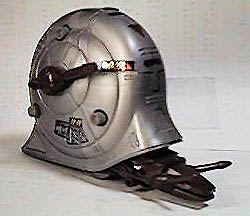

Also acquired while with my parents: a noticeable paunch, courtesy of my Mum's culinary generosity. Oops.
Otherwise, and obviously aside from the wedding, the trip to Worthing was quiet. The parents took me, B., brother and sister-in-law out for a very convivial meal at a restaurant called The Fish Factory -- which appears to have an almost non-existent web profile, did much better vegetarian food than you'd expect from the name, and even had some vaguely interesting international bottled lagers.
Generally, though, the most interesting thing to do in Worthing is go to Brighton instead. So after a picnic at Devil's Dyke on Saturday, we saw the Rex Whistler exhibition at Brighton Museum, called in at the vegetarian shoe shop and wandered up and down the Lanes in a desultory sort of way. I always enjoy Brighton's bohemian ambience, and being there in the immediate aftermath of the Gay Pride march probably helped with that.
As I said to B., it's looking now as if the next weddings we'll be going to in Worthing will be those of our nieces and / or nephews, and they don't even exist yet. Hurry up and procreate, brother.
08 August 2006
Warning: Potential Double-Entendre Overload
And that other piece of information for which you've presumably all spent the week agog with anticipation:
My newspaper article should, God willing, appear next Saturday (12 August) in The Guardian -- specifically its listings supplement, The Guide. It's about one of my perennial obsessions, Philip K. Dick, the film of whose novel A Scanner Darkly is due out in the U.K. on Friday 18 August. I'm very pleased, both with the piece and -- as you might imagine -- with the fact of its publication.
My newspaper article should, God willing, appear next Saturday (12 August) in The Guardian -- specifically its listings supplement, The Guide. It's about one of my perennial obsessions, Philip K. Dick, the film of whose novel A Scanner Darkly is due out in the U.K. on Friday 18 August. I'm very pleased, both with the piece and -- as you might imagine -- with the fact of its publication.
Unbridled Pleasure
Until fairly recently -- when we decided it was altogether too much work when we were supposed to be enjoying ourselves -- B. and I had a system for scoring weddings.
This was a percentage grade, based on numbers out of ten awarded for the following:
1. Ceremony venue, including decoration and the like
2. Ceremony
3. Appearance of principals, including costuming (with points deducted for any bridesmaids below the age of 12, and any page-boys whatsoever)
4. Unobtrusiveness or nonexistence of photography
5. Reception venue
6. Quality / quantity of food
7. Quality / quantity of drink
8. Wit and brevity of speeches
9. Quality of entertainment
10. Company
This was always subject to alteration and refinement -- there were certainly times when we conflated 1. and 5., and others when we expanded 6. and 7. into four independent categories. We may have sometimes included inappropriately faffy criteria like "general ambience".
Indeed, part of the reason the system didn't work terribly well in practice was that we could never keep our criteria consistent from one wedding to the next, and that unless we wrote the scores down at the time (and before we'd come to a full appreciation of point 7.), we'd never remember those either.
In any case, we didn't grade either of the two weddings we were at last week. At the first it wouldn't have been appropriate, since the bride and groom had done the whole thing on a shoestring, squeezing in at the nearest church on a Tuesday, hosting the reception in their flat and garden, and asking all their friends to contribute food, drink, flowers, hairdressing etc according to ability.
And at the second we'd been very strictly forbidden by the bride to do anything of the kind.
But -- and this is the point towards which I'm rather vacantly meandering -- both events would have scored highly, according to any version of the system.
If we had been scoring. Which we really weren't, honestly.
Tuesday's bride, Z., was one of the very oldest of my old friends, whom I've known since we were in the region of six (me) and ten (her), and to whom I apparently endeared myself for life by telling her her leg-warmers looked like "mutant tights". Indeed, I was down on the order of service (I read the prayers of intercession) as "Read by Phil Hallard [sic], Z.'s oldest friend". Amusingly, her husband W., whom she met through their mutual passion for Civil War battle reenactment, is about eight years younger than I am.
I'm not going to detail Z. and W.'s performance in each criterion, but all were pretty impressive given the circumstances, and some (the decoration of the garden, for instance) were remarkably accomplished. The veggie food was limited in scope, but not so in quantity (and B. and I had managed to find a rather nice Lebanese café round the corner for lunch, so we weren't desperate). I'm the only friend from those days whom Z. has kept in touch with, so people I knew -- her parents aside -- were a bit thin on the ground. And we had to leave to get a train back to Bristol before the entertainment got under way... but still, the whole occasion was very wonderful.
It was also one of the gayest weddings I've been to, with the best man, numerous guests and (not particularly covertly) one of the clergy all being of the dorothyophilic persuasion. Apparently W.'s stag night involved his friends taking him to a gay club "to keep him out of trouble" -- a potentially risky strategy, I'd have thought, but one which evidently paid off.
As I've said, Z. led us in procession through the streets of North London in her bridal gown, receiving appropriate honks and whistles from spectators en route. Which is very her.
Friday's bride, M., was another old friend (but not as old as Z., and also younger). She's still in touch with many people I ought to be better at keeping in contact with myself, and whom it was desperately lovely to be able to see and get drunk with again. The ceremony was in our home town of Worthing, with the reception afterwards within sight of Arundel Castle, so that added nostalgia value as well.
M.'s new husband is a very nice chap (as indeed is Z.'s), so it was pleasing to see them so happy to be together. And M.'s father suffered a very severe stroke a few years ago, so it was very heartening to see him able to walk up the aisle with her, and later to propose a toast.
The food (veggie included) was very nice indeed, and either the disco was a particularly splendid one or else I was in an almost unprecedently good mood. I spent large swathes of the evening dancing, anyway, which as B. will testify is generally something I do only if a medium-to-high voltage is being run through me. The rest of the time B. and I spent sharing a table with the next couple who are due to get married[*], with frequent congenial visits from the Chief-Usher-cum-M.C., one of the bridesmaids and various others.
Anyway. I realise most of you don't know any of these people, and I don't mean to bang on. The point is, both were hugely enjoyable occasions, where I got to see people I love being very happy, and was therefore happy myself.
And all without any need to run a sweepstake on the duration of the speeches.
[*] Of the three weddings I'm going to this year, all are this month, and all are on weekdays. I'll let you know how the last one went after Bank Holiday Monday.
This was a percentage grade, based on numbers out of ten awarded for the following:
1. Ceremony venue, including decoration and the like
2. Ceremony
3. Appearance of principals, including costuming (with points deducted for any bridesmaids below the age of 12, and any page-boys whatsoever)
4. Unobtrusiveness or nonexistence of photography
5. Reception venue
6. Quality / quantity of food
7. Quality / quantity of drink
8. Wit and brevity of speeches
9. Quality of entertainment
10. Company
This was always subject to alteration and refinement -- there were certainly times when we conflated 1. and 5., and others when we expanded 6. and 7. into four independent categories. We may have sometimes included inappropriately faffy criteria like "general ambience".
Indeed, part of the reason the system didn't work terribly well in practice was that we could never keep our criteria consistent from one wedding to the next, and that unless we wrote the scores down at the time (and before we'd come to a full appreciation of point 7.), we'd never remember those either.
In any case, we didn't grade either of the two weddings we were at last week. At the first it wouldn't have been appropriate, since the bride and groom had done the whole thing on a shoestring, squeezing in at the nearest church on a Tuesday, hosting the reception in their flat and garden, and asking all their friends to contribute food, drink, flowers, hairdressing etc according to ability.
And at the second we'd been very strictly forbidden by the bride to do anything of the kind.
But -- and this is the point towards which I'm rather vacantly meandering -- both events would have scored highly, according to any version of the system.
If we had been scoring. Which we really weren't, honestly.
Tuesday's bride, Z., was one of the very oldest of my old friends, whom I've known since we were in the region of six (me) and ten (her), and to whom I apparently endeared myself for life by telling her her leg-warmers looked like "mutant tights". Indeed, I was down on the order of service (I read the prayers of intercession) as "Read by Phil Hallard [sic], Z.'s oldest friend". Amusingly, her husband W., whom she met through their mutual passion for Civil War battle reenactment, is about eight years younger than I am.
I'm not going to detail Z. and W.'s performance in each criterion, but all were pretty impressive given the circumstances, and some (the decoration of the garden, for instance) were remarkably accomplished. The veggie food was limited in scope, but not so in quantity (and B. and I had managed to find a rather nice Lebanese café round the corner for lunch, so we weren't desperate). I'm the only friend from those days whom Z. has kept in touch with, so people I knew -- her parents aside -- were a bit thin on the ground. And we had to leave to get a train back to Bristol before the entertainment got under way... but still, the whole occasion was very wonderful.
It was also one of the gayest weddings I've been to, with the best man, numerous guests and (not particularly covertly) one of the clergy all being of the dorothyophilic persuasion. Apparently W.'s stag night involved his friends taking him to a gay club "to keep him out of trouble" -- a potentially risky strategy, I'd have thought, but one which evidently paid off.
As I've said, Z. led us in procession through the streets of North London in her bridal gown, receiving appropriate honks and whistles from spectators en route. Which is very her.
Friday's bride, M., was another old friend (but not as old as Z., and also younger). She's still in touch with many people I ought to be better at keeping in contact with myself, and whom it was desperately lovely to be able to see and get drunk with again. The ceremony was in our home town of Worthing, with the reception afterwards within sight of Arundel Castle, so that added nostalgia value as well.
M.'s new husband is a very nice chap (as indeed is Z.'s), so it was pleasing to see them so happy to be together. And M.'s father suffered a very severe stroke a few years ago, so it was very heartening to see him able to walk up the aisle with her, and later to propose a toast.
The food (veggie included) was very nice indeed, and either the disco was a particularly splendid one or else I was in an almost unprecedently good mood. I spent large swathes of the evening dancing, anyway, which as B. will testify is generally something I do only if a medium-to-high voltage is being run through me. The rest of the time B. and I spent sharing a table with the next couple who are due to get married[*], with frequent congenial visits from the Chief-Usher-cum-M.C., one of the bridesmaids and various others.
Anyway. I realise most of you don't know any of these people, and I don't mean to bang on. The point is, both were hugely enjoyable occasions, where I got to see people I love being very happy, and was therefore happy myself.
And all without any need to run a sweepstake on the duration of the speeches.
[*] Of the three weddings I'm going to this year, all are this month, and all are on weekdays. I'll let you know how the last one went after Bank Holiday Monday.
03 August 2006
Inter-Nuptial Stopover
Well, the London wedding went very well -- the happy couple led us all in a procession through the streets from ceremony to reception, which I think appealed to the bride's innate theatricality. We're off to Sussex shortly for the second hitching of the week. I'll blog them in more detail next week sometime.
The article is now written and accepted. I'll go into more detail on that next week as well, but suffice it to say I'm very very happy on that score.
Have a good weekend, all.
The article is now written and accepted. I'll go into more detail on that next week as well, but suffice it to say I'm very very happy on that score.
Have a good weekend, all.
Subscribe to:
Posts (Atom)