20 October 2012

Book: Burning

I seem somehow to have neglected to mention here that Burning with Optimism's Flames, the Faction Paradox anthology in which my short story "De Umbris Idearum" appears alongside the work of numerous exciting authors, is actually out in ebook format, and can be bought from Obverse Books, Amazon.co.uk or Amazon.com. The hardback is expected soon, although I believe there's some kind of delay at the printer's.

The redoubtable Andrew Hickey has already reviewed the book in glowing terms. I'm nearly halfway through, and while it's obviously not a disinterested opinion, I entirely agree with him.

I've had an absurdly unpleasant and stressful week, or I'd certainly have mentioned on Wednesday that the previous Faction Paradox collection, A Romance in Twelve Parts (including my short story "A Hundred Words from a Civil War"), was going free on Amazon.co.uk and Amazon.com that day. Even without my tireless self-promotion, though, it briefly reached the dizzying heights of number 4 in Amazon's SF and fantasy download charts.

In City of the Saved news, Tales of the City has had a moderately approving review from no less reputable a source than The British Fantasy Society. I've also put the Background Notes which I prepared some time ago for prospective authors of future City of the Saved stories up on my website. This is the generic City background material, not the stuff relating to any particular anthology, but still, you may find it of interest.

Incidentally, I'm doing some more editing, and so far I'm enjoying it as much as I did last time. I'm not mentioning the project in question publicly at the moment, so the connection between this paragraph and the preceding one is left as an exercise for the reader.

07 October 2012

A Man of Substance

Here's some of the thing I'm writing at the moment:
     Señor 105 grunted. He was a man of immense solidity, his gray-blue business suit packed with granite-hard muscle tissue. He looked as if he could absorb the impact of a medium-sized family saloon car and stay standing, though possibly slightly dazed. His face was obscured by a grey mask, with huge black ovals concealing his eyes, two tiny nostril-holes and the number 54 stitched across its forehead. The frightening effect was mitigated, partly by the way it disclosed his mouth and grizzled goatee beard, but mostly by the brown fedora he wore over the top of it.

     Above his right shoulder bobbed a delicate shell-pink balloon.

     ‘I don’t know,’ the Señor admitted reluctantly. Linguistics, like most areas of human knowledge, were something of a specialty with him. ‘The writing system is like nothing I’ve seen before. Some of the symbols could come from ancient languages, though not the Roman alphabet we in the West use. Others seem new.’ Though built like the wrestler he was, Lori’s friend was also the scientist and scholar which his masks, each themed around one of the 105 known elements in the periodic table, would suggest. He had told Lori that the one he wore today represented xenon, whose name came from the Greek word for ‘alien’.
Señor 105 is a masked Mexican wrestler, or luchador. He wears 105 masks, and is known as Señor 105, because he lives in a perpetual early 1970s where seaborgium and its successors are as yet unheard of [1].
 
As well as being a wrestler, 105 is a scientific genius, a polymath, a man of peace though capable of great violence, a friend to children and to stray balloons housing sentient isotopes of helium [2]. He regularly fights to save Mexico City and the world from such threats as aliens, monsters, giant robots, jackalopes, dinosaurs and men with dangerously enthralling moustaches.

Like many of the central characters in the stories I've written, Señor 105 isn't my creation. He was invented by Cody Quijano-Schell (who also produced the splendid cover for Tales of the City) for his story "Iris Wildthyme y Señor Cientocinco contra Los Monstruos del Fiesta" in Iris Wildthyme and the Celestial Omnibus. In his first appearance, Señor 105's job was essentially to welcome Iris -- a personal friend of, among others, Carnacki, Professor Challenger, Santa Claus and Doctor Who -- into the weird genre world of Lucha libre. Even here, however, the wrestler comes across as the hero of his own adventures: already the story reads as a crossover with a series which hasn't happened yet.

Which, at the time, was true. Since then, however, the Señor has reappeared at novella length (also written by Cody) in Miss Wildthyme and Friends Investigate, starred in his own volume of the Obverse Quarterly, Senor 105 and the Elements of Danger (which allowed six other authors to provide their own takes on the character), and most recently spun off into his own range of e-novellas, The Periodic Adventures of Señor 105 from Manleigh Books (by diverse hands -- one of which, it would now appear, is mine).

I love Señor 105's surreal, pulpy world, which is explicitly posited on the fact that anything can happen at any time with no particular need for scientific explanation (frustrating though the latter fact often is to the rational-minded 105 himself). It's why I've chosen one particular old, rejected proposal, whose opening chapter I posted here quite some time ago, to form the basis of the story.

I have to admit that Mexico, and the Lucha libre genre particularly (which, outside the Señor 105 adventures, I've only ever encountered through that Angel episode), are some distance outside my usual comfort zone, which is probably why my story takes the luchador and his friends to the relatively neutral territory of the United States. It's also the first time I've written somthing for e-publication only, which feels a little odd.

It's not necessarily a final title, but so far my novella's called The Ghosts of Odin-Hotep. I'll keep you posted as it progresses.

Incidentally, there's a fine gallery of Señor 105 fan art here.

[1] If he remains active to the present day -- which is doubtful, as he's in his 50s in 1970 -- he's presumably be known either as Señor 114 (in which case his highest-numbered mask will confusingly be 116) or Señor 116 (in which case he'll be two masks short).
[2] Her name's Sheila, incidentally. Lori, the Señor's other friend, is a freelance detective with a totally explicable penchant for dressing up as a Royal Canadian Mounted Policeman.

21 September 2012

Matt Kimpton

Just a note to record my sadness at the recent passing of Matt Kimpton, a short-story writer who moved in some of the same circles as me and whose writing I very much admired. His death at the age of 35 is tragically premature.

I didn't know Matt well -- we'd never met in person -- but we had enough of the same friends that I felt the benefit of his witty, self-deprecating humour on Facebook and elsewhere. Much of his work was in oral storytelling -- he held the position of Chief Skald of Suffolk from 2010 to 2011 -- but he also wrote with humour and humanity about his life-threatening illness, notably here in the Independent. His stories, should you choose to seek them out, were 'Life After Queth' in Short Trips: Farewells, 'Shadow of Times Before' in The Panda Book of Horror and 'Storyteller' in A Romance in Twelve Parts. His final published fiction (as far as I know) is due to be released in The Casebook of the Manleigh Halt Irregulars, one of the titles in Year 2 of the Obverse Quarterly, due out later in the year.

'Storyteller' is a wonderful piece, set in Anglo-Saxon England and drawing heavily on the skaldic storytelling tradition. Like all the authors in A Romance in Twelve Parts, Matt kindly used his contribution as a springboard to provide a guest drabble for my own story, 'A Hundred Words from a Civil War' (it's number LXIV, and one of my favourites). I very much hoped that I'd be able to get a longer City of the Saved story out of him one of these days.

I'm very sorry to have seen the last of Matt. He was a funny, generous, popular man who will be very much missed. I'll be thinking of his family and friends as they say farewell to him today.

19 September 2012

The Other Problem of Susan

In an effort to keep better track of my reading and book ownership than my ageing parental mind can manage these days, I recently joined Goodreads, a highly specialised social networking site which enables users to keep track of each other's reading habits, post reviews, discuss books and the like -- and, if they're authors, promote their own stuff, which I need to get round to doing properly. Given the rate at which people typically read books, it's not the busiest forum on the internet, but I'm finding it useful and fun so far.

(If you're on Goodreads, I'm here -- and I do own more than 450 books, it's just that entering them all takes time.)

One thing I'm trying to use it for is posting mini-reviews of books as I finish them -- I've managed so far, although as I only joined a month or so ago this only applies to six books to date. This should help this blog in the long run, as all I'll need to do to create a book review roundup post is cut and paste from Goodreads. (I've got a fair bit of catching up to do, though. At some point I'll try to transfer the reviews I've posted here in the other direction too. I've already done it for Dune.)

Which brings me to this: the venerable British fantasist Alan Garner recently released an adult sequel to his first two novels, the children's fantasies The Weirdstone of Brisingamen and The Moon of Gomrath. In honour of this, I reread the first two books for probably the first time since I was about fifteen, before proceeding to the sequel, Boneland. Here are the Goodreads reviews, written as I worked my way through the series.

The Weirdstone of Brisingamen

Well, Garner could certainly write, even in his twenties. The prose is bleakly, laconically poetic, the dialogue manages to be memorable rather than blandly archaic, and the book's full of images which have stayed with me in the 25 years between readings. The sequence of squirming through a tunnel deep underground may actually be responsible for my strong dislike of caves as an adult, and I found rereading those passages physically stressful, to the extent that I had to keep setting the book aside and reminding myself of where I really was. That's good writing.

Amongst all that, the plot barely matters, but it's amusing to realise now the extent to which Garner simply took the story of The Lord of the Rings and reset it in Cheshire, with children playing the hobbits. The Cadellin-Grimnir-Nastrond setup is irresistibly reminiscent of Gandalf, Saruman and Sauron, and the book features dwarves, elves, trolls, farmers, mines, goblins under a different name and a beautiful woman in a forest handing out gifts (although many of these, the "mara" troll-women especially, are creatively different from Tolkien's). There's even a jewel -- the titular Weirdstone -- which has to be taken to an arbitrary place in order for the plot to end.

It's obvious, though, that plot isn't really Garner's priority. (At one point, a random unexplained stranger arrives on a magic horse, gives everyone a lift from one geographical location to another, then buggers off again.) The story is compelling, which is what matters, and it acts as a framework for Garner's haunting words and images.

I'm following this up with The Moon of Gomrath, as a prelude to reading Garner's demicentennial sequel, Boneland.

The Moon of Gomrath

This is an altogether different proposition from The Weirdstone of Brisingamen. The prose is still bleakly beautiful, but the characters are better developed, more assertive and more independent after their experiences of the last novel, and the story is far more creative. The imagination which created elements like the mara and the lyblacs for the last book is given full rein here. The bodachs, the palugs, above all the Brollachan, are all weird and disturbing creations not found elsewhere in fantasy.

That's not to say there are no influences. There are a few Lord of the Rings echoes still -- the magical McGuffin is now a series of ancient bracelets of lunar power, one of which is revealed to be wielded by the last book's Galadriel substitute -- and the focus on the Morrigan as primary villain recalls CS Lewis' White and Green Witches in the Narnia books. (Rather shockingly for a trilogy whose third volume has just been published, it was less than half a decade between the publication of The Last Battle and that of The Weirdstone of Brisingamen.)

That said, The Moon of Gomrath's evocation of a matriarchal Wild Magic pre-dating the masculine wizardly magic of Cadellin and co prefigures multiple examples of children's fiction, from the weird hierarchy of High, Dark, Light and Wild Magics in Susan Cooper's The Dark Is Rising sequence to Terry Pratchett's treatment of witchcraft in the Tiffany Aching books.

For me there's nothing quite so memorably upsetting as the underground sequences in Weirdstone, but the developing both of Garner's cosmology and of the individual characters of the children (especially Susan, emerging triumphantly from her brother's shadow here) make this the better, more sophisticated book. The hints of Susan's and Colin's futures (we're told casually on the penultimate page that the latter "never found rest again") make the eventual publication of Boneland, if not inevitable, then something many of this book's readers have probably been waiting fifty years for.

Boneland

Boneland is essentially the story of the psychoanalysis of Colin, the male co-protagonist of The Weirdstone of Brisingamen and The Moon of Gomrath -- now an adult of indeterminate middle age, working as a radio astronomer at Jodrell Bank and living in a shack at Alderley Edge. Beyond a few significant flashbacks he has no memory of his childhood adventures, but he retains the trauma of them, especially the disappearance of his twin sister Susan.

Boneland takes place in the same landscape as the earlier Alderley books, but it is no longer the haunt of elves, dwarves and wizards. This book's fantastical elements arise more subtly from Susan's implicit fate (only foreshadowed in The Moon of Gomrath, although Colin's reading of the outcome is convincing in the light of what we saw there), and what emerges as the unusual nature of his analyst. There's also a series of time-hopping reversions to the prehistoric life of a man who turns out to be a Homo erectus shaman also inhabiting Cheshire, seeking a successor to his post of observing and thus maintaining the world, whose relation to the main narrative is definite but elusive.

Though of no great length, Boneland is a dense, slippery text which starts off close to incomprehensible but becomes crystal clear as one learns to inhabit the storytelling. That's the kind of reading experience I always find rewarding, but it's not the light read its predecessors were.

In fact, it reminded me of nothing so much as the revisionist texts which reinterpret much-loved works of children's fantasy through a filter of adult understanding and knowledge: Lev Grossman's Magicians sequence and Neil Gaiman's "The Problem of Susan" (both dealing with the Narnia books) spring most readily to mind, but one could also cite Alan Moore's Lost Girls (Alice, Peter Pan, Oz) or Geoff Ryman's Was (Oz).

In most such stories, adventures are re-examined as traumatic, paradigm-shaking experiences which can neither be revisited nor fully shared, but which will colour the rest of the adventurer's life; child protagonists are followed into their problematic adulthood, with the psychological fallout of their pasts unflinchingly surveyed; and parental figures, even God-analogues, are interrogated and found wanting in benevolence and responsibility.

Boneland is exactly that kind of revisitation of past innocence with a cynical half-century of hindsight -- indeed, the Alderley books are of essentially the same vintage as the Narnia cycle, with less than half a decade separating Weirdstone (1960) from The Last Battle (1956). However, Boneland has the unique qualification that it's not a piece of sophisticated fanfic based around the Alderley books, but the authentic work of their original author. If CS Lewis had survived until 2008 and suddenly written an eighth Narnia book at the age of 110, it would have been comparable.

The original books are essential reading for fully understanding Garner's own Problem of Susan (although there's one non-revelation which might have been more effective if read in isolation from them). The primary source of Colin's trauma particularly makes no sense without such background knowledge: suffice it to say that what Colin thinks of as a curse may be, given its source, the nearest thing available to a blessing. The narrative is rife with this kind of unresolved moral inversion, however, and in the end the subjective ambiguity of Colin's childhood experiences grows to dominate the book.

Although I loved the Alderley books as a child, I'm ashamed to say that I've not actually read Alan Garner's other adult novels, nor even his other children's novels, Elidor, The Owl Service and Red Shift. My parents told me at the age of 10ish that they'd be too difficult for me, and I somehow never caught up with them later in life. I intend to rectify this soon.

12 September 2012

Feeling Testy

Like most male authors who profess to have a clue about feminism, I sometimes fret about unconscious gender bias in my work. There's no real way to tell whether your work is accidentally sexist: I try my hardest to avoid many of the well-known pitfalls, from the trivial (like making characters male -- or indeed heterosexual, white etc -- by default) to the absolutely appalling (like the casual use of rape as a plot point), but heaven only knows how many solecisms I'm committing unwittingly.

One test which is often applied to texts (usually films) is the Bechdel Test, first posited by cartoonist Alison Bechdel in 1985 and taken up by feminist commentators since. The Bechdel Test proposes that, as a kind of minimum threshold of gender awareness:
  1. A film should have two women in it.
  2. They should talk to each other.
  3. The conversation should be about something other than a man.
As I say (and leaving aside the tricky issue of how the character in the comic knows in detail what conversations a film might include before she goes to see it), this test was designed for films, and it's not infallible even there. Some films have settings which would realistically exclude women; some have no dialogue; some are entirely about penguins.  None of these approaches are inherently anti-feminist. However, astonishing numbers of works fail the Bechdel Test without any such excuse.

It's instructive, though not entirely equivalent, to apply the test to literary works to see whether its criteria are being met, and if not, whether this is for a good reason or a useless one.

What follows is a Bechdel-Test tour of my published work. If whiny post-feminist man-angst annoys you, you're probably better off going and watching Steel Magnolias or Fight Club, depending on preference.

My entries in The Book of the War (2002): A tricky one to start off with, as The Book as a whole has virtually no dialogue, and my segments certainly don't. One can assume that Amanda Legend Lefcourt and Dauphine Malatesta had conversations together, but they were presumably at least partly about Lord Foaming Sky, whom Malatesta assassinated. I think we have to discount this one as inconclusive. 0/0.

'Scapegoat' (2003): The entire story is two blokes talking. At the end, one of them uses a woman for transitory sexual relief. A pretty ignominious failure at the second hurdle. 0/1.

Of the City of the Saved... (2004): Several examples, thankfully (although it should be pointed out that there's a heck of a lot more scope for a variety of scenes in an average-length novel than in an average-length movie). A little under half the significant characters are of the female persuasion (not all the remainder are male). Laura Tobin and Mesh Cos, Mesh and Kyme Janute (twice), Tobin and Compassion III and Tobin and Civitata, all talk of things other than the late Ved Mostyn. Admittedly three of those characters were originally the same woman, while Janute is accidentally rather than essentially female, having like all the Manfolk been born male. Still, it would be hard to argue that this doesn't pass. 1/2.

'Sex Secrets of the Robot Replicants' (2004): There's only one woman in the story. This is mostly because the majority of the characters are either Jason Kane or a clone of him, but still. However I justify it, this one's a fail. 1/3.

Peculiar Lives (2005): This is also a bit difficult, as: a) the narrator's a man and we see most of what happens through his eyes; b) it's a deliberate pastiche of a particular type of inter-War SF, where articulate women weren't thick on the ground. Even so, I think it scrapes through: Emily and Freija have an exchange in Erik's hearing about Emily's past (or lack of one). You could discount it on the technicality that Freija's too young to be considered a woman, but I'm sure that's not what the original rule had in mind. 2/4.

'Minions of the Moon' (2005): Iris Wildthyme attempts to seduce Harry Peerless, who is in fact Olivia Somerset in drag. A cunningly disguised pass. 3/5.

'The Long Midwinter' (2005): A bit of a mess generally, this story has the Doctor and two obscure companions I didn't care about (one male, one female) visiting the posthuman inhabitants of a brown dwarf world. The locals have a sensible male-female mix, but we mostly see them interacting individually with the visitors, and there are no conversations between women. Fails the test, clearly. 3/6.

'The Ruins of Time' (2006): This time the TARDIS's complement includes the Doctor's granddaughter Susan and her redoubtable history teacher Barbara -- as well as Barbara's companion Ian and the Doctor himself -- but the pair of them don't actually have a conversation together. Nor do they talk to any other women, because every other character in the story's a hermaphrodite. Another fail (unless, of course, you count the hermaphrodites as both men and women). 3/7.

Five vignettes and a co-written story in Collected Works (2006): Individually some of these fail the Bechdel Test, but individually the vignettes are so short it hardly seems fair to apply a diversity standard to them.  Taken en masse (and ignoring the fact that the members of the Quire are technically part of the same metahuman individual whose gender is indeterminate), we see Bev Tarrant talking to Dorso about the Quire's position on the Braxiatel Collection, Bernice talking to Dorso about parenting styles, and Dorso talking to Incunabula (like Freija a girl rather than a woman, although in her case this is less certain) about complete nonsense. The co-written story, 'Future Relations', has a couple of conversations between Bernice and Verso, but they're all about Verso's boyfriend Parasiel. Nonetheless, an overall pass. 4/8.

Nursery Politics (2007): Bernice and Ithva the Draconian ambassador's wife (and imperial spy) have a lengthy conversation ranging through politics, literature, parenting and military history. Bernice also speaks at length to a character named Victoria, but 'she' turns out to be a neuter shapeshifting sponge with a fragmented polysexual personality. Pass. 5/9.

Predating the Predators (2008): Most of the main characters are women this time -- two of the three narrators and the primary villain -- although most of the supporting cast (an alien mad scientist aside) are male.  As the climax approaches there are several conferences and confrontations involving Imogen, Bernice, Elanore and Leustassavil, though none of these happen without men present. Still, for the test as phrased, it's a pass. 6/10.

'Battleship Anathema' (2009): No, this one's hopeless. Again it's a pastiche, but of something whose own gender balance isn't actually too bad. The longest scenes are Iris's conversations with Admiral Rex Halidom and Archdeacon Barnaby: there's no good reason for them to be male except that I wanted to write in the voices of Edward James Olmos and Dean Stockwell. There are female characters other than Iris, but very little's made of them. Big fail here. 6/11.

'A Hundred Words from a Civil War' (2011): In a drabble, every word counts, and a conversation between two people of the same gender can waste valuable words identifying them with more than a 'he' and 'she'. There are a number of contextless conversations where we don't know the gender of the speakers, but we can hardly count those. A scene between a female Pope and a vampire queen fails because they're discussing assassinating the (male) Mayor. Nonetheless, there's one scene which qualifies -- the trench-warfare segment in which Capt 'Spiky' Sperrin and Lt 'Fanny' Featherstone discuss the imminent zeppelin-zombie attack. This is mildly embarrassing, as I only changed the soldiers' sexes at the last minute. Still, another pass. 7/12.

Framing sequences for Tales of the City (2012): 'Akroates' is a meditative piece, with almost no action or dialogue. 'Apocalypse Day' brings together the characters (three female, four male, plus one husband) from the other stories in the book, but then splits them up so none of the women are talking to any of the others. I really have no idea why I did that, unless it's the convenience of the aforementioned 'he said' / 'she said' shortcut. A fail, and it really didn't need to be. 7/13.
Additionally, I'm sorry to say my Burning with Optimism's Flames story fails (due to being mostly about Roman Catholic priests in the past and present, although Imogen from Predating the Predators reappears), as does my recently completed novel (being largely about the patriarchal power structures of traditional stories). So even that feeble score's going to take a sharp downturn imminently.

Part of what this highlights is that the Bechdel Test, being designed for contemporary film, isn't actually very good at the less conservative end of science fiction. Futuristic material may have less excuse for marginalising women (hence Alien being the example given in that original strip), but SF can do things with gender that are an awful lot more radical than simply attempting parity between the sexes. Between them, my stories feature a busload of hermaphrodites, neuter individuals both organic and machine, naturally sex-changing characters, composite individuals, occasional mentions of trisexual species and a transvestite.

(This may sound like a parochial objection, but... well, mainstream fiction can also do transvestites.The Bechdel Test assumes rigid gender identities, such that characters can be unambiguously classed as "men" or "women", and that can be an issue in non-SF too. If two post-op male-to-female transsexuals discuss a pre-op friend, does that pass the Bechdel? If two Roman matrons discuss a eunuch slave, does that fail?)

This does make it particularly frustrating that 'The Ruins of Time' fails, because the hermaphrodite milieu is striving quite strenuously to question our (and cause the 1960s human characters to question their) accepted constructions of gender.

Mostly, though, I have to admit that my stories don't have that kind of mitigating factor. Which suggests that I really need to think harder about this kind of thing.

10 August 2012

Burning Issue

I promised myself I'd add at least one ordinary, discursive, non-publicity post here before the next book came along that I needed to pimp. Obviously events overtook me there.

Julian "Jay" Eales, who way back in the twentieth century published me in the Doctor Who 'fanthologies' Perfect Timing 2 and Walking in Eternity, is editing a Faction Paradox anthology for Obverse Books, a follow-up to A Romance in Twelve Parts named Burning with Optimism's Flames.  He's been releasing teasers for the stories at his blog, Factor Fiction.  The final story in the collection -- and therefore the final teaser, posted today -- is 'De Umbris Idearum', written by me.

As a reader as well as a contributor (and indeed as a fellow editor), I'm enormously impressed with the talent Jay's assembled for the collection. Simon Bucher-Jones, Jonathan Dennis and Kelly Hale have all written fantastic stuff for Faction Paradox and elsewhere in the past, including The Book of the War and Kelly's fantastic Erasing Sherlock. Sarah Hadley is another relic of those ancient fanthologies, whose short stories I greatly enjoyed at the time. Stephen Marley wrote the astoundingly fine Doctor Who novel Managra, which has been a huge source of inspiration to me (it features numerous characters from different eras of history -- plus Popes, vampires and clones of fictional characters -- interacting in a huge second-millennium-Europe theme park, which may give you some idea). And, of course, I'm very pleased indeed to see the three new-to-Obverse writers who I recruited for Tales of the City -- Helen Angove, Elizabeth Evershed and Juliet Kemp -- returning for this volume. I'm not familiar with the work of the other five contributors, but if they're up to the same standard then Burning with Optimism's Flames will be a real treat for its readers.

My story's a grand historical epic of Popes, cults and heretics, ranging across twelve centuries. It's the first Faction Paradox story I've written which doesn't involve the City of the Saved in any way, although both Mother Imogen Tantry, later Pope Beatrix II (from The Vampire Curse and "A Hundred Words from a Civil War") and Father Self of Faction Paradox (seen in flashback in Of the City of the Saved...) appear. It looks as if it's appearing last in the volume, so I'm going to have a hard set of acts to follow.

I'll update you all when Burning with Optimism's Flames becomes available to pre-order. Meanwhile I've set up a page for the book at my website, which gives you very slightly more information about the story.

22 June 2012

I'll Be Bound

Paper copies of Tales of the City [NB: note new link to dedicated ordering page] are now available, and some of them are in my possession. The wonderful cover looks even better wrapped around a crisply-printed, well-laid-out book full of narrative goodness, without (as far as I can see so far, anyway) any of the accidental printing glitches I feared. (B. has however found a space missing after a full stop, which will be entirely my fault and for which I can only apologise.)

I'm delighted, obviously -- although the ebook's been out for a while, and has even garnered one highly positive review, my understanding of publishing was formed long enough ago that a book never feels published to me until its contents can be pinned down and contained between covers. It's never felt more appropriate to refer to paper books as "bound".

To celebrate, I've updated my website with the extras for the book, including the author biogs (previously posted here), a City of the Saved chronology and... what I'm nervous about calling, but has to be considered in purely chronological terms to be, the Last Ever City of the Saved story. It's called "God Encompasses", and it follows on directly from the events of "A Hundred Words from a Civil War" and "Apocalypse Day". (Both "God Encompasses" and the City chronology contain SPOILERS for Tales of the City, so caveat lector.)

It's not anyone's intention that this should be the last City of the Saved story published, however. I've massively enjoyed the editing process for Tales, and I hope it will be the first of, if not many then at least several, collaborations of the kind with Obverse Books. News of further City volumes should hopefully be posted here in due course.

01 June 2012

Trailers of the City #6

Since the ebook of Tales of the City is due out today, with the physical codices to follow in a week or two, it's time for the last in my occasional series of trailers for the anthology.The sixth and final full-length story is by Mr Dave Hoskin:
Dave Hoskin is a writer living in Melbourne. His fiction has appeared in Doctor Who – Short Trips: Transmissions, Bernice Summerfield: Something Changed, Faction Paradox: A Romance in Twelve Parts, Midnight Echo and World's Collider. His non-fiction has appeared in The Big Issue, Metro, Australian Book Review and Overland. His favourite colour is jam, his favourite band is world peace, and his favourite pastime is closed for renovations. Currently he has no bruises, but several scars. Some of them are visible to passersby.
I first encountered Dave's work in Something Changed, to which I thought his contribution was outstanding. His name didn't stick with me, though, until 'iNtRUsioNs', his splendidly disturbing piece in Transmissions -- again, one of the best stories in a far stronger collection. His Faction Paradox story 'Tonton Macoute' (the story of the Faction's cook, a pragmatic gourmet who takes on the qualities of the entities he eats, up to and including things like gods) -- and in particular the follow-up drabble Dave contributed to 'A Hundred Words from a Civil War', in which the resurrected Macoute finishes his preparations for eating the City itself -- convinced me that he was an author I wanted to write a full-length City of the Saved story.

Dave's story in Tales of the City is a quieter, more personal affair: 'Bruises' is a police noir with a strange theological twist -- not an unfamiliar genre in City terms, but one which Dave accomplishes particularly effectively. It takes the City's cheerily utopian and pluralist ethos to some very dark places... which is just what's needed as the book approaches the epilogue, 'Apocalypse Day'.

It starts like this:
     She started by licking the bruise off my face.
To read the story, buy the Tales of the City ebook, or order the physical volume, from Obverse Books.

30 May 2012

Urban design

I'm finally in a position to reveal the highly talented Cody Quijano-Schell's cover design for Tales of the City, and it's fantastic:


Click to see a larger version, in all its brilliant weirdness. (Also available at my website.)

The ebook is due out this Friday, 1 June, with the physical volume to follow a week or two later. Place your order here.

23 May 2012

Books update: Deserts, Sheikhs, Monks and Magicians

It's probably about time I wittered on about books other people have written for a change.


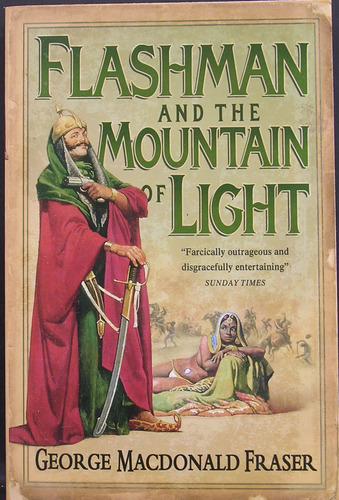
Since January I've read a further seven and a bit of George MacDonald Fraser's Flashman books, bringing me (in publication order) up to about quarter of the way through Flashman and the Mountain of Light. I'm enjoying them hugely, though I've found it improves them to intersperse them with other things. I'll blog about all twelve once I'm finished, I think.

I believe I'd already read Michael Chabon's Manhood for Amateurs when I blogged that last piece, but it managed to slip my mind. It's a series of memoir-essays, rather than the handbook which the title promises for navigating masculinity, fatherhood and husbanddom in a post-feminist world (a shame, as I could really have done with one of those). It's very sweet though, and beautifully written, especially when talking about familiar elements of geekdom such as Lego and Doctor Who (Chabon is, inevitably, a fan). The only downside, and it's an equally characteristic one, is that it sometimes becomes doubly impenetrable by talking not only about sport but specifically about American sports.

Frank Herbert's Dune is... well, long, isn't it? And there's an awful lot of it that's primarily about sand. To tell the truth, I was disappointed in this, one of SF's undoubted towering classics which I'd never quite got round to reading before. The worldbuilding is astonishing -- possibly unmatched outside Tolkein, in fact -- but most of it is kept off the page, in oblique hints in the appendices and glossary or at most in the dialogue of subplots which only temporarily diverge from the grand epic scenes of trudging on and on through some more sand. In fact, one gets a much, much stronger sense of Herbert's remarkable universe through watching David Lynch's magnificent film than by reading the book.Creating the Imperium but setting your story on Arrakis makes about as much sense to me as imagining the whole of Middle-Earth, then writing a huge novel set entirely in Forodwaith.

The writing isn't particularly impressive either, often aiming for a grandeur which it never quite lives up to, and getting lost in its own abstractions. I was amused by the fleeting mention of a Fremen warrior called Geoff. I reckon he deserves his own web comic.

Another SF book failing for me to live up to its (more recent) hype was Lavie Tidhar's Osama, a poetic but ultimately rather predictable alternative-world fantasy with a Dickian twist. It gains kudos for dealing directly with the eponymous bogeyman of our age, who in a world free of terrorism has become the hero of a series of pulp thrillers whose author the protagonist, an equally Dickian private eye, must track down. The twist will not surprise anybody who's been keeping their eye on popular BBC time-travel series over the past few years, though, and ultimately I was left with the impression of a book which thinks itself cleverer and more daring than it is.

I read SJ Parris's Heresy as research for a thing I can't talk about yet, and found it distinctly under par. It's a mystery set in Elizabethan Oxford, where a serial killer's carrying out murders modelled on Foxe's Book of Martyrs, but is hugely less fun than that makes it sound. The formulaic plot relies on intelligent people being dense and making stupid decisions, and there's only the most desultory of attempts to help the reader inside the renaissance mindset. (To give you some idea, one character uses the word "paranoid" -- a solecism which this reviewer makes a valiant, but ultimately bollocks, effort to justify.)

Stonemouth, like Iain Banks' last non-genre novel, The Steep Approach to Garbadale, reads like a greatest hits collection: a family of gangsters; a young protagonist returning home; his long-lost love; violence, drugs and shagging; landscape and buildings; the merest hint of incest; a suspension bridge... Banks effortlessly gets inside the head of a generation for whom the internet and mobile phones have literally been around all their lives, in a way I'm not confident I could do at nearly 20 years younger. It's a good read -- fun, and evocative, and ultimately touching -- but don't expect any of the exuberant originality which makes Banks' truly great works great.

From Obverse Books this year I've read the latest Iris Wildthyme collection, Wildthyme in Purple, whose theme of pulp fiction leads to some surprising approaches, verging from pastiche to metafiction to massivel multitextual crossover; The Diamond Lens (Obverse Quarterly volume 1.3), which reprints some fascinating and genuinely excellent SF and fantasy short stories by the almost entirely neglected Fitz-James O'Brien; and Zenith Lives! (OQ volume 1.4), which revives the Sexton Blake villain Monsieur Zenith the Albino, in assorted tales by some familiar Obverse hands and -- in a startling coup -- Michael Moorcock.

In theory, Shada, Gareth Roberts' novelisation of Douglas Adams' unfinished Doctor Who story, combines two of my favourite things. In practice, the story is so familiar from partial releases including a scriptbook that it's rather less exciting than the combination would suggest. That said, it's not at all bad -- veteran Who novelist and latterly scriptwriter Roberts is doing his best (which can be pretty good) to do justice to something written by a genius on an off-day (which is also, mostly, good). He does a lot of work to firm up the characters and tidy the wobbly plot, explaining in an afterword that he was working with later versions of the script than have previously been published (so it's difficult to know what exactly he added, except when it's obviously novelistic). He also talks about a process of archaeologically extracting Adams' pre-deadline intentions from early drafts, abandoned plotlines and unfollowed hints, and again it's impossible to know how accurate his guesses are.

The book's not entirely satisfying: it's obviously not a pure transcription of the nonexistent TV story, but it's too tied to those roots to take flight as a novel. I enjoyed it, though.

Last year I read Terry Pratchett's The Wee Free Men and A Hat Full of Sky, and earlier this year I finished off the Tiffany Aching sequence with Wintersmith and I Shall Wear Midnight. They're very good books, full of humanity and realism (witchcraft is a painful, thankless path of discipline and service, and if you take pleasure in it, it probably means you've turned evil). If I had to quibble, I'd say that the wonderfully-drawn character of Tiffany becomes slightly less interesting as she leaves adolescence for womanhood, although this may be because the fourth book, Pratchett's penultimate to date, lacks focus in rather the same way as his more recent and disappointing Snuff.

Another book intent on deglamorising magic -- and, much though I love Pratchett, one that seems to me to be in a different league altogether -- is The Magicians by Lev Grossman. This is one which does live up to its hype; The Magicians is a very strong novel in its own right, as well as being both a brilliantly-imagined fantasy and a clever critique of fantasy in general.

Thoroughly readable on the surface as fantasy of escapism in which (as closely as the demands of copyright law will allow) students at the US equivalent of Hogwarts graduate and find their way into Narnia, it's actually a fiercely intelligent deconstruction of the cosy comforts of this kind of conventional story. It does this partly through treating its situations with rigorous realism and logic, and partly through the character of its protagonist Quentin -- a teenager (and later a man) who's never satisfied with what he has and always suspects the universe is keeping something better from him. His addictive character could be said to typify the Western consumerist mindset to which modern fantasy is obliged to cater (although it must be said that The Magicians is also a bestseller, and that The Magician King, the second book in what looks suspiciously like a trilogy, is already sitting on my Kindle awaiting my attention).

Grossman's glittering, crystalline prose is perfectly pitched to serve the clarity of his purpose: in the end, one suspects, the only reason this is a fantasy at all is because the real world it depicts is ultimately equally unsatisfying.

If I had to recommend one of these books, this would be the one.

[Edit 26/5/12: Somehow managed to forget Shada. Have included it now. Also linked Foxe's Book of Martyrs.]

22 May 2012

Hyde Bound

I've updated my website today, with the blurb for Tales of the City, which currently looks like this:
After the end – ours and the universe’s – there is the City of the Saved. A repository for the uploaded souls of all humanity, the City is a technological utopia, a secular heaven. Heroes and villains, angels and monsters may be found in the City, but many ordinary people live here, too.

Well, all of them in fact.

In these stories, the first by writers other than the City’s creator Philip Purser-Hallard, we meet six of them. A hitchhiker, a lecturer, a tourist, a socialite, a twin, a cop: ordinary men and women living an extraordinary afterlife.

These are their tales.
(Sadly it now looks as if 1 June was an optimistic publication date, and the actual release of  Tales of the City is likely to be closer to the end of the month.) 

The updates make liberal use of the new City of the Saved logo, as designed by Cody:


I've also uploaded a bunch of recent microfiction from my Twitter account, @trapphic, including some new additions to my sequence of Victorian literature mashups, which I'd thought were pretty much played out:
‘Miss Havisham was an amateur. Henry Higgins, a dilettante. To make someone a real lady,’ the Baron avers, ‘you must start with the basics.’

* * *

‘You!’ gasped Edward Hyde, cringing. ‘But – how?’ ‘We have our friend to thank for that,’ noted Henry Jekyll, nodding at the Time-Traveller.
I've been busy with multiple other things as well, including a brief introduction for Obverse Books' forthcoming Faction Paradox titles, a draft of a short story (slightly longer than 'A Hundred Words from a Civil War', though not as long as 'Minions of the Moon'), an imminent change of day-job and a small child with chicken-pox. Some of these have been more enjoyable than others.

Cross Talk

You may be wondering, since I haven't blogged on the subject recently, how I've been adapting to my newfound atheism.

I haven't mentioned it for a while because, after the frankness of those two early posts, I've been feeling as if I'd rather prefer to get on with my crisis of faith in private, instead of tweeting it on a minute-by-minute basis. Suffice it to say that not a great deal has actually changed: my worldview was sufficiently secularised before that not having itunderpinned by a literal belief in a deity hasn't really made a terribly seismic difference.

I'm still wearing the wooden cross I've worn under my clothing since some friends brought it back for me from Lourdes when I was eighteen. The habit had become so ingrained it took me months to spot that this was even anomalous -- and about five minutes to conclude that my reasons for wearing it had far more to do with its sentimental value than with what I'd believed. I'm even attending an Anglican church only slightly more sporadically than I used to (atheism being generally accepted as no real bar to ordination these days, let alone communicant status). I've always found church ritual soothing, a link to a historical context of British communities across the generations, and that hasn't changed either.

It's possible I'm not a very effective atheist, but that's not really surprising. I was never a terribly effective christian either.

The main difference I've found in my thinking -- and it shames me to admit this -- is that I find forgiving people far more difficult these days. If you'd asked me a year ago to name a specifically 'christian' virtue -- ie, one which christianity is unusual in promoting, and which has therefore possibly been marginally more prevalent in christian circles than elsewhere, historically speaking[1] -- it would have been forgiveness, which Jesus was so keen on that he reportedly practised it even at the moment of his death. It's a vital social value, which assists in the general smooth running of the comomnwealth by keeping individuals and groups from constant feuding. It would certainly be indispensible in a utopia, which is one reason why it's difficult to imagine a utopia without faith. 

In any case, it's not something I'd feel happy to think I'd lost. 

However, I've come to understandthat the forgiveness I used to try to practice (not terribly effectively, I admit -- see above) had more than I realised of schadenfreude in it. The peculiar eschatology I'd constructed had no truck with the idea of eternal damnation -- that I'd dismissed, once I was old enough to escape the usual childhood terrors, as a barbaric dogma -- but it had metabolised the idea of purgatory into something typically idiosyncratic. I believed that, after death, each individual (myself not excluded, obviously) would be presented with a moment of absolute self-knowledge, in which it was revealed to them -- not as mere fact, but as an empathetic recognition -- exactly what they'd done and been in life. Every petty selfishness, every thoughtless action, every glib dismissal, sneering gibe, assault, murder or act of genocide would be seen clearly for what it was, and for the effect on its recipients.

Having received this insight, I blithely assumed, everybody would repent and turn to God.  There'd be no need for hell after that, because who could withstand such self-knowledge and retain their pride?

As I say, it was eccentric.  But it comforted me, when I saw people getting away with selfish, shitty behaviour -- especially the kind of thoughtless use of power which screws up entire populations for generations -- to know that it would rebound on them in the end.

It wasn't a vengeful thought particularly, just a feeling that this was the right, the just, way for the world to be run. Margaret Thatcher or Ronald Reagan or Autgusto Pinochet or Rupert Murdoch might die peacefully in bed, surrounded by admiring well-wishers, but they'd damn well have their complacency stripped away from them afterwards. And, given genuine repentance and a heartfelt apology for the vicious crap they'd inflicted on the poor plebs around them during their lifetimes, I'd be magnanimously willing to share Heaven with the (formerly) evil fuckers. 

It sounds odd, I admit, but to be honest I'm not sure it's possible to sustain a religious universalism under a benign God without something of the kind. 

Now that comfort isn't available to me any more, I find myself raging day after day, appalled that whatever horrific idea Cameron and Clegg and Osborne (yes, and Murdoch) think up next to ravage the country with, the bastards are going to get away with it. They may face some uncomfortable verbal criticism, but unless God moves in some pretty fucking mysterious ways, it'll be water off a duck's back to them. Unlike the sick and disabled people, the single mothers, the nurses and teachers, whom these wankers are screwing on a daily basis to serve the interest of their plutocratic arsehole friends[2], they'll never see a moment's serious consequence to their actions. 

That isn't just, it isn't right, it isn't reasonable. It's not how I want the world I live in to be. 

When people say (atheists, I mean, and as a criticism) that religion is comforting, they usually mean that it allows believers not to be scared in the face of their own death. To be honest, I still don't see that as an issue.  I fear the pain that I imagine will precede death, but not the cessasion of my personality. Perhaps when you've grown up fearing hell, the prospect of oblivion seems like a neutral option. 

But my religion was a comfort to me, and it was one which for years helped me avoid confronting a basic truth:

The world is unjust, and it doesn't get any better, and that's the fault of specific people. Nobody -- apart from us -- is going to teach them any better. And until they make amends, the bastards don't deserve forgiveness.

[1] And yes, I'm fully aware of the large body of potential counterexamples.
[2] It's possible I swear rather more these days, as well.

19 May 2012

Trailers of the City #5

Here's the fifth and penultimate trailer for Tales of the City, the anthology of short stories I've edited set in the City of the Saved and due to be published by Obverse Books on (at last estimate) 1 June.

Dale Smith's biog, rather unexpectedly, says this:  
Dale Smith: I need you to kill a man, they said. Two hundred, I said, and how do I find him? There was some website – www.dalesmithonline.com – but the only thing you got from that was that he had already died, sometime before the invention of the broadband modem. But I found him. ‘I know how to live forever,’ he whispered as I stabbed him. Nothing personal, just work. But his name wouldn’t die. Dale Smith, Dale Smith, Dale Smith: he was everywhere. He was dead, and he wouldn’t die. That’s why I’m here. I need you to kill a man.
Dale's modesty covers the fact that he's the most distinguished contributor to the book, with two Doctor Who novels, a number of plays, some short stories (for Obverse and others) and the single best novella published under the Time Hunter banner under his belt. I've always admired his writing, which is intelligent, emotionally engaging and unafraid to take risks, with an interesting predilection for biotechnology. 

I knew as soon as I saw Dale's pitch for Tales of the City that I had to publish it: the central character alone was so perfect for the City setting that I was cross at not having thought of her myself. It's called 'About a Girl' and if I had to classify it by genre, I'd call it a cyberpunk horror rockumentary.  Here's the first sentence:
     They called themselves The Twenty-Seven.
That might be enough information for some of you to guess the story's starting-point, but you're unlikely to guess the rest. To read the story, order Tales of the City from Obverse Books.

04 May 2012

Trailers of the City #4

Update: Tales of the City has been moved up to form the first volume of year 2 of the Obverse Quarterly, ahead of the David-Bowie-themed Iris Wildthyme collection Lady Stardust. This means both that the expected publication date is early next month, and that I need to get a move on with these teasers.

  So:
Helen Angove began her working life as an electrical engineer on the south coast of England, took a brief detour as a pricing analyst for an electricity supply company (which was as much fun as it sounds) and then veered off in a different direction altogether by becoming a priest in the Church of England. Now, however, she is living with her husband and two children in Southern California, and is against all the dictates of common sense exploring the possibility of writing as a viable career choice. She has known Philip Purser-Hallard for longer than either of them might care to remember, and holds him responsible for inculcating in her a long-lasting love of science fiction. Her love of Jane Austen, on the other hand, she developed entirely on her own, and the blame for deciding to combine the two can be laid at the feet of no one else.
As that biog implies, I've known Helen longer than any of the other contributors -- since our teens, in fact, so that as she says we influenced each other's tastes in reading rather early.  Her writing is thoughtful and evocative and humane, and -- as she remains shockingly unpublished prior to now -- I'm delighted to be able to include a sample of it in Tales of the City. 

Helen's story, 'Highbury', is a comedy of manners, albeit with a nasty twist.  (I've actually thought for ages that the City of the Saved was a perfect setting for such a story, to the extent that my very first City proposal opened at a Jane Austen tea party with cyborgs and neanderthals in attendance.) Here's the first sentence:
     A gentleman should be allowed to consider a library a place of refuge: a room where he can have the reasonable expectation of temporary retreat from the distractions of domestic life and the interruptions of the fairer sex.
To read the rest of the story, order Tales of the City from Obverse Books.

25 April 2012

The Art of Faction

Incidentally, I wrote this about Faction Paradox on a mailing list this morning, and am reasonably pleased with it. Brief though it is, I thought I might as well post it here, to add a tiny bit of texture to the wall-to-wall plugging.

I think the steadily accreting continuity of Faction Paradox detracts from its core appeal. It upsets me when I see fans on Gallifrey Base replying to some newbie saying "Ooh, Faction Paradox -- what's that? Where should I start?" by handing out a reading list they have to work through before they understand it properly. The correct answer is, "Well, the best books are [give a couple of choices here] -- read those and see whether you like them."

In my view, the successful Faction Paradox stories have shared three things:
  1. A interest in history, coupled with an understanding that it's ultimately negotiable; 
  2. A subversive politics which sees all forms of authority (including that of the storyteller) as fundamentally questionable; 
  3. A syncretic aesthetic based in anachronism, cult imagery and outsider art, which articulates points 1 and 2 above. 
It's doing --- on a wider historical and cultural canvas --the kinds of things steampunk did before it lost all interest in intelligent discourse and became a fashion statement.

Some of the best Faction Paradox stories have combined all this with an exhaustive knowledge of Faction continuity (Newtons Sleep being the obvious example), while others (Warlords of Utopia, Erasing Sherlock) have basically ignored it. Both approaches work fine.

In other words, if what you like about Faction Paradox is voodooesque cultists standing around posing in period dress and skull-masks -- it's OK. You get it. That's fine.

Trailers of the City #3

This is the third trailer for the forthcoming short-story anthology Tales of the City, set in the City of the Saved and available for pre-order from Obverse Books. Here's the biog of Juliet Kemp, the author of the third story in the book:
Juliet Kemp lives in London and writes things down a lot. She has had previous stories published in the anthology Hellebore and Rue and in Eclectic Flash. She has a website at http://julietkemp.com where she talks about plants, building things out of pallets, and anything else that catches her interest.
I've known Juliet for some years now, and have been impressed by the quality of the fiction of hers I've read. Two of her stories, 'Things Found on a Beach' and 'Falling after Icarus', are available to read online (you can even buy the latter for the Kindle), so you can judge for yourself as well. (Juliet also writes articles and technical manuals for computer programmers, which I admit I haven't attempted to read.)

Her Tales of the City story, 'Lost Ships and Lost Lands', is a traveller's tale, a shipboard adventure with a twist, taking place in a District of the City unlike any we've seen before. The first sentence goes like this:
     The train rattled away and back out of Cerulean District, leaving Brianna alone on the open platform.
(You may spot a minor continuity issue here with Of the City of the Saved..., which I've taken the bold editorial step of ignoring completely.) 

To read the rest of the story, order Tales of the City from Obverse Books.

[NB: The splendid new City of the Saved logo is by Obverse's equally splendid in-house graphic designer, Cody Quijano-Schell, and will be appearing on my website shortly.]

10 March 2012

Trailers of the City #2

Second in an occasional series publicising the forthcoming Tales of the City anthology -- although yes, I have to admit I haven't posted anything here since the last one.
Elizabeth Evershed is a freelance writer based in London. Since graduating from Durham University in 2009 with a PhD in late medieval and early Renaissance literature, she has worked in various capacities as a tutor and researcher, proofreader and copy-editor, and freelance consultant on plain English in the public sector. She is a regular contributor to Literature Online, where she has written critical biographies of a wide range of science fiction and fantasy authors from JRR Tolkien to China Miéville. The world of the City has provided her with a rare opportunity to combine science fiction, quasi-historical and campus fiction in ‘The Socratic Problem’, as well as have some fun sending up famous philosophers. Elizabeth writes comic literary fiction in her spare time and has just completed her first novel.
I've known Liz for a while: she was one of the founder members of a writers' group called Subway to which I belonged in the early noughties. (The group produced an anthology, Emerge, which included 'Scapegoat', my second published piece of fiction.)

Though Subway was a product of the internet era, we occasionally met in person for readings, workshops and social events, and I knew from these that Liz was a gifted, witty and highly intelligent writer. When pondering which authors I might bring in as contributors from outside Obverse Books' usual talent pool, Liz was one of those at the top of my list. I was delighted when she said yes, and I very much hope it won't be the last work she does for Obverse.

'The Socratic Problem' is, as I expected, a very clever and funny piece. It's a campus story, dealing with academic rivalries and clashes of ideas as the City's University of the Seven Ages appoints a historical celebrity as its Visiting Lecturer. Here's the first sentence:
     No doubt about it: Inigo Faber was having a dog of an afterlife, and, as dog days went, this was an uncommonly hairy one.
To read the rest of the story, order Tales of the City from Obverse Books.

07 March 2012

Trailers of the City #1

Here's what Blair Bidmead, whose Happily Ever After is a High-Risk Strategy opens Tales of the City, has to say in his author biog:
Blair Bidmead, author of 'Happily Ever After Is a High-Risk Strategy', has had three short stories published previously – 'Party Kill Accelerator!' (in The Panda Book Of Horror), 'Now Or Thereabouts' (in Faction Paradox: A Romance In Twelve Parts) and 'Are You Loathsome Tonight?' (in Señor 105 & the Elements of Danger). He has a novel on the go, another in mind and a webcomic in his not-too-distant future. A musician, an artist and a (semi-) retired hedonist, Blair lives in London with his wife and two young children and is tired, but sickeningly happy. He thinks that talking in the third person only feels right when the Rock does it.
Blair was an unpublished author a few years ago, but his three published stories have been excellent, and are getting better. I'm particularly fond of 'Are You Loathesome Tonight' -- a smackdown between a Mexican masked wrestler and a dinosaur version of Elvis, taking place in 1970 Las Vegas and with a narrator who may well be Hunter S. Thompson -- which manages to be even madder than that brief synopsis makes it sound.

What really sold me, though, on the idea of getting Blair to write a City of the Saved story was his guest drabble in 'A Hundred Words from a Civil War', which convinced me in the space of 100 words that he understood and loved the City as a setting. (It's drabble number XXX, on p209 of the print edition of A Romance in Twelve Parts.)

A mix of not-necessarily-obvious genres was one thing I was keen to see in Tales of the City, and Blair's is a road trip story, with a hitchhiker cadging a lift with a surprising pair of travelling companions. Here's the first sentence of 'Happily Ever After is a High-Risk Strategy':
     So there I was; dawn at the truck stop by the ziggurat at the mouth of the Mesopotamian Interstate.
To read the rest of the story, order Tales of the City from Obverse Books.

Ordering

If you've been keenly following the progress of Tales of the City, the City of the Saved anthology I'm editing, you may be pleased to know that the book is now available for pre-order as an individual title from the publishers, Obverse Books.

You can also subscribe to year 2 of the Obverse Quarterly at that link, of which Tales of the City is the second volume -- the others being a collection of Iris Wildthyme stories themed around David Bowie songs, the adventures of some time-travelling policemen and an anthology of unrelated detective stories. Individual titles are £9.99 while a year's sub comes in at £28... so, if only three of those sound worth buying to you, it's cheaper to get the subscription to all four books.

I'm going to be posting sporadic teasers for Tales of the City every month or so between now and when it's published. Since our rumoured eighth contributor sadly never materialised, the final lineup of stories is as follows:
Akroates by Philip Purser-Hallard
Happily Ever After Is a High-Risk Strategy by Blair Bidmead
The Socratic Problem by Elizabeth Evershed
Lost Ships and Lost Lands by Juliet Kemp
Highbury by Helen Angove
About a Girl by Dale Smith
Bruises by Dave Hoskin
Apocalypse Day by Philip Purser-Hallard
Leaving my own endpieces aside, each teaser will focus on one of these, taking them in the order they're presented in the book (which is also chronological order). The first one follows...