On Monday night I watched David Lynch's Dune for the first time in roughly twenty years. I'd forgotten how bloody good it was.
Wikipedia tells me that Dune made huge losses, and my Encyclopedia of Science Fiction opines moreover that "seldom has a big-budget genre film been so execrated by fans and film critics alike", adding that "its narrative is confused to the point of incoherence" [p357]. Which is odd.
If anything, I thought the film erred on the side of telling us too much -- the access we were given to the characters' secret thoughts in voiceover (an odd approach in itself, when shared across quite so many characters as this) was overdone, to the extent that I wondered if it might have been a late afterthought following studio panic. Very likely Frank Herbert's novel is more coherent (certainly it has the space to be, being over 600 pages long as opposed to just over two hours), but I had no problem following the complex, factionalised politics, the deep and complex history or the technological innnovations.
As for the occasional impressionistic storytelling... well, it's a David Lynch film. Compared with Mulholland Drive or Firewalk with Me it's a masterpiece of lucidity.
What really impressed me, though -- and I know this is exactly what you'd all expect me to say -- was the worldbuilding. In this Lynch is assured, deft and totally coherent, creating a faceted, intricately-etched galactic society where the numerous factions (each with their own cultures, costumes, histories, technologies and in some cases languages) relate to one another as parts of a convincing, utterly vivid whole. He's helped in this, presumably, by the deep and detailed background of the novel -- but he transforms it into something wholly visual, told through architecture and landscape and costume and colour and artwork and (inevitably, this being Lynch) body morphology.
It's a full-immersion world, one which takes you in and, for the space of two hours, allows you to walk around inside somebody else's imagination. There are moments (the personal forcefields, the Spacer Guild control room) when the special effects in retrospect look rather... well, improvable, but the magnificent visual imagination of the film persuades the eye to accept them at face value. The set pieces -- the Sandworm scenes particularly -- can only be described as Star Wars with brains.
(The film's also, as I've only now realised, an enormous visual influence on Babylon 5, and in particular the culture of the Centauri. The palaces, the uniforms, the bald prophetesses -- even the visual content of the latter's prophecies -- are lifted pretty much entire. Well, I suppose Lynch wasn't using them any more, and it does make the culture in question far more convincing than just another set of generic aliens.)
It's the only work of media SF which has truly managed to convince me that long historical millennia have elapsed since everything I was familiar with passed away. That's a magnificent trick to pull off. (The one point on which it sadly falls down is that almost every member of this galactic society -- even those called things like "Shaddam" and "Yueh" -- is noticeably white, whereas the world they live as part of is clearly derived at a great distance from Arabic-Islamic culture.)
In the face of the sheer intelligent spectacle of the film, the achievements of the cast become largely irrelevant -- fortunately, as many of them aren't all that good. It's entertaining to see young Sting ogling young Kyle McLachlan, though, and even more so to see a slightly pre-Next Generation Patrick Stewart with long flowing hair... at the back.
When I first saw Dune I would have been thirteen: I have the January 1985 reprint of the book (with an image from the movie on the front), which I must have bought after watching it for the first time. I can't remember now how far I managed to get into it -- not very far, I imagine, despite how much the film had thrilled me. To the thirteen-year-old me it seemed dull and wordy, and for years I was convinced that this was actually the case.
Seeing the film again -- and having so many of my adult SF-reader buttons pressed by it -- has convinced me to give it another try. I may even seek out the Sci-Fi Channel miniseries and see how it measures up.
I may not go as far as reading all the prequels, though.
01 June 2006


31 May 2006
Surfacing
Yesterday I sent off the final(ish) drafts of the short stories for Big Finish anthologies which have been keeeping me occupied me of late (and keeeping me so scandalously from you, dear reader).
Between them they come to well over 20,000 words, which explains why they've seemed such a marathon effort. That's over half the length of Peculiar Lives, which took me six months to write, and more than a sixth that of Of the City of the Saved..., which took me well over a year.
Of course there's still a certain amount of faffing to be done with both of them, as the editors get back to me with comments and suggestions as to how they might be improved, or made to fit better into their respective anthologies. In addition, one piece is actually a co-write with that volume's editor, so in that case there'll almost certainly be more toing-and-froing between us before we're satisfied with the result.
Still, at present I'm very happy with how both pieces have turned out. One's a straightforward short story -- albeit rather longer than usual at 8,600 words -- written to some fairly stringent (if largely self-imposed) restrictions which I'll talk about some more once it's been published. It shouldn't be too long before this one's announced, so I'll update you on that once the information's been released. I don't think it's giving too much away, though, to say that this one's the reason I've been watching quite so much early Doctor Who recently.
The other piece is actually five interludes to be scattered throughout a (different) anthology, together with the aforementioned co-written short story which forms its finale. This one's been particularly interesting to work on, as I've been developing an ongoing plotline which has repercussions in the other contributors' stories, and hopefully takes some cues from them as well. The plan is that this will result in a well-integrated and coherent collection which will read as a whole rather than a series of unrelated pieces. We'll see how well that comes off, but from everything I've seen so far the Ed in question is managing it most impressively.
It's also the first time I've co-written a piece of prose, which adds to the novelty value (at least for me -- probably not so much for you). Again, more information on this once the book's been announced (though I'm not sure at present quite when that will be), and once it's published I'll also update the website with some details of the unusual writing process.
Meanwhile, The Albino's Dancer, the Time Hunter novella which follows next-but-one in the series after Peculiar Lives, is due out imminently (the Telos website suggests 15 June). To celebrate the fact, its author Paul Dale Smith has updated his website with various bits and pieces, including a rather lovely imaginary Foreword to the novella. This makes excellent use of the various metafictional references in the Time Hunter sequence, and pleasingly references my own book and its narrator, Erik Clevedon. (There are also at least two pieces of fiction hidden as "easter eggs" on PDS's Albino's Dancer pages, which I'll leave you to find by yourselves.)
I read The Albino's Dancer a little while ago, and it's highly recommended -- certainly the best Time Hunter novella since Kitsune, (leaving aside Peculiar Lives, which I'm not really qualified to comment on). It's a witty, complex book that treats both the characters and the reader with respect, and has a plot like intricate origami. It comes highly recommended from me, and you can preorder it here.
Between them they come to well over 20,000 words, which explains why they've seemed such a marathon effort. That's over half the length of Peculiar Lives, which took me six months to write, and more than a sixth that of Of the City of the Saved..., which took me well over a year.
Of course there's still a certain amount of faffing to be done with both of them, as the editors get back to me with comments and suggestions as to how they might be improved, or made to fit better into their respective anthologies. In addition, one piece is actually a co-write with that volume's editor, so in that case there'll almost certainly be more toing-and-froing between us before we're satisfied with the result.
Still, at present I'm very happy with how both pieces have turned out. One's a straightforward short story -- albeit rather longer than usual at 8,600 words -- written to some fairly stringent (if largely self-imposed) restrictions which I'll talk about some more once it's been published. It shouldn't be too long before this one's announced, so I'll update you on that once the information's been released. I don't think it's giving too much away, though, to say that this one's the reason I've been watching quite so much early Doctor Who recently.
The other piece is actually five interludes to be scattered throughout a (different) anthology, together with the aforementioned co-written short story which forms its finale. This one's been particularly interesting to work on, as I've been developing an ongoing plotline which has repercussions in the other contributors' stories, and hopefully takes some cues from them as well. The plan is that this will result in a well-integrated and coherent collection which will read as a whole rather than a series of unrelated pieces. We'll see how well that comes off, but from everything I've seen so far the Ed in question is managing it most impressively.
It's also the first time I've co-written a piece of prose, which adds to the novelty value (at least for me -- probably not so much for you). Again, more information on this once the book's been announced (though I'm not sure at present quite when that will be), and once it's published I'll also update the website with some details of the unusual writing process.
Meanwhile, The Albino's Dancer, the Time Hunter novella which follows next-but-one in the series after Peculiar Lives, is due out imminently (the Telos website suggests 15 June). To celebrate the fact, its author Paul Dale Smith has updated his website with various bits and pieces, including a rather lovely imaginary Foreword to the novella. This makes excellent use of the various metafictional references in the Time Hunter sequence, and pleasingly references my own book and its narrator, Erik Clevedon. (There are also at least two pieces of fiction hidden as "easter eggs" on PDS's Albino's Dancer pages, which I'll leave you to find by yourselves.)
I read The Albino's Dancer a little while ago, and it's highly recommended -- certainly the best Time Hunter novella since Kitsune, (leaving aside Peculiar Lives, which I'm not really qualified to comment on). It's a witty, complex book that treats both the characters and the reader with respect, and has a plot like intricate origami. It comes highly recommended from me, and you can preorder it here.
09 May 2006
A Momentary Break in the Static
I'm sorry, once again, about the radio silence from these parts. I'm snowed under with various aspects of work and life at present, and keeping the blog updated is -- just for the moment -- rather more than I can manage on a regular basis.
Things which I am up to include two short fiction projects for Big Finish, both of which are for different reasons rather longer, rather more interesting and considerably bittier to write than the usual fare. I'm enjoying them both very much, but they are taking up large chunks of the available time. Expect to see moderately exciting announcements reasonably soon now.
I'm still hoping that time will soon allow me to post more regularly, and more interestingly, here and on Parrinium Mines. But, er, not the moment. Sorry.
If you were wondering, Club Sabbath was tremendous fun, despite some teething troubles -- it's probably already going down in urban legend as the night with as many M.C.s as there were comedians, after several of Lawrence's associates found their improv skills in demand following his early and impromptu vanishing act. What with the masks, it's always possible some of the punters present didn't notice.
Still, everyone involved was funny -- sadly Danielle Ward wasn't able to be there, but I was glad to have the opportunity to discover that Natalie Haynes is just as hilarious.
What's more, the London Stone is a surprisingly atmospheric and strange venue, belying the gothy kitsch of its owners' website. The whole of the cellar bar is painted to resemble a library in the idiom of Edgar Allen Poe, with the toilets hidden amusingly behind concealed doors in the painted bookshelves. Along with the predictable skulls and candles there's a large display case full of alchemical instruments. It's very odd.
The beer's hopeless, mind you. Still, it was tremendous fun to meet up with numerous splendid people, including Vigornian, Puffinry, Mags and The Ladylark, and to talk Doctor Who with some of them.
Back in Bristol, B. and I have discovered another rather decent pub in our near vicinity. This one is a bit gentrified, and some of the rooms do look a little like a furniture catalogue... but it does Bristol Beer Factory beers, and Wild Hare organic lager, and Pieminister's fantastic pies (the "Mighty Aphrodite" with aubergine, pepper and feta being particularly recommended), and is thus deserving of our custom.
Otherwise, things are manic yet strangely uninteresting. Our Buffy and Six Feet Under retrospectives have now progressed to seasons Six and Five respectively, and I'm reading books by two S.F.-or-affiliated authors about whom I've raved here previously: Priest's The Affirmation (a sequel of sorts to The Dream Archipelago, although predictably one which subverts it entirely) and McAuley's Fairyland , both of which are fantastic.
(My copy of Fairyland has "Philip Hallard 1997" written in the flyleaf. Frustratingly, I've only just got round to reading it.)
And -- while I usually make it a policy not to bang on about Doctor Who here more than my general career path makes necessary -- I can't resist pointing out that The Girl in the Fireplace was a beautiful, intricately-crafted clockwork miniature of an episode, single-handedly restoring my faith in the series after what I've felt to be a very rocky start to this season and to David Tennant's tenure as the Doctor. Praise be to Steven Moffat.
Things which I am up to include two short fiction projects for Big Finish, both of which are for different reasons rather longer, rather more interesting and considerably bittier to write than the usual fare. I'm enjoying them both very much, but they are taking up large chunks of the available time. Expect to see moderately exciting announcements reasonably soon now.
I'm still hoping that time will soon allow me to post more regularly, and more interestingly, here and on Parrinium Mines. But, er, not the moment. Sorry.
If you were wondering, Club Sabbath was tremendous fun, despite some teething troubles -- it's probably already going down in urban legend as the night with as many M.C.s as there were comedians, after several of Lawrence's associates found their improv skills in demand following his early and impromptu vanishing act. What with the masks, it's always possible some of the punters present didn't notice.
Still, everyone involved was funny -- sadly Danielle Ward wasn't able to be there, but I was glad to have the opportunity to discover that Natalie Haynes is just as hilarious.
What's more, the London Stone is a surprisingly atmospheric and strange venue, belying the gothy kitsch of its owners' website. The whole of the cellar bar is painted to resemble a library in the idiom of Edgar Allen Poe, with the toilets hidden amusingly behind concealed doors in the painted bookshelves. Along with the predictable skulls and candles there's a large display case full of alchemical instruments. It's very odd.
The beer's hopeless, mind you. Still, it was tremendous fun to meet up with numerous splendid people, including Vigornian, Puffinry, Mags and The Ladylark, and to talk Doctor Who with some of them.
Back in Bristol, B. and I have discovered another rather decent pub in our near vicinity. This one is a bit gentrified, and some of the rooms do look a little like a furniture catalogue... but it does Bristol Beer Factory beers, and Wild Hare organic lager, and Pieminister's fantastic pies (the "Mighty Aphrodite" with aubergine, pepper and feta being particularly recommended), and is thus deserving of our custom.
Otherwise, things are manic yet strangely uninteresting. Our Buffy and Six Feet Under retrospectives have now progressed to seasons Six and Five respectively, and I'm reading books by two S.F.-or-affiliated authors about whom I've raved here previously: Priest's The Affirmation (a sequel of sorts to The Dream Archipelago, although predictably one which subverts it entirely) and McAuley's Fairyland , both of which are fantastic.
(My copy of Fairyland has "Philip Hallard 1997" written in the flyleaf. Frustratingly, I've only just got round to reading it.)
And -- while I usually make it a policy not to bang on about Doctor Who here more than my general career path makes necessary -- I can't resist pointing out that The Girl in the Fireplace was a beautiful, intricately-crafted clockwork miniature of an episode, single-handedly restoring my faith in the series after what I've felt to be a very rocky start to this season and to David Tennant's tenure as the Doctor. Praise be to Steven Moffat.
The Professor's Banoffee Pie
(So named for historical reasons which need not concern us here. Serves a smallish party, or a very greedy family.)
You will need:
around ½ a packet of digestive biscuits
[possibly butter and golden syrup]
toffee [see below]
8 to 10 bananas (overripe and/or bruised are fine)
1 pint of whipping cream
instant coffee
ground coffee.
Making the toffee
The classic technique is to buy a couple of tins of condensed milk, and carry out the following surprising procedure on them.
Place the tins -- full, intact and unpierced -- in a large pan of boiling water. Boil them persistently for around four hours, topping up the water frequently. Provided you remember that last bit, the tins will not explode.
At the end of this, take the tins out and place them in cold water to cool. When you open them you will, I promise, find that the inside of them has turned into toffee of a spreadable consistency.
Alternatively, if you're no longer a cheapskate student, you can buy this stuff instead. Mmm.
Assembling the pie
Put the biscuits in a bag and smack them about with a rolling pin until they've gone all crumbly. This can be a good way of working out frustration with work, or with your love life.
Either put the biscuit crumbs neat into a greased dish, or else microwave them for a couple of minutes, stirring every 30 seconds or so, with a spoonful of syrup and a couple of knivesful of butter, to turn them into a biscuit base. Neat works fine, though.
Spread liberally with toffee. Don't forget to clean the knife afterwards. Mm.
Mash the bananas.
Yes, I said mash them. Sliced-banana banoffee is an abomination unto the Lord.
No, it's not going to end up too sweet. It's all under control, I promise.
Now spread mashed banana over the layer of toffee. God, that looks good. Yes. Yes.
Add a couple of spoonsful of instant coffee to the cream (you can use decaff if you're feeding children or unusually susceptible guests). Whip the cream until it's stiff and fluffy, like a randy bunny-rabbit.
Spread liberally over the layer of banana. Sprinkle with a spoonful of ground coffee (again, decaff if necessary). The bitterness of the coffee will offset the sweetness of the banana, bringing the sweetness of the whole within manageable levels.
Put in the refrigerator to set. Probably not for too long, though. It doesn't keep at all well, more's the pity.
You will need:
around ½ a packet of digestive biscuits
[possibly butter and golden syrup]
toffee [see below]
8 to 10 bananas (overripe and/or bruised are fine)
1 pint of whipping cream
instant coffee
ground coffee.
Making the toffee
The classic technique is to buy a couple of tins of condensed milk, and carry out the following surprising procedure on them.
Place the tins -- full, intact and unpierced -- in a large pan of boiling water. Boil them persistently for around four hours, topping up the water frequently. Provided you remember that last bit, the tins will not explode.
At the end of this, take the tins out and place them in cold water to cool. When you open them you will, I promise, find that the inside of them has turned into toffee of a spreadable consistency.
Alternatively, if you're no longer a cheapskate student, you can buy this stuff instead. Mmm.
Assembling the pie
Put the biscuits in a bag and smack them about with a rolling pin until they've gone all crumbly. This can be a good way of working out frustration with work, or with your love life.
Either put the biscuit crumbs neat into a greased dish, or else microwave them for a couple of minutes, stirring every 30 seconds or so, with a spoonful of syrup and a couple of knivesful of butter, to turn them into a biscuit base. Neat works fine, though.
Spread liberally with toffee. Don't forget to clean the knife afterwards. Mm.
Mash the bananas.
Yes, I said mash them. Sliced-banana banoffee is an abomination unto the Lord.
No, it's not going to end up too sweet. It's all under control, I promise.
Now spread mashed banana over the layer of toffee. God, that looks good. Yes. Yes.
Add a couple of spoonsful of instant coffee to the cream (you can use decaff if you're feeding children or unusually susceptible guests). Whip the cream until it's stiff and fluffy, like a randy bunny-rabbit.
Spread liberally over the layer of banana. Sprinkle with a spoonful of ground coffee (again, decaff if necessary). The bitterness of the coffee will offset the sweetness of the banana, bringing the sweetness of the whole within manageable levels.
Put in the refrigerator to set. Probably not for too long, though. It doesn't keep at all well, more's the pity.
23 April 2006
Club Sabbath
It's probably time I plugged this:

[Click on little images for big images.]
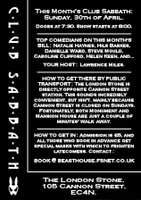
It's a standup comedy club night in a London pub, organised and compèred by my one-time editor and occasional collaborator Lawrence Miles.
[Edit to add:]
The pub is The London Stone 105 Cannon Street EC4N, which is located just opposite Cannon Street station -- although the nearest stations actually open on a Sunday are Monument and Mansion House, apparently.
(The pub seems to be named after an actual London Stone, which I'd never heard of before. It shows signs of being a goth pub -- or, even more worryingly, a wannabe-goth pub -- but that shouldn't affect the quality of the comedy one way or the other. Decent beer doesn't look noticeably likely.)
It's happening next Sunday evening, 30 April. Doors open at 7:30 (although quite how that works in the context of a pub I'm not too sure), and the comedy begins at 8. Price on the doors is £5, although it's been widely rumoured that anyone bringing a remote-control Dalek will get in at half price.
Lawrence's sense of humour is weird, eclectic and borderline psychotic, and the guest comedians -- Natalie Haynes, Hils Barker, Danielle Ward, Steve Mould, Caroline Clifford and Helen Keen -- seem to be well thought of. I've heard Ward on the radio, anyway, and she's certainly very funny. So it should be good for a laugh.
I'll be there, at least.


[Click on little images for big images.]
It's a standup comedy club night in a London pub, organised and compèred by my one-time editor and occasional collaborator Lawrence Miles.
[Edit to add:]
The pub is The London Stone 105 Cannon Street EC4N, which is located just opposite Cannon Street station -- although the nearest stations actually open on a Sunday are Monument and Mansion House, apparently.
(The pub seems to be named after an actual London Stone, which I'd never heard of before. It shows signs of being a goth pub -- or, even more worryingly, a wannabe-goth pub -- but that shouldn't affect the quality of the comedy one way or the other. Decent beer doesn't look noticeably likely.)
It's happening next Sunday evening, 30 April. Doors open at 7:30 (although quite how that works in the context of a pub I'm not too sure), and the comedy begins at 8. Price on the doors is £5, although it's been widely rumoured that anyone bringing a remote-control Dalek will get in at half price.
Lawrence's sense of humour is weird, eclectic and borderline psychotic, and the guest comedians -- Natalie Haynes, Hils Barker, Danielle Ward, Steve Mould, Caroline Clifford and Helen Keen -- seem to be well thought of. I've heard Ward on the radio, anyway, and she's certainly very funny. So it should be good for a laugh.
I'll be there, at least.
19 April 2006
Increase Your Mirth by 20%
Like Peculiar Times, Spamusement seems to have entered something of a lull recently.
I thought of this because one of the most ubiquitous pieces of junk email that I've been getting recently persists in informing me that "Ratess will skyrocket soon".
I wonder when it's going to happen? I imagine her sitting in her little cockpit, tiny flying-goggles on her furry face, as she courageously faces her pioneering destiny.
I thought of this because one of the most ubiquitous pieces of junk email that I've been getting recently persists in informing me that "Ratess will skyrocket soon".
I wonder when it's going to happen? I imagine her sitting in her little cockpit, tiny flying-goggles on her furry face, as she courageously faces her pioneering destiny.
Profound Apologies...
...for leaving this blog so long between updates at the moment. Life has been getting overly manic, what with two short fiction projects (which I'll tell you about once they're announced) due in at the end of next month. I'm quite pleased with what's come out of my head so far, but I'm not progressing as fast as I'd wish, and the two-week Easter break was altogether a bit of a panic.
I'm not going to get any more chatty in the short term, I'm afraid, but once those stories (and, with luck, the various other things that are busying me so incessantly at present) are out of the way, I should be able to waste your bandwidth with drivelly musings and book reviews once more. I have, at the very least, another good idea for an Invisible City to regale you with.
Sadly, real life (or, more accurately, fiction) will also be getting in the way of updating last year's Doctor Who viewing blog, Parrinium Mines, with my opinions on this year's series... at least for the moment. I'm still hoping I can come back to them later in the year, reviewing The Christmas Invasion through to Doomsday in time for this year's Christmas special. (I'm afraid my thoughts on The Christmas Invasion and New Earth are not entirely complimentary, but with any luck that will change as the season progresses and, erm, K-9 returns. Yes, that's probably likely.) I've also been watching, for research purposes, more episodes of very early Doctor Who than the human brain was designed to withstand, so hopefully I can also update those of you who choose to read Parrinium Mines on those at some stage.
Meanwhile I'm not getting a lot of time to read, but About Time 1 and The Dream Archipelago are keeping me entertained between them. And Season 5 of Buffy, while messy and overplotted, still makes me cry at the end, even though I've seen it four or five times already.
More anon. But, you know, possibly not very anon.
I'm not going to get any more chatty in the short term, I'm afraid, but once those stories (and, with luck, the various other things that are busying me so incessantly at present) are out of the way, I should be able to waste your bandwidth with drivelly musings and book reviews once more. I have, at the very least, another good idea for an Invisible City to regale you with.
Sadly, real life (or, more accurately, fiction) will also be getting in the way of updating last year's Doctor Who viewing blog, Parrinium Mines, with my opinions on this year's series... at least for the moment. I'm still hoping I can come back to them later in the year, reviewing The Christmas Invasion through to Doomsday in time for this year's Christmas special. (I'm afraid my thoughts on The Christmas Invasion and New Earth are not entirely complimentary, but with any luck that will change as the season progresses and, erm, K-9 returns. Yes, that's probably likely.) I've also been watching, for research purposes, more episodes of very early Doctor Who than the human brain was designed to withstand, so hopefully I can also update those of you who choose to read Parrinium Mines on those at some stage.
Meanwhile I'm not getting a lot of time to read, but About Time 1 and The Dream Archipelago are keeping me entertained between them. And Season 5 of Buffy, while messy and overplotted, still makes me cry at the end, even though I've seen it four or five times already.
More anon. But, you know, possibly not very anon.
05 April 2006
Scribonia
Scribonia, known to poets as the Tattooed City, is indistinguishable in most respects from any other provincial city. It has its business and its retail districts, its blocks of flats and townhouses, churches and mosques, its libraries and City Hall, in which its citizens talk and shop and sleep and go about their business. Examining the city from the air, or from a satellite, one would perceive little of note.
Close up, however, is a different story. For every building of Scribonia – each wall and windowsill, each slate and steeple – is covered with writing. Loops and curlicues and upstrokes smother every shopfront, every station and tenement. Fountains and statuary, pavements and rooftops: each surface, from the bridges’ lowest foundations to the steeple of the tallest church, is etched with curled, reticulated characters – the arcane alphabet used only by Scribonia’s Guild of Graffitists.
Scribonia’s public services department tries its best, but even with some thousands of the population in its direct employ, scrubbing and cleaning at the bricks and flagstones every day, they cannot keep pace with the assiduous encroachments of the Guild.
Nobody knows who runs the Guild, or if it even exists. Everyone assumes that the artful vandalism must be co-ordinated: the only sane alternative is that every citizen, municipal cleaners included, secretly carries around a can of paint or marker pen to fill in any gaps they find in the all-pervading script. It may be that – as one dissident politician has concluded – the city itself is generating the inscriptions, dreaming the writing into existence every night through the subconscious workings of its fevered citizens.
Nonetheless, many Scribonians yearn to join the hypothetical Guild, and aspiring graffitists often overlay the dense designs with their own crude scrawlings.
Others – the majority – have become obsessed with understanding what the graffiti says. Its alphabet bears no resemblance to any others known: and yet its students have detected patterns, repetition, dialogue – even the work of individual hands. Many have tried to learn the language: if any have succeeded, they do not acknowledge the fact. It may be that success confers de facto membership of the Guild, with all the burden of secrecy that implies.
One school of interpretation, known as the Esotericists, believes that the graffiti is a blueprint: a detailed description, complete with architectural measurements and outlines, of another city. This city coexists with Scribonia, pervading it in this encoded form. Parts of the written city are demolished daily by the tireless sponges of the scrubbers, yet they can be rebuilt, or new structures created to take their place, with a few flicks of a Guildmember’s pen.
What is this city like? The Esotericists agree that it must be a far more elevated, purer place than grimy, dull Scribonia: a city of pure thought, of inspiration, where style is given life, unhampered by the demands of substance.
One day, they say, this city will not merely deface the present Scribonia: one day, its sheer weight of information will come to overwrite the mundane city, and Scribonia’s dull matter will give way to the immaterial design. A new age of enlightenment will follow, and the citizens will exist in an eternal harmony of intellect.
There will be no place for graffiti then, of course.
--
Visit the Gazetteer of Invisible Cities at Blind Atlas
Close up, however, is a different story. For every building of Scribonia – each wall and windowsill, each slate and steeple – is covered with writing. Loops and curlicues and upstrokes smother every shopfront, every station and tenement. Fountains and statuary, pavements and rooftops: each surface, from the bridges’ lowest foundations to the steeple of the tallest church, is etched with curled, reticulated characters – the arcane alphabet used only by Scribonia’s Guild of Graffitists.
Scribonia’s public services department tries its best, but even with some thousands of the population in its direct employ, scrubbing and cleaning at the bricks and flagstones every day, they cannot keep pace with the assiduous encroachments of the Guild.
Nobody knows who runs the Guild, or if it even exists. Everyone assumes that the artful vandalism must be co-ordinated: the only sane alternative is that every citizen, municipal cleaners included, secretly carries around a can of paint or marker pen to fill in any gaps they find in the all-pervading script. It may be that – as one dissident politician has concluded – the city itself is generating the inscriptions, dreaming the writing into existence every night through the subconscious workings of its fevered citizens.
Nonetheless, many Scribonians yearn to join the hypothetical Guild, and aspiring graffitists often overlay the dense designs with their own crude scrawlings.
Others – the majority – have become obsessed with understanding what the graffiti says. Its alphabet bears no resemblance to any others known: and yet its students have detected patterns, repetition, dialogue – even the work of individual hands. Many have tried to learn the language: if any have succeeded, they do not acknowledge the fact. It may be that success confers de facto membership of the Guild, with all the burden of secrecy that implies.
One school of interpretation, known as the Esotericists, believes that the graffiti is a blueprint: a detailed description, complete with architectural measurements and outlines, of another city. This city coexists with Scribonia, pervading it in this encoded form. Parts of the written city are demolished daily by the tireless sponges of the scrubbers, yet they can be rebuilt, or new structures created to take their place, with a few flicks of a Guildmember’s pen.
What is this city like? The Esotericists agree that it must be a far more elevated, purer place than grimy, dull Scribonia: a city of pure thought, of inspiration, where style is given life, unhampered by the demands of substance.
One day, they say, this city will not merely deface the present Scribonia: one day, its sheer weight of information will come to overwrite the mundane city, and Scribonia’s dull matter will give way to the immaterial design. A new age of enlightenment will follow, and the citizens will exist in an eternal harmony of intellect.
There will be no place for graffiti then, of course.
--
Visit the Gazetteer of Invisible Cities at Blind Atlas
30 March 2006
Beer Pressure
Had a thoroughly enjoyable time last weekend with Silk and his good lady Kate, who it's very lovely to see back together again after a recent period of dithering. We'd been planning, originally, to go to the Bristol Beer Festival, but unfortunately the tickets sold out in record time months ago. The centrepiece of the weekend was therefore a linear pub crawl from North Bristol back to our house, starting at about 1pm and finishing at 10:30pm because we wanted to get chips on the way home.
Present: self, B., Silk, Kate, my friend Anthony and Kate's friend Vaughn. Ants was with us until 7ish, when he had to return home to Petersfield and his wife and daughter. Vaughn joined us in a pub or two. B.'s stamina failed her at about 8:30 (well, she's been working hard recently), and she took a bus home.
Itinerary of pubs visited:
1. The Hare on the Hill. Very pleasant small pub owned by Bath Ales, whose available varieties we sampled all of between us. I had the S.P.A. Bath are my favourite local brewers' since Smiles went tits-up (of which more anon), and The Hare is one of their four pubs in Bristol, all of which are excellent. They do very nice crisps, too.
2. Micawber's Ale House. A solid traditional pub with some good real ales and musical tastes running oddly to 70s disco. I had a pint of Brains S.A., I think, although at this point I still hadn't had lunch and was getting a bit light-headed. We therefore repaired to...
3. Zerodegrees. Local branch of a chain of two microbreweries-cum-nightclubs (apparently a third is opening in Reading sometime soon), which I've had cause to mention here before. This was included largely for the excellent pizzas, of which we had several. On the beer front I drank the black lager, which is always Mmmmm, and the overly sweet mango beer, which I wasn't nearly drunk enough to enjoy.
4. A diversion to the recently-reopened Smiles Brewery Tap, which was deeply disappointing. Smiles closed down last year and has been bought out by Highgate, who don't seem on the evidence we sampled to be brewing the beers to anything like the same standard. (It's also no longer brewed on the premises, making the pub's name a bit of a misnomer.) They sold us chocolate, though.
5. The Bank. We'd never been here before, but it stood in at the last minute for The Three Sugar Loaves, which was unexpectedly closed. I can't remember what I had to drink -- whatever the guest ale was, I assume, but things were becoming pleasantly fuzzy by this stage. We played dominoes, and listened to Guns'n'Roses singing "Live and Let Die" on the juke box.
6. The Cornubia. One of the major highlights of Bristol's real ale scene. The Cornubia always has half a dozen different real ales on tap, and half of them are generally very obscure. I have no idea what I drank here, but it was bloody good. We ran into some loud refugees from the Beer Festival, and a random Doctor Who author was working behind the bar. Ants left and Vaughn joined us, after a certain amount of getting lost.
7. The Shakespeare. One of no fewer than four pubs of that name in Bristol. (B. and I used to go to pub quizzes at The Shakespeare when we lived nearby, and we occasionally met up for lunch at the daringly-named Ye Shakespeare when we both worked in town. I hadn't heard of The Shakespeare until just now, though.[Edit 31/2/6: No, I'm wrong -- we went there when we went to Glasnost one time. I hadn't realised that was what it was called, but under the circumstances I should probably have expected it. Anyway...]) The one in Prince Street has a banner outside boasting of its real ales, and does indeed do some very nice ones. Reconstructing my probable state of mind at the time, I imagine I had the Greene King I.P.A., but I can't swear to it. I remember crisps, though. Vaughn and B. both left us after this one. Personally I was impressed that any of us had lasted this long.
8. The Coronation. One of our two locals, in the sense that it's within reasonable walking distance of us and we go there sometimes. (They do a free cheeseboard on a Sunday.) Owned by Hop Back, and selling a fine selection of their splendid beers. Again, I forget what I had -- possibly the Odyssey. Distressingly, though, they'd stopped doing food.
9. The Tobacco Factory. Our other kind-of-local, and our last stop before the chip shop. They sell Bristol Beer Factory beers, which are very tasty. I drank the Red, which for some reasons isn't listed on the website, but is my favourite of their beers.
By this point I was feeling extremely hungry, so we bought chips and pasties, came home and watched as many episodes of series one of Look Around You as we could before we fell over.
We followed this up on Sunday with a relatively tame trip to The Boston Tea Party and Bristol City Museum.
Present: self, B., Silk, Kate, my friend Anthony and Kate's friend Vaughn. Ants was with us until 7ish, when he had to return home to Petersfield and his wife and daughter. Vaughn joined us in a pub or two. B.'s stamina failed her at about 8:30 (well, she's been working hard recently), and she took a bus home.
Itinerary of pubs visited:
1. The Hare on the Hill. Very pleasant small pub owned by Bath Ales, whose available varieties we sampled all of between us. I had the S.P.A. Bath are my favourite local brewers' since Smiles went tits-up (of which more anon), and The Hare is one of their four pubs in Bristol, all of which are excellent. They do very nice crisps, too.
2. Micawber's Ale House. A solid traditional pub with some good real ales and musical tastes running oddly to 70s disco. I had a pint of Brains S.A., I think, although at this point I still hadn't had lunch and was getting a bit light-headed. We therefore repaired to...
3. Zerodegrees. Local branch of a chain of two microbreweries-cum-nightclubs (apparently a third is opening in Reading sometime soon), which I've had cause to mention here before. This was included largely for the excellent pizzas, of which we had several. On the beer front I drank the black lager, which is always Mmmmm, and the overly sweet mango beer, which I wasn't nearly drunk enough to enjoy.

4. A diversion to the recently-reopened Smiles Brewery Tap, which was deeply disappointing. Smiles closed down last year and has been bought out by Highgate, who don't seem on the evidence we sampled to be brewing the beers to anything like the same standard. (It's also no longer brewed on the premises, making the pub's name a bit of a misnomer.) They sold us chocolate, though.
5. The Bank. We'd never been here before, but it stood in at the last minute for The Three Sugar Loaves, which was unexpectedly closed. I can't remember what I had to drink -- whatever the guest ale was, I assume, but things were becoming pleasantly fuzzy by this stage. We played dominoes, and listened to Guns'n'Roses singing "Live and Let Die" on the juke box.
6. The Cornubia. One of the major highlights of Bristol's real ale scene. The Cornubia always has half a dozen different real ales on tap, and half of them are generally very obscure. I have no idea what I drank here, but it was bloody good. We ran into some loud refugees from the Beer Festival, and a random Doctor Who author was working behind the bar. Ants left and Vaughn joined us, after a certain amount of getting lost.
7. The Shakespeare. One of no fewer than four pubs of that name in Bristol. (B. and I used to go to pub quizzes at The Shakespeare when we lived nearby, and we occasionally met up for lunch at the daringly-named Ye Shakespeare when we both worked in town. I hadn't heard of The Shakespeare until just now, though.[Edit 31/2/6: No, I'm wrong -- we went there when we went to Glasnost one time. I hadn't realised that was what it was called, but under the circumstances I should probably have expected it. Anyway...]) The one in Prince Street has a banner outside boasting of its real ales, and does indeed do some very nice ones. Reconstructing my probable state of mind at the time, I imagine I had the Greene King I.P.A., but I can't swear to it. I remember crisps, though. Vaughn and B. both left us after this one. Personally I was impressed that any of us had lasted this long.
8. The Coronation. One of our two locals, in the sense that it's within reasonable walking distance of us and we go there sometimes. (They do a free cheeseboard on a Sunday.) Owned by Hop Back, and selling a fine selection of their splendid beers. Again, I forget what I had -- possibly the Odyssey. Distressingly, though, they'd stopped doing food.
9. The Tobacco Factory. Our other kind-of-local, and our last stop before the chip shop. They sell Bristol Beer Factory beers, which are very tasty. I drank the Red, which for some reasons isn't listed on the website, but is my favourite of their beers.
By this point I was feeling extremely hungry, so we bought chips and pasties, came home and watched as many episodes of series one of Look Around You as we could before we fell over.
We followed this up on Sunday with a relatively tame trip to The Boston Tea Party and Bristol City Museum.
24 March 2006
Quickie
Just a brief post, to confirm that I haven't forgotten about this blog's existence. I've got an action-packed (well, pub-packed) weekend in the offing, so I probably won't get time to update it again until next week now.
In the meantime, and following on from the Invisible Cities meme, allow me somewhat belatedly to commend to you the blog of the incredibly gifted Simon Bucher-Jones, complete with songs, poetry and his own entry in that same pseudocartographic canon. Some good people -- nominally including myself -- are also attempting to collect, index and create material of this general ilk at Blind Atlas. There should be more exciting stuff arriving there at some point soon.
In the meantime, and following on from the Invisible Cities meme, allow me somewhat belatedly to commend to you the blog of the incredibly gifted Simon Bucher-Jones, complete with songs, poetry and his own entry in that same pseudocartographic canon. Some good people -- nominally including myself -- are also attempting to collect, index and create material of this general ilk at Blind Atlas. There should be more exciting stuff arriving there at some point soon.
15 March 2006
Luton Beds England
...So how many U.K. county abbreviations are also verbs? I can think of Bedforshire (see above), Wiltshire ("Swindon Wilts"), Huntingdonshire ("Ramsey Hunts"), Buckinghamshire ("Aylesbury Bucks") and I suppose Staffordshire (er, "Lichfield Staffs"). Including homophones allows for Hertfordshire ("Watford Herts"), Lincolnshire ("Boston Lincs") and, just possibly, Worcestershire ("Malvern Worcs") and Warwickshire ("Kirsty Kingsbury Warks").
Yorkshire only counts if you believe The Meaning of Liff ("Jasmine yorked politely, loathing him to the depths of her being"), which is obviously cheating.
It's only the shires that even have abbreviations, isn't it? Except that I think Glamorgan may be "Glam". Ironically.
I'm ashamed to say that there are entire counties in Scotland I've never even heard of. They made Kincardineshire up, surely?
I'm really tired.
Yorkshire only counts if you believe The Meaning of Liff ("Jasmine yorked politely, loathing him to the depths of her being"), which is obviously cheating.
It's only the shires that even have abbreviations, isn't it? Except that I think Glamorgan may be "Glam". Ironically.
I'm ashamed to say that there are entire counties in Scotland I've never even heard of. They made Kincardineshire up, surely?
I'm really tired.
13 March 2006
Masks and Machines
I've made a smallish update to the website today, adding to the A Life Worth Living pages my rejected story submissions for Big Finish's most recent follow-up volume, Something Changed. There are plot spoilers for the book, but as it's been out a while now I'm assuming that that shouldn't be a huge problem for anybody, given the appropriate amount of warning.
While I fully respect the editor Simon Guerrier's judgement about which submissions were going to fit into the volume and which wouldn't, I do feel slightly wistful reading these again, as any of the three would have been huge fun to write. Ah, well.
You can read the first chapter of Something Changed online at the Big Finish site.
B. and I went to see Neil Gaiman and Dave McKean's stunning Mirrormask at the Watershed on Saturday. It's a mindblowingly good film -- if you've ever marvelled at the visual texture and general bloody weirdness of McKean's art, then seeing it translated into a fully realised animated world with actors walking around in it is unmissable. Gaiman's schizoid fairy-tale of a script was equally magnificent, although I'm not entirely sure about the ending.
[SPOILERS follow -- highlight the whitespace to read:]
During her time in the otherworld, Helena has been watching the Shadow Princess living her life for her: arguing with her father, dating unsuitable boys, burning her artwork and generally acting out. Helena's trapped sensation as she gazes out at this, helpless to intervene, is a powerful metaphor for the the tiny trace of rationality left in our psyches during our years of hormone-fuelled teenage excess -- which in Helena's case we know to be exacerbated by her mother's illness.
Unfortunately, the metaphor is de-clawed, and the plot rendered somewhat nonsensical, by the revelation at the end that only a night has passed while Helena has been in the otherworld, and that her mother is recovering fine from her operation. I couldn't help feeling that a more fitting, more emotionally honest and generally more Gaimanesque ending would have had Helena returning to a world where her mother's operation had been a failure, and where the Princess's actions had consequences for Helena to deal with.
[SPOILERS finish.]
Still a marvellous film, though, and one I'd recommend to more or less everybody likely to be reading this.
While I fully respect the editor Simon Guerrier's judgement about which submissions were going to fit into the volume and which wouldn't, I do feel slightly wistful reading these again, as any of the three would have been huge fun to write. Ah, well.
You can read the first chapter of Something Changed online at the Big Finish site.
B. and I went to see Neil Gaiman and Dave McKean's stunning Mirrormask at the Watershed on Saturday. It's a mindblowingly good film -- if you've ever marvelled at the visual texture and general bloody weirdness of McKean's art, then seeing it translated into a fully realised animated world with actors walking around in it is unmissable. Gaiman's schizoid fairy-tale of a script was equally magnificent, although I'm not entirely sure about the ending.
[SPOILERS follow -- highlight the whitespace to read:]
During her time in the otherworld, Helena has been watching the Shadow Princess living her life for her: arguing with her father, dating unsuitable boys, burning her artwork and generally acting out. Helena's trapped sensation as she gazes out at this, helpless to intervene, is a powerful metaphor for the the tiny trace of rationality left in our psyches during our years of hormone-fuelled teenage excess -- which in Helena's case we know to be exacerbated by her mother's illness.
Unfortunately, the metaphor is de-clawed, and the plot rendered somewhat nonsensical, by the revelation at the end that only a night has passed while Helena has been in the otherworld, and that her mother is recovering fine from her operation. I couldn't help feeling that a more fitting, more emotionally honest and generally more Gaimanesque ending would have had Helena returning to a world where her mother's operation had been a failure, and where the Princess's actions had consequences for Helena to deal with.
[SPOILERS finish.]
Still a marvellous film, though, and one I'd recommend to more or less everybody likely to be reading this.
11 March 2006
Neath
You get a better class of meme with Mr Chapman. I don't know where Neath is in relation to Polopolis, Spindlemarch or Velocester (and I can't remember whether Calvino already did this one). Nevertheless...
Neath is a mining town, a city build by those who toil in the ground. Beneath the surface of the plain where it lies, broad thoroughfares and narrow back-alleys warren the earth, thronged by people and vehicles. Manholes above them provide access to the upper world: during the last century, ventilation holes were also added, fitted with powerful fans, to draw away the fumes of cars and motorcycles.
Houses and shops are bricked-off caverns next to these thoroughfares, each with its windows to the surface letting in the sun: from the air, Neath is a variegated tabletop of earth and glass.
The grander, more imposing structures burrow further beneath the city. The cathedral is a vast, vaulted cellar, hundreds of metres deep, its steeple a spike thrust far down into the earth. Tenement slums and office blocks, artificially lit and ventilated, delve many stories downward, the grimiest apartments and most prestigious meeting-rooms down in the depths. The mining magnates lounge, bloated and pallid, deep down in their geothermal penthouse suites.
The city’s squares and plazas are roofed with earth and stone, held up with many pillars. Civic statuary in Neath tends to be modest in stature, and Atlas a common subject for sculptors. Along the boulevards and avenues flap stunted pigeons, flashing in and out of lightwells, avoiding obstacles.
The few significant regional roads which run through Neath plunge down ramps as they reach the city’s outlying suburbs, buses and lorries entering these subterranean streets to drop off or pick up their loads. Popular goods in Neath include televisions, fans and light, airy clothes: there is little market for heaters, scarves or rotary washing-lines. The city’s major exports are iron and root vegetables.
Neath is a city in reflection, a city flipped head-to-toe. Above the ground, electric cables, water-pipes and phone-lines mesh and interlink: broad channels carry sewage down to the lake. Municipal workers, dressed in waterproof coveralls, blink myopically as they wade the length of them. Here and there wine-racks and storage-cellars stand exposed to the air.
Overground stations, accessed by escalators from the streets below, send trains hurtling along specially-constructed superterranean rail-lines from city-block to city-block. Inside them, the passengers huddle, agoraphobic and exposed. Neath’s inhabitants are diminutive, timid and nervous with prominent ears. Their noses twitch compulsively, as they inhale the unfamiliar scents of the outside.
Neath is a mining town, a city build by those who toil in the ground. Beneath the surface of the plain where it lies, broad thoroughfares and narrow back-alleys warren the earth, thronged by people and vehicles. Manholes above them provide access to the upper world: during the last century, ventilation holes were also added, fitted with powerful fans, to draw away the fumes of cars and motorcycles.
Houses and shops are bricked-off caverns next to these thoroughfares, each with its windows to the surface letting in the sun: from the air, Neath is a variegated tabletop of earth and glass.
The grander, more imposing structures burrow further beneath the city. The cathedral is a vast, vaulted cellar, hundreds of metres deep, its steeple a spike thrust far down into the earth. Tenement slums and office blocks, artificially lit and ventilated, delve many stories downward, the grimiest apartments and most prestigious meeting-rooms down in the depths. The mining magnates lounge, bloated and pallid, deep down in their geothermal penthouse suites.
The city’s squares and plazas are roofed with earth and stone, held up with many pillars. Civic statuary in Neath tends to be modest in stature, and Atlas a common subject for sculptors. Along the boulevards and avenues flap stunted pigeons, flashing in and out of lightwells, avoiding obstacles.
The few significant regional roads which run through Neath plunge down ramps as they reach the city’s outlying suburbs, buses and lorries entering these subterranean streets to drop off or pick up their loads. Popular goods in Neath include televisions, fans and light, airy clothes: there is little market for heaters, scarves or rotary washing-lines. The city’s major exports are iron and root vegetables.
Neath is a city in reflection, a city flipped head-to-toe. Above the ground, electric cables, water-pipes and phone-lines mesh and interlink: broad channels carry sewage down to the lake. Municipal workers, dressed in waterproof coveralls, blink myopically as they wade the length of them. Here and there wine-racks and storage-cellars stand exposed to the air.
Overground stations, accessed by escalators from the streets below, send trains hurtling along specially-constructed superterranean rail-lines from city-block to city-block. Inside them, the passengers huddle, agoraphobic and exposed. Neath’s inhabitants are diminutive, timid and nervous with prominent ears. Their noses twitch compulsively, as they inhale the unfamiliar scents of the outside.
09 March 2006
Who in Review
I'm a little baffled by the mention given to my short story "The Long Midwinter" in the latest Doctor Who Magazine's review of Short Trips: The History of Christmas.
Matt Michael obviously feels under pressure to mention every story in the collection, which given 24 stories and a 500-word review is naturally a bit of a challenge. Under such circumstances, it would be understandable if he chose to skip most of them, instead concentrating on a paragraph or so about the four or five that have obviously fired his imagination.
Rather gamely, though, he tries to cram them all in, with the result that some of his comments are somewhat... elliptical. The sentence which mentions "The Long Midwinter" does so in the context of it being one of four stories which, like Richard Salter's "Callahuanca", employs "the theme of the Doctor fulfilling a promise".
I'm certainly not offended or annoyed by this -- just puzzled. Because the Doctor keeping a promise isn't a theme in "The Long Midwinter". As far as I can recall, it isn't even an event in "The Long Midwinter". The Doctor does some people a favour -- which is the sort of thing he tends to do anyway -- but there are no promises involved. I'd love to know what Matt had in mind here.
He's kind enough, though, to say that there "aren't any stinkers" in the collection, which is pleasing. And it's good that he finds the space to praise Jonathan Clement's lovely story "Ode to Joy", which fully deserves it.
Matt Michael obviously feels under pressure to mention every story in the collection, which given 24 stories and a 500-word review is naturally a bit of a challenge. Under such circumstances, it would be understandable if he chose to skip most of them, instead concentrating on a paragraph or so about the four or five that have obviously fired his imagination.
Rather gamely, though, he tries to cram them all in, with the result that some of his comments are somewhat... elliptical. The sentence which mentions "The Long Midwinter" does so in the context of it being one of four stories which, like Richard Salter's "Callahuanca", employs "the theme of the Doctor fulfilling a promise".
I'm certainly not offended or annoyed by this -- just puzzled. Because the Doctor keeping a promise isn't a theme in "The Long Midwinter". As far as I can recall, it isn't even an event in "The Long Midwinter". The Doctor does some people a favour -- which is the sort of thing he tends to do anyway -- but there are no promises involved. I'd love to know what Matt had in mind here.
He's kind enough, though, to say that there "aren't any stinkers" in the collection, which is pleasing. And it's good that he finds the space to praise Jonathan Clement's lovely story "Ode to Joy", which fully deserves it.
08 March 2006
Game Plan
OK, so the brief political thought which follows would probably count as a conspiracy theory, if it were well enough thought through to count as a theory. And as such someone else may have thought of it already anyway.
But... I was reading this story in The Guardian, and I came upon the following quote from the U.S. ambassador to Iraq:
And then the aggressive war-game player in me thought, "That's a damn good strategy. Set up a contained arena far away from your own territory, provoke your most dangerous opponents into killing each other there, and then withdraw and leave them to it. Sure, you'll need to take on the victor eventually, but by that time you'll be in such a strong position they won't stand a chance."
Admittedly it involves some American fatalities in the meantime, but it's always been clear that this was an acceptable risk in achieving whatever the long-term goal actually is. The disruption of the oil supply might be considered a more serious concern (and it's one which Risk doesn't model, although as I recall Supremacy has a decent stab at it), but the U.S. has been making some serious effort recently to identify sources elsewhere, especially in its own oil-rich states of Texas and Alaska.
Taking it as read for the moment that George Bush is a man of -- at best -- short-sighted morals, who is advised by people very much more intelligent and ruthless than he is... how implausible is it, honestly, that this might be the long-term plan they have in mind? In these days of militant, outward-looking Islam, statesmen of Bush's father's generation must look back with some nostalgia to the good old days of the Iran-Iraq war.
Hell, it's what I'd do. Assuming, of course, that this was a board game.
But... I was reading this story in The Guardian, and I came upon the following quote from the U.S. ambassador to Iraq:
Mr Khalilzad suggested the situation [in Iraq] was so dangerous that without a substantial US presence, a civil war could suck in other Arab countries on the side of the Sunnis and Iran on the side of the Shias, creating conditions for a regional conflict and disrupting global oil supplies. "That would make Taliban Afghanistan look like child's play," he said.And the self-centred Westerner in me thought, "Well, at least that would keep them all occupied."
And then the aggressive war-game player in me thought, "That's a damn good strategy. Set up a contained arena far away from your own territory, provoke your most dangerous opponents into killing each other there, and then withdraw and leave them to it. Sure, you'll need to take on the victor eventually, but by that time you'll be in such a strong position they won't stand a chance."
Admittedly it involves some American fatalities in the meantime, but it's always been clear that this was an acceptable risk in achieving whatever the long-term goal actually is. The disruption of the oil supply might be considered a more serious concern (and it's one which Risk doesn't model, although as I recall Supremacy has a decent stab at it), but the U.S. has been making some serious effort recently to identify sources elsewhere, especially in its own oil-rich states of Texas and Alaska.
Taking it as read for the moment that George Bush is a man of -- at best -- short-sighted morals, who is advised by people very much more intelligent and ruthless than he is... how implausible is it, honestly, that this might be the long-term plan they have in mind? In these days of militant, outward-looking Islam, statesmen of Bush's father's generation must look back with some nostalgia to the good old days of the Iran-Iraq war.
Hell, it's what I'd do. Assuming, of course, that this was a board game.
05 March 2006
Bx
I'm reading two first novels at the moment, from authors whose later work I admire, and finding them variously disappointing.
Well, actually David Mitchell's Ghostwritten isn't all that disappointing -- in fact it's very good. It's just that his later Cloud Atlas uses many of the same ideas, but takes them very much further, so that Ghostwritten feels a bit seen-it-all-before. If I'd read this in 1999, when it came out, I'd probably have been captivated.
Like Cloud Atlas, Ghostwritten is divided into sections, each with a different first-person narrator, with a large number of subliminal, but very few overt, connections between the narratives. Ghostwritten takes us on a geographical progress, from an outlying Japanese island off Okinawa right the way across Eurasia to an outlying island off the Irish coast, and thence to the U.S. I'm currently on the eighth of the nine main narratives (the tenth being a coda which returns us to the narrator of the first), with an Irish physicist who holds in her head the secrets of quantum computing, and possibly also a Grand Unified Theory of Everything, returning to the Gaelic-speaking rural island of her birth and her blind harpist husband.
Blind Irish harpists in literature are always a step too symbolic for me, I'm afraid, and in general Ghostwritten is just that shade less subtle and more obvious than the sublimely wonderful Cloud Atlas. In its favour, its narrative progress is tighter and more controlled, with characters from certain narratives turning up in later ones, and events in one having consequences, of one kind or another, in the next. Cloud Atlas feels more like a series of interconnected short stories, although its grand historical sweep -- running from the South Seas in the 1840s to a post-apocalyptic far-future -- is concomitantly more ambitious and impressive. Cloud Atlas is a story about the slow failure of human civilisation, in which reincarnation may play a part, while Ghostwritten, though not without millennial and mystical overtones, focuses on the personal more than the political.
That said, many of the individual narratives are engrossing, and their human stories involving: the descriptions of cities, islands and mountains carry effortless conviction. The S.F. elements of Cloud Atlas -- which it would be difficult to describe as belonging in any sense to an S.F. novel -- are prefigured by the matter-of-fact treatment given one of Ghostwritten's more eponymous narrators, a walk-in spirit who possesses a total of nine human beings in the course of its narrative, before reaching its own variant of closure. (As with most of the closure in this book, though, it leaves you eager to find out what happened next.)
I'm clearly not in a position to assess Ghostwritten properly until I've finished it, but all the evidence so far suggests that it was, indeed, a very fine debut novel. It's just that the author is fortunate enough to have surpassed it since, and that I've been unfortunate enough to read the two in the wrong order.
Wanting a touch of the exciting and exotic whilst reading Ghostwritten, I turned to one of the S.F. novels I picked up recently from my Dad: Four Hundred Billion Stars by Paul J. McAuley. This one was the real disappointment: so far I'm just over halfway through, and really struggling with it.
I'm a big fan of most of the McAuley books I've read. Pasquale's Angel is fantastic, a really exciting and convincing alternative history. Red Dust is an outstanding evocation of a future Mars as a long-established colony of China. Eye of the Tyger is similarly impressive, and for my money one of the best Doctor Who novellas Telos published, although strangely underappreciated by Doctor Who fans[1]. The only novel of his which has left me rather less whelmed has been Child of the River, which somehow failed to engage me and left me with little desire to read the other two books in the Confluence trilogy.
In all of the above, however, setting and character are central: each (Child of the River not excepted) explores a vivid and well-thought-out environment through the viewpoint of a convincing and engaging protagonist. Four Hundred Billion Stars (henceforth 4×10¹¹S) seems to be trying to do the same thing, but founders on the unfortunate facts that its setting is dull and leaden, and its protagonist lumpen and unlikeable. In theory it's a planetary romance, in that a planet is being explored, but the exploration it describes is so flat and uninvolving that I'm getting the impression even the author found it difficult to engage with.
The novel is self-consciously in the hard S.F. tradition, and -- perhaps because the first-time author was too diffident about his intended audience -- seems to be downplaying the possibility that its characters might have any actual character. There've been some heavy-handed hints that a revelation concerning the protagonist's last parting with her family is planned, but on the whole I find it difficult to see why I should care. Perhaps I'm meant to be getting excited by the science (mostly biology and astronomy) of it all, but so far that's provided barely a glimmer of interest.
Naturally one doesn't expect every successful author to hit a home run on their first attempt as Mitchell did... but evidently 4×10¹¹S tied with Rudy Rucker's enormously better Wetware to win the 1988 Philip K. Dick Award[2]. Failing a breathtaking upturn in the second half I'm frankly baffled as to why, unless the judging committee saw signs of future promise which have altogether passed me by. There are Doctor Who books not even by Paul McAuley which are vastly superior to this.
It does, however, share a universe with at least two other McAuley novels (Secret Harmonies and Eternal Light) and sundry short stories. On these grounds I feel that I probably ought to persevere with it, although it may prove to be the equivalent of reading Rocannon's World in order to understand The Left Hand of Darkness and The Dispossessed.
[1] It also contains a character called "Tx", hence my somewhat eccentric choice of title.
[2] You know, I really hope they call those "The Phils", rather than... never mind.
Well, actually David Mitchell's Ghostwritten isn't all that disappointing -- in fact it's very good. It's just that his later Cloud Atlas uses many of the same ideas, but takes them very much further, so that Ghostwritten feels a bit seen-it-all-before. If I'd read this in 1999, when it came out, I'd probably have been captivated.
Like Cloud Atlas, Ghostwritten is divided into sections, each with a different first-person narrator, with a large number of subliminal, but very few overt, connections between the narratives. Ghostwritten takes us on a geographical progress, from an outlying Japanese island off Okinawa right the way across Eurasia to an outlying island off the Irish coast, and thence to the U.S. I'm currently on the eighth of the nine main narratives (the tenth being a coda which returns us to the narrator of the first), with an Irish physicist who holds in her head the secrets of quantum computing, and possibly also a Grand Unified Theory of Everything, returning to the Gaelic-speaking rural island of her birth and her blind harpist husband.
Blind Irish harpists in literature are always a step too symbolic for me, I'm afraid, and in general Ghostwritten is just that shade less subtle and more obvious than the sublimely wonderful Cloud Atlas. In its favour, its narrative progress is tighter and more controlled, with characters from certain narratives turning up in later ones, and events in one having consequences, of one kind or another, in the next. Cloud Atlas feels more like a series of interconnected short stories, although its grand historical sweep -- running from the South Seas in the 1840s to a post-apocalyptic far-future -- is concomitantly more ambitious and impressive. Cloud Atlas is a story about the slow failure of human civilisation, in which reincarnation may play a part, while Ghostwritten, though not without millennial and mystical overtones, focuses on the personal more than the political.
That said, many of the individual narratives are engrossing, and their human stories involving: the descriptions of cities, islands and mountains carry effortless conviction. The S.F. elements of Cloud Atlas -- which it would be difficult to describe as belonging in any sense to an S.F. novel -- are prefigured by the matter-of-fact treatment given one of Ghostwritten's more eponymous narrators, a walk-in spirit who possesses a total of nine human beings in the course of its narrative, before reaching its own variant of closure. (As with most of the closure in this book, though, it leaves you eager to find out what happened next.)
I'm clearly not in a position to assess Ghostwritten properly until I've finished it, but all the evidence so far suggests that it was, indeed, a very fine debut novel. It's just that the author is fortunate enough to have surpassed it since, and that I've been unfortunate enough to read the two in the wrong order.
Wanting a touch of the exciting and exotic whilst reading Ghostwritten, I turned to one of the S.F. novels I picked up recently from my Dad: Four Hundred Billion Stars by Paul J. McAuley. This one was the real disappointment: so far I'm just over halfway through, and really struggling with it.
I'm a big fan of most of the McAuley books I've read. Pasquale's Angel is fantastic, a really exciting and convincing alternative history. Red Dust is an outstanding evocation of a future Mars as a long-established colony of China. Eye of the Tyger is similarly impressive, and for my money one of the best Doctor Who novellas Telos published, although strangely underappreciated by Doctor Who fans[1]. The only novel of his which has left me rather less whelmed has been Child of the River, which somehow failed to engage me and left me with little desire to read the other two books in the Confluence trilogy.
In all of the above, however, setting and character are central: each (Child of the River not excepted) explores a vivid and well-thought-out environment through the viewpoint of a convincing and engaging protagonist. Four Hundred Billion Stars (henceforth 4×10¹¹S) seems to be trying to do the same thing, but founders on the unfortunate facts that its setting is dull and leaden, and its protagonist lumpen and unlikeable. In theory it's a planetary romance, in that a planet is being explored, but the exploration it describes is so flat and uninvolving that I'm getting the impression even the author found it difficult to engage with.
The novel is self-consciously in the hard S.F. tradition, and -- perhaps because the first-time author was too diffident about his intended audience -- seems to be downplaying the possibility that its characters might have any actual character. There've been some heavy-handed hints that a revelation concerning the protagonist's last parting with her family is planned, but on the whole I find it difficult to see why I should care. Perhaps I'm meant to be getting excited by the science (mostly biology and astronomy) of it all, but so far that's provided barely a glimmer of interest.
Naturally one doesn't expect every successful author to hit a home run on their first attempt as Mitchell did... but evidently 4×10¹¹S tied with Rudy Rucker's enormously better Wetware to win the 1988 Philip K. Dick Award[2]. Failing a breathtaking upturn in the second half I'm frankly baffled as to why, unless the judging committee saw signs of future promise which have altogether passed me by. There are Doctor Who books not even by Paul McAuley which are vastly superior to this.
It does, however, share a universe with at least two other McAuley novels (Secret Harmonies and Eternal Light) and sundry short stories. On these grounds I feel that I probably ought to persevere with it, although it may prove to be the equivalent of reading Rocannon's World in order to understand The Left Hand of Darkness and The Dispossessed.
[1] It also contains a character called "Tx", hence my somewhat eccentric choice of title.
[2] You know, I really hope they call those "The Phils", rather than... never mind.
02 March 2006
Phil: My Head, With Nonsense
Occasionally -- generally after partaking too liberally of caffeinated beverages -- I find my cranium invaded by thoughts which would seem more at home inside Colin's head.
For instance, what part of a rat is the zinger? Is it the same as the dinger? And what are the similarities between a rat and a schroe?
(The Head wouldn't have provided the explanatory links there, of course. I should be more disciplined about leaving these things as an exercise for the head-reader.)
Sadly, the River Exe and the River Wye turn out not to be at right angles to one another at all.
For instance, what part of a rat is the zinger? Is it the same as the dinger? And what are the similarities between a rat and a schroe?
(The Head wouldn't have provided the explanatory links there, of course. I should be more disciplined about leaving these things as an exercise for the head-reader.)
Sadly, the River Exe and the River Wye turn out not to be at right angles to one another at all.
27 February 2006
More TV
I didn't realise it at the time, but when I last mentioned B.'s and my epic Buffy rewatch, we were precisely halfway through the 144 episodes of the series, poised equidistant between the early promise of Welcome to the Hellmouth and the touching climax of Chosen.
Since then we've finished watching Season Four, culminating in the wonderful triptych of The Yoko Factor, Primeval and Restless. I'm amazed by how much better the season is than I remembered it -- I recently argued at some length to a friend (sorry about that, Silk) that it was the show's worst year, but leaving aside the dodgy start (arising mainly from ditching the high-school format and two of the regular characters) and the limp "acting" of Marc Blucas as Riley, it pretty much rocks.
After starting off the season looking terribly depleted after Angel and Cordelia's departures, and despite the additional blow of losing Seth Green's magnificent Oz halfway through, by the end of the season the regular cast feels very strong again. Admittedly the addition of Riley has done little to help, but Anya is still wonderfully acerbic, Spike is uniquely Spike, and Amber Benson blends awkwardness, power and an entirely different kind of hot-chickery as Tara. Moreover, this is the season where Willow grows up, losing her most vulnerable edges and gaining social grace as a functional adult. Even Adam has a screen presence and a cool quotient which -- Spike being the only possible exception -- no other villain on the show can match.
Admittedly the arc story leaves something to be desired -- namely, anything much by way of plot complexity -- and the half-time removal of a key player in Maggie Walsh makes what there is seem less coherent than it ought to be. But the basic conception of the Initiative, and its culmination in Adam, manage to depart from the formula (so far as there is one) for Buffy villains whilst making fine intuitive sense. I also love the way in which -- although this is never flagged in the episode in question -- the vital information used to defeat Adam (the location of his uranium power core) comes to the heroes courtesy of Jonathan during his ego-trip in Superstar.
There are some outstandingly good episodes in there, among them the silent-comedy-horror Hush, the painfully character-driven diptych of This Year's Girl and Who Are You, the hilarious Superstar and finally what may be the single best story of the series (or its most self-indulgent embarrassment, depending on who you talk to), the episode-length dream-sequence Restless. Even the episodes I remembered as pretty feeble -- Fear Itself, for instance, or Where the Wild Things Are -- have a lot to recommend them by way of jokes and character moments. (I've always had a soft spot for Beer Bad, despite the fact that it's widely considered the worst Buffy episode of all, so I won't comment on that lest I come across as an indiscriminate Whedonist cheerleader.)
So... an unexpected amount of enjoyment, there, which I hope will continue into the remaining seasons -- all of which, like this one, are slightly dodgy in their disparate ways. Which means it's time for Buffy's most accomplished genre parody, Buffy Vs Dracula, and the arrival of Dawn. I'll keep you updated.
Oh, and in not entirely unrelated news -- so OK, yes, on reflection I probably am a Whedon groupie -- our Serenity DVD arrived today. Wahey!
Since then we've finished watching Season Four, culminating in the wonderful triptych of The Yoko Factor, Primeval and Restless. I'm amazed by how much better the season is than I remembered it -- I recently argued at some length to a friend (sorry about that, Silk) that it was the show's worst year, but leaving aside the dodgy start (arising mainly from ditching the high-school format and two of the regular characters) and the limp "acting" of Marc Blucas as Riley, it pretty much rocks.
After starting off the season looking terribly depleted after Angel and Cordelia's departures, and despite the additional blow of losing Seth Green's magnificent Oz halfway through, by the end of the season the regular cast feels very strong again. Admittedly the addition of Riley has done little to help, but Anya is still wonderfully acerbic, Spike is uniquely Spike, and Amber Benson blends awkwardness, power and an entirely different kind of hot-chickery as Tara. Moreover, this is the season where Willow grows up, losing her most vulnerable edges and gaining social grace as a functional adult. Even Adam has a screen presence and a cool quotient which -- Spike being the only possible exception -- no other villain on the show can match.
Admittedly the arc story leaves something to be desired -- namely, anything much by way of plot complexity -- and the half-time removal of a key player in Maggie Walsh makes what there is seem less coherent than it ought to be. But the basic conception of the Initiative, and its culmination in Adam, manage to depart from the formula (so far as there is one) for Buffy villains whilst making fine intuitive sense. I also love the way in which -- although this is never flagged in the episode in question -- the vital information used to defeat Adam (the location of his uranium power core) comes to the heroes courtesy of Jonathan during his ego-trip in Superstar.
There are some outstandingly good episodes in there, among them the silent-comedy-horror Hush, the painfully character-driven diptych of This Year's Girl and Who Are You, the hilarious Superstar and finally what may be the single best story of the series (or its most self-indulgent embarrassment, depending on who you talk to), the episode-length dream-sequence Restless. Even the episodes I remembered as pretty feeble -- Fear Itself, for instance, or Where the Wild Things Are -- have a lot to recommend them by way of jokes and character moments. (I've always had a soft spot for Beer Bad, despite the fact that it's widely considered the worst Buffy episode of all, so I won't comment on that lest I come across as an indiscriminate Whedonist cheerleader.)
So... an unexpected amount of enjoyment, there, which I hope will continue into the remaining seasons -- all of which, like this one, are slightly dodgy in their disparate ways. Which means it's time for Buffy's most accomplished genre parody, Buffy Vs Dracula, and the arrival of Dawn. I'll keep you updated.
Oh, and in not entirely unrelated news -- so OK, yes, on reflection I probably am a Whedon groupie -- our Serenity DVD arrived today. Wahey!
The Mancunian Chronicles
O.K., so when I said "the weekend", I was obviously counting Monday, because I don't have to be at work on Mondays. Except that I did today, for reasons with which I shan't bore you.
Although it was, for this reason, foreshortened, my weekend was pleasingly productive: I sent off the proposal for my reference book, did some work on one of the short story ideas, and even managed to get to the pub on Sunday evening.
Anyway. Tonight the BBC are broadcasting the last episode of the first season of Life on Mars, and I wanted to get some thoughts down before it airs.
Personally, I'm a little ambivalent about the fact that the programme's running to a second season (the current thinking being, apparently, that there will be three overall, and that the background story of Sam's time-travelling and the reasons behind it will be wrapped up at the end of season three). It's obvious that everyone involved is having immense fun pastiching the '70s tough-cop show and doesn't want to stop, but many of the recent episodes have been marking time as far as the arc story is concerned.
Some of these episodes have been great -- last week's, with the crime under investigation being corruption in the police station itself, and with the unusually vivid images of Sam's 2006 life attempting to break through into his 1973 one, was fantastic. But I can't help feeling that a tighter story-arc operating within a single season would have been more satisfying.
Of course, as somebody astutely pointed out, three eight-episode seasons are around the same length as a single season of a US TV series, so it's not quite the grotesque inflation it would appear (though of course, a BBC TV hour is about half as long again as a US TV "hour").
All the same, I'm glad to see from last week's trailer that it looks as if some of the interesting stuff is finally going to be addressed:
[NB Look away now if you don't want to see SPOILERS:]
Sam's father is finally making his appearance, so we should learn how it was that Sam was "let down" by him, and there appears to be a conversation between Sam and Philip Glenister's very excellent Gene Hunt acknowledging that Hunt is to some extent in on whatever's happening to Sam.
The latter is something I've suspected for a while. The first time he meets Hunt, Sam asks him something along the lines of "So what part of my mind do you represent, then?". While I'm sure the situation is nothing like as Star Trek as that would imply, occasional scenes, as well as the DI's knowing references to "Hyde", have continued to foster the impression.
("Hyde", of course, is where the 1970s characters believe Sam came from prior to his "transfer", and has become a watchword for Sam's 2006 life. The name is surely significant. It immediately calls to mind "Jekyll and Hyde", suggesting that Sam may live some kind of secret life in the present -- Jim Smith at Shiny Shelf has an interesting theory along these lines. What's more, when taken alongside "Hunt" it suggests "Hide and Seek", which I'm fairly sure is what little-boy Sam and his red-coated friend are playing during the sporadic flashbacks to whatever happened in the woods.)
In Jungian terms, Hunt is functioning as Sam's "Shadow", the amalgamation of the elements of his personality (bigotry, sexism, brutality, boastfulness, and the instinct for policing which Sam has been prevented from exercising in the present) which Sam himself feels unable to acknowledge overtly. In this reading, the chalk-and-cheese buddy-cop aspect of the series rises above pastiche and becomes Sam's process of individuation, a confronting and uniting with his dark half.
And, while we're talking Jung, can it really be a coincidence that the show's only female regular, who persuades Sam to stay in 1973 and becomes his inspiration and guide during his stay there, is named Annie, as in Anima? It may even be that, with the second pair of polar opposites Chris and Ray factored in, the four male policemen form a quaternion, one of the Jungian models for the self.
Of course, this is unlikely to become explicit, and would almost certainly be horrible naff if it did: Jungian analysis is always more interesting than Jungian exposition. It would obviously be unwise anyway to expect much by way of resolution from an end-of-season episode, although I'm hoping for some significant developments. Lovely though the evocation of the seventies, both as a historical and a televisual era, has been, the show did draw me in by promising to be about a time-travelling policeman.
Given that there are going to be two more seasons, there are some places it will look increasingly odd if the narrative doesn't go. So far, Sam has made no effort whatsoever to contact himself or his friends in the future, whether by leaving himself messages or by making an alteration of any kind to history[*]. Surely, at some point, he's going to have to confront his own young self. The early promise of disturbing intimacy with his mother needs to be followed up. And, much though I enjoy the headfuckery of her occasional presence, some actual reason, even a dream-logic one, has to be given sooner or later for the the girl off the test card turning up in Sam's flat at nights.
Sadly they'll probably never do the plotline I most want to see, where Sam goes into a coma in 1973 and wakes up to find himself doing black-and-white Dixon of Dock Green style policing in the 1950s.
Evening, all.
[*] Certainly if I were a time-travelling policeman in Manchester in 1973, and people kept mentioning Hyde to me, I'd feel pretty much impelled to warn the local medical authorities not to appoint Dr Harold Shipman to any jobs in the area. Perhaps the programme-makers feel this might come across as tasteless.
Although it was, for this reason, foreshortened, my weekend was pleasingly productive: I sent off the proposal for my reference book, did some work on one of the short story ideas, and even managed to get to the pub on Sunday evening.
Anyway. Tonight the BBC are broadcasting the last episode of the first season of Life on Mars, and I wanted to get some thoughts down before it airs.
Personally, I'm a little ambivalent about the fact that the programme's running to a second season (the current thinking being, apparently, that there will be three overall, and that the background story of Sam's time-travelling and the reasons behind it will be wrapped up at the end of season three). It's obvious that everyone involved is having immense fun pastiching the '70s tough-cop show and doesn't want to stop, but many of the recent episodes have been marking time as far as the arc story is concerned.
Some of these episodes have been great -- last week's, with the crime under investigation being corruption in the police station itself, and with the unusually vivid images of Sam's 2006 life attempting to break through into his 1973 one, was fantastic. But I can't help feeling that a tighter story-arc operating within a single season would have been more satisfying.
Of course, as somebody astutely pointed out, three eight-episode seasons are around the same length as a single season of a US TV series, so it's not quite the grotesque inflation it would appear (though of course, a BBC TV hour is about half as long again as a US TV "hour").
All the same, I'm glad to see from last week's trailer that it looks as if some of the interesting stuff is finally going to be addressed:
[NB Look away now if you don't want to see SPOILERS:]
Sam's father is finally making his appearance, so we should learn how it was that Sam was "let down" by him, and there appears to be a conversation between Sam and Philip Glenister's very excellent Gene Hunt acknowledging that Hunt is to some extent in on whatever's happening to Sam.
The latter is something I've suspected for a while. The first time he meets Hunt, Sam asks him something along the lines of "So what part of my mind do you represent, then?". While I'm sure the situation is nothing like as Star Trek as that would imply, occasional scenes, as well as the DI's knowing references to "Hyde", have continued to foster the impression.
("Hyde", of course, is where the 1970s characters believe Sam came from prior to his "transfer", and has become a watchword for Sam's 2006 life. The name is surely significant. It immediately calls to mind "Jekyll and Hyde", suggesting that Sam may live some kind of secret life in the present -- Jim Smith at Shiny Shelf has an interesting theory along these lines. What's more, when taken alongside "Hunt" it suggests "Hide and Seek", which I'm fairly sure is what little-boy Sam and his red-coated friend are playing during the sporadic flashbacks to whatever happened in the woods.)
In Jungian terms, Hunt is functioning as Sam's "Shadow", the amalgamation of the elements of his personality (bigotry, sexism, brutality, boastfulness, and the instinct for policing which Sam has been prevented from exercising in the present) which Sam himself feels unable to acknowledge overtly. In this reading, the chalk-and-cheese buddy-cop aspect of the series rises above pastiche and becomes Sam's process of individuation, a confronting and uniting with his dark half.
And, while we're talking Jung, can it really be a coincidence that the show's only female regular, who persuades Sam to stay in 1973 and becomes his inspiration and guide during his stay there, is named Annie, as in Anima? It may even be that, with the second pair of polar opposites Chris and Ray factored in, the four male policemen form a quaternion, one of the Jungian models for the self.
Of course, this is unlikely to become explicit, and would almost certainly be horrible naff if it did: Jungian analysis is always more interesting than Jungian exposition. It would obviously be unwise anyway to expect much by way of resolution from an end-of-season episode, although I'm hoping for some significant developments. Lovely though the evocation of the seventies, both as a historical and a televisual era, has been, the show did draw me in by promising to be about a time-travelling policeman.
Given that there are going to be two more seasons, there are some places it will look increasingly odd if the narrative doesn't go. So far, Sam has made no effort whatsoever to contact himself or his friends in the future, whether by leaving himself messages or by making an alteration of any kind to history[*]. Surely, at some point, he's going to have to confront his own young self. The early promise of disturbing intimacy with his mother needs to be followed up. And, much though I enjoy the headfuckery of her occasional presence, some actual reason, even a dream-logic one, has to be given sooner or later for the the girl off the test card turning up in Sam's flat at nights.

Sadly they'll probably never do the plotline I most want to see, where Sam goes into a coma in 1973 and wakes up to find himself doing black-and-white Dixon of Dock Green style policing in the 1950s.
Evening, all.
[*] Certainly if I were a time-travelling policeman in Manchester in 1973, and people kept mentioning Hyde to me, I'd feel pretty much impelled to warn the local medical authorities not to appoint Dr Harold Shipman to any jobs in the area. Perhaps the programme-makers feel this might come across as tasteless.
23 February 2006
Hiatus
I know, my dears, I know -- I've been neglecting you shamefully. Please do stay, though -- I'd miss you all terribly, if you left. I hope that one day soon I shall be able to make it up to you.
(Hmm. Sufficient contrition there, I wonder, or was I over-emoting? Oh, thank you. You were too. Mwah.)
Right, then. Last week, half term, was very nearly busier than termtime generally is, except that -- as I've now discovered, having been back at work so far this week -- somehow it actually wasn't. Hey ho.
I did manage to get a fair bit of writing done -- most of a proposal for that New Idea for a Doctor Who reference book that I was talking about the other week, in fact -- but still have a great deal to do. Fortunately, some of it is stuff I'm being paid for (I'm currently on promises of commissions for two short stories) so I have plenty of motivation.
I also had what I thought at the time was the one good business idea of my entire life -- one that was brilliant and mind-surfing and zeitgeist-catching, and was absolutely definitely going to make me at least moderately rich. I spent at least a day flapping about what I should do with it before discovering from somebody in the know that it was completely impractical with present-day technology. Buggeration.
Half term was madly busy for many other reasons, though, most of them people-related. The Saturday before last my little-sister-in-law was in town visiting her boyfriend, who's in Bristol to work on Casualty in a frighteningly he's-something-in-the-media sort of way. B. and I spent some of Saturday with l.-s.-i.-l. in the astoundingly hedonistic Bar Chocolat in Clifton. (The website refers to it as a "shop", but is in fact very much a café, which exists to ply the weak and easily tempted with gloriously rich hot chocolate and a wide variety of stunning chocolate cakes). We ended up at her boyfriend's friend's flat, getting annoyed with Trivial Pursuit and experiencing the apocalyptic sugar rush which seems to be a prerequisite for brilliant-yet-unworkable once-in-a-lifetime ideas.
Monday brought a visit from our old university friend S., who's now a political activist in her native Malaysia, campaigning on thoroughly vital and worthy stuff like environmental issues, women's rights and freedom of the press. It was entirely lovely to see her -- the constraints of geography have meant that it's been five or six years now -- and we ended up staying up till 2:30 and finishing the Caol Isla.
Malaysia is traditionally one of the most liberal of Islamic countries, and remains the exemplar which the U.S. and the rest of the West hold up to Muslims to show them How To Do Democracy And Get It Right. S. had some disturbing stories about ways in which the reality fails to match up to this perception, including some attempts at introducing frankly Handmaid's Tale pieces of legislation applying Qur'anic principles to women's lives in ludicrously misconceived ways.
Though we obviously try not to worry, the idea of our good friend (who, if she didn't precisely matchmake B. and me, did at least help to catalyse the relevant decision) doing high-profile work in such a political environment is unsettling, to say the least. Fortunately, she feels that her visibility, and her Oxford connections, will probably afford her some degree of protection... and for all its faults Malaysia's hardly Afghanistan, at least for now.
(I was also pleased to learn that she's working closely with liberal Muslim groups as well as leaders of minority faiths, as she used to be rather dismissive of religious believers as well as the religions themselves. It's only sensible under the circumstances, of course -- nobody ever broke open a closed mindset by pointing at it and laughing.)
Unfortunately the staying-up-till-2:30 aspect of Monday evening meant that B.'s and my Valentine's Day meal on Tuesday was rather more beset by tiredness than it ideally ought to have been. The food at Demuth's was as fantastic as ever, although the details of precisely what I ate appear to have fallen out of my head. (Oh, I do remember the hazelnut and praline ice cream. And I think my main course was pasta. It was all gorgeous, anyway.) We did get pissed off, in a tired and half-hearted sort of way, when the restaurant insisted on throwing us out after two hours so that they could cram the next couple in. We'd been given no warning that this was their intention, and had been enjoying what we thought was a leisurely and unpressured meal. Grr.
On Friday we looked after our four-year-old goddaughter E., and spent much of the day acting out bizarre imaginary stories involving dolphins who aged backwards and cuddly toys which turned into chocolate brownies. It was lovely spending the time with her, although her idea of collaborative play is to tell an adult exactly what scenario she wants performed and to correct them if they deviate from this in any way. She'll make an excellent auteur director one day. We also took her to the soft play area at the local MonstroPlex, but their policy of throwing the play area open to "children" up to the age of twelve resulted in some bruising and tears. Grr again, although of course E. was fine again very shortly afterwards.
And then on Saturday and Sunday we went to visit another old university friend in Staffordshire, within easy driving distance of a very splendid pub-cum-microbrewery. R.'s boyfriend J. is a splendid cook, and furthermore they have excellent, and extensively applied, taste in wine, so we ended up eating and drinking very well. Afterwards, we played Risk (using a free download and a giant P.C. wall-projector, which felt very Bond-villainesque), and R. -- the only one of us who'd never actually played before -- ended up conquering the world, the minx.
So. An unusually sociable week, highly hectic and with far less time for writing than the actual volume of writing warranted, hence my busyness and the concomitant lack of updates to this blogatorium. So, sorry about that.
I've been reading books and watching T.V., too, but I'll leave talking about those until the weekend.
(Hmm. Sufficient contrition there, I wonder, or was I over-emoting? Oh, thank you. You were too. Mwah.)
Right, then. Last week, half term, was very nearly busier than termtime generally is, except that -- as I've now discovered, having been back at work so far this week -- somehow it actually wasn't. Hey ho.
I did manage to get a fair bit of writing done -- most of a proposal for that New Idea for a Doctor Who reference book that I was talking about the other week, in fact -- but still have a great deal to do. Fortunately, some of it is stuff I'm being paid for (I'm currently on promises of commissions for two short stories) so I have plenty of motivation.
I also had what I thought at the time was the one good business idea of my entire life -- one that was brilliant and mind-surfing and zeitgeist-catching, and was absolutely definitely going to make me at least moderately rich. I spent at least a day flapping about what I should do with it before discovering from somebody in the know that it was completely impractical with present-day technology. Buggeration.
Half term was madly busy for many other reasons, though, most of them people-related. The Saturday before last my little-sister-in-law was in town visiting her boyfriend, who's in Bristol to work on Casualty in a frighteningly he's-something-in-the-media sort of way. B. and I spent some of Saturday with l.-s.-i.-l. in the astoundingly hedonistic Bar Chocolat in Clifton. (The website refers to it as a "shop", but is in fact very much a café, which exists to ply the weak and easily tempted with gloriously rich hot chocolate and a wide variety of stunning chocolate cakes). We ended up at her boyfriend's friend's flat, getting annoyed with Trivial Pursuit and experiencing the apocalyptic sugar rush which seems to be a prerequisite for brilliant-yet-unworkable once-in-a-lifetime ideas.
Monday brought a visit from our old university friend S., who's now a political activist in her native Malaysia, campaigning on thoroughly vital and worthy stuff like environmental issues, women's rights and freedom of the press. It was entirely lovely to see her -- the constraints of geography have meant that it's been five or six years now -- and we ended up staying up till 2:30 and finishing the Caol Isla.
Malaysia is traditionally one of the most liberal of Islamic countries, and remains the exemplar which the U.S. and the rest of the West hold up to Muslims to show them How To Do Democracy And Get It Right. S. had some disturbing stories about ways in which the reality fails to match up to this perception, including some attempts at introducing frankly Handmaid's Tale pieces of legislation applying Qur'anic principles to women's lives in ludicrously misconceived ways.
Though we obviously try not to worry, the idea of our good friend (who, if she didn't precisely matchmake B. and me, did at least help to catalyse the relevant decision) doing high-profile work in such a political environment is unsettling, to say the least. Fortunately, she feels that her visibility, and her Oxford connections, will probably afford her some degree of protection... and for all its faults Malaysia's hardly Afghanistan, at least for now.
(I was also pleased to learn that she's working closely with liberal Muslim groups as well as leaders of minority faiths, as she used to be rather dismissive of religious believers as well as the religions themselves. It's only sensible under the circumstances, of course -- nobody ever broke open a closed mindset by pointing at it and laughing.)
Unfortunately the staying-up-till-2:30 aspect of Monday evening meant that B.'s and my Valentine's Day meal on Tuesday was rather more beset by tiredness than it ideally ought to have been. The food at Demuth's was as fantastic as ever, although the details of precisely what I ate appear to have fallen out of my head. (Oh, I do remember the hazelnut and praline ice cream. And I think my main course was pasta. It was all gorgeous, anyway.) We did get pissed off, in a tired and half-hearted sort of way, when the restaurant insisted on throwing us out after two hours so that they could cram the next couple in. We'd been given no warning that this was their intention, and had been enjoying what we thought was a leisurely and unpressured meal. Grr.
On Friday we looked after our four-year-old goddaughter E., and spent much of the day acting out bizarre imaginary stories involving dolphins who aged backwards and cuddly toys which turned into chocolate brownies. It was lovely spending the time with her, although her idea of collaborative play is to tell an adult exactly what scenario she wants performed and to correct them if they deviate from this in any way. She'll make an excellent auteur director one day. We also took her to the soft play area at the local MonstroPlex, but their policy of throwing the play area open to "children" up to the age of twelve resulted in some bruising and tears. Grr again, although of course E. was fine again very shortly afterwards.
And then on Saturday and Sunday we went to visit another old university friend in Staffordshire, within easy driving distance of a very splendid pub-cum-microbrewery. R.'s boyfriend J. is a splendid cook, and furthermore they have excellent, and extensively applied, taste in wine, so we ended up eating and drinking very well. Afterwards, we played Risk (using a free download and a giant P.C. wall-projector, which felt very Bond-villainesque), and R. -- the only one of us who'd never actually played before -- ended up conquering the world, the minx.
So. An unusually sociable week, highly hectic and with far less time for writing than the actual volume of writing warranted, hence my busyness and the concomitant lack of updates to this blogatorium. So, sorry about that.
I've been reading books and watching T.V., too, but I'll leave talking about those until the weekend.
07 February 2006
My Life, and Other Fantasies
So... aside from pontificating about science fiction and Islam (which reminds me, Jon Courtenay Grimwood is another author I really must get round to reading sometime soon), what have I been up to recently?
Well, the same as ever, really. I've sent off the chapter breakdown and sample chapter for this arguable pseudonymous novel -- the chapter was speed-written really, 3000 + words in just a couple of days last weekend, but I'm still pretty pleased with how it came out. I need to wait and find out whether the range editors agree.
I've also had my proposal for a short story approved, and am also pleased with that. I think I can probably reveal without too much risk of shocking my readership that it's another Doctor Who one. I think I've found a strong central concept and worked out a moderately detailed background, with the potential for further elaboration as I write the actual prose. I've also inherited some strong central characters from the original TV series, which I obviously can't take the credit for but am happy about anyway.
I'm also faffing about with a handful of speculative projects, including an idea (currently very vague and nebulous) for that rarest of species, a Doctor Who reference guide that nobody else has written yet. I don't know whether I'll be able to persuade any of the likely publishers to take it on, though, or whether it'll turn out to be as precious as gold dust to a Cyberman.
The vagaries of Channel 4 scheduling meant that I've entirely missed recording or watching episode three of Desperate Housewives Season 2, which is deeply annoying. I'm looking forward to Teleporting last night's Life on Mars, though. I really must blog out my theories about this series sometime soon, before they all turn out to be moot. (The degree of my enthusiasm can be gauged by the fact that I currently have Test Card F as my desktop image, despite the fact that it's almost impossible to see my icons against it.)
The Buffy rewatch is going well -- we've just seen the superlative body-swap episode, Who Are You?, which sidelines Buffy in order to focus on the internal strife of Faith, which Sarah Michelle Gellar (playing Faith in Buffy's body, obviously) portrays with heartstring-twanging authenticity. And the next one's the Jonathan episode, so hurrah twice over.
Apart from The Time Ships, I've just finished reading The Extremes by Christopher Priest, which was as fine and thought-provoking as ever, but which I felt suffered somewhat from a mismatch of authorial voice and subject-matter. Priest's meditative, quietly shocking style doesn't really lend itself to a full-on virtual reality thriller full of gun-battles and FBI agents, even if one of the agents does spend most of the novel staying in a quiet Sussex seaside town.
Otherwise... life's been busy for various reasons, non-writing work continues to be much the same as usual, and next week is half-term, which will be very welcome indeed. Plans for the week include getting some writing done, having a romantic Valentine's meal out with B., looking after our god-daughter for a morning, and visits from and to some old university friends whom we don't see nearly often enough -- in one case because she lives in Kuala Lumpur, in the other just because we're crap. Looking forward very much to all of that.
And now I need to go and have a shower.
Well, the same as ever, really. I've sent off the chapter breakdown and sample chapter for this arguable pseudonymous novel -- the chapter was speed-written really, 3000 + words in just a couple of days last weekend, but I'm still pretty pleased with how it came out. I need to wait and find out whether the range editors agree.
I've also had my proposal for a short story approved, and am also pleased with that. I think I can probably reveal without too much risk of shocking my readership that it's another Doctor Who one. I think I've found a strong central concept and worked out a moderately detailed background, with the potential for further elaboration as I write the actual prose. I've also inherited some strong central characters from the original TV series, which I obviously can't take the credit for but am happy about anyway.
I'm also faffing about with a handful of speculative projects, including an idea (currently very vague and nebulous) for that rarest of species, a Doctor Who reference guide that nobody else has written yet. I don't know whether I'll be able to persuade any of the likely publishers to take it on, though, or whether it'll turn out to be as precious as gold dust to a Cyberman.
The vagaries of Channel 4 scheduling meant that I've entirely missed recording or watching episode three of Desperate Housewives Season 2, which is deeply annoying. I'm looking forward to Teleporting last night's Life on Mars, though. I really must blog out my theories about this series sometime soon, before they all turn out to be moot. (The degree of my enthusiasm can be gauged by the fact that I currently have Test Card F as my desktop image, despite the fact that it's almost impossible to see my icons against it.)
The Buffy rewatch is going well -- we've just seen the superlative body-swap episode, Who Are You?, which sidelines Buffy in order to focus on the internal strife of Faith, which Sarah Michelle Gellar (playing Faith in Buffy's body, obviously) portrays with heartstring-twanging authenticity. And the next one's the Jonathan episode, so hurrah twice over.
Apart from The Time Ships, I've just finished reading The Extremes by Christopher Priest, which was as fine and thought-provoking as ever, but which I felt suffered somewhat from a mismatch of authorial voice and subject-matter. Priest's meditative, quietly shocking style doesn't really lend itself to a full-on virtual reality thriller full of gun-battles and FBI agents, even if one of the agents does spend most of the novel staying in a quiet Sussex seaside town.
Otherwise... life's been busy for various reasons, non-writing work continues to be much the same as usual, and next week is half-term, which will be very welcome indeed. Plans for the week include getting some writing done, having a romantic Valentine's meal out with B., looking after our god-daughter for a morning, and visits from and to some old university friends whom we don't see nearly often enough -- in one case because she lives in Kuala Lumpur, in the other just because we're crap. Looking forward very much to all of that.
And now I need to go and have a shower.
06 February 2006
A Good Head of Steam
I love Wikipedia for its sense of community, its democratic ethos and its eclecticness. I love the fact that I have my own entry, which has been edited by a Danish computer scientist and a magistrate in Singapore. I love the fact that there's a project specifically dedicated to making the entries relating to Doctor Who as exhaustive as possible, and that a featured article can surprise me by bringing to my attention a culture I would never otherwise have had a clue about the existence of.
I do, however, take issue with the ideas expressed in its article on steampunk, and not having the time to edit said article to an appropriately scholarly standard at present, I intend to sound off about the fact here instead.
Feel free -- as if you wouldn't anyway -- to skip this entry if jargonistic criticobollocks concerning obscure contemporary subgenres of speculative fiction fails to interest you.
The article's basic definition -- "Fiction in the steampunk genre is set in the past, or a world resembling the past, in which modern technological paradigms occurred earlier in history, but were accomplished via the science already present in that time period" -- is actually a pretty good one, especially when qualified by the observation that steampunk is "usually set in an anachronistic Victorian or quasi-Victorian alternate history setting".
Clute and Nicholls' generally admirable Encyclopedia of Science Fiction simplifies this considerably, reducing it to "the modern subgenre whose sf events take place against a 19th-century background" [p1161]. This omits several elements which the Wikipedia entry has picked up on, including the fact that steampunk lends itself to alternative histories and that it typically -- and I would say essentially -- involves historically primitive science (often steam-driven, hence the name) taking on the functionality of modern or futuristic technologies (computers, long-distance communications, spacecraft). To be fair, though, Nicholls wrote the entry in 1993, when works of steampunk were rarer, wheras the Wikipedia article was last updated today. Clute and Paul J McAuley do better in 1997's Encyclopedia of Fantasy, where they classify the type as "technofantasy that is based, sometimes quite remotely, on technological anachronism" [p895].
The technological anachronism is, I'm convinced, the key to categorising works of S.F. as steampunk. As a genre, steampunk grew out of cyberpunk -- hence, obviously, the other half of the name -- and has the same interest in challenging authorities and creating countercultures by means including the technological. By showing these technologies arising before their time, and producing the resultant revolutions in thought against an anachronistic historical backdrop, steampunk questions the historical process by which heresies (scientific and otherwise) become orthodoxies, and countercultures enter the mainstream.
This is most obvious in one of the seminal works of steampunk, William Gibson and Bruce Sterling's The Difference Engine, which portrays a nineteenth-century information revolution centring around Charles Babbage's mechanical computer. This is explicitly contrasted with the real revolution in Victorian thinking which arose from the discovery of evolution, while the rebellious-poets-turned-establishment-politicians Shelley and Byron lay the basis for a future totalitarian regime. In an Epilogue the information itself evolves to become artifically sentient, and finds itself the tool used by this regime for the oppression of its human subjects.
All of this is fairly subtle, sophisticated stuff, and is something which the Wikipedians, dazzled by style and paying rather less attention to substance, seem entirely to have missed. As often as not the difficulty with Wikipedia lies in its very comprehensiveness, with the fact that reader / editors add to the corpus an awful lot more often than they take away. Thus the steampunk article has become ludicrously inclusive, extending the historical period and the generic referents far beyond the scope implied by that opening paragraph, to the point that it is no longer of much use to anyone.
If I were to define steampunk, I would suggest the following as essential criteria:
1. The technological anachronism of modern functionalities in a Victorian(ish) setting.
2. A strong grounding in real-world history, and the historical process.
3. A countercultural aesthetic, whether achieved directly or ironically.
The Wikipedia article is nothing like so rigorous. The idea that "the genre has expanded into medieval settings", for instance, shows a chronic (as well as a chronologic) misunderstanding of the genre's basis. The Victorian setting is important both thematically (the Victorian era itself being a time of rapid and catastrophic intellectual revolution) and aesthetically (thanks to the distinctiveness of its technologies). Extending the range to cover the whole of the nineteenth-century and the Edwardian era is probably fair enough, but a work like McAuley's Pasquale's Angel (where Leonardo da Vinci ushers in an early Industrial Revolution in Renaissance Florence), though splendid, can't be considered steampunk. I've heard it referred to as "clockpunk" as in "clockwork", which makes some sense, but it -- like "sandalpunk", "bronzepunk" and "stonepunk" -- can't be said to belong in the article.
There is a case for including works set in strongly Victorian-influenced alternative presents or futures, which rule themselves in through a close awareness of their Victorian roots and of the historical process mentioned in point 2.... but the suggested category of "fantasy steampunk", which fails altogether to engage with real-world history, is entirely spurious. A work like China Miéville's Perdido Street Station may have steam-powered A.I. robots in it, but they exist in a made-up setting alongside magicians, demons and human-animal hybrids. Its use of tropes taken from steampunk adds enormously to its richness of texture, but it's in no way an examination of technological revolution or shifts in historical thought. Instead, it uses some of the trappings of steampunk for purposes quite different from those of the genre.
Equally not steampunk, and for surprisingly similar reasons, is Stephen Baxter's The Time Ships, the "authorised sequel" to H.G. Wells' The Time Machine which I was mentioning just the other week. Whereas true steampunk arises from a close examination of the understanding and imagination of the Victorian era, Baxter's novel is essentially a work of modern hard S.F., replete with Dyson spheres, quantum multiverses, Gödelian logical systems and a complex explanation of the working physics of what was, for Wells, purely a philosophical and literary device. Wells' Time Traveller is used essentially as an ingénue to tour the universe Baxter wants to write about: what Wellsian touches there are (the "land leviathans" of the war-ravaged alternative 1930s, for instance, or the utopian social planning which the denizens of this era have in mind for when their War is over) are mere window-dressing on Baxter's late-twentieth-century story.
[The sharp-eyed may notice that the Wikipedia article against which I am supposedly railing does not, in fact, claim The Time Ships as a steampunk work. Oops. It's just that I'm rereading Baxter's novel at the moment, and this aspect of it -- the fact that it claims to be a sequel to Wells whilst in fact being the kind of novel Baxter thinks it would be more interesting if Wells had written instead -- is annoying me. I imagine some readers of Peculiar Lives may sympathise.]
This point is more widely applicable, however, as steampunk is always keen to analyse and problematise the era it's examining, and by extension the era in which it was written, giving rise to the "countercultural aesthetic" I've mentioned in point 3. As the article suggests, it might do so by techniques including dystopias or ironic utopias based on the principles of the time: it won't, however, achieve anything much by just providing a pulp-fiction romp through the era, which is why I'm suspicious of many of the films, TV programmes and rôle-playing games which the Wikipedians claim for the genre. There's very little that's countercultural or subversive about Back to the Future Part III, for example.
On the other hand, The League of Extraordinary Gentlemen almost certainly does qualify thanks to its gleefully ironic recreation of the imperial and racial attitudes of the era -- despite the fact that it's set in the continuum of Victorian pulp fiction rather than that of the historical era. This brings me to another point, which I'd add as a non-essential fourth criterion, that all of my points above are served by a metatextual relationship with the fiction of the period: works of steampunk are frequently direct sequels to, incorporate characters from, or at the very least allude heavily to, the speculative and other fiction of the era. This is as true of The Difference Engine, which features characters from Benjamin Disraeli's Sybil, as it is of LoEG.
So. What texts would be on an essential steampunk reading list? I'll be honest: I haven't read enough of the recognised classics (although some of them, like Anti-Ice and The Space Machine are on my "read soon" list) to be sure. The Difference Engine would be there, certainly, as would the two volumes of LoEG, and Brian Aldiss' Frankenstein Unbound. Michael Moorcock's Dancers at the End of Time trilogy would make it, as perhaps would his Oswald Bastable trilogy (published in one volume as Nomad of the Time-Streams). I'm not convinced about Tim Powers' often-cited The Anubis Gates because of its heavy fantasy content, although it has been a couple of decades since I last read it -- almost as long as Harry Harrison's A Transatlantic Tunnel, Hurrah!, which I suspect should be on the list. It's obviously a work in progress.
As indeed are most of the opinions above. If anyone's managed to follow me so far, then I'd be intrigued to hear what you think.
I do, however, take issue with the ideas expressed in its article on steampunk, and not having the time to edit said article to an appropriately scholarly standard at present, I intend to sound off about the fact here instead.
Feel free -- as if you wouldn't anyway -- to skip this entry if jargonistic criticobollocks concerning obscure contemporary subgenres of speculative fiction fails to interest you.
The article's basic definition -- "Fiction in the steampunk genre is set in the past, or a world resembling the past, in which modern technological paradigms occurred earlier in history, but were accomplished via the science already present in that time period" -- is actually a pretty good one, especially when qualified by the observation that steampunk is "usually set in an anachronistic Victorian or quasi-Victorian alternate history setting".
Clute and Nicholls' generally admirable Encyclopedia of Science Fiction simplifies this considerably, reducing it to "the modern subgenre whose sf events take place against a 19th-century background" [p1161]. This omits several elements which the Wikipedia entry has picked up on, including the fact that steampunk lends itself to alternative histories and that it typically -- and I would say essentially -- involves historically primitive science (often steam-driven, hence the name) taking on the functionality of modern or futuristic technologies (computers, long-distance communications, spacecraft). To be fair, though, Nicholls wrote the entry in 1993, when works of steampunk were rarer, wheras the Wikipedia article was last updated today. Clute and Paul J McAuley do better in 1997's Encyclopedia of Fantasy, where they classify the type as "technofantasy that is based, sometimes quite remotely, on technological anachronism" [p895].
The technological anachronism is, I'm convinced, the key to categorising works of S.F. as steampunk. As a genre, steampunk grew out of cyberpunk -- hence, obviously, the other half of the name -- and has the same interest in challenging authorities and creating countercultures by means including the technological. By showing these technologies arising before their time, and producing the resultant revolutions in thought against an anachronistic historical backdrop, steampunk questions the historical process by which heresies (scientific and otherwise) become orthodoxies, and countercultures enter the mainstream.
This is most obvious in one of the seminal works of steampunk, William Gibson and Bruce Sterling's The Difference Engine, which portrays a nineteenth-century information revolution centring around Charles Babbage's mechanical computer. This is explicitly contrasted with the real revolution in Victorian thinking which arose from the discovery of evolution, while the rebellious-poets-turned-establishment-politicians Shelley and Byron lay the basis for a future totalitarian regime. In an Epilogue the information itself evolves to become artifically sentient, and finds itself the tool used by this regime for the oppression of its human subjects.
All of this is fairly subtle, sophisticated stuff, and is something which the Wikipedians, dazzled by style and paying rather less attention to substance, seem entirely to have missed. As often as not the difficulty with Wikipedia lies in its very comprehensiveness, with the fact that reader / editors add to the corpus an awful lot more often than they take away. Thus the steampunk article has become ludicrously inclusive, extending the historical period and the generic referents far beyond the scope implied by that opening paragraph, to the point that it is no longer of much use to anyone.
If I were to define steampunk, I would suggest the following as essential criteria:
1. The technological anachronism of modern functionalities in a Victorian(ish) setting.
2. A strong grounding in real-world history, and the historical process.
3. A countercultural aesthetic, whether achieved directly or ironically.
The Wikipedia article is nothing like so rigorous. The idea that "the genre has expanded into medieval settings", for instance, shows a chronic (as well as a chronologic) misunderstanding of the genre's basis. The Victorian setting is important both thematically (the Victorian era itself being a time of rapid and catastrophic intellectual revolution) and aesthetically (thanks to the distinctiveness of its technologies). Extending the range to cover the whole of the nineteenth-century and the Edwardian era is probably fair enough, but a work like McAuley's Pasquale's Angel (where Leonardo da Vinci ushers in an early Industrial Revolution in Renaissance Florence), though splendid, can't be considered steampunk. I've heard it referred to as "clockpunk" as in "clockwork", which makes some sense, but it -- like "sandalpunk", "bronzepunk" and "stonepunk" -- can't be said to belong in the article.
There is a case for including works set in strongly Victorian-influenced alternative presents or futures, which rule themselves in through a close awareness of their Victorian roots and of the historical process mentioned in point 2.... but the suggested category of "fantasy steampunk", which fails altogether to engage with real-world history, is entirely spurious. A work like China Miéville's Perdido Street Station may have steam-powered A.I. robots in it, but they exist in a made-up setting alongside magicians, demons and human-animal hybrids. Its use of tropes taken from steampunk adds enormously to its richness of texture, but it's in no way an examination of technological revolution or shifts in historical thought. Instead, it uses some of the trappings of steampunk for purposes quite different from those of the genre.
Equally not steampunk, and for surprisingly similar reasons, is Stephen Baxter's The Time Ships, the "authorised sequel" to H.G. Wells' The Time Machine which I was mentioning just the other week. Whereas true steampunk arises from a close examination of the understanding and imagination of the Victorian era, Baxter's novel is essentially a work of modern hard S.F., replete with Dyson spheres, quantum multiverses, Gödelian logical systems and a complex explanation of the working physics of what was, for Wells, purely a philosophical and literary device. Wells' Time Traveller is used essentially as an ingénue to tour the universe Baxter wants to write about: what Wellsian touches there are (the "land leviathans" of the war-ravaged alternative 1930s, for instance, or the utopian social planning which the denizens of this era have in mind for when their War is over) are mere window-dressing on Baxter's late-twentieth-century story.
[The sharp-eyed may notice that the Wikipedia article against which I am supposedly railing does not, in fact, claim The Time Ships as a steampunk work. Oops. It's just that I'm rereading Baxter's novel at the moment, and this aspect of it -- the fact that it claims to be a sequel to Wells whilst in fact being the kind of novel Baxter thinks it would be more interesting if Wells had written instead -- is annoying me. I imagine some readers of Peculiar Lives may sympathise.]
This point is more widely applicable, however, as steampunk is always keen to analyse and problematise the era it's examining, and by extension the era in which it was written, giving rise to the "countercultural aesthetic" I've mentioned in point 3. As the article suggests, it might do so by techniques including dystopias or ironic utopias based on the principles of the time: it won't, however, achieve anything much by just providing a pulp-fiction romp through the era, which is why I'm suspicious of many of the films, TV programmes and rôle-playing games which the Wikipedians claim for the genre. There's very little that's countercultural or subversive about Back to the Future Part III, for example.
On the other hand, The League of Extraordinary Gentlemen almost certainly does qualify thanks to its gleefully ironic recreation of the imperial and racial attitudes of the era -- despite the fact that it's set in the continuum of Victorian pulp fiction rather than that of the historical era. This brings me to another point, which I'd add as a non-essential fourth criterion, that all of my points above are served by a metatextual relationship with the fiction of the period: works of steampunk are frequently direct sequels to, incorporate characters from, or at the very least allude heavily to, the speculative and other fiction of the era. This is as true of The Difference Engine, which features characters from Benjamin Disraeli's Sybil, as it is of LoEG.
So. What texts would be on an essential steampunk reading list? I'll be honest: I haven't read enough of the recognised classics (although some of them, like Anti-Ice and The Space Machine are on my "read soon" list) to be sure. The Difference Engine would be there, certainly, as would the two volumes of LoEG, and Brian Aldiss' Frankenstein Unbound. Michael Moorcock's Dancers at the End of Time trilogy would make it, as perhaps would his Oswald Bastable trilogy (published in one volume as Nomad of the Time-Streams). I'm not convinced about Tim Powers' often-cited The Anubis Gates because of its heavy fantasy content, although it has been a couple of decades since I last read it -- almost as long as Harry Harrison's A Transatlantic Tunnel, Hurrah!, which I suspect should be on the list. It's obviously a work in progress.
As indeed are most of the opinions above. If anyone's managed to follow me so far, then I'd be intrigued to hear what you think.
I Slam a Phobia
(I Slam, You Slam, We All Slam for Islam)
It's hardly a new observation, but I find these days that I have altogether more in common with liberal atheists, agnostics and members of other faiths than I have with hardline members of what's nominally my own religion. Certainly the organisation known as "Christian Voice" -- spuriously, since it appears to be a platform solely for the unpalatable views of one Stephen Green -- made me furious with its denunciation of Jerry Springer: The Opera.
It wasn't that JS:TO was necessarily any good (I haven't seen it, but opinions I read ranged roughly from "brilliant and inspired" to "inane drivel"), or that it wasn't offensive (again, not having seen it I can't comment, although it sounds as if some of the material would have been difficult to stomach even for an heretical christian like me) -- it's the idea of someone having the arrogance and gall to object to its existence on the grounds that they personally found it made them uncomfortable.
It's a work of fiction! It can't hurt you! Even if the author has different beliefs from yours, even if it makes jokes about your faith, even if it personally insults you, your God, your mother and your dog, IT CAN'T POSSIBLY DO ANYONE ANY HARM!
...I wanted to say.
Jesus himself was mocked, bodily humiliated and tortured to death for speaking his beliefs. Christianity seems to have survived that incident, and indeed could arguably be seen to have done rather well out of it. Is it really incumbent upon us, two thousand years later, to protect Jesus from verbal insults, to the extent of attempting to silence the beliefs of others?
(That was a rhetorical question, the answer to which is: "Of course it bloody isn't. Jesus Christ!")
All of which (apart from the Jesus-specific stuff, obviously) pretty much sums up my response to what the media assures us has been the "Islamic world"'s reaction to the cartoons of Muhammad published in a Danish newspaper. They're just funny drawings, people. They can't do you any harm, and unless you're actually Danish you would (originally) have had to go to considerable lengths just to find and be offended by them. The idea that the Danish government should override the right to free speech enshrined in its law and punish the cartoonists or the editors, in order to satisfy the calls for retribution emanating from people living for the most part thousands of miles away, is so wrong as to be grotesque.
There seems to be a conflation of two separate but linked issues. One is the fact of the newspaper printing images of Muhammad, which are forbidden in Islam; the other is the fact that some of the cartoons the newspaper chose are offensive, in a satirical sort of way, to Islam itself. To anyone other than a fairly fanatical Muslim, the first issue is pretty clearly a non-starter: non-Muslims in a non-Islamic country can hardly be expected to follow a moral code in which they have no interest whatosever. It's as absurd as the attempts of the religious right in the U.S. to impose christian values upon its secular population, except that there isn't even the justification that Denmark is historically an Islamic country.
The second point -- essentially, that freedom of speech brings with it a responsibility not to say gratuitously offensive things about other people's cherished beliefs -- is on the face of it a more reasonable proposition, and it's here that most of the more sympathetic Western commentators are focussing their attention.
As I've already suggested, I do understand what it's like to have one's beliefs insulted by other people for fun, although I haven't really felt it very strongly since I was about sixteen. (Watching The Life of Brian pretty much shook me out of it, to be honest.) Christians living in modern secular Britain have to develop a thick skin about the public representation of their faith, and rightly so. Our beliefs thrive through challenge: if they're worth anything at all, opposition will strengthen them, and that's no less true of opposition through mockery and satire, painful though it is to be on the receiving end of the same.
Some of the Jyllands-Posten cartoons are offensive, puerile and petty. I would feel hurt by them, were I someone who held Muhammad as a figure of reverence[*]. However, the gulf between "feeling hurt by something" and "calling for retribution to be visited upon the perpetrators of something" is one which would, I think, bear some degree of exploration.
If I seem to be suggesting that the Muslims who feel offended by these cartoons need to grow up and get the hell over it, then I'm afraid that that seems to me to be not a million miles from the truth.
Holding onto a religion -- any religion -- in the modern world means accepting that the vast majority of the population will disagree with you in principle, and differ from you (often radically) in practice. In prior centuries, individual societies may have been able to get along -- not usually very admirably -- as monocultures, suppressing the dissidents within their boundaries and having as little as possible to do with the infidels outside. The history of the twentieth century has ruled out this kind of isolationism forever.
It's almost too obvious an observation to actually make, but any philosophical system -- be it Christianity, Islam, communism, capitalism, anarchy or Flying Spaghetti Monsterism -- could be a utopia, provided everybody freely assented to it. The moment it imposes itself upon someone who doesn't, it becomes a tyranny.
It's equally obvious that no system is ever going to win over the souls of every human being on the planet. Although certain belief-systems have a built-in assumption that they can, whether the mechanism be the Second Coming or the triumph of the proletariat, the real problem comes with the assumption that any dissenting voice can safely be dismissed as that of a damned heretic, a victim of false consciousness, or (in extreme cases) the Devil himself.
This means, unfortunately, that contemporary Islam can only do one of three things:
1. Take over the world, suppressing dissent wherever it finds it and becoming the first global theocracy (assuming the Americans don't get there first). [NB: This would not be a good idea.]
3. Reform itself, abandon many of its proscriptions and absolutes and become a strong, liberal voice speaking up for basic human and spiritual values. (I'm convinced that this will happen, but hardly in my lifetime.)
3. Adapt to the contemporary pluralist global environment in the way that other belief-systems have had to, and stop throwing tantrums because other cultures refuse to play their games the way it wants to play them.
That last one is, I'm afraid, the only realistic option in the medium term. The more Muslims worldwide who come to realise this, the more congenial the twenty-first century will be for everybody.
And just in case it isn't obvious, all this goes for bloody Stephen Green as well.
[*] I confess that I have certain difficulties with the figure of Muhammad himself, as perhaps the most problematic of the founders of major world religions. Heaven knows Jesus' celibacy (as far as his recorded life-story goes) has caused christianity some difficulties down the centuries, and his pacifism is generally brushed under the carpet -- but at least he never led an army of conquest, and nobody has ever claimed that he married a nine-year-old. Still, I'm willing to accept that my mental image of Muhammad is very likely no more accurate than those presented in the Jyllands-Posten.
It's hardly a new observation, but I find these days that I have altogether more in common with liberal atheists, agnostics and members of other faiths than I have with hardline members of what's nominally my own religion. Certainly the organisation known as "Christian Voice" -- spuriously, since it appears to be a platform solely for the unpalatable views of one Stephen Green -- made me furious with its denunciation of Jerry Springer: The Opera.
It wasn't that JS:TO was necessarily any good (I haven't seen it, but opinions I read ranged roughly from "brilliant and inspired" to "inane drivel"), or that it wasn't offensive (again, not having seen it I can't comment, although it sounds as if some of the material would have been difficult to stomach even for an heretical christian like me) -- it's the idea of someone having the arrogance and gall to object to its existence on the grounds that they personally found it made them uncomfortable.
It's a work of fiction! It can't hurt you! Even if the author has different beliefs from yours, even if it makes jokes about your faith, even if it personally insults you, your God, your mother and your dog, IT CAN'T POSSIBLY DO ANYONE ANY HARM!
...I wanted to say.
Jesus himself was mocked, bodily humiliated and tortured to death for speaking his beliefs. Christianity seems to have survived that incident, and indeed could arguably be seen to have done rather well out of it. Is it really incumbent upon us, two thousand years later, to protect Jesus from verbal insults, to the extent of attempting to silence the beliefs of others?
(That was a rhetorical question, the answer to which is: "Of course it bloody isn't. Jesus Christ!")
All of which (apart from the Jesus-specific stuff, obviously) pretty much sums up my response to what the media assures us has been the "Islamic world"'s reaction to the cartoons of Muhammad published in a Danish newspaper. They're just funny drawings, people. They can't do you any harm, and unless you're actually Danish you would (originally) have had to go to considerable lengths just to find and be offended by them. The idea that the Danish government should override the right to free speech enshrined in its law and punish the cartoonists or the editors, in order to satisfy the calls for retribution emanating from people living for the most part thousands of miles away, is so wrong as to be grotesque.
There seems to be a conflation of two separate but linked issues. One is the fact of the newspaper printing images of Muhammad, which are forbidden in Islam; the other is the fact that some of the cartoons the newspaper chose are offensive, in a satirical sort of way, to Islam itself. To anyone other than a fairly fanatical Muslim, the first issue is pretty clearly a non-starter: non-Muslims in a non-Islamic country can hardly be expected to follow a moral code in which they have no interest whatosever. It's as absurd as the attempts of the religious right in the U.S. to impose christian values upon its secular population, except that there isn't even the justification that Denmark is historically an Islamic country.
The second point -- essentially, that freedom of speech brings with it a responsibility not to say gratuitously offensive things about other people's cherished beliefs -- is on the face of it a more reasonable proposition, and it's here that most of the more sympathetic Western commentators are focussing their attention.
As I've already suggested, I do understand what it's like to have one's beliefs insulted by other people for fun, although I haven't really felt it very strongly since I was about sixteen. (Watching The Life of Brian pretty much shook me out of it, to be honest.) Christians living in modern secular Britain have to develop a thick skin about the public representation of their faith, and rightly so. Our beliefs thrive through challenge: if they're worth anything at all, opposition will strengthen them, and that's no less true of opposition through mockery and satire, painful though it is to be on the receiving end of the same.
Some of the Jyllands-Posten cartoons are offensive, puerile and petty. I would feel hurt by them, were I someone who held Muhammad as a figure of reverence[*]. However, the gulf between "feeling hurt by something" and "calling for retribution to be visited upon the perpetrators of something" is one which would, I think, bear some degree of exploration.
If I seem to be suggesting that the Muslims who feel offended by these cartoons need to grow up and get the hell over it, then I'm afraid that that seems to me to be not a million miles from the truth.
Holding onto a religion -- any religion -- in the modern world means accepting that the vast majority of the population will disagree with you in principle, and differ from you (often radically) in practice. In prior centuries, individual societies may have been able to get along -- not usually very admirably -- as monocultures, suppressing the dissidents within their boundaries and having as little as possible to do with the infidels outside. The history of the twentieth century has ruled out this kind of isolationism forever.
It's almost too obvious an observation to actually make, but any philosophical system -- be it Christianity, Islam, communism, capitalism, anarchy or Flying Spaghetti Monsterism -- could be a utopia, provided everybody freely assented to it. The moment it imposes itself upon someone who doesn't, it becomes a tyranny.
It's equally obvious that no system is ever going to win over the souls of every human being on the planet. Although certain belief-systems have a built-in assumption that they can, whether the mechanism be the Second Coming or the triumph of the proletariat, the real problem comes with the assumption that any dissenting voice can safely be dismissed as that of a damned heretic, a victim of false consciousness, or (in extreme cases) the Devil himself.
This means, unfortunately, that contemporary Islam can only do one of three things:
1. Take over the world, suppressing dissent wherever it finds it and becoming the first global theocracy (assuming the Americans don't get there first). [NB: This would not be a good idea.]
3. Reform itself, abandon many of its proscriptions and absolutes and become a strong, liberal voice speaking up for basic human and spiritual values. (I'm convinced that this will happen, but hardly in my lifetime.)
3. Adapt to the contemporary pluralist global environment in the way that other belief-systems have had to, and stop throwing tantrums because other cultures refuse to play their games the way it wants to play them.
That last one is, I'm afraid, the only realistic option in the medium term. The more Muslims worldwide who come to realise this, the more congenial the twenty-first century will be for everybody.
And just in case it isn't obvious, all this goes for bloody Stephen Green as well.
[*] I confess that I have certain difficulties with the figure of Muhammad himself, as perhaps the most problematic of the founders of major world religions. Heaven knows Jesus' celibacy (as far as his recorded life-story goes) has caused christianity some difficulties down the centuries, and his pacifism is generally brushed under the carpet -- but at least he never led an army of conquest, and nobody has ever claimed that he married a nine-year-old. Still, I'm willing to accept that my mental image of Muhammad is very likely no more accurate than those presented in the Jyllands-Posten.
Subscribe to:
Posts (Atom)