14 September 2007

Nanite to Remember

Monday evening B. and I went to the Bath Science Café to hear a talk on nanotechnology given by a real-life nanotechnologist.

The "café" actually meets in a pub -- the very pleasant Raven, which sells its own custom-brewed beer and Pieminister pies -- so the atmosphere and surroundings were convivial. (Rather amusingly, the Raven's website claims that "No-one does vegetarian pies like we do". Well, only every other pub who Pieminister have a contract with, dear.)

I was astonished at how popular the event was -- there must have been 50 or so people crammed into the Raven's upper room. (The chap behind the bar claimed that the science events were more popular than the poetry ones. Quite what that suggests about contemporary British culture, and whether I approve, I'm not sure.) Most of those present seemed, judging by the tenor of the discussion afterwards, to be either professional scientists or enthusiastic amateurs. More on that later.

The speaker was a personable, engaging sort of chap, very knowledgeable and informative about current developments in, and uses of, nanotech. He saw the primary future benefits of the technology as being computational and medical. (He cited a claim by the U.S. National Institute for Health from five or so years ago that nanotech would have eradicated -- not cured, but actually eliminated -- cancer by 2015. They seem to have changed their mind about the timing of this since then, but even so, his point was that this was something nanotech might conceivably one day do.)

It was when he came to the potential dangers of this field of research that his bias became apparent. He suggested that the real threat from nanotech, if any, comes from pollution and potential toxicity, and that these would require further study before any particular instance of nanotech was accepted as safe for general use. He was very dismissive of the so-called "grey goo" scenario -- essentially an epidemic affecting all matter, whereby self-replicating nanobots run out of control and start assimilating everything they encounter.

I'm not an expert, by any means, and I assumed that his basis for dismissing the idea was a sound one, based in his own expertise in the field. But, er no. When challenged, it emerged that his main reasons for rejecting "grey goo" theory were:
  • Prince Charles and Michael Crichton believe in it, so it must be nonsense.
  • It has a silly name.
  • It's part of a general reaction against science on the part of the public which hampers the freedom of government-funded research.
  • Current science is incapable of creating self-replicating machines.
It was that last bit which he seemed to consider his trump card -- and it is, indeed, the only one of those arguments which might be seen to have any bearing on the actual truth of the matter.

Unfortunately, he seemed entirely unwilling to consider that "current science" might be incapable of things which "future science" would do as a matter of routine, despite the fact that the existence of his entire field seemed absurdly visionary a mere 50 years ago.

That utter lack of historical perspective (he admitted that he never read any science fiction) seemed to conspire with a fatal failure of imagination to blind him selectively to any long-term negative implications of his work.

This meant that while, for instance, he was quite capable of using the far-fetched idea of cell-repairing nanites eradicating cancer as propaganda to raise further funding for his field, he utterly rejected the equally fanciful idea that said nanites might be capable of reproducing -- despite the fact that self-replication would surely be the only way of achieving the necessary level of saturation in a human body to achieve that.

Similarly the suggestion that self-replicating nanobots would be capable, like any self-replicating system, of undergoing evolution, and therefore potentially of overcoming their initial programming safeguards, was rejected on the grounds that, er, there's no such thing as a self-replicating nanobot yet. So that's all right then.

(Now, if there's some theoretical reason why all complex systems must be incapable of self-replication, or why such a system would be incapable of spontaneously mutating and evolving so as to grow exponentially in size and influence until eventually it transformed the entire nature of the planetary surface, then I'd have been very interested to be told about it. But I don't honestly think there can be, because after all, it's already happened once.)

I didn't ask him where he stood on the idea of using nanites to dismantle all the non-stellar matter in the solar system and turn it into concentric dyson spheres of computronium, running the uploaded descendants of the human species at oct- or nonillions of times our current joint processing capacity. I guessed his answer would probably be, "Oh no, we couldn't possibly do anything like that at the moment."

Instead I tried to fool him by using a Good Nanotech Prediction -- that medical nanotech might eradicate not only cancer, but all forms of cellular damage including old age -- as the predicate for a Bad Nanotech Prediction -- that said technology would immediately become the preserve of the rich, giving rise to an immortal cast of geronto-plutocrats.

He said, er, no, he didn't think so, not as long as nanotech was funded by the government, because that meant all that stuff would be public property and would go straight onto the N.H.S.

Hmm.

In fact, his main thesis appeared to be that government funding for nanotech was an absolute essential, and that anyone who opposed it -- indeed, anyone who felt the public should have any say whatsoever in how scientists spent their money -- was "anti-science". (He didn't actually use those words, but he did repeatedly call those holding the opposite point of view "pro-science", so I think I'm justified in assuming it.)

Now, I consider myself to be "pro-science". I even consider myself to be "pro-nanotech", in the sense that I think it's really cool and freaky and could achieve some startlingly awesome things. (Admittedly that may not be a very sophisticated "pro-science" position, but just look at the competition.)

However, I do think people are justified in being cautious when events which may be statistically very improbable nonetheless carry enormous penalties if that unlikely roll of the dice comes up. It may, for instance, be very unlikely indeed that C.E.R.N.'s Large Hadron Collider will produce a black hole which will fall to the centre of the Earth and orbit it rapidly, sucking in everything it encounters and causing the extinction of the human race, our culture (including its science) and our entire ecosystem within a matter of hours... but dude, it only needs to happen once.

The speaker (whose blushes I've spared by not naming him, although it shouldn't be difficult to find out his name if you're interested, even if you're coming to this post after the information changes on that first page I linked to) seemed baffled -- hurt even -- that the public have such mistrust for scientists that they'll accuse harmless researchers like himself of possibly destroying the world.

As I say, he was a likeable chap, and it was difficult not to feel for him. But frankly, he -- in his deliberate use of propaganda, his amused rejection of the opinion of non-experts and above all his utter refusal to consider the potential long-term negative effects of his field on an equal footing with the potential positives -- provided a prime example of exactly what it is about scientists which the public finds so difficult to trust.

"We're people, just like them," he said. "We're human beings, too." Because obviously no human being in history has ever been known to do anything whatsoever which might be construed as stupid or unethical. For Christ's sake get a bloody grip, man.

In summary: never trust a scientist who doesn't read S.F. They'll create armies of giant robots which break out from their underground laboratories and destroy your city, then whine that no-one ever warned them that might happen.

Despite the above character assassination, though, I really enjoyed the event. It was refreshing to be part of a crowd who seemed to be actively thinking about important issues, even if most of them did appear to be cheerleading for a clueless loon. Ironically -- or at least, I'm sure many of those present would have found it ironic -- it was the same feeling of communal intellectual engagement I get from the seminars at Greenbelt. I'm going to try to go to more of them.

Indeed, there's also a Bristol Science Café which, it seems, meets just up the road from us. In one of our favourite pubs, in fact. I can't think why we haven't been before.

Expect more of these reports in future.

12 September 2007

Checking Out the Competition

Rejoice! For I now have my contributors' copies of Nobody's Children, and it looks lovely. The various minor issues I had with the proofs have mostly been resolved, and it's a joy to see the thing I've written in its final bound form, with covers and a dust jacket and all.

As if to celebrate, I've uploaded loads of extras to my Nobody's Children webpages, including some quite extensive Notes -- which contain some quite extensive SPOILERS, so do be careful if you haven't yet read the book -- and an exclusive short story, "Making a Collection", which deals with elements from Nobody's Children and Collected Works, and offers a glimpse of what's to come in the Bernice Summerfield universe. (Don't worry, though -- it deliberately does so so obscurely that you shouldn't be able to derive any actual plot details from it. Read it again in four months' time and go "ooh".)

I was under the impression that I'd mentioned before, on more than one occasion, how splendid Kate Orman's and Jon Blum's novellas for this book are, and how I'm pretty pleased with mine as well. However, looking back over this blog, among all the things I've said about writing the book I don't think I've ever actually mentioned how much I like our finished product.

So let me say it now: between us I think we've come up with a pretty damn decent story. Do buy it.

As you can read here, Jon thinks so too, and he's promoting the book with a competition for the best review posted either to his LiveJournal or to the book's thread at Outpost Gallifrey. As he says, you don't even need to like the book to enter -- just to be able to say intelligent and insightful things about it.

And you could win a signed copies of one of Jon and Kate's books. Hell, I'll even throw in a signed copy of Emerge as well, since I still seem to have a stack of them sitting around and it contains my earliest professionally published short story (assuming for the sake of argument that the entries in The Book of the War don't count as a "story"). It's a bona fide rarity, with work from SF author Simon Morden (The Lost Art, Another War) and performance poet Jude Simpson among others.

So don't just buy Nobody's Children -- review it!

Hurrah.

08 September 2007

Babel-17 Is Missing

Various random and unconnected book-related things follow.

You may have noticed that I've been rather quiet recently about Nobody's Children, the novella triptych I spent much of the end of last year and the beginning of this writing in conjunction with Kate Orman and Jon Blum.

Officially -- insofar as such things are ever announced officially -- the book's been out for several weeks now. Some customers certainly have their copies, and have read it. I'm still waiting for my author's complimetaries, though, and none of the bookshops I have access to have it in either.

This is perfectly routine, but quite frustrating, especially since I've had a bunch of extras ready for weeks now, which I'd really rather not add to my website until I've actually had sight of the book. Oh well.

Instead I've put online, with Paul "Brax" Castle's permission, a copy of the interview he carried out with me for the Summer issue of his splendid Doctor Who fanzine, Shooty Dog Thing. If you've unaccountably missed out on my opinions on the various Doctor Who spinoff ranges, the genius of Philip K. Dick and the precise nature of my own literary talents, then do hurry over and read them here.

Meanwhile, as well as banging away at this enigmatic Doctor Who reference book I mentioned some time ago, there's every sign that I'll be writing another Doctor Who short story... er, shortly. Which is good news, as it's useful to keep one's creative head in practice while writing non-fiction.

As a consumer rather than a creator, I'm pleased to note that two of the latest batch of Doctor Who tie-in novels are by the rather excellent Mark Michalowski and the exceedingly excellent Paul Magrs, both of whom would have been high on my own list of people to commission if -- due to some hilarious sitcomesque misunderstanding -- I'd been installed in the BBC Books editor's chair. Having moaned about the poor quality of some of the recent commissions, I'm looking forward very much to reading Wetworld and Sick Building -- although I'm disappointed that the latter was inexplicably deprived of its original title of "The Wicked Bungalow".

Amazon also tell me that they've dispatched in my direction Daniel O'Mahony's Force Majeure -- not a Who novel, but a standalone magic-realist-fantasy thing from Telos, birthed from the brain of one of the best of the Who authors. So that'll be nice too.

Meanwhile, I've started rereading The Anubis Gates, finished Carter Beats the Devil by Glen David Gold (and not Glengarry Glen Ross, as I keep wanting to call him), and realised that I accidentally left Samuel Delany's Babel-17 out of my last books roundup.

Plus there are all those comics to review, and they're swiftly falling out of my brain. I must do that soon.

06 September 2007

Final Greenbelt Roundup

I'm not away any more. In fact I've been back for over a week, but things have been a bit busy. Sorry about that.

Greenbelt was enormous fun, and surprisingly relaxing this year -- in previous years when I've been doing stuff I've ended up getting rather stressed, but this time around I was able to incorporate my Surefish blogging into my daily routine quite happily.

I just want to tidy up by mentioning a few things which that reportage didn't have the space to cover...

Daliso Chiponda's comedy slot (which I went to after filing my last day's copy) was good in parts, but lacked structural unity. Despite the "Attack of the Colonies" title, and although some of his best material was political ("There are good things about living in a dictatorship. When you have phone sex, it's always a threesome."), the show as a whole was a stream-of-consciousness ramble through jokes about relationships, family life and -- rather archaically -- how white men can't dance, which never really came together.

I didn't blog about how much time I spent in the beer tent, which was rather a lot in the end. There were a couple more beers than last year, which I appreciated, although they could still do with expanding their range for next year. The tent was often very full indeed, I suspect partly because they'd relaxed the "No Under 18s" rule (not for drinking, obviously, but for being physically within the bounds of the licensed area).

I enjoyed a rather spendid worship installation which combined gigantic paintings of Christ's hands with a piece called "Prayer of the Heart" by John Tavener, incorporating multilingual Kyries sung by Björk. It was very powerful, weird and visceral music, which would have had substantial emotional punch without the spiritual content. At first I found the noise of the festival all around the room rather distracting, but after a while I was able to imagine it incorporated into the music itself. Which was also kind of weird. I don't tend to get much time for meditation, and this was a good experience. I went back a couple of times.

That said, visual art at the festival generally had dropped off compared with previous years. The emphasis seemed to be on art as a process, with several visual artists creating artwork around the site, but the gallery-style displays of previous years were prominently lacking, which was a great shame.

I enjoyed visiting the animals. I always miss my cats when we're away, and there's something very comforting about physical contact with other mammals. Plus there was a hen who could fit up to seven chicks under her wings at a time.

I bought Billy Bragg's book and the interesting-looking The Gospel According to Science Fiction. The former was sold to me by a very professional eight-year-old girl, which I found a little unnerving.

I have some photos which I need to upload at some point, although Lord knows when. Some are of some very exciting (and huge) kites being flown in the shapes of fish and lizards and things.

That's about it, really. Next year I really must get organised about speaking again, before everyone forgets who I am.

26 August 2007

Philip Purser-Hallard Is Away

Saturday 25 August: I'm at Greenbelt.

(And I wrote "Arse", not "A*se".)

Sunday 26 August: Still here.

Monday 27 August: And still.

(I'm back now, though.)

22 August 2007

Project Pope

What with one thing and another that's been happening recently, I haven't mentioned how enormously I'm looking forward (as usual) to this year's Greenbelt festival, or to encourage you to read my daily festival blogs when they appear on Surefish.

(If you don't know what I'm talking about, click here to check out my previous years' enthusings on the subject.)

In the meantime, also at Surefish, my column for this month has appeared (with some subtle editing by Andy to make my predictions about August's weather look less blitheringly idiotic). This one's artfully designed to look lazy and summery and as if it wasn't any work at all. In fact it took me nearly a day to put together... which hopefully won't be the case for the Greenbelt writeups, or I'll have nothing to write up.

As a special bonus feature (exclusive to this blog!) here are the five runners-up for that "Top 5 Science Fiction Popes" list:
6. Innocent XIV (Holy Fire by Bruce Sterling). After experimental rejuvenation treatment, Innocent pioneers the sacramental use of hallucinogens and becomes the figurehead for an artificially youthful global gerontocracy.
7. Hadrian XI ("The Futurological Congress" by Stanislaw Lem). This Hadrian is constantly beset by Catholics -- some armed with specialised "papalshooters" -- hoping to make a martyr of him.
8. Crocodylus I (Futurama by Matt Groening et al). The reptilian Space Pope is known to disapprove of mixed human-robot relationships.
9. Eleanor I (The Night's Dawn Trilogy by Peter F. Hamilton). Eleanor excommunicates all users of biotechnology in 2090, creating an acrimonious rift between human cultures. You see, that's what happens when you let women become pontiffs...
10. Amen I (St Leibowitz and the Wild Horse Woman by Walter M. Miller Jr.) The former hermit is installed as a puppet Pope by the machiavellian Cardinal Brownpony, in the former U.S.A. a millennium after a nuclear holocaust.
To be honest, some of those are reaching a bit -- I wouldn't recommend St Leibowitz and the Wild Horse Woman to anybody, particularly not to anybody who'd read A Canticle for Leibowitz and was expecting a worthwhile sequel.

If I hadn't been so fussy about using the Popes' regnal names, I would have included the unnamed Bishop of Rome who sends a young monk out to search for the body of a robot saint in Anthony Boucher's "The Quest for St Aquin" and the clone of Cardinal Richelieu who siezes the Papal See (but whose ex officio name is never revealed) in the Doctor Who novel Managra. It just wouldn't have looked as good.

Books Update: Iron and Clay

Due to various external sources of hassle, it's been over two months since I last updated you on my reading habits.

It feels longer, for some reason -- so long I can barely remember what I thought of some of the following at the time of reading. Nonetheless, I did resolve to write at least two sentences about everything I read this year, even (well, implicitly) if those were trade-paperback comic compilations read in a blatant attempt to bring my reading rate back up to a book a week for 2007.

Roughly in reading order, then...

Collapse was fascinating, an involuted and in-depth attempt at anatomising the process of major societal collapse, as seen in numerous historical and present-day cultures. Like Jared Diamond's earlier Guns, Germs and Steel, it's theoretically a work of history, but one with polemically strong scientific interests and a scope so broad as to be more typical of... well, science fiction.

The most interesting part of the book for me -- and happily also the longest -- was the examination of the fates of the various Norse colonies in the North Atlantic, and in particular that of the Greenlandic Norse, whose demise is in stark contrast to the contemporary (and continued) thriving of the Inuit in the same location.

While learning about other cultures and their history is always fascinating, Diamond's style is abstract and and his descriptions of, say, Polynesian or Maya or Anasazi culture can end up a little alienating. The close connection between Norse history and my own (like most English people I almost certainly have Vikings among my ancestors, the Old English I studied at university was very close to Old Norse, and I've actually visited Iceland) made these chapters feel a lot more vivid.

Diamond assumes throughout that all his readers will be more interested in North America and its neighbours than anywhere else. This and his tendency to focus on the minutiae of agriculture, lead him to start he book with an extensive, rampantly dull exploration of current farming practices in rural Montana, to ease the reader in gently with something reassuringly familiar before heading off and examining scarily exotic cultures like Northern Europe.

Nonetheless, Diamond's central thesis -- which I've summarised briefly here -- is compelling and disturbing, and needs to be heard. I'd recommend the book to anyone who really cares about the future of human civilisation. Although you might want to skip some of the lengthier descriptions of soil degradation that get you there, and just take Diamond's word for it that this is the sort of thing that happens.

The Amazing Adventures of Kavalier and Clay is the second book I've read by the excellent Michael Chabon, the first being the very fine The Final Solution. His prose has a roomy, open feel to it, his characters have depth and unexpected corners, and their experiences can be deeply affecting. Like The Final Solution, Kavalier and Clay concerns Jewish refugees during the Second World War, but these ones, instead of going to the Home Counties and meeting the octogenarian Sherlock Holmes, end up writing comic books in New York.

There's a great deal about the early history of superhero characters, and about the general theory of comic-writing, which shows that Chabon really knows his stuff. Other metaphors pressed into service include the art of stage magic and the staged escape (Joe Kavalier, who draws the adventures of the superhero, "The Escapist", whom his escapological escapades have inspired, is an escape artist in every sense)... and the Golem of Prague, whose artificial existence is somehow tied up with that of Joe and his oddly-named New York cousin Sammy Clayman.

It's a deceptively complex novel, and one I need to reread to get the nuances. Fortunately it's also an unmitigated joy to read, and I'm keen to follow it up with The Yiddish Policemen's Union when I get hold of a copy.

(My father-in-law liked it, too.)

I've already mentioned the release of the latest, and assumed final, Time Hunter novella, Child of Time by George Mann and David J Howe. I've now read it, and it's a pleasant if inconsequential conclusion to Honoré and Emily's adventures. It is in many ways a homage to the series' inspiration, Daniel O'Mahony's exceptionally fine Doctor Who novella The Cabinet of Light, and on a purely narrative level it nearly succeeds. Unfortunately, it's a far cry from being as well-written as several of the other Time Hunter books, a fact which becomes especially clear when it reprints Cabinet's prologue as an epilogue.

Given the efforts Time Hunter has made to carve a niche out separately from its parent series, it's a little sad that the best thing about Child of Time is a guest appearance by the Doctor himself. Disguised though he is under the cunning and copyright-defying pseudonym "Dr Smith", Mann and Howe do well in recreating O'Mahony's version of the character as seen in Cabinet (and indeed the book's conclusion makes his identity very clear indeed). It's good that the series has come to a definite conclusion rather than petering out, but a shame it couldn't have gone out on a more triumphant high. Ah well.

Norman Spinrad's The Iron Dream is a novel that requires some explanation, and a certain amount of apology. It's the epitome of high concept,being the novel Adolf Hitler would have written if he'd given up on radical politics, emigrated to the U.S.A. in 1919 and become a hack author turning out pulp S.F. by the yard.

To be strictly accurate, though, that novel -- Lord of the Swastika -- comprises about 95% of The Iron Dream, the rest being a minimalist framing narrative consisting of a blurb, an author biog and a deliberately fatuous critical essay dissecting "Hitler"'s work. It's the latter which delivers the allohistorical punchline: in the absence of German expansionism, the Greater Soviet Union has risen to unquestioned dominance over Eurasia, and Hitler's novel -- not to mention the colourful eye-catching swastika iconography which he created for it -- has become an inspiration for a generation of Americans desperate to resist the Red menace.

"Hitler"'s narrative is a full-on psychotic foaming-at-the-mouth power-fantasy, where blond, muscular Trueman Feric Jaggar returns from the mongrelised mutant state of Borgravia to his ancestral fatherland of Heldon, siezes power through petty political thuggery (nobly described, of course), and then proceeds to cleanse his post-apocalyptic Earth of every nuclear-spawned mutant (especially the loathsome, insidious psychic parasites known as Dominators) to deviate from the true (and, it implicitly appears, exclusively Aryan) human genome.

Spinrad's aim is to highlight the inherent fascism -- the racism, the sexism, the militaristic fetishism, the sublimated homoeroticism -- of a good deal of ancestral pulp S.F. I certainly found myself overwhelmingly reminded at times of E.E. "Doc" Smith's Lensman heptalogy, whose hero, eugenically bred by the noble godlike Arisians to rid the universe of the loathsome demonic Eddorians, rises to dominance over... well, you can probably fill in the rest.

I admit I found Spinrad's point a little... well, obvious... but that may be down to my having been born at around the time he was writing the thing, and having lived through a generation's worth of deconstruction surrounding these early texts and archetypes.

My real problem with The Iron Dream is that Lord of the Swastika is, of necessity, a very bad book indeed. There's a certain amount of fun to be had with stylistic pastiche, with phallic symbolism and Hitler's leather obsession, but this -- I promise -- palls very, very quickly. The reader gets the joke -- that this is alt-Hitler's fantasy of how his long-abandoned plans for political domination might have played out -- within the first few pages, and is left facing chapter after chapter dealing with a protagonist with no sense of irony or self-doubt, written by a "writer" equally devoid of both qualities, in which violent boorishness and unthinking kneejerk bigotry are elevated to the status of moral absolutes.

Someone with a monomania about racial and genetic purity may be capable of causing far more harm to the world than someone obsessed with train timetables, but they're not noticeably more interesting to read about.

Since Spinrad's "Hitler" controls the narrative, there aren't even any of the setbacks or "unexpected" twists which make a genuinely unironic adventure story palatable. A genuine pulp S.F. novel with this premise would at least have built up to a revelation that -- shock! -- Feric Jaggar, who controls an entire nation of Truemen with the force of his will is in reality (and unbeknownst to himself) not a Trueman at all, but a vile Dominator! ...Or that -- horror! -- despite their beliefs the Helder are not in fact unmutated humans, but are themselves mutants of some eventually-revealed kind, the true True Human Genome having vanished generations earlier.

Any decent pulp S.F. author would have seen the need for these or something similar, but "Hitler"'s utter confidence in Jaggar's divinely-ordained rightness rules out any such possibility. And so we slog through 235 pages of dreary, soul-pounding thuggery and self-aggrandisement to reach the (admittedly clever) punchline. Spinrad's novel could have worked so much better as a short story -- a lengthier critical essay, say, giving more historical and biographical background for the alternative Hitler and his world, and quoting frequent extracts from Lord of the Swastika to back up its points.

The actual existence of those 235 pages achieves nothing whatsoever that couldn't have been achieved by simply telling us about them. By writing them out in full, Spinrad has wasted hours of my time and I dread to think how much of his own.

The central conceit of The Iron Dream is, ultimately, quite a neat one, but it's nowhere near enough to power a novel. The book's also somewhat embarrassing to read on the train, emblazoned as it is with a swastika and the legend "A SCIENCE FICTION NOVEL BY ADOLF HITLER!"

(...I should write about comics now, but this is long enough already, and I have a festival to flap about. I'll have to come back to those in a week or so's time.)

18 August 2007

Cruciverbiage

I may have invented a new class of crossword clue in the shower. On the other hand, someone else may well have thought of it already.

Docker to line up, we predict, awaiting first two notes (9).

Highlight the whitespace to read the answer, which is: "STEVEDORE".

B. isn't sure this would be adopted, because (whitespace again: software differs from mobile to mobile, so not everyone's phone will predict "queue" as "steve". On the other hand, I think the interchangeability means it still works.

Have any of you cruciverbalists encountered clues of this type? If not, do you think they might catch on?


[Clue edited slightly 19/8/7]

14 August 2007

Largely Random Observations

Or, What I'd Be Blogging About If Only I Had The Time

1. I must stop mentioning the weather in my Surefish column. When this month's number goes live it's going to start "Gosh, isn't it marvellous that summer's finally started after all that miserable rain we were having earlier?" Aargh.

2. B. and I have been married for eight years as of today. Hurrah for us! Eight years is Sodium, if I recall correctly.

3. Thanks to the aforementioned balmy summer weather, I spent today wandering about the office in:
  • wet trousers.
  • a wet shirt.
  • a wet tie.
  • wet underpants.
  • no shoes, because they were wet.
  • dry socks, because I keep a pair at work.
It's amazing how much difference dry socks make to your comfort levels. I'm beginning to think I should keep a pair of pants at work too, and possibly an entire spare bedroom.

4. Trisyllabic words that should rhyme but don't: "kilobyte" and "trilobite".

5. When I was growing up in Worthing, my parents had a lean-to shed which they referred to -- in an act of 70s middle-class pretension which Margo Leadbeatter would have baulked at -- as "our loggia". It was only when I read A Room with a View that I realised that what I'd always heard as "losure" was an Italian word, rather than being short for "enclosure".

6. Heroes is -- so far, at least, which from our point of view synchronises with BBC3's advance showings but not with The Sci-Fi Channel -- pretty great.

7. Cryptic crosswords are surprisingly difficult, though. I've been making a vague effort to start doing them regularly, given that sources as diverse as B.'s granny and Toby off The West Wing inform me that they keep your brain supple well into old age. I'm finding the bastards almost impossible, though, suggesting that I've already descended too far into senility for any non-miraculous intervention to be effective. Oh well.

8. I can't work out quite why anyone would want to visit Ashton Court for the Bristol Balloon Fiesta, given that there are better places across Bristol's multiple hills for watching the launches and flights. On Saturday our preferred vantage point (and that of around 2,000 other people, most of them under the age of six) was up the cliffs near Clifton Observatory, where the balloons pass pretty much overhead. (Sometimes they dip right down into the Avon Gorge first, which apparently is Just Showing Off.) It seems particularly perverse to drive to Ashton Court just as some godblighted football match is finishing at Ashton Gate Stadium, which is what the entire population of Southern England bar those 2,000 were doing an hour or so before the launch.

9. The other day I read an ancient Dilbert strip which included the words "Now I have to hug this guy so it won't seem awkward." Five minutes later I had "Purple Haze" going through my head.

10. After nearly nine years of very occasionally killing mice or other small vertebrates, then sitting and watching the corpses in the forlorn hope that they'll start moving again, Mulder has finally worked out what being a predator is actually about. Or so the mouse B. found on the living-room floor last Wednesday would suggest... if it had any front half left to squeak the news with.

10 August 2007

Pressing Linguistic Questions of Our Day, No. 41,685

RAFFLE is to RATIO as FELAFEL is to FELLATIO. True or false?

(The existence of Aer Lingus has always made me feel that the Italian national airline should be called Aero Latio.)

01 August 2007

Nobody's Perfect

Ahem. I may have mentioned on one or two occasions that my new novella, "Nursery Politics", is out next month in the Bernice Summerfield collection Nobody's Children, and that you might care to buy it. I may even have published the occasional link to where on the Big Finish site you might be able to purchase it from.

Ignore those. Big Finish have just redesigned and relocated their entire site, and none of the old links work. You can buy Nobody's Children here.

It's going to be a lot of work at my website updating all the old links. Hey ho.

On the plus side, though, the cover is up. And if you hurry to the front page, you can even see, for now, a banner with my name in it. (It's at the bottom right. No, further down. No, look, down there, you see?)

Meanwhile, the extra I hoped to stick on the website to accompany the book hasn't worked out, so I'm going to have to think of something else there. More news on that shortly, I hope.


[Edit to add: Just had a big -- if rather general and faffy -- update to my website. Hopefully the links to the Big Finish products will stay working. If not, then aargh.]

27 July 2007

Self Parody

Just a quickie to congratulate friend and occasional business contact Andrew Chapman on having an extract from his "Will Self writes Harry Potter" parody, "Harry Potter and the Viscera of Kittens", broadcast on this morning's Today programme.

(Today -- for those of you living over-, or possibly under-, seas -- is BBC Radio 4's flagship news programme, and still arguably the most influential news outlet in the U.K. Obviously today was a bit of a quiet day for actual news.)

The relevant couple of minutes of programme is available online for the next week or so here (scroll down to 08:52). Alternatively, you can listen to Andrew reading the whole thing here.

24 July 2007

Apocalypse Now, Utopia Later

Oh right, yes, sorry. I was miles away.

I've been very lax in updating this blog for a few weeks now. The week before last I was (I'm glad to say) enjoying my time off too much to spend much of it staring at a computer screen, and since then I've been absurdly busy again, mostly catching up after my week off. (Such is the nature of our western society -- it's the post-christian work ethic, you know. Some days I long to live in one of those eastern post-buddhist cultures where they really know how to let their hair down and and relax, like, say, Japan. Oh.)

I've also, to be scrupulously honest, been playing rather a lot of Scrabble with people on Facebook.

But now the proofreading of Nobody's Children is suddenly horribly urgent, and I'm unlikely to get the time to update this blog with the reviews of Collapse, The Amazing Adventures of Kavalier and Clay and the numerous trade-paperback comic collections I've been reading in order to bump my books-per-week score back up again after the couple of months spent reading Collapse and Iron Council -- let alone the baby gorilla photos I owe you -- for a few days' yet.

In the meantime, and with what I'm rather forlornly hoping might be an endearing predictability, I'm breaking silence in order to trail my latest column for Surefish. Andy the editor has titled it "Apocalypse Now?", but I'm still rather fond of my original title -- so much so in fact that I think I'll use it here.

The piece was written after our last round of floods, and (I believe) was left by Andy on a thingy to upload automatically after he went on holiday. So I have to admit that it reads as a little out of date now.

In particular, I should apologise to His Grace the Bishop of Carlisle. I must acknowledge that Her Majesty's Government failed to heed the warning he gave us after the earlier flooding and reintroduce the death penalty for sodomy, and that the Deity (or, for the most hardened unbelievers amongst us, a complex chaotic weather system) has since responded with yet further travails -- just as the arsebrained twat predicted.

So, my apologies to him for that.

In happier news (though still bittersweet), the eleventh and (for the moment) final volume of Telos's Time Hunter series, Child of Time by George Mann and David Howe, has now been released. I've yet to read my copy, but I gather it features some characters from my book in the series, Peculiar Lives, in a prominent rôle. So that's nice.

And, as I say, it shouldn't be long now before Nobody's Children is out. I'm hoping to have something rather special to put up on my website as an extra, but that's still under wraps for now.

Mmm, wraps. Time for supper, I think.


PS: Oh -- one other thing, speaking of Japan: The Onion has one of the funnier pieces of S.F. I've read recently. Enjoy.

09 July 2007

Because You Can Never Have Too Many Blog Posts About Cats

Since I last updated this blog, I've spent a day at my work's annual staff conference, disposed of the first mouse Mulder's brought down during the three years since we moved to this house, written another (as yet unpublished) column for Surefish, and taken both cats to the vet for their annual checkup and booster vaccines.

(The mouse was dead. I don't like handling dead mice, but I like it a lot less when they turn out not to be dead after all. So that was something of a relief. We're probably going to have to find a bell for Mulder's collar, though.)

Sunday I divided between car travel, attending a barbecue and being a bed for kittens. The kittens have recently been adopted by the little sister-in-law and her chap, and look like this:
Kittens 2 Kittens 1
I shouldn't be remotely surprised if more such photos arrived on Flickr soon.

The rest of the week I'm taking off work, and pretty much everything else. I intend to spend the majority of it sleeping, reading and watching TV. However, I may also update this blog further, once I've finished reading The Amazing Adventures of Kavalier and Clay. I may even finally get round to uploading those pictures of gorillas. And more of the kittens, I shouldn't wonder.

05 July 2007

The Sound of Voodoo Drums

If you've been wondering what I've thought of the latest season of Doctor Who, the term I'd use would be "mixed", or more accurately "very mixed indeed, so much so as to generate whiplash when watched back-to-back". Some of the early episodes were very, very bad; the run of episodes from Human Nature to Utopia was the best New Who has ever been; and then the whole thing fell apart semi-disastrously at the end.

Ah, well. At least they haven't done anything perverse and idiotic like shunting Freema Agyeman's appealing and charismatic Martha off to Torchwood while bringing back bloody Catherine Tate as the full-time companion for Season Four. Oh, wait.

If, as is quite likely, you're more interested in knowing specifically what I thought of Season Three's treatment of religious themes, then by a mind-boggling coincidence my latest column for Surefish dwells extensively on that very topic.

In other news, those of you mourning the premature and sad demise of the Faction Paradox novels may well be interested in seeing this. Daniel O'Mahony is, I think I'm safe in saying, the most talented writer to have worked in the Faction Paradox arena, and to have a full-length novel from him set in the Faction universe will be a rare treat. I only hope that this is the first of many from Random Static.

30 June 2007

The Great Rock'n'Roll Dwindle

If you've been reading this blog for a while, you may have noticed that I almost never write about music. Up to this point, I haven't even had a tag for it.

This is partly because music is a rather marginal art-form in my life, compared with my preferred media of TV and books (then cinema, then whatever we're supposed to call actual art to distinguish it from other types of art, then probably comics.) It's partly also because I can rarely afford to buy CDs, let alone attend concerts -- except at Greenbelt every year, where I occasionally find myself essaying momentary music criticism in my reportage for Surefish.

Doing so makes me uncomfortable because -- and this is the main reason why I usually never blog about anything remotely related to this -- my taste in popular music is notoriously dreadful, lacking any kind of coherence, sophistication or class. I'm partial to -- among miscellaneous other things -- '80s syth-pop and glam rock, a certain amount of strenuously heavy metal, Simon and Garfunkel, Tom Lehrer, Dire Straits and Celtic folk-rock. These are not the preferences of someone whose opinion -- let alone whose CD collection -- anybody else wants to listen to at all.

Which brings me with crashing inevitability to last night, when B. and I attended the latest engagement in Meat Loaf's Bat Out of Hell III tour, just up the road from us at Ashton Gate.

(It was smaller than I expected. I always imagine football stadia as being bloody huge, but this one was almost cosy.)

The last time I attended a Meat Loaf concert was, not altogether coincidentally, also the last time I attended any kind of popular concert whatsoever, except for the free ones at Greenbelt. This was back in the early 1990s[1]: I was young, happy, in love (well, kind of, ish), and Mr Loaf, already in his mid-forties, sang like a portly, ill-kempt angel. His transports of cheap, theatrical sentiment, self-mocking yet so very sincere, spoke evocatively to the fierce romantic joy so recently and unexpectedly released in my buttoned-up public-school soul.

This time round I was fifteen years tireder. My back, legs and bladder ached from all the standing, and the gentlemen standing directly in front of me kept backing into my personal space, treating the quiet romantic passages as opportunities to chat loudly with one another or their mobile phones (with which they also filmed the more spectacular visual effects, thus impeding my view of same), and treating the loud apocalyptic passages as opportunities to do the same only VERY MUCH LOUDER.

Admittedly I'm still in love (and on a much more permanent and reliable basis than with my fondly-remembered companion from that concert half a lifetime ago), but otherwise it was a lot more difficult to lose myself in the moment, and the music.

I'm not the only one who's older, either. The problem with a rock icon nearly as old as your Dad[2] is that, however dedicated he is to touring, by the time you're wanting to recapture your lost youth he's bound to be getting on a bit. Meat Loaf has lost none of his enthusiasm, but his voice is a lot older and has trouble with the high notes: what was once an endearing shambling slouch when performing has become a bizarre bent-double posture as he strains to recreate the passion and power of his youthful lungs. To be honest, he looked a lot of the time as if he was in pain, which given his health issues did worry me a bit. But he's a trooper, and he soldiered on.

That said, the first half of the concert, a reprise of some of the songs from Bats Out of Hell I and II, seemed strangely enervated, as if even Loaf's heart wasn't really in it. I noticed that a lot of the songs had been arranged or abridged to allow for a reduced input from him, giving a lot of the lyrics to his (very good, and very nicely-shaped) female backing vocalists and playing up the role of the instrumentals.

Things picked up a lot when he moved onto the new material from Bat Out of Hell III.

I'm still undecided about the album, which I only got around to buying recently -- there's some excellent stuff on it, but it's a lesser album than Bats I and II to the precise extent that Jim Steinman was less involved in it. Meat Loaf without Steinman is a showman without a show; Steinman without Meat Loaf is "Total Eclipse of the Heart". Given that the original Bat Out of Hell only had seven songs on it, I don't see why Bat III couldn't have worked with just the Steinman songs and nothing else... but these days people like to feel they're paying for quantity rather than just quality. As it is, a good third of the album is irksomely bland and could be dispensed with.

Be that as it may, the performances of "Bad for Good", "If It Ain't Broke, Break It" and the astonishing "In the Land of the Pig, the Butcher is King" had all the violence and verve that had been missing from the first half of the concert (and which aren't nearly so apparent on the CD, either)[3]. And the finale -- a straight-down-the-line, album-template rendition of "Bat Out of Hell" itself -- was as gloriously, headbangingly rousing as it ever has been.

Afterwards we walked home aching, and were too tired to interact sensibly, and went to bed. As far as recapturing my aforementioned youth went, it was probably less of a success for me than it was for Mr Loaf. But I had fun anyway.

In spirit he's as magnificent as he was when I was twenty, and in my memory he always will be. But I can't help hoping I don't manage to dilute that memory further by seeing him perform in person again.


[1] My life appears to have developed a continuity error at this point: for my personal chronology to work out properly, I must have attended this concert in 1990 or 1991. But I could have sworn that Bat Out of Hell II, released in 1993, was on sale at the venue, along with its related T-shirts. Did I perhaps go to more than one Meat Loaf concert in the early '90s? It's unlikely, but possible. At this remove, however, my brain remains confused on the matter.

[2] In fact he's eight years younger. But Debbie Harry actually is as old as my Mum, which I find disturbing to contemplate.

[3] Are these songs written for Loaf's new vocal range? It's possible, but I don't know nearly enough about how these things work to say.

Excommunication

Yet again, thanks to the never-ending (because never-beginning) devotion to customer service of bloody Onetel, all my email accounts are down except the one my spam comes to. So if you've emailed me in the past day or so, I won't have got it, and if you're emailing me now it's best to try anything whatsoever at infinitarian dot com.

God knows how long this is going to last this time. Could be tomorrow, could be the week after next. I really must get my alternatives sorted out properly.

22 June 2007

TV Update: Doctors, Lawyers and Political Candidates

Meanwhile, I seem to have been neglecting the usual reports on my TV-watching habits for, well, it looks like most of this year.

This Life remains excellent drama, although rewatching it after many years I'm a little puzzled as to how intensely I felt it was speaking to me the first time round. Admittedly I had a fair number of unfortunate house-sharing experiences in the 1990s, but I'm sure it can't just have been that which made me feel that This Life represented the authentic voice of my generation.

Oh, well. Whatever it was, it's gone now. Still a damn good series, though.

Not, admittedly, as good as The West Wing, which fluctuating access to TV-on-demand recently allowed B. and me to watch the first half of the seventh season of. I think we're going to have to rent it to watch the rest. (Please, no-one tell me who wins the election -- though frankly Arnold Vinick would be vastly preferable to the Republicans who are currently in charge of the United States and, in an offhand sort of way, the world. Indeed, I almost wonder whether that wouldn't make a better ending to the series, avoiding obvious wish-fulfilment fantasies while showing that Bartlett's true legacy lies in making the far right unelectable. Don't tell me, though.)

And don't tell me what happens at the end of Season Three of Battlestar Galactica, either -- the falling-out between Virgin and Sky has meant that we still haven't managed to watch all of it, which I'm still enormously frustrated by.

Semi-finally, we seem to be watching the first season of 24. Why? I mean, it's absolute rubbish. Utterly implausible, bereft of sympathetic or believable characters, distasteful in its politics and featuring the most repellent hero I've seen since The Talented Mr Ripley. And yet I seem to be hooked. If anyone can explain this to me, I'd be profoundly grateful.

What else? Oh, the first episode of Jekyll was pretty good. And current Doctor Who is, of course, ace beyond my wildest imaginings. The last time there were four episodes this good in a row, the Doctor had a crewcut. And if the final two episodes of the season manage to maintain the same standard... well, I'm not sure there'll have been anything comparable, in T.V. terms, since about 1963.

Books Update: Great Western Trains

After boasting back in May that I'd read 18 books in 18 weeks, I've since managed a rather unimpressive nearly two. This brings me up to 20 (nearly) in 25, suggesting that if I want to keep up my book-a-week-for-2007 score I either need to read a lot of very short books in the coming months, or else take some time off work.

I actually finished Iron Council about a week ago, and have since embarked on The Amazing Adventures of Kavalier and Clay. (Weirdly, they both have golems in them.) Collapse I'm still working through, but I've very nearly finished the penultimate chapter, so I'm on the home stretch now.

Iron Council was splendid, all weird geography and earnest politics -- a return to form for China Miéville after the rather disappointing The Scar which I reviewed here. (Hmmm. I see I spent a large portion of last summer reading a Miéville book in parallel with a Jared Diamond, as well.)

Based on what others had told me, I was expecting Iron Council to be a fantasy Western, and it's true that there's a lengthy interlude in the middle of the book (in itself probably the length of a novel in pre-Tolkien terms) which conforms to that description. For most of the time, however, we're back in Miéville's byzantine / gothic / dickensian city-state, New Crobuzon, and it's this setting which is his true masterpiece. Returning there felt nostalgic, like visiting somewhere you spent some time a good many years ago (well, to be fair, Perdido Street Station is a bloody long book) and finding it different, but with its spirit of place entirely unaltered.

The story combines exploration and the frontier spirit with left-wing revolutionary rhetoric, which is an intriguing mix. The central image of a "free" train -- roving wherever its occupants decide, as they continually lay the track ahead of them and take it up behind -- is a powerful one, and a strong metaphor for a successful anarchistic society. Some of the action sequences could have been clearer (notably the big "golems vs elementals" battle, which would have benefited from a clearer definition of the difference between the two before it started), and the lack of resolution is frustrating (though intentionally so -- revolution, like resolution, is deferred indefinitely), but on the whole I found Iron Council a really satisfying read.

It was, however, an incredibly dense one. Miéville's prose is intense and convoluted, engaging the reader so urgently and passionately it feels more like wrestling than argument. Going from that to Michael Chabon's clear, calm prose is like stepping from a dark and claustrophobic closet into a light and airy attic room.

I should be able to review Collapse properly after I finish it, but I've found it a compelling read. As with Guns, Germs and Steel, Diamond's fascination with the minutiae of agricultural production has been tiring at times, but the book's overall thrust (which is essentially oh god oh god we're all overconsuming and wasting our natural resources and polluting our water and air and soil and ravaging our natural environment and if we don't do something about it RIGHT NOW we're all going to die) isn't really the kind of thing I feel I can afford to ignore.

Penguinage

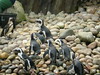
I'm still catching up with the Bristol Zoo photos, including these splendid penguins:
Penguins 2

Most of these are African penguins, but there are also some little blue penguins, as mentioned in Douglas Adams and Mark Carwardine's Last Chance to See.
Penguins 4

We also offer some blurry pseudo-underwater photos of seals...
Seals 1

...plus yet more of my cats.
Scully 5

The baby gorilla's next, I promise. Full Bristol Zoo set here.

(Meanwhile I've changed my profile photo back to the well-worn previous one, at conjugal request. If you particularly enjoyed the inverse goatee, you can still admire it here.)