28 May 2007

You Can't Leave That Lyin' There

B. and I visited Bristol Zoo on Saturday, for the first time in a while. Apart from anything else I'd been neglecting my parental duties towards the two-toed sloth whom goddaughter E. adopted for me back on my birthday. We also knew that one of the Zoo's female gorillas had a baby back in December, and thought that May would be a good time to see it.

I have lots of photos of various animals, but they're taking an age to upload, and I really want to spend some of today doing other things. The baby gorilla photos will have to wait till later, as will the baby prairie dogs, moorhen chicks and various less cute adult animals. (None of the sloth, though.)

For now you'll have to content yourself with photos of the shy sand cat,
Sand Cat
the elusive red panda,
Red Panda
the stately lioness,
Lions 4
and the noble capybara.
Capybara 2

Full set here, with more to follow later.

26 May 2007

Message from Mars

I'm sorry if these updates are getting tedious, but this is a correction of sorts to an earlier post.

Masterfoods responded today to my original complaint about the newly non-vegetarian nature of Snickers and Mars bars. (Or rather, they replied to a "Mr Purfer_hallard", who they coincidentally seem to believe resides at my address.) Although most of what they had to say I knew already, it does turn out that Bounties and Twixia were never vegetarian in the first place.

While this certainly means that my earlier paranoid speculations were groundless, it also suggests that Masterfoods' decision to be "principled" in announcing their forthcoming departure from vegetarian standards, had not been matched by equally principled decisions in the past.

Oh well, you get the idea. They also reimbursed me for some full-of-meaty-goodness Snickerses I'd returned to them. Of course the cheque's made out to Mr Purfer_hallard.

23 May 2007

Typology

This was inspired by a typo on a mailing list, during a discussion of whether Human Nature and Human Nature could be fitted into Doctor Who continuity together.
SHARD UNIVERSE [Terminology] There are certain patterns of events which, because of their precise formation and structure in time, are capable of "seeding" history, in much the same way as a single shard of crystal can convert a beakerful of solution into crystals of identical shape and construction.

From a time-bound perspective, the phenomenon resembles nothing so much as eerily significant coincidence, as particular situations, and even names and dates, "echo" and recur throughout perceived history. A god becomes mortal; a demon is chained; an island civilisation falls before the wingbeats of angelic or demonic powers. From some perspectives, even the Homeworld itself might appear to have fallen more than once.

Non-time-active civilisations often perceive such events as the action of providence in history, and it is trure that many such "shards" are deliberately seeded by the Wartime powers and other time-active cultures to their own ends.

Others, however, are naturally occurring. It is thought that these apparently random seed events may themselves be echoes from previous or parallel universes where such recurrences have infested the timeline, resulting in a history of endlessly repeated near-identical episodes. These "Shard Universes" would be characterised by formulaic, clicéd scenarios, barely-distinguished individuals and obsessive returns to depressingly familiar tableaux and set-pieces.

[© Philip Purser-Hallard 2007]
I still love The Book of the War.

Mars Retreats!

Despite the last couple of posts, I've no intention of turning Peculiar Times into a campaigning blog. I'm pleased, though, that Masterfoods have announced a partial U-turn on their decision to laugh maniacally while putting animal derivatives in their chocolate bars. I'm delighted that Snickerses and Maltesers will remain vegetarian, but continue to be annoyed that Bounties and Twices (that is the plural of Twix, presumably?) won't.

A cynic might choose to see this as an application of the familiar principle of overstating one's negotiating position in order to win concessions. Masterfoods are, after all, going ahead with their intention to make a large number of their products non-vegetarian, and most of the consumers who would normally be protesting are currently patting themselves on the back for a job well done. It seems a slightly extreme length to go to, but it would be a canny application of politics to marketing, and might well win some award or other.

What else? I'm expecting to finish the rewrites on Nursery Politics this week, which will be something of a relief. It's been dominating my brain for far too long now, to the detriment (I realise) of this blog.

There have been cygnets and moorhen chicks near work for two weeks now, zealously watched over by their respective parents, and the cygnets in particular have grown visibly during that period. Two weeks ago they were generic baby birds, tiny and grey and fluffy and easily mistaken for mutant ducklings. Today they're twice the size (though sadly reduced in number from nine to seven), and already showing signs of neck elongation.

Unfortunately I've repeatedly forgotten to take my camera in to work, so I have no photos. They're very sweet, though.

Finally, it seems I was premature in suggesting that I'd be able to finish Collapse and Iron Council within two weeks and thus keep up my book-a-week record for 2007 -- I'm barely halfway through either of them. Both are very good, though I find aspects of Jared Diamond's writing style and worldview mildly irritating. More of that later, I shouldn't wonder.

14 May 2007

Dear Masterfoods...

I left the following feedback on the Masterfoods Consumer Care web comments form. They'd "love to hear from you" too, apparently.
I am writing to protest in very strong terms against your decision to include animal derivatives in your chocolate bars, a decision I have just learned about through an article in The Guardian. This is completely gratuitous when all such products have previously been free of animal ingredients, and is tantamount to announcing that you do not care to retain the custom of the UK's millions of vegetarians.

I am a long-term customer, a regular consumer of Snickers and Twix bars and your Snickers, Mars and Maltesers choc ices[1], and I will not be buying any more of these products until you announce that they are once again being made in compliance with vegetarian standards[2].

I take particular exception to the reported statement of your spokesman that "If the customer is an extremely strict vegetarian, then we are sorry the products are no longer suitable". Refusing to eat animal products is not "extremely strict" vegetarianism – it is the definition of vegetarianism. This ignorance on your part gives the impression of even greater indifference towards your former vegetarian customers.

(I should point out that, while I will be very grateful for feedback on this specific issue, I do NOT give my permission for you to use my contact details for any other purpose, and will be seriously annoyed if you do so.)
[1] This helps to explain why I am now on another diet.
[2] This may not, therefore, be such a bad thing.


Honestly, though, in the name of Almighty God and all his terrapins and seraphim, where do they think they get off, doing this and then insisting that they're being "principled" by actually telling people about it?

In pleasanter news, I see Jeremy Paxman's started giving advanced notice of his facial expressions.

09 May 2007

Well Wishers

Without wanting to come over all mouthpiecey, may I commend to you my occasional employers Christian Aid's forthcoming campaign week, as advertised on YouTube?

If only because I drink about six pints of precious fresh water a day, the only reason I filter it first is because otherwise I'm not keen on the taste, and I'd love to see those same luxuries extended to others.

06 May 2007

02 May 2007

Books Update: Expectations, Given Form

It's been a while since I last wrote a bit about what I've been reading, with the result that I'm now four books in deficit. All of them I came to with certain expectations, having read books by their respective authors before.

And here they are:

The Steep Approach to Garbadale is, shockingly, the twenty-first novel I've read by Iain Banks (along with a volume of shorts and a book about whisky), and there was much about it that was comfortingly familiar. Rather too much, I found in fact, as the narrative presented me with a hero emotionally crippled by his childhood love (as in The Crow Road and Walking on Glass), avoiding his sprawling, matriarchal family (The Crow Road again, and also Whit) who run a venerable, highly successful business (The Business) making a game which forms a metaphor for politics (The Player of Games) and taking lots of drugs (passim). What's more, this family has been guarding a terrible secret for a generation (The Wasp Factory and -- oh look -- The Crow Road) whose nature (which I won't reveal here) will also be familiar to long-term appreciators of Banks' oeuvre.

Banks' writing is always competent, and Steep Approach is less flabby and in need of editorial trimming than his last S.F. novel, The Algebraist. There are some lovely bits of writing relating to the hero, Alban's, youthful affair with his cousin, and to his long-dead mother's suicide. But overall it says very little of weight, has none of Banks's usual exuberant creativity, and feels much as if he's writing by the numbers. I've never met a Banks novel I've actively disliked (A Song of Stone and Canal Dreams come closest), but this one's something of a disappointment.

The Penelopiad, on the other hand, is classic Margaret Atwood without, as far as I know, being a retread of anything she's written before. Looking at The Odyssey through the eyes of Odysseus' long-suffering wife Penelope follows a standard feminist-revisionist approach (though it's one James Joyce, for instance, had flirted with before), but it's very productive. Penelope lends the novella a lively, sympathetic voice, sidestepping the victim status she might otherwise invite by tempering her complaints with hard-edged ruthlessness. Atwood gives the novella a second thread in the choric voices of the maids unjustly hanged by Ulysses for fraternising with Penelope's suitors, showing how Penelope herself is compromised by her privileged background as an aristocrat. It's a clever, erudite, witty and highly readable book, and reminded me of why I enjoy Atwood's writing so much.

The only previous work I'd read of Stephen Marley's was his 1995 Doctor Who novel, Managra, which was one of the very best published in Virgin's Missing Adventures range, and a major source of inspiration for Of the City of the Saved.... His Spirit Mirror is an earlier and sadly less deft novel.

The first in Marley's notorious (among Missing Adventures readers, anyway) yet little-read (ditto) "Chinese lesbian vampires" trilogy -- his first novel, bizarrely, being a life of the Virgin Mary -- Spirit Mirror has a lot to recommend it, including inventive ideas, strong characters and vivid descriptions both beautiful and horrific. Unfortunately it's all very po-faced, lacking the streak of wicked humour and deliberately outrageous invention which raises Managra to greatness. The second-century Chinese setting lends local colour -- though less than you might expect -- but ultimately the book is rather flat genre fantasy with some interesting moments.

(Oh, and although the novel contains both Chinese lesbians and vampires, there is no overlap between the two.)

Martin Day's one contribution to Virgin's Missing Adventures line was The Menagerie, a sadly lesser work than Managra, but he has since redeemed himself with contributions to the BBC's Doctor Who book ranges, notably Bunker Soldiers and The Sleep of Reason. I had hoped that Wooden Heart, like Gareth Roberts' Only Human, might be an exception to the dismal tendency of Who books since the new series to be shallow, vapid froth.

Sadly, it isn't quite. Day's work has always had a slight tendency to verbosity, which sadly comes out here in a book I can't imagine its target audience of 8-year-olds enjoying very much. There are some interesting themes relating to ethics and the nature of good and evil, which it's certainly surprising to see tackled by David Tennant's Doctor, but they never develop into anything truly worthwhile.

In the early days of the new series, we long-term Who book readers bemoaned the fact that none of the new Ninth Doctor tie-in books could match such TV episodes as Dalek and Father's Day for subtlety and complexity. Day's book isn't actually a great deal deeper or more complex than those, and yet it easily outdoes the current TV series for thematic sophistication. I find this disappointing.

After all that, then, the list of books I've read so far this year runs thusly:That's eighteen of the buggers. It's also the eighteenth week of the year, and while I started some of the above before the end of 2006, I'm also part of the way into Collapse and Iron Council already, which means I'm very slightly ahead of the game. Assuming that the name of the game is "reading a book a week".

And that's not counting humorous books read on the lavatory.

Still on my to-read list since last time are the following (new arrivals in bold, "less urgent" stuff in square brackets):

Non-Fiction:
Fiction:From all of the above we can deduce that:

a) I don't read nearly as many non-fiction books as I intend to.
b) An embarrassing amount of my reading is Doctor Who related.
c) Only women writers are fulfilling my expectations at present.

Perhaps I'd better start one of those Justina Robsons.

27 April 2007

Forget Snakes on a Plane...

Kim Newman's history of the Hammer horror film in this month's Fortean Times mentions a "tragically unmade" project entitled Zeppelin vs Pterodactyls.

Pairs of Linked Columns

Recently I experienced what I seem to remember we used to call a "day off". In case you've never had cause to encounter one of these, it seems to involve getting up very late, sitting on a sofa watching old Doctor Who videos with a cat on your lap, and drinking beer occasionally.

That was last... Thursday, I think.

This indicates that things are beginning to get back to normal after the manic rush to finish Nobody's Children, but still very slowly. I keep being terribly busy, both at work and at home. My aspiration is that things will hopefully calm down a bit next week.

I might even be able to start blogging properly again. Let it be noted that I owe the assembled company mini-reviews of The Steep Approach to Garbadale and Margaret Atwood's rather excellent The Penelopiad. I really should read more Atwood. In the meantime I'm so tired I can barely type, so you'll have to bear with me.

That said... this month's column is up at Surefish, and follows on rather nicely from last month's. And I've sent off a revised proposal for the next long-term writing project, which is looking very hopeful now, and which I may say more about shortly.

Meanwhile, I've had a backlog of photos which I've just uploaded to Flickr.

I'm gonna spend my Easter with a Dalek:
Easter 2007

Look! There are spiders!
Spiders 1 Spiders 2

And a couple of weeks ago now B. and I and all the members of B.'s extended family visited a very decent pub in Worcestershire...
Fleece Inn 1
...and a ruined abbey in nearby Gloucestershire.
Hailes Abbey 6
View the whole set here.

19 April 2007

Hullo.

I'm still knackered from finishing the novella, and from my frenetic and unrestful week. This has included taking a six-year-old and a three-year-old to a chocolate factory (with the able assistance of their parents, admittedly), attending the theatre in aid of my mother-in-law's birthday celebrations and writing another column for Surefish. [ETA: I should clarify that the first two of these were pleasant as well as tiring.]

How are you?

On Tuesday I finally got round to updating my website to reflect the existence of Nobody's Children (and also of the forthcoming reprint of "Sex Secrets of the Robot Replicants"). I've even put in an extra bit in my F.A.Q. about them. I wonder if anyone ever reads that now Wikipedia exists.

I had been hoping to stick the whole of my rejected proposal for The Curse of Odin-Hotep, as promised, but I'm too knackered. Maybe later. In the longer term, the whole website's in urgent need of a design overhaul, but I lose the will to live whenever I even try to think about that.

Oh look, there I go again.

11 April 2007

"Mim," I Cry

The blurb for Nobody's Children is now up at the Big Finish site. Since I wrote large chunks of said blurb, I don't imagine anyone will mind my reproducing it here:
The war is meant to be over. The Draconian Empire has won the day, and the Mim have lost pretty much everything.

That includes the borogoves of Proxima Longissima, the Mim's beloved children. The Draconians claim the borogoves are foundlings, abused and neglected by their parents. In the Empire they will be protected and provided for.

Fearing that his species faces extinction, one of last surviving Mim begs Bernice Summerfield to come and see for herself. Benny just wants to do right by her own son, Peter, and the brother or sister who may follow him. But soon the borogoves are, rather unexpectedly, her godchildren, and Benny becomes their best hope for a future peace.

As if dead oceans and burning deserts weren't hostile enough, Benny must enter the labyrinthine corridors of diplomacy - where right and wrong are questions of perspective, and even her own loved ones are not wholly innocent...
As I'm sure I've mentioned before, the book consists of three novellas, by Kate Orman, Jon Blum and me. It's going to be fab. Do buy it.

In unrelated but startlingly contiguous news, Dave Stone's novel The Two Jasons is a sequel to my short story "Sex Secrets of the Robot Replicants" in A Life Worth Living. And if you haven't read that short story... well, it's going to be reprinted as a prelude to Dave's book, so you can now. (Or you can just buy A Life Worth Living, of course.)

The website's overdue an update reflecting these releases, but I'm going to be tearingly busy for the next couple of weeks, catching up with everything I should have been doing for the past three or four months. Expect an increase in blog traffic soon... but not quite yet.

06 April 2007

Brainchildren

I've started the final push towards a finished version of "Nursery Politics", and thus of Nobody's Children. The whole process of writing this latest novella has been surprisingly gruelling -- I'm not really sure why, but I'm sure you'll have noticed me complaining about the fact.

It'll be over soon, though, and there's potentially good news about another project afterwards (not that I'm ready to think about that as yet).

While I've been doing this, B. has been finishing off and displaying her latest piece of art: Vesica Piscis, part of an Easter art exhibition run by a local church. It looks like this.

Vesica Piscis 5

More photos are visible here... and for what a vesica piscis actually is, see here.

31 March 2007

Books Update: Sex, Lies and Computronium

Well, I don't seem to have had much luck today getting on with writing my own book. So here's what I've been reading recently, when I've had the time...

Postmodern Pooh by Frederick Crews is the belated followup to The Pooh Perplex, which I was discussing nearly a month ago now. It's certainly not just more of the same, though -- where the original poked whimsical fun at the eccentricities of literary criticism up to the 1960s, critical theory has moved on, as has Crews himself. As I noted before, the satire here is cruel, harsh and very much in earnest. And frankly, modern academia deserves it.

Accelerando by Charles Stross is roughly as interesting as I hoped before I started reading it. This makes it both more interesting than I thought after the first chapter, and less interesting than I thought after the third.

It's the story of a 21st-century family over a hundred years, the conceit being that -- as the title suggests -- Stross' 21st century quickly becomes most S.F.'s very distant future. That first chapter shows the 2010s as a familiar (though well-drawn) post-cyberpunk milieu, with mind-computer interfaces, AIs and other bleeding-edge technologies just beginning to take effect as agents of countercultural social change. By the eighth chapter, set in the 2080s, most of the planetary solar system has been dismantled to create a colossal solar-powered computer on which humanity's incomprehensibly posthuman descendants can run their software personas, while those who choose to remain merely superhuman are using wormhole technology to construct interstellar habitats for their immortal selves, their descendants and their reincarnated ancestors.

Accelerando's scope and vision are breathtaking, and during the first two-thirds there's a constant sense of exhilaration as the future history speeds us through different genres of S.F. -- from cyberpunk into space-opera, from evolutionary speculation into eschatology -- while various familiar contemporary icons, brands and philosophies remain almost recognisable. Stross is a smart writer, and one with a soul as well (I loved his sympathetic liberal imam), a quality which is sometimes lacking in cerebral S.F. But ultimately the narrative slows once more as the focus slides away from the strictly unimaginable subjectivity of his posthumans to the cultural backwaters of those whose weak transhumanisms mean they remain fundamentally recognisable to us.

It's difficult, of course -- many would say impossible -- to write sympathetically about truly alien characters. But in sidestepping the attempt, Accelerando seems to be ducking the challenge its own bravado has set it -- meaning that ultimately (despite having easily five times as much imagination as many S.F. book series five times its length) it disappoints slightly. It's highly recommended, nonetheless, for what it does achieve.

A Pocketful of Lies by J-P Stacey is the self-published pamphlet of short stories I was plugging back in December, and which I've reprehensibly only just got round to reading. It's good, though, both as individual stories and in assembled form. Given the constraints on length, most of the stories are more by way of vignettes than actual narratives, though there are exceptions (and in fact the shortest pieces are the some of the best, the mock lonely hearts ads in particular). The best piece is the last, the distinctly Dickian paranoia-fantasy "Stay Calm", but I also liked the quieter, more lyrical "She Watched Television", a description of how someone spent her evening. A couple of the stories are less successful, but given that the book's free (and available as a PDF just over here) I don't see how you can go wrong.

Alan Moore and Melinda Gebbie's Lost Girls has received a certain amount of notoriety for its rewriting of out-of-copyright children's fantasy as unashamed erotica (or pornography, which is the term Moore and Gebbie prefer). Complaining that the constant, admittedly highly inventive sex makes the book feel rather one-note throughout would clearly be missing the point, on a par with moaning that the characters in Neuromancer keep banging on about computers. But still, it didn't do much for me on an erotic level.

The really clever stuff lies in the reinterpretation of the experiences of the three main characters -- Alice, Dorothy and Wendy. The women, who range in age from early twenties (Dorothy) to late fifties (Alice), meet in a Swiss hotel in 1913, where they tell each other stories and shag a lot, both other people and each other, in a fin de siècle kind of a way. It turns out that each as a girl created an elaborate fantasy-world in response to her early sexual awakening -- whether to romanticise it, to escape from it or (one suspects) a bit of both.

The book seems confused in its approach to the imagination: on the one hand celebrating it, on another it seems to see its main function as the construction of strictly sexual fantasies. Whatever evolutionary biologists may tell us, I find the idea of world-creating fantasy as an outworking of the libido depressingly reductionist. Furthermore, telling each other their true stories (and shagging a lot) appears to allow each woman to face up to her past, suggesting that fantasy is something you grow out of when you discover sex. I can't imagine that this is the message which the author of Promethea and V for Vendetta intended me to take away, but it's in this confusion that I feel the book falls down.

The book (which comes in three volumes and a slipcase) is a very beautiful object, and Moore's writing and Gebbie's art create some wonderful moments. It's full of trademark Moore tricks, including inventive tricks of layout, visual puns and some very clever pastiche. If it's an experiment which ultimately fails, then it's one which comes up with some very interesting results along the way. It's surely telling, though, that -- reading it so soon after Postmodern Pooh -- I found myself wishing for a parody where the elderly Christopher Robin recalls his youthful homosexual encounters with a predatory older "bear", while helping a melancholy classmate come to terms with his own "tail" and discovering one particularly memorable "pole".

Ahem.

Since finishing these various volumes, I've been (and still am) reading The Steep Approach to Garbadale -- which, to someone who's read all of Iain Banks's work to date, feels terribly familiar. I've also, rather unexpectedly, embarked on Spirit Mirror by Stephen Marley, which I picked off the shelf in a vague search for something a bit different. It's an orientalist fantasy about Chinese lesbian vampires in the second century A.D., so it certainly qualifies. So far I'm rather enjoying it.

30 March 2007

The Shape of Kingdoms to Come

My latest column's up at Surefish now. It's a bit more abstract and faffy this time, probably due to my having to squeeze it out in a gap between writing "Nursery Politics". I'm pleased with the title, though.

I'm not getting much feedback on these columns via Surefish, so I'm always interested to know what people here think of them. How many of you are actually reading them, for a start? Is the fact that they're about religion / written from a broadly christian perspective / hosted by Christian Aid putting people off, or is it generally true that if you're interested enough to read my witterings here then you'll have a look at them somewhere else as well?

(The previous columns are linked to from the current one, if anyone feels like catching up. I have to say I like the different artwork they've been using for the mastheads.)

25 March 2007

Feeling the Draft

Well, now my first complete draft of the Benny novella's finished, which is nice. Not unrelatedly, I'm knackered.

For those of you who enjoy statistics... this draft is 28,970 words long (and that will probably grow during rewrites), over a quarter of which is written in the character of Jason Kane, with a further seven characters getting some first-person narration. It's in eight chapters,with a prologue and an epilogue. And the word "murder" and its conjugates appear 19 times.

My contribution's entitled "Nursery Politics", and we're probably not calling the volume War Stories any more. I'm not sure I'm allowed to say what we are calling it.

[Edit 27-3-7: Ah yes, it looks like I am. It's called Nobody's Children.]

And now I have: a) the week off work for rewrites, and b) a rapidly-encroaching stinking cold. Given that the last time I took leave I ended up with a bout of food poisoning, I'm beginning to suspect that my employers are dosing me with biological agents whenever I take time off, to condition me against it and make me a more productive employee. It's particularly galling given that I've been feeling a bit ill, but not enough to actually take a day off, for most of 2007 so far.

Otherwise, I've been reading The Steep Approach to Garbadale, watching Blackadder and taking the occasional photo when I've had the chance. I took lots of the view of the city and Suspension Bridge from Bedminster Down when I walked up to the chemist there the other day, but the visibility was hopeless and they all turned out rubbish.

More later in the week, assuming I'm not bedridden or dead or anything by then.

22 March 2007

Top Tip

Chocolate Cheesecake Fans! For a tasty snack, simply spread cream cheese on milk chocolate HobNobs. Hey presto -- instant mini chocolate cheesecake bites!

Work's going slowly. I should be finishing the novella, but I've got bogged down in my latest Surefish column. (I was hoping I'd be able to write some articles on the 200th anniversary of slavery, as well, but time hasn't allowed.)

I owe this blog mini-reviews of Postmodern Pooh, Accelerando, A Pocketful of Lies and -- as soon as I finish it, which will probably be tonight -- Lost Girls.

I'm still reading The Steep Approach to Garbadale, but that's likely to keep me occupied for a while. It's debatable how much Banks has improved as a writer since his early days, but one admirable quality he's lost is that of concision.

20 March 2007

When Commuters Snap

Parson Street 1
Parson Street 1,
originally uploaded by Phil PH.
I'm testing Flickr's blogging interface. I took this photo this morning, from the really rather grotty station where I take the train to work.

I'm rather pleased with how it came out -- the church looks gothic and ominous underneath the clouds. Less so when you know it's now converted into a clothing factory, but never mind.

18 March 2007

Rosettastonishment

Wurgh. By dint of fuelling myself almost constantly with chocolate, coffee, crisps and beer over the past four days, I've fought my way through to roughly 2,000 words from the end of my novella.

Completing a first draft is scarcely the end of the process, of course, but for me it's the end of the really painful bit, so halle-shagging-lujah. I'm really going to need to clean up my diet once this story's finished, though.

To make up for my otherwise terseness here in the blogosphere, here's the final passage of what could have been Chapter One of The Curse of Odin-Hotep. It's, er, not very long.
Some hours later still, and many fathoms above the scurrying Archivists who were now scouring the Vault from top to bottom, a young woman named Arabella Monteith arrived to begin her day’s work at the British Museum.

Her job for that week was to check the engine-catalogue against the public holdings on display in the Egyptian Gallery, and she had high hopes that – if she performed it well, and continued to perform similarly tedious tasks with equal proficiency and without complaint for the rest of her life – she might conceivably find herself promoted to a junior assistant curatorship before she was fifty.

Reflecting that she might as well begin with one of the vaguely interesting artefacts, Arabella turned the knob on her handheld processing engine, and entered the Gallery as the micro-furnace warmed up.

She gazed at the Museum’s most famous exhibit, sitting proudly on its prominent plinth. Something about it troubled her.

Arabella leaned in, under the sightless eyes of the sarcophagi, to examine the display – then gasped in shock.

The sound echoed around the marbled gallery like the first whisper of stale air from a sealed tomb.


[Pax Britannia series elements © Abaddon Press 2005.]
So, there you have it. When I get the time I imagine I'll put up the whole chapter -- along with the chapter breakdown so you can see where the story would have ended up if there'd, you know, actually been a story -- on my website somewhere.

On the Flickr front, I've discovered you can place your photos on a map, which is mildly exciting. If only I could remember where in Horsham I'd taken the three I took there, then, er, I could put them there.

As I say, more photos -- and indeed more blogging generally -- should follow once this book's out of the way.

14 March 2007

Photo Tropism

I mentioned ages ago that my admirable and generous parents had given me a spanking new digital camera for a combined birthday and Christmas present. It's only now, having sped my computer up appreciably by changing my antivirus software, that it's been practical for me to install the software to run the thing, and to actually do stuff with the photos I took in December.

Behold, therefore, my Flickr account. It's not very full as yet, but I have lots of plans for things I want to take photos of in Bristol, next month when it's sunnier and I've less pressing calls on my time.

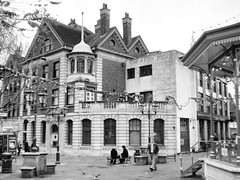
The bits of reality which I'm really interested in capturing visually are the places where urban spaces go non-linear -- the gaps between the infrastructure, the weird architectural interfaces between radically different styles of construction, sites of sweeping vertical or historical disparity.

Blimey, hark at me. This is why I want to take photos, though, as the sensation these places give me isn't something that's easy to put into words (although Of the City of the Saved... made a stab at it). The shockingly inept photos I took of Manchester using B.'s camera last June should give you some idea of what I'm aiming at conceptually [1].

Horsham in December isn't really the best place in England to observe this kind of stuff, but I rather like this one, taken on my Dad's birthday:

Horsham 1

I've monochromed it because I tend to think buildings look better that way, unless the colours themselves are the interesting aspect.

I've already identified three cardinal rules:

1. Busier is not better.
2. Wait for the people to get the hell out of the way.
3. And the cars.

Given that I'm a blogger, another vital motivation is of course to take photos of my cats and inflict them on the world. Aaah.


1. Edit to add: They also look so much better now, after I've run them through the software that came with the new camera. These ones look better in colour than in monochrome, if only because the light is so bleached. The third one in particular I'd be rather pleased with if only I could get rid of my bloody finger.