A number of interesting things happened over the weekend, the least enjoyable of which was being woken up at 2:30am by the fire brigade putting out the fire that somebody had set in our neighbours' car. How charming of them.
One of the most enjoyable things -- in a vengeful, wrathful, blasting-the-infidels kind of way -- was playing Risk Godstorm with R. and M. on Saturday evening. It's a deeply enjoyable game which follows the basic mechanics of Risk 2210 A.D. -- itself a significant updating of classic Risk with its "Slug it out till you're the last one left alive" ethic -- with some intriguing twists. (Enormous fun though the old-fashioned approach, in a mindlessly macho kind of way, was, Godstorm and the modern variants do seem to be a little more... nuanced[1].)
In Godstorm, five of the ancient polytheistic pantheons -- the Babylonian, Egyptian, Greek, Celtic and Norse gods -- do battle alongside armies of their followers, inflicting the lands of Europe and the Mediterranean with plagues and tempests and the like. Pretty much the same dynamic holds as in 2210 A.D., with the gods replacing the various specialist "commander" pieces, but with two glorious departures: firstly, one of the continents it's possible to occupy is Atlantis, which is both more profitable and easier to defend than the other territories but is susceptible, at an undetermined point in the game, to vanishing altogether from the board; and secondly, troops who die are moved onto the separate Underworld board, where they continue to fight for domination and whence they can, potentially, be resurrected. Huzzah for maurauding armies of the dead!
Add to this the fact that some of the "miracle cards" (equivalents of 2210 A.D.'s command cards) can potentially effect enormous changes on the state of play, and Godstorm certainly seems to be the most spectacular of the Risk variants to date.
Unfortunately, the length of time it took us to learn the new rules, together with the necessity of getting R. & M.'s child units into bed before we could start, meant that we only had time to play for three "epochs" (rounds of turns -- a single turn can easily take half an hour), rather than the prescribed five.
We decided that the existence of the afterlife makes things a lot more agreeable for players who are doing badly, as each unit wiped off the face of the Earth is a reinforcement in the battle for the Underworld. There are a few kinks in the gameplay (set out in this rather overcritical review), but the only aspect I found really unsatisfying was the lack of differentiation between the gods. Of course I accept that this would make the game even more complicated, but as things stand there's basically no distinction made apart from the colours of the pieces and the names of the individual gods on each side, and as a huge mythology geek I find this unsatisfying.
It would have been nice if the various gods were more powerful when on their home turf, for instance, which would have been easy enough to build in. I'd also have preferred to have had some acknowledgement of the gods' distinctive personalities, perhaps via pantheon-specific decks of cards. As it is, the game insists on reducing them into a one-size-fits-all formula of Sky God, War God, Death God and Goddess of Magic. This works well enough with the Greek pantheon from which it's evidently derived, with Zeus, Aries, Hades and Hecate fulfilling the roles (although it's odd to consider Hecate on a par with the Olympians), but it falls down badly when applied to the other pantheons.
The Norse, for instance, have Odin, Thor, Loki and Freya in these slots, none of whom fits even remotely. Not only has Loki nothing to do with death and Freya nothing obvious to do with magic, but Odin is, if anything, more of a war god than Thor, who is associated with thunder and thus with the sky. But the formula says that the head of the pantheon is the Sky God, so what can you do? (In fact assigning areas of patronage to the Aesir in the mode of the Olympians is a fundamentally misconceived endeavour, showing the hegemony of Hellenistic thinking in Western mythography, but never mind.)
Still, it would be churlish to be overcritical of any game which allows you to smite your enemies whilst bellowing "Die, heathen scum, for I am Thor!" or chanting The Ride of the Valkyries, even if you do have to do it quietly to avoid waking the children. Very much recommended.
...then on Sunday B. and I discovered that a local pub does a free cheeseboard at Sunday lunchtime. Life is good.
[1] If you are a classic Risk enthusiast, then under no circumstances should you download [link deleted due to lack of self-discipline], a freeware version with substantially speeded-up gameplay which allows you to play against multiple virtual players with distinctive strategies. It's horrifyingly addictive.
12 September 2005

09 September 2005
Abstinence (If Only)
Lord, it's been a busy week. A new academic year, and suddenly the library is swarming with students. Of course their disconcerting enthusiasm will abate before very long, but at the moment they keep pestering us for advice and information, sitting on the furniture, moving the books, and generally causing chaos and disruption to our neat and orderly library. Obviously this isn't the kind of behaviour I want to encourage... but my hands (unlike the grubby little fingers of the students) are tied.
Seriously, it's bedlam. I meant to update this blog at work on Tuesday, but I really haven't had the time all week.
I promised that I'd explain the rationale behind my frankly deranged decision to give up coffee... and, well, it's nothing terribly profound, really: I was drinking too much of it, and wanted to cut down. Unfortunately, too much and too regular caffeine generates a genuine, honest-to-goodness addiction -- with symptoms like mood swings, stress, irritability, excessive tiredness, trembling, headaches and the like -- and the only way to shake this off completely is to go into full-on withdrawal for a period of eight weeks. By the end of that time (or so my medical friend R. assures me) all the effects are expunged, and one can either swear off the noxious brew forever, or once again start taking it in moderation as a stimulant.
In the meantime, of course, one isn't allowed coffee or tea in any form (including decaff, in which enough traces remain to tide the addiction over... I just hope mint tea isn't addictive, fattening or carcinogenic, because at the moment I'm more or less drowning in it). And, of course, one has to deal with the withdrawal symptoms, which (predictably and hilariously) include stress, mood swings, irritability, excessive tiredness, headaches, trembling...
In my case, the problem is compounded by the fact that I can only write with any degree of creativity when I'm caffeinated to the gills, which means my present, temporary, sabbatical from trying to write creatively is my only realistic opportunity to detox. I'm appreciating the downtime -- with any luck I can return to writing in November, refreshed and reinvigorated and brimming over with scintillating ideas. (Mixed metaphor there, unless you envisage the ideas as comprising a fluid which also scintillates. You see the kind of thing I'm up against.)
I'm temporarily back on the diet as well, to purge the pizza and burritos and pasta and sausages and mezze and cooked breakfasts and cookies and doughnuts and beer I consumed at Greenbelt. From this point of view Saturday was somewhat non-optimal, as B. and I visited the Bristol Organic Food Festival.
It's a fantastic, huge event, sprawling along two banks of the harbourside, with stall after stall after stall offering delicious organic goodies and, in many cases, offering free samples to taste. Said samples are, of course, tiny, but wandering around accepting morsels of bread, cheese, oil, vinegar, pate, wine, beer, crisps, chocolate, cake and the like for long enough adds up to a pretty hearty lunch. (There was some gorgeous-smelling organic coffee as well, which naturally was off-limits.) We ended up spending far too much money, and came away with wine, amaretto, cheese, pâté, chocolate, lemon curd and brownies in four varieties (standard, white chocolate, coconut and, fantastically, chilli flavour), all in a big bag.
In the evening we dragged our friend M. out to The Wellington, where we ended up eating reasonably decent veggie chilli and drinking extremely decent Bath Ales. A very satisfactory day in many ways, but not terribly so for the welfare of my waistline.
The rest of the weekend continued to be remarkably relaxing, certainly relative to the hecticness of this week and the week before. I spent most of it just lounging around, and found that I had some time for things like reading, watching DVDs, stroking the cats and the like. OK, some of the DVDs were for research purposes, but still.
It means I'm really looking forward to the forthcoming weekend -- which, thank heavens, will be starting in just under half an hour. Hurrah.
Seriously, it's bedlam. I meant to update this blog at work on Tuesday, but I really haven't had the time all week.
I promised that I'd explain the rationale behind my frankly deranged decision to give up coffee... and, well, it's nothing terribly profound, really: I was drinking too much of it, and wanted to cut down. Unfortunately, too much and too regular caffeine generates a genuine, honest-to-goodness addiction -- with symptoms like mood swings, stress, irritability, excessive tiredness, trembling, headaches and the like -- and the only way to shake this off completely is to go into full-on withdrawal for a period of eight weeks. By the end of that time (or so my medical friend R. assures me) all the effects are expunged, and one can either swear off the noxious brew forever, or once again start taking it in moderation as a stimulant.
In the meantime, of course, one isn't allowed coffee or tea in any form (including decaff, in which enough traces remain to tide the addiction over... I just hope mint tea isn't addictive, fattening or carcinogenic, because at the moment I'm more or less drowning in it). And, of course, one has to deal with the withdrawal symptoms, which (predictably and hilariously) include stress, mood swings, irritability, excessive tiredness, headaches, trembling...
In my case, the problem is compounded by the fact that I can only write with any degree of creativity when I'm caffeinated to the gills, which means my present, temporary, sabbatical from trying to write creatively is my only realistic opportunity to detox. I'm appreciating the downtime -- with any luck I can return to writing in November, refreshed and reinvigorated and brimming over with scintillating ideas. (Mixed metaphor there, unless you envisage the ideas as comprising a fluid which also scintillates. You see the kind of thing I'm up against.)
I'm temporarily back on the diet as well, to purge the pizza and burritos and pasta and sausages and mezze and cooked breakfasts and cookies and doughnuts and beer I consumed at Greenbelt. From this point of view Saturday was somewhat non-optimal, as B. and I visited the Bristol Organic Food Festival.
It's a fantastic, huge event, sprawling along two banks of the harbourside, with stall after stall after stall offering delicious organic goodies and, in many cases, offering free samples to taste. Said samples are, of course, tiny, but wandering around accepting morsels of bread, cheese, oil, vinegar, pate, wine, beer, crisps, chocolate, cake and the like for long enough adds up to a pretty hearty lunch. (There was some gorgeous-smelling organic coffee as well, which naturally was off-limits.) We ended up spending far too much money, and came away with wine, amaretto, cheese, pâté, chocolate, lemon curd and brownies in four varieties (standard, white chocolate, coconut and, fantastically, chilli flavour), all in a big bag.
In the evening we dragged our friend M. out to The Wellington, where we ended up eating reasonably decent veggie chilli and drinking extremely decent Bath Ales. A very satisfactory day in many ways, but not terribly so for the welfare of my waistline.
The rest of the weekend continued to be remarkably relaxing, certainly relative to the hecticness of this week and the week before. I spent most of it just lounging around, and found that I had some time for things like reading, watching DVDs, stroking the cats and the like. OK, some of the DVDs were for research purposes, but still.
It means I'm really looking forward to the forthcoming weekend -- which, thank heavens, will be starting in just under half an hour. Hurrah.
05 September 2005
Excursions in Time
Right, then, yes.
The Time-Traveler's Wife, by Audrey Niffenegger. It is, quite honestly, bloody amazing.
It's certainly received it's fair share of hype -- and being nominated by Richard and Judy for their daytime-TV book club is an awful lot for any novel to live down -- but it really is remarkably good.
It's not marketed as S.F., which is one of the things publishers do these days so that S.F. books with not-too-outrageous settings can sold more widely. It is, however, deeply respectful of its basic science-fiction premise (a protagonist whose unusual genetic condition causes him to time-travel involuntarily, apparently under the partial control of his subconscious mind) and follows it through with as much rigorous and careful extrapolation as I've ever found in a work of S.F. (far more than in some). It also works as a "proper" novel, in that the characters are multi-layered, convincing, painfully familiar and shaped by their experiences and relationships even when -- as in the cases of the two protagonists, time-travelling Henry and his lifelong love Clare -- those expeiences are deeply weird and non-realistic in nature.
The book isn't flawless. It is, at times, a little precious, and the passages where Proust and Rilke are quoted in the original languages are frankly pretentious. There's also, tight though the plot-logic is, a papered-over chasm in the book's intellectualism where some philosophical examination of Henry's plight, particularly of the inescapable determinism which his explorations of the past appear to reveal, would seem really to be called for. But, though the romance is one of an unusually cerebral nature, it's clearly the central relationship which the book is truly about.
The core image of the novel comes, in fact, in the epilogue where... [NB: The following has been made invisible to avoid spoiling the book. Highlight the whitespace to read...] ...an elderly woman spends her last years waiting for the promised final visit of her long-dead time-travelling husband. This image alone would have made for a wonderful short story, but that would have lacked the emotional punch which it derives from its novelistic context. Without knowing Clare and Henry as we do by this point in the book, it would have been a clever and reasonably poignant idea, rather than an achingly potent source of longing and grief.
Basically, The Time-Traveler's Wife is the only book I've read in absolute ages which has had me in uncontrollable tears at the end. I could barely see the words to read them, in fact... which was kind of annoying, actually, but still, extremely cathartic.
Einstein's Dreams by Alan Lightman is an altogether different kind of book -- still cerebral, and still about time, but far from being character-focussed. Indeed, it has virtually no named characters: the framing narrative deals with the young Albert Einstein and a colleague of his at the patent office, but that's about it. Instead it's a magic-realist exploration of creatively-imagined worlds where time works differently from our own, the linking idea being that these are the rejected hypotheses, experienced in dreams, which led Einstein to his theory of relativity.
The imagination which has gone into thinking up these worlds is breathtaking in itself. There's a world where the future does not exist and cannot be conceptualised, and a world where there's no such thing as memory; worlds where time cannot be quantified and worlds where it is the ultimate and only absolute; worlds where time works like a stream or like a wheel or like an infinite hall or mirrors; even a determinist world like the one in The Time-Traveler's Wife, where everybody's future is mapped out and where nobody therefore cares about the consequences of their actions.
The really clever thing is the way all of these hypotheticals -- which are treated as springboards for creative thought rather than bases for logical extrapolation -- become metaphors for the real relationship between our human identities and our subjective perceptions of time. The novel as a whole explores disparate imaginative spaces, each with its own rules, and their reciprocal effects upon the human beings who live in them. Comparisons with Italo Calvino's Invisible Cities (as luck would have it, the only Calvino I've managed to read, and very fine it is too) are predictable, but worthwhile.
Nameless though the characters are, their internal monologues are often deeply moving -- all the more so since a number of them are clearly altered versions of Einstein's own present, past and future, and his own surroundings in 1905 Berne are generally recognisable, if profoundly changed. (Much of this aspect of the book passed me by, to be honest, as I'm not that clued-up on Einstein's life. I really should read a biography and then reread the novel, as I'm sure it would repay that kind of attention.)
Honestly, this is a fantastically good work of art, which everybody with any interest both in theoretical physics and damn good writing should definitely read.
Meanwhile... I've finished Seven Deadly Sins, which suffers by comparison with the above (but does have a couple of splendid stories by the reliable Paul Magrs and Tara Samms). I've also embarked on Simon Morden's novella Another War, having first reread "A Forgotten Corner of Hell" in the Subway collection Brilliant Things, to which it's a sequel. Where "A Forgotten Corner of Hell" (in which a 1920s country house vanishes to become contiguous with an otherdimensional netherworld) reads rather as if H.P. Lovecraft's been given a rewrite by Agatha Christie, Another War (where the house reappears in present-day Oxfordshire) gives the impression that Tom Clancy's now been allowed to have a go. I'm enjoying it very much so far.
I think I'll hold off commenting on The Cambridge Companion to Science Fiction till I've finished it -- I'm a little over halfway through now. It's been a mixture, so far, of nodding along in agreement and disagreeing vociferously, to the bemusement and consternation of my wife and / or colleagues.
The Time-Traveler's Wife, by Audrey Niffenegger. It is, quite honestly, bloody amazing.
It's certainly received it's fair share of hype -- and being nominated by Richard and Judy for their daytime-TV book club is an awful lot for any novel to live down -- but it really is remarkably good.
It's not marketed as S.F., which is one of the things publishers do these days so that S.F. books with not-too-outrageous settings can sold more widely. It is, however, deeply respectful of its basic science-fiction premise (a protagonist whose unusual genetic condition causes him to time-travel involuntarily, apparently under the partial control of his subconscious mind) and follows it through with as much rigorous and careful extrapolation as I've ever found in a work of S.F. (far more than in some). It also works as a "proper" novel, in that the characters are multi-layered, convincing, painfully familiar and shaped by their experiences and relationships even when -- as in the cases of the two protagonists, time-travelling Henry and his lifelong love Clare -- those expeiences are deeply weird and non-realistic in nature.
The book isn't flawless. It is, at times, a little precious, and the passages where Proust and Rilke are quoted in the original languages are frankly pretentious. There's also, tight though the plot-logic is, a papered-over chasm in the book's intellectualism where some philosophical examination of Henry's plight, particularly of the inescapable determinism which his explorations of the past appear to reveal, would seem really to be called for. But, though the romance is one of an unusually cerebral nature, it's clearly the central relationship which the book is truly about.
The core image of the novel comes, in fact, in the epilogue where... [NB: The following has been made invisible to avoid spoiling the book. Highlight the whitespace to read...] ...an elderly woman spends her last years waiting for the promised final visit of her long-dead time-travelling husband. This image alone would have made for a wonderful short story, but that would have lacked the emotional punch which it derives from its novelistic context. Without knowing Clare and Henry as we do by this point in the book, it would have been a clever and reasonably poignant idea, rather than an achingly potent source of longing and grief.
Basically, The Time-Traveler's Wife is the only book I've read in absolute ages which has had me in uncontrollable tears at the end. I could barely see the words to read them, in fact... which was kind of annoying, actually, but still, extremely cathartic.
Einstein's Dreams by Alan Lightman is an altogether different kind of book -- still cerebral, and still about time, but far from being character-focussed. Indeed, it has virtually no named characters: the framing narrative deals with the young Albert Einstein and a colleague of his at the patent office, but that's about it. Instead it's a magic-realist exploration of creatively-imagined worlds where time works differently from our own, the linking idea being that these are the rejected hypotheses, experienced in dreams, which led Einstein to his theory of relativity.
The imagination which has gone into thinking up these worlds is breathtaking in itself. There's a world where the future does not exist and cannot be conceptualised, and a world where there's no such thing as memory; worlds where time cannot be quantified and worlds where it is the ultimate and only absolute; worlds where time works like a stream or like a wheel or like an infinite hall or mirrors; even a determinist world like the one in The Time-Traveler's Wife, where everybody's future is mapped out and where nobody therefore cares about the consequences of their actions.
The really clever thing is the way all of these hypotheticals -- which are treated as springboards for creative thought rather than bases for logical extrapolation -- become metaphors for the real relationship between our human identities and our subjective perceptions of time. The novel as a whole explores disparate imaginative spaces, each with its own rules, and their reciprocal effects upon the human beings who live in them. Comparisons with Italo Calvino's Invisible Cities (as luck would have it, the only Calvino I've managed to read, and very fine it is too) are predictable, but worthwhile.
Nameless though the characters are, their internal monologues are often deeply moving -- all the more so since a number of them are clearly altered versions of Einstein's own present, past and future, and his own surroundings in 1905 Berne are generally recognisable, if profoundly changed. (Much of this aspect of the book passed me by, to be honest, as I'm not that clued-up on Einstein's life. I really should read a biography and then reread the novel, as I'm sure it would repay that kind of attention.)
Honestly, this is a fantastically good work of art, which everybody with any interest both in theoretical physics and damn good writing should definitely read.
Meanwhile... I've finished Seven Deadly Sins, which suffers by comparison with the above (but does have a couple of splendid stories by the reliable Paul Magrs and Tara Samms). I've also embarked on Simon Morden's novella Another War, having first reread "A Forgotten Corner of Hell" in the Subway collection Brilliant Things, to which it's a sequel. Where "A Forgotten Corner of Hell" (in which a 1920s country house vanishes to become contiguous with an otherdimensional netherworld) reads rather as if H.P. Lovecraft's been given a rewrite by Agatha Christie, Another War (where the house reappears in present-day Oxfordshire) gives the impression that Tom Clancy's now been allowed to have a go. I'm enjoying it very much so far.
I think I'll hold off commenting on The Cambridge Companion to Science Fiction till I've finished it -- I'm a little over halfway through now. It's been a mixture, so far, of nodding along in agreement and disagreeing vociferously, to the bemusement and consternation of my wife and / or colleagues.
Greenbelt Post-Mortem
So... just to return one more time to the subject of Greenbelt. The blog entries at surefish cover most of what I actually did, and much of what I thought: what they don't say is that I spent the whole time stressed out and knackered, having taken on way too much this year.
My talk itself wasn't too bad in terms of stress -- it was written and polished by the time I arrived, and really it only necessitating taking an hour out that morning to practise, and caffeining and sugaring myself up immediately beforehand (and really, coffee and donuts aren't a very grave hardship). Certainly the buzz which came from realising I'd delivered it well, and kept the audience entertained and interested for an hour, more than made up for the work I put in.
The panel discussion was even less hassle, although I didn't feel it was terribly successful. (No reflection on my fellow panellists, Annie and Conrad, nor indeed to host Nick: there were half a dozen blogging-related events at this year's festival, and I don't think there was a great deal of interest or energy left to spare for ours. Nick's comment that "I think we just about got away" with it pretty much sums it up.)
The journalism, however, was exhausting. It wasn't just the couple of hours each day it took away from my time at the festival (that being about how long it took me to compose 600 well-crafted words in the inevitable non-optimum conditions), it was the way I felt obliged to do stuff all the time rather than relaxing, just so that I'd have something to blog about -- and, when I was doing said stuff, to take notes about the stuff I was doing rather than just enjoying it.
Apologies to anyone reading this who enjoyed the blogs, but I don't think I'll be doing that again. Greenbelt is pretty much the only opportunity I get to relax and be calm in spiritually nourishing surroundings, and sadly I had precious little of that this year.
Another thing I didn't mention (and it it turns out I could have done, as surefish themselves have a fairly ambivalent review of the event here) were my reservations about the Sunday morning communion. While I do find the diversity (and the sheer number) of those present thoroughly inspiring, one result of it is that the service is always very awkwardly pitched, aiming to appeal to adults of a wide variety of worship backgrounds as well as children and teenagers (an important consideration, since the service generally lasts an hour and a half at least).
This year in particular, the worship group running the thing seemed to be hopelessly out of their depth, inviting the congregation to join them in responses which many present found deeply bizarre. (Much of this was sexual politics, which I'm aware Greenbelt is more keen on than most christian congregations... but still, you don't need to have a particularly dirty mind to be disturbed by someone asking all the children present to shout "Taste our fruits".)
Moreover, their centrepiece, a story written as a myth / parable around this year's festival theme of "Tree of Life", was awful. Badly-written, confusing drivel where overblown metaphors contended in a Darwinian battle for dominance, and -- quite absurdly, given the fantastical nature of the framing narrative -- a ploddingly literal version of Jesus's institution of the tradition of the Holy Communion had been bolted on as crassly as if Tolkien had decided to sample the crucifixion accounts in The Lord of the Rings. I'm no liturgist, but I've written fantasy, and I'm certain I could have come up with something considerably better.
The service also commenced with an unusually beautiful poem by Stewart Henderson, which was thoroughly ruined by being read in the style of an illiterate rap-artist. Argh. As I say, I was in a critical rather than a spiritual state of mind at the time, but even so, I do hope Greenbelt don't use Revive again.
Still, the service as a whole did what it was supposed to do, and I did enjoy the hymns. The fact that I have some negative opinions (that Paul Cornell's unique position in relation to the new series of Doctor Who was under-used in his session, for instance, much of which could have been delivered by any clued-up fan) doesn't mean that the positive stuff wasn't true as well (and Cornell's session was certainly highly entertaining). Despite not being able to relax, I did enjoy the whole experience -- except during the actual writing of the blogs, when I was just frustrated not to be elsewhere doing something else.
My highlights: Karen Armstrong, an intelligent and lucid speaker; Cole Morton and Gareth Higgins on separating faith and church by erasing the secular / spiritual divide; The Proclaimers; the visual art, oustanding, as ever; the beer and food, which really were heavenly. And, obviously, the intangible atmosphere of the whole place.
And next year I'll get time to appreciate it all properly, so hurrah.
My talk itself wasn't too bad in terms of stress -- it was written and polished by the time I arrived, and really it only necessitating taking an hour out that morning to practise, and caffeining and sugaring myself up immediately beforehand (and really, coffee and donuts aren't a very grave hardship). Certainly the buzz which came from realising I'd delivered it well, and kept the audience entertained and interested for an hour, more than made up for the work I put in.
The panel discussion was even less hassle, although I didn't feel it was terribly successful. (No reflection on my fellow panellists, Annie and Conrad, nor indeed to host Nick: there were half a dozen blogging-related events at this year's festival, and I don't think there was a great deal of interest or energy left to spare for ours. Nick's comment that "I think we just about got away" with it pretty much sums it up.)
The journalism, however, was exhausting. It wasn't just the couple of hours each day it took away from my time at the festival (that being about how long it took me to compose 600 well-crafted words in the inevitable non-optimum conditions), it was the way I felt obliged to do stuff all the time rather than relaxing, just so that I'd have something to blog about -- and, when I was doing said stuff, to take notes about the stuff I was doing rather than just enjoying it.
Apologies to anyone reading this who enjoyed the blogs, but I don't think I'll be doing that again. Greenbelt is pretty much the only opportunity I get to relax and be calm in spiritually nourishing surroundings, and sadly I had precious little of that this year.
Another thing I didn't mention (and it it turns out I could have done, as surefish themselves have a fairly ambivalent review of the event here) were my reservations about the Sunday morning communion. While I do find the diversity (and the sheer number) of those present thoroughly inspiring, one result of it is that the service is always very awkwardly pitched, aiming to appeal to adults of a wide variety of worship backgrounds as well as children and teenagers (an important consideration, since the service generally lasts an hour and a half at least).
This year in particular, the worship group running the thing seemed to be hopelessly out of their depth, inviting the congregation to join them in responses which many present found deeply bizarre. (Much of this was sexual politics, which I'm aware Greenbelt is more keen on than most christian congregations... but still, you don't need to have a particularly dirty mind to be disturbed by someone asking all the children present to shout "Taste our fruits".)
Moreover, their centrepiece, a story written as a myth / parable around this year's festival theme of "Tree of Life", was awful. Badly-written, confusing drivel where overblown metaphors contended in a Darwinian battle for dominance, and -- quite absurdly, given the fantastical nature of the framing narrative -- a ploddingly literal version of Jesus's institution of the tradition of the Holy Communion had been bolted on as crassly as if Tolkien had decided to sample the crucifixion accounts in The Lord of the Rings. I'm no liturgist, but I've written fantasy, and I'm certain I could have come up with something considerably better.
The service also commenced with an unusually beautiful poem by Stewart Henderson, which was thoroughly ruined by being read in the style of an illiterate rap-artist. Argh. As I say, I was in a critical rather than a spiritual state of mind at the time, but even so, I do hope Greenbelt don't use Revive again.
Still, the service as a whole did what it was supposed to do, and I did enjoy the hymns. The fact that I have some negative opinions (that Paul Cornell's unique position in relation to the new series of Doctor Who was under-used in his session, for instance, much of which could have been delivered by any clued-up fan) doesn't mean that the positive stuff wasn't true as well (and Cornell's session was certainly highly entertaining). Despite not being able to relax, I did enjoy the whole experience -- except during the actual writing of the blogs, when I was just frustrated not to be elsewhere doing something else.
My highlights: Karen Armstrong, an intelligent and lucid speaker; Cole Morton and Gareth Higgins on separating faith and church by erasing the secular / spiritual divide; The Proclaimers; the visual art, oustanding, as ever; the beer and food, which really were heavenly. And, obviously, the intangible atmosphere of the whole place.
And next year I'll get time to appreciate it all properly, so hurrah.
03 September 2005
Reading List (Update)
I really ought to get round to maintaining a proper online books list somewhere like All Consuming, rather than keeping on posting them here. But I still haven't. So for reference (my own, largely), here's the current list of what would be in my "To Read" pile if I had one (which, being anal about shelving all my books in the proper order at all times, I don't).
As you'll see from the following, I haven't managed to read many of the books I intended to over the summer. Getting through About Time 5 was something of a mammoth haul -- it's looking as if the entire six-volume series is going to weigh in at something like a million words. That's the length of Clute and Nicholls' Encyclopedia of Science Fiction, entirely devoted to Doctor Who. But who needs a sense of proportion when you have cultural investigators of the calibre of Messrs Miles and Wood?
I did manage to get through The Dancers at the End of Time, Warring States, The Time Traveler's Wife, Einstein's Dreams and of course Wildthyme on Top, two of which I'm still intending to post about shortly. Bizarrely, it's only now that I realise that every single one of these is about time-travellers, alternative formulations of time or both, and that most of them have "time" (or "thyme") in the title. I'm not as obsessive as this makes me sound, honestly.
Current reading consists of Short Trips: Seven Deadly Sins (largely for Paul Magrs' Iris Wildthyme story, "Suitors Inc.") and The Cambridge Companion to Science Fiction, which has somehow become a great deal more difficult since I decided to give up coffee. (Oh yes, I need to post about that at some point too. It's just a temporary thing, with any luck.)
So, here's the revised list (new stuff added since last time in bold):
Karen Armstrong, The Battle for God.
Brian Bates, The Real Middle Earth.
Mark Chadbourn, World's End.
Umberto Eco, Foucault's Pendulum.
William Gibson, Pattern Recognition.
Gwynneth Jones, Bold as Love.
China Miéville, Perdido Street Station.
David Mitchell, Cloud Atlas.
Simon Morden, Another War.
Vladimir Nabokov, Ada or Ardor.
Christopher Priest, The Space Machine.
Christopher Priest, A Dream of Wessex.
And, once again in the "not sure I can be arsed" category...
Jacqueline Rayner, Winner Takes All.
Gary Russell, Spiral Scratch.
The Morden and the Armstrong were bought at, or arising from, Greenbelt, although the festival bookshop wasn't particularly helpful there. They didn't stock The Battle for God, despite Armstrong's research into fundamentalism being what she was speaking (very interestingly) about; and they very quickly sold out of her more recent book on Islam. Another War they only had in stock because Simon (who spoke on "Christian fiction" and why it's all so awful) had brought along some of his own copies. Stocking Peculiar Lives and Of the City of the Saved... was pretty much out of the question. Never mind.
Some rather more substantial posts about books and stuff should follow over the course of the weekend, with any luck. This past week has all been a bit manic.
As you'll see from the following, I haven't managed to read many of the books I intended to over the summer. Getting through About Time 5 was something of a mammoth haul -- it's looking as if the entire six-volume series is going to weigh in at something like a million words. That's the length of Clute and Nicholls' Encyclopedia of Science Fiction, entirely devoted to Doctor Who. But who needs a sense of proportion when you have cultural investigators of the calibre of Messrs Miles and Wood?
I did manage to get through The Dancers at the End of Time, Warring States, The Time Traveler's Wife, Einstein's Dreams and of course Wildthyme on Top, two of which I'm still intending to post about shortly. Bizarrely, it's only now that I realise that every single one of these is about time-travellers, alternative formulations of time or both, and that most of them have "time" (or "thyme") in the title. I'm not as obsessive as this makes me sound, honestly.
Current reading consists of Short Trips: Seven Deadly Sins (largely for Paul Magrs' Iris Wildthyme story, "Suitors Inc.") and The Cambridge Companion to Science Fiction, which has somehow become a great deal more difficult since I decided to give up coffee. (Oh yes, I need to post about that at some point too. It's just a temporary thing, with any luck.)
So, here's the revised list (new stuff added since last time in bold):
Karen Armstrong, The Battle for God.
Brian Bates, The Real Middle Earth.
Mark Chadbourn, World's End.
Umberto Eco, Foucault's Pendulum.
William Gibson, Pattern Recognition.
Gwynneth Jones, Bold as Love.
China Miéville, Perdido Street Station.
David Mitchell, Cloud Atlas.
Simon Morden, Another War.
Vladimir Nabokov, Ada or Ardor.
Christopher Priest, The Space Machine.
Christopher Priest, A Dream of Wessex.
And, once again in the "not sure I can be arsed" category...
Jacqueline Rayner, Winner Takes All.
Gary Russell, Spiral Scratch.
The Morden and the Armstrong were bought at, or arising from, Greenbelt, although the festival bookshop wasn't particularly helpful there. They didn't stock The Battle for God, despite Armstrong's research into fundamentalism being what she was speaking (very interestingly) about; and they very quickly sold out of her more recent book on Islam. Another War they only had in stock because Simon (who spoke on "Christian fiction" and why it's all so awful) had brought along some of his own copies. Stocking Peculiar Lives and Of the City of the Saved... was pretty much out of the question. Never mind.
Some rather more substantial posts about books and stuff should follow over the course of the weekend, with any luck. This past week has all been a bit manic.
31 August 2005
Lives Again
Another pleasingly enthusiastic review of Peculiar Lives has surfaced at Science Fiction Crowsnest (NB: You may encounter popups at the site). I must start collecting these links on a webpage.
29 August 2005
Normal Service...
...certainly isn't going to be resumed tonight. But it should be later in the week, with any luck.
Apologies to all my regular readers for the relentlessly God-bothering tone of this blog as of late. As you'll have gathered, the Greenbelt christian arts festival has been rather occupying my attention: now that I'm back this shouldn't be the case for much longer, at least until August next year. If you want to know what I did and how it was, then follow the links below -- but if you do, then you probably already have.
(For those of you who can't be bothered, the talk went very well. It was crowded out, in fact, with some 260 attendees. Doctor Who is a very big draw this year. [Edit: Full transcripts should be going up on the web at some point, and with luck Greenbelt will eventually be selling recordings of the event itself.])
I will at some point be producing a post about the festival generally, saying the things I couldn't really say whilst writing on behalf of surefish.co.uk -- but otherwise Peculiar Times should shortly be returning to its regular round of political and philosophical rumination, literary and televisual criticism, random autobiographical maunderings, unhealthy speculation about Nicole Kidman and gratuitous plugs for my books. How lucky you all are.
I have (at least) one reading-related post in particular which I really must write at some point soon, covering among other things The Time Traveler's Wife, Einstein's Dreams and the first quarter of The Cambridge Companion to Science Fiction.
It's going to have to wait, though, because currently I am, quite honestly, absolutely bloody knackered. And I'm enrolling students again tomorrow morning.
Apologies to all my regular readers for the relentlessly God-bothering tone of this blog as of late. As you'll have gathered, the Greenbelt christian arts festival has been rather occupying my attention: now that I'm back this shouldn't be the case for much longer, at least until August next year. If you want to know what I did and how it was, then follow the links below -- but if you do, then you probably already have.
(For those of you who can't be bothered, the talk went very well. It was crowded out, in fact, with some 260 attendees. Doctor Who is a very big draw this year. [Edit: Full transcripts should be going up on the web at some point, and with luck Greenbelt will eventually be selling recordings of the event itself.])
I will at some point be producing a post about the festival generally, saying the things I couldn't really say whilst writing on behalf of surefish.co.uk -- but otherwise Peculiar Times should shortly be returning to its regular round of political and philosophical rumination, literary and televisual criticism, random autobiographical maunderings, unhealthy speculation about Nicole Kidman and gratuitous plugs for my books. How lucky you all are.
I have (at least) one reading-related post in particular which I really must write at some point soon, covering among other things The Time Traveler's Wife, Einstein's Dreams and the first quarter of The Cambridge Companion to Science Fiction.
It's going to have to wait, though, because currently I am, quite honestly, absolutely bloody knackered. And I'm enrolling students again tomorrow morning.
26 August 2005
Greetings
Just a brief pre-emptive welcome to anybody who visits this blog over the weekend of Greenbelt 2005, either as a result of my appearances at Between the Lines or via my festival blog for surefish (to which, unless anything radically unexpected happens, my next post here should link).
So. Hello. Welcome to Peculiar Times. [Shuffles awkwardly.]
Please feel free to read, to browse the archives and links (especially to my homepage, where there's lots of stuff relating to my published fiction), and to leave comments if you so wish.
While I write this I am, in no particular order:
1. Trying desperately to research blogging and blog theory as preparation for the panel discussion in Between the Lines on Sunday at 6pm. (Technorati is proving helpful in this respect.)
2. Looking forward eagerly to my arrival at Greenbelt in roughly eleven hours' time, and to the subsequent festivities.
3. Supposedly (as in "supposed by my employers to be") working as a librarian. (No, really, I've just catalogued a book. Later on I'll be enrolling new students and issuing them with library cards.)
Greenbelt is, I'm sure, going to be wonderful -- the only issue being, as ever, how to divide one's time between the hectic mix of arts, seminars, worship and social interaction that's on offer. (The last of these has to remain unlubricated by decent beer, sadly -- not that Greenbelt's "dry" these days, just that the beer at the Cheltenham Racecourse bar is legendarily indecent.)
[STOP PRESS EDIT: I am informed by a reliable correspondent that this year there is, in fact, a Real Ale Marquee! And Richard Dawkins insists there's no such thing as a miracle...]
But if you're reading this as one of the people I welcomed above, you know exactly how wonderful it is, because you've been there already -- or, if you're particularly keen and net-addicted, are there right now.
I hope you're enjoying it as much as I intend to, and I look forward to seeing you there.
So. Hello. Welcome to Peculiar Times. [Shuffles awkwardly.]
Please feel free to read, to browse the archives and links (especially to my homepage, where there's lots of stuff relating to my published fiction), and to leave comments if you so wish.
While I write this I am, in no particular order:
1. Trying desperately to research blogging and blog theory as preparation for the panel discussion in Between the Lines on Sunday at 6pm. (Technorati is proving helpful in this respect.)
2. Looking forward eagerly to my arrival at Greenbelt in roughly eleven hours' time, and to the subsequent festivities.
3. Supposedly (as in "supposed by my employers to be") working as a librarian. (No, really, I've just catalogued a book. Later on I'll be enrolling new students and issuing them with library cards.)
Greenbelt is, I'm sure, going to be wonderful -- the only issue being, as ever, how to divide one's time between the hectic mix of arts, seminars, worship and social interaction that's on offer. (The last of these has to remain unlubricated by decent beer, sadly -- not that Greenbelt's "dry" these days, just that the beer at the Cheltenham Racecourse bar is legendarily indecent.)
[STOP PRESS EDIT: I am informed by a reliable correspondent that this year there is, in fact, a Real Ale Marquee! And Richard Dawkins insists there's no such thing as a miracle...]
But if you're reading this as one of the people I welcomed above, you know exactly how wonderful it is, because you've been there already -- or, if you're particularly keen and net-addicted, are there right now.
I hope you're enjoying it as much as I intend to, and I look forward to seeing you there.
23 August 2005
Festival Flapping
My Greenbelt talk is still way too long. I think I'm going to have to cut references to the original series of Doctor Who down to a sixty-second mention, just to remind people that there was such a thing. Even then there's some decent material on the new series that I'm going to have to drop.
It's frustrating that the original plan, of doing one session on Old and one on New Who, had to be ditched. Admittedly it forces me to be ruthless, which is good -- but so far I've been struggling to get through my practice runs in 50 minutes, which (taking into account shuffling-in-and-out time for the audience) leaves no time at all for questions at the end.
It seems that the venue has shifted location this year, away from the central "Festival Village" area and into the fringes of the campsite, apparently along with several of the other seminar venues. Supposedly this is part of a general scheme to try to prevent talks being disrupted by loud music and / or D.J.ing from the other venues, which is in itself a pretty good idea, as that's often been pretty distracting for audiences and speakers alike. Whether the new configuration results in the seminars being less well-attended remains to be seen, but it's probably worth trying for the one year at least.
I'm looking forward hugely to this year's festival, although this is tempered by having to be back at work for the next three days (and therefore being unable to arrive in Cheltenham until mid-evening on Friday, grr). For some reason the upper echelons at St Brad's are of the opinion that making students come and enrol the moment their G.C.S.E. results arrive, will give the college a competitive edge... rather than, as seems rather more realistic, pissing off all their prospective registrants royally.
It certainly pisses off their staff, many of whom feel quite strongly that they should be entitled to have the time up to the August Bank Holiday off, even if they were expected back straight afterwards. And, as I've said before, this summer holiday has been hopelessly unproductive as far as writing's gone, to the extent that even getting the talk written feels like something of a triumph. So I'm actually feeling rather annoyed and unfulfilled, except when actively looking forward to Greenbelt.
Still, never mind. The weekend will, I'm sure, be fab, intensive workload and all.
I may not get the chance to update here again before I go, in which case the next things you'll see here will be the links I'll be putting up to my three-day festival blog at surefish. Enjoy.
It's frustrating that the original plan, of doing one session on Old and one on New Who, had to be ditched. Admittedly it forces me to be ruthless, which is good -- but so far I've been struggling to get through my practice runs in 50 minutes, which (taking into account shuffling-in-and-out time for the audience) leaves no time at all for questions at the end.
It seems that the venue has shifted location this year, away from the central "Festival Village" area and into the fringes of the campsite, apparently along with several of the other seminar venues. Supposedly this is part of a general scheme to try to prevent talks being disrupted by loud music and / or D.J.ing from the other venues, which is in itself a pretty good idea, as that's often been pretty distracting for audiences and speakers alike. Whether the new configuration results in the seminars being less well-attended remains to be seen, but it's probably worth trying for the one year at least.
I'm looking forward hugely to this year's festival, although this is tempered by having to be back at work for the next three days (and therefore being unable to arrive in Cheltenham until mid-evening on Friday, grr). For some reason the upper echelons at St Brad's are of the opinion that making students come and enrol the moment their G.C.S.E. results arrive, will give the college a competitive edge... rather than, as seems rather more realistic, pissing off all their prospective registrants royally.
It certainly pisses off their staff, many of whom feel quite strongly that they should be entitled to have the time up to the August Bank Holiday off, even if they were expected back straight afterwards. And, as I've said before, this summer holiday has been hopelessly unproductive as far as writing's gone, to the extent that even getting the talk written feels like something of a triumph. So I'm actually feeling rather annoyed and unfulfilled, except when actively looking forward to Greenbelt.
Still, never mind. The weekend will, I'm sure, be fab, intensive workload and all.
I may not get the chance to update here again before I go, in which case the next things you'll see here will be the links I'll be putting up to my three-day festival blog at surefish. Enjoy.
Lives in Review
Richard McGinlay at Sci-Fi Online provides the first proper review of Peculiar Lives, excluding those written for mailing lists or bulletin boards.
(If I were one to quibble I might say that there's more of an engagement with relatively trivial details, and less with the actual story, than I'd ideally be keen on... but for obvious reasons, it's not the done thing to review one's own reviews. McGinlay is complimentary about the novella, and that is very pleasing indeed.)
(If I were one to quibble I might say that there's more of an engagement with relatively trivial details, and less with the actual story, than I'd ideally be keen on... but for obvious reasons, it's not the done thing to review one's own reviews. McGinlay is complimentary about the novella, and that is very pleasing indeed.)
21 August 2005
Blog Cabin
B. and I spent most of yesterday building one of these:
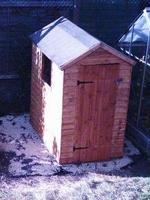 ...and then eating one of these as a reward. (We chose the "Sun". Mm, halloumi.)
The Greenbelt talk is coming together reasonably nicely, now. Unfortunately there's a lack of people to practise it at -- my usual test audience, R. and M., are waiting for me to lend them the videos of 2005 Doctor Who before they'll actually know what I'm talking about.
This means that a week tomorrow will be the first time I've stood up to deliver it to anybody other than B. and the cats, which is mildly terrifying. Still, never mind.
I also need to do some proper research for Sunday's panel discussion on Blogging, which is kind of intimidating as well. Does anyone have recommendations for the following, all of which I need to read some of at some point:
1. Some interesting and/or high-profile Christian and/or literary blogs?
2. Sites which go rather more into the cultural (and preferably not too much of the technical) theory of blogging -- in terms of history, current trends, ethics, politics and the like?
Any suggestions gratefully received.
 ...and then eating one of these as a reward. (We chose the "Sun". Mm, halloumi.)
The Greenbelt talk is coming together reasonably nicely, now. Unfortunately there's a lack of people to practise it at -- my usual test audience, R. and M., are waiting for me to lend them the videos of 2005 Doctor Who before they'll actually know what I'm talking about.
This means that a week tomorrow will be the first time I've stood up to deliver it to anybody other than B. and the cats, which is mildly terrifying. Still, never mind.
I also need to do some proper research for Sunday's panel discussion on Blogging, which is kind of intimidating as well. Does anyone have recommendations for the following, all of which I need to read some of at some point:
1. Some interesting and/or high-profile Christian and/or literary blogs?
2. Sites which go rather more into the cultural (and preferably not too much of the technical) theory of blogging -- in terms of history, current trends, ethics, politics and the like?
Any suggestions gratefully received.
19 August 2005
In Other News...
...It seems as if I'll be even busier at Greenbelt than previously announced. In addition to writing a daily blog for surefish (don't worry, I'll link to it from here), they'll also be running an article to tie in with my talk about (all together now) The Spirituality of Doctor Who. Those pieces will probably be going up on this page, so keep your eyes peeled over the Bank Holiday weekend.
If you're going to be at Greenbelt, you'll be able to see me actually delivering the talk at 1pm on Monday 29 August at Between the Lines: with luck a full transcript will materialise eventually to join last years' talks here. If you'd like to hear me and a panel of other self-appoitned experts, wittering on about blogging, then you'll need to be at the same venue at 6pm on the Sunday -- coincidentally, two hours before the venue shows Greenbelt speaker Paul Cornell's Doctor Who episode Father's Day.
In other other news, my hardback copies of Peculiar Lives arrived from Telos yesterday, and are really rather nice. The cover is dark blue, with a textured leather effect (not real leather, obviously) and there's a ribbon bookmark, adding to the whole elderly-book feel. These publishers take real care over, and pride in, the physical appearances of all their books, and with these hardback editions it really shows.
If you're still considering whether or not to buy the novella, whether in hardback or paperback, then don't forget that a sample chapter of the novella is being hosted online at Outpost Gallifrey. Read it before you shell out (and then shell out, obviously).
Now that the hardbacks are out, and following the release of Wildthyme on Top, the only fiction of mine that currently remains to be released is "The Long Midwinter" in Short Trips: The History of Christmas. Whether anything further will have been announced by the time that comes out remains to be seen... but frankly, I seem to be suffering from a certain amount of creative burnout just at the moment. The past month has been the least productive time-off-work I've had for years, and I've had to put a couple of hopeful-looking projects on the back-burner from sheer lack of ability to proceed with them.
I'm thinking I might take a bit of a sabbatical after Greenbelt, and spend two or three months without trying to write creatively at all. The hope is that depriving myself of the opportunity to follow through on my ideas will immediately result in a plethora of them presenting themselves, all of which I can jot down and save for later, when I can return to work refreshed and reinvigorated. This, at least, is the theory.
If you're going to be at Greenbelt, you'll be able to see me actually delivering the talk at 1pm on Monday 29 August at Between the Lines: with luck a full transcript will materialise eventually to join last years' talks here. If you'd like to hear me and a panel of other self-appoitned experts, wittering on about blogging, then you'll need to be at the same venue at 6pm on the Sunday -- coincidentally, two hours before the venue shows Greenbelt speaker Paul Cornell's Doctor Who episode Father's Day.
In other other news, my hardback copies of Peculiar Lives arrived from Telos yesterday, and are really rather nice. The cover is dark blue, with a textured leather effect (not real leather, obviously) and there's a ribbon bookmark, adding to the whole elderly-book feel. These publishers take real care over, and pride in, the physical appearances of all their books, and with these hardback editions it really shows.
If you're still considering whether or not to buy the novella, whether in hardback or paperback, then don't forget that a sample chapter of the novella is being hosted online at Outpost Gallifrey. Read it before you shell out (and then shell out, obviously).
Now that the hardbacks are out, and following the release of Wildthyme on Top, the only fiction of mine that currently remains to be released is "The Long Midwinter" in Short Trips: The History of Christmas. Whether anything further will have been announced by the time that comes out remains to be seen... but frankly, I seem to be suffering from a certain amount of creative burnout just at the moment. The past month has been the least productive time-off-work I've had for years, and I've had to put a couple of hopeful-looking projects on the back-burner from sheer lack of ability to proceed with them.
I'm thinking I might take a bit of a sabbatical after Greenbelt, and spend two or three months without trying to write creatively at all. The hope is that depriving myself of the opportunity to follow through on my ideas will immediately result in a plethora of them presenting themselves, all of which I can jot down and save for later, when I can return to work refreshed and reinvigorated. This, at least, is the theory.
Don't Mention the Waugh
It's important I complete my epic write-up of last weekend's festivities before it all falls out of my head. As my fourth decade progresses, I find myself forgetting things remarkably easily -- I used to retain information without even trying, often without even wanting to at all, and now it's a real struggle. It's tragic really.
...Where was I?
Right. Yes. The Oxford reunion weekend -- and specifically, the DougSoc reunion weekend, which means that it wasn't terribly much like the floppy-haired cricket-whited unrequited Weltschmertzfest that the phrase "Oxford reunion weekend" suggests.
(To be honest, Oxford in the 1990s wasn't a particularly Brideshead place anyway -- except for a few unrequited-floppy-cricket types who insisted on perceiving it as such, and who for fairly obvious reasons tended to congregate around Christ Church, which as ill luck would have it was my college. I didn't tend to spend much time there.)
Anyway. Last weekend was well-attended, with some thirty or more DougSoccers, accompanied by partners and in two cases infant offspring, partaking of traditional activities ably organised by Silk and Pete, to whom enormous thanks are due.
Festivities began at Saturday lunchtime with a grimly determined picnic in the University Parks. This eventually succumbed to the inevitable downpour, and we decamped to The Lamb and Flag[1], one of the many highly decent real ale pubs in Oxford (and the only one, I believe I'm right in saying, which has its own dedicated beer, Lamb and Flag Gold, although it's not brewed on the premises).
After this we resorted to The Bear, the traditional starting-point for the now internationally-renowned DougSoc Role-Playing Pub Crawls. (Historically the reason for this has been the extensive outside seating, which is of course useless in a downpour. We crowded out the sweaty, steamy interior instead.) Enormous kudos points are due to Pete at this point for creating an all-new pub crawl (which hopefully will be getting archived at some point) -- a hugely ambitious crossover between the Hitchhiker, Prisoner, Sandman and Doctor Who universes.
The original DougSoc Doctor Who pub crawl (not archived) was called The Claws of Time and featured yours truly as the Master (bwa-ha-ha). The Doctor Who elements in this updated version were naturally based around the 2005 series, and pubgoers were given the parts of the Doctor, Rose, Captain Jack, Margaret the Slitheen (played by B.) and The Editor (played by me -- I'm evidently typecast. It's the beard, I think.) We were sent on a schedule from pub to pub, drinking and interacting in character with each other, and more surreally with characters from the other fictional universes.
All of which was enormous fun, even if it did involve wandering around in the rain (and visiting The Turl, which has gone enormously downhill and where the only remotely drinkable beer was Guinness[2]. For completeness' sake, the other pubs where I was sent were The St Aldate's Tavern -- formerly known as The Hobgoblin, and prior to that The Bulldog -- and the splendidly-named The Three Goat's Heads.)
After which we all went for a nice Italian meal, then to the Oscar Wilde Room in Magdalen College for your classic booze-up-with-comedy-sketches event. Booze consisted of beer, wine, Pan-Galactic Gargle Blasters[3] and all the usual; comedy consisted of recycled Cruel and Unusual Punishment sketches, along with some other usual suspects like Fry and Laurie. A massively good time was had by pretty much all, although the children and most of their parents had vanished by this point.
Attempts to play Mao were abortive as far as most of us were concerned, since the (otherwise highly impressive and efficient) organisers had failed to take into account the need for playing-cards and the players had to trek back to someone's house. Plus it was late, and a lot of us lost our all-night-partying student stamina long ago, so went to bed instead. (B. and I slept at her old college, St Hilda's, which has a very nice S.C.R. guest room and rather less impressive cooked breakfasts.)
Sunday morning saw the most Bridesheadish activity of the whole weekend. I didn't partake of the punting, having a pathological dislike of any activity which stands a chance of resulting in any part of me being submerged in filthy river-water. Instead I wandered around the bookshops kindly provided by the entrepreneurs of Oxford for the purpose, and picked up a copy of the Hugo-Award-winning Cambridge Companion to Science Fiction, which I'm looking forward to reading even as we speak.
I met up with the others for lunch at Magdalen College bar, after which we lounged around in Christ Church Meadow before in some cases progressing to the very best of Oxford's fine real ale pubs, The Turf Tavern, for a final round of beer before making our ways to our various homes.
The whole thing was generally a fantastic time, with the opportunity to catch up with some people I haven't seen for a very long time and many others who I don't see nearly often enough.
Plus beautiful surroundings, nice beer, good food, fun activities and, naturally, the universe going "foom". What more could one ask?
[1] Pub reviews courtesy of Colin, for nostalgic reasons, and therefore very likely several years out of date.
[2] A short history of Phil's drinking preferences over the years, for those of you whose curiosity was piqued by the tobacco rant:
1985 to 1990ish (aged 14 to 18) -- Pimm's and lemonade (the first thing I ever got drunk on). Dry Blackthorn or Woodpecker cider. Martini and lemonade, Bacardi and Coke. Lambrusco.
1990ish to 1999ish (aged 18 to 27 -- the Oxford years, frustratingly enough) -- Guinness and other then-mainstream stouts such as Murphy's and Beamish. Occasional mass-produced ales like Caffrey's. Tastes in wine becoming more acceptable, moving quickly from white to dogmatically red, with an exception made for retsina. Spirit consumption limited to ouzo and vodka, except at drunken parties when pretty much anything would do (see [3] below).
1999ish to the present (aged 27 to 33) -- Sudden discovery of real ale and consequent reformatting of the palate. Favourite beers now too numerous to name. Still ignorant about wine, but I know what I like and it's definitely not white. Not at all averse to a decent single malt whisky, either.
[3] The historic DougSoc recipe for a Pan-Galactic Gargle Blaster: take 2 parts Blue Curaçao to 2 parts vodka, 1 part tequila and 1 part rum. (In practice, just take 2 parts Curaçao to 4 of anything that pours.) Mix in a large mixing-bowl. Add orange juice in much larger quantities until the mixture is an opaque green colour. Slosh in a little of anything else that looks like it might be interesting, then ladle out to all comers. Garnish with a slice of aubergine (optional).
...Where was I?
Right. Yes. The Oxford reunion weekend -- and specifically, the DougSoc reunion weekend, which means that it wasn't terribly much like the floppy-haired cricket-whited unrequited Weltschmertzfest that the phrase "Oxford reunion weekend" suggests.
(To be honest, Oxford in the 1990s wasn't a particularly Brideshead place anyway -- except for a few unrequited-floppy-cricket types who insisted on perceiving it as such, and who for fairly obvious reasons tended to congregate around Christ Church, which as ill luck would have it was my college. I didn't tend to spend much time there.)
Anyway. Last weekend was well-attended, with some thirty or more DougSoccers, accompanied by partners and in two cases infant offspring, partaking of traditional activities ably organised by Silk and Pete, to whom enormous thanks are due.
Festivities began at Saturday lunchtime with a grimly determined picnic in the University Parks. This eventually succumbed to the inevitable downpour, and we decamped to The Lamb and Flag[1], one of the many highly decent real ale pubs in Oxford (and the only one, I believe I'm right in saying, which has its own dedicated beer, Lamb and Flag Gold, although it's not brewed on the premises).
After this we resorted to The Bear, the traditional starting-point for the now internationally-renowned DougSoc Role-Playing Pub Crawls. (Historically the reason for this has been the extensive outside seating, which is of course useless in a downpour. We crowded out the sweaty, steamy interior instead.) Enormous kudos points are due to Pete at this point for creating an all-new pub crawl (which hopefully will be getting archived at some point) -- a hugely ambitious crossover between the Hitchhiker, Prisoner, Sandman and Doctor Who universes.
The original DougSoc Doctor Who pub crawl (not archived) was called The Claws of Time and featured yours truly as the Master (bwa-ha-ha). The Doctor Who elements in this updated version were naturally based around the 2005 series, and pubgoers were given the parts of the Doctor, Rose, Captain Jack, Margaret the Slitheen (played by B.) and The Editor (played by me -- I'm evidently typecast. It's the beard, I think.) We were sent on a schedule from pub to pub, drinking and interacting in character with each other, and more surreally with characters from the other fictional universes.


All of which was enormous fun, even if it did involve wandering around in the rain (and visiting The Turl, which has gone enormously downhill and where the only remotely drinkable beer was Guinness[2]. For completeness' sake, the other pubs where I was sent were The St Aldate's Tavern -- formerly known as The Hobgoblin, and prior to that The Bulldog -- and the splendidly-named The Three Goat's Heads.)
After which we all went for a nice Italian meal, then to the Oscar Wilde Room in Magdalen College for your classic booze-up-with-comedy-sketches event. Booze consisted of beer, wine, Pan-Galactic Gargle Blasters[3] and all the usual; comedy consisted of recycled Cruel and Unusual Punishment sketches, along with some other usual suspects like Fry and Laurie. A massively good time was had by pretty much all, although the children and most of their parents had vanished by this point.
Attempts to play Mao were abortive as far as most of us were concerned, since the (otherwise highly impressive and efficient) organisers had failed to take into account the need for playing-cards and the players had to trek back to someone's house. Plus it was late, and a lot of us lost our all-night-partying student stamina long ago, so went to bed instead. (B. and I slept at her old college, St Hilda's, which has a very nice S.C.R. guest room and rather less impressive cooked breakfasts.)
Sunday morning saw the most Bridesheadish activity of the whole weekend. I didn't partake of the punting, having a pathological dislike of any activity which stands a chance of resulting in any part of me being submerged in filthy river-water. Instead I wandered around the bookshops kindly provided by the entrepreneurs of Oxford for the purpose, and picked up a copy of the Hugo-Award-winning Cambridge Companion to Science Fiction, which I'm looking forward to reading even as we speak.
I met up with the others for lunch at Magdalen College bar, after which we lounged around in Christ Church Meadow before in some cases progressing to the very best of Oxford's fine real ale pubs, The Turf Tavern, for a final round of beer before making our ways to our various homes.
The whole thing was generally a fantastic time, with the opportunity to catch up with some people I haven't seen for a very long time and many others who I don't see nearly often enough.
Plus beautiful surroundings, nice beer, good food, fun activities and, naturally, the universe going "foom". What more could one ask?
[1] Pub reviews courtesy of Colin, for nostalgic reasons, and therefore very likely several years out of date.
[2] A short history of Phil's drinking preferences over the years, for those of you whose curiosity was piqued by the tobacco rant:
1985 to 1990ish (aged 14 to 18) -- Pimm's and lemonade (the first thing I ever got drunk on). Dry Blackthorn or Woodpecker cider. Martini and lemonade, Bacardi and Coke. Lambrusco.
1990ish to 1999ish (aged 18 to 27 -- the Oxford years, frustratingly enough) -- Guinness and other then-mainstream stouts such as Murphy's and Beamish. Occasional mass-produced ales like Caffrey's. Tastes in wine becoming more acceptable, moving quickly from white to dogmatically red, with an exception made for retsina. Spirit consumption limited to ouzo and vodka, except at drunken parties when pretty much anything would do (see [3] below).
1999ish to the present (aged 27 to 33) -- Sudden discovery of real ale and consequent reformatting of the palate. Favourite beers now too numerous to name. Still ignorant about wine, but I know what I like and it's definitely not white. Not at all averse to a decent single malt whisky, either.
[3] The historic DougSoc recipe for a Pan-Galactic Gargle Blaster: take 2 parts Blue Curaçao to 2 parts vodka, 1 part tequila and 1 part rum. (In practice, just take 2 parts Curaçao to 4 of anything that pours.) Mix in a large mixing-bowl. Add orange juice in much larger quantities until the mixture is an opaque green colour. Slosh in a little of anything else that looks like it might be interesting, then ladle out to all comers. Garnish with a slice of aubergine (optional).
17 August 2005
Ad Nauseam
Every time I see or hear a mention[1] of the revolting British supermarket chain Asda (now a subsidiary of the much larger revolting U.S. supermarket chain Wal-Mart), their advertising jingle starts playing in my head. You know, the one they used to use in those incredibly cheesy T.V. adverts which would end with someone patting their back pocket in time with the jingle, to show how much spare change they had left after doing their shopping there. The one which they used to play over and over and over and over and over again on their stores' P.A. systems, before some international agreement or other on the use of psychological torture was invoked to stop them.
Is this an example of effective marketing?
Bear in mind when formulating your answer that as a direct result of the above I loathe Asda with a violent, psychotic passion, and that if a branch of it were the last grocery shop left on Earth, I would not only prefer to starve to death than to do my shopping there, but wouldn't intervene to prevent it burning down if it contained the final bar of chocolate in existence.
[1] Don't bother following that link, it's not very interesting. Just the springboard for a rant.
Is this an example of effective marketing?
Bear in mind when formulating your answer that as a direct result of the above I loathe Asda with a violent, psychotic passion, and that if a branch of it were the last grocery shop left on Earth, I would not only prefer to starve to death than to do my shopping there, but wouldn't intervene to prevent it burning down if it contained the final bar of chocolate in existence.
[1] Don't bother following that link, it's not very interesting. Just the springboard for a rant.
15 August 2005
Image Consciousness
 The weekend in Oxford was very fantastic indeed, and I will be describing it at length.
For the moment, though, here's an experiment on my part in using Blogger's new picture-uploading facility. The photo, of a shop named Honey's on the High Street, exists courtesy of my fellow DougSoccer Alex and illustrates what a peculiar place Oxford is. There can't be many cities in the U.K. where a newsagent would pick on this specific publication as their primary selling-point.
Give Me Nicotine or Give Me Death
I'm pretty much entirely not a smoker. As a student I flirted with cigarettes, largely out of curiosity; but having established to my satisfaction that neither the flavour nor the high was fun enough to justify the considerable expense -- and, crucially, that smoking didn't make me look cool enough that girls were more likely go to bed with me -- I gave up on it.
These days the only tobacco I taste takes the form of a cigar on special occasions: weddings, usually, or when friends are celebrating the successful functioning of their reproductive equipment.
So the direct effect on my life of what, apparently, two-thirds of M.P.s want -- a total ban on smoking in pubs -- would be negligible. But the effect on British pub culture would be devastating, and that's something I do feel I have a stake in. As a member of CAMRA I'm entitled to pontificate about such things, at extreme length if necessary, whilst resting a full-to-the brim pint on the upper surface of my belly. So...
If the Government bans smoking in pubs, as many voters seem to want them to do, then pubs will at a stroke become less inclusive, friendly and welcoming. Students, old men with dogs and a fair number of affluent professionals will suddenly find it vastly preferable to go to a private members' club, or more depressingly to consume their fags and beer at home. Drinking in streets and parks, which the Government also frowns on, will certainly increase.
Under the legislation the Government is actually proposing, whereby it's only pubs which sell food where the ban will be observed, publicans will be obliged to decide whether they'd prefer to alienate the smokers or the eaters among their clientele. Whatever happens, pubs are going to go out of business -- and you can bet it's not going to be the ones with the financial backing of mainstream breweries or big McPubCo chains.
I understand the health benefits, just as I understand that... oh Lord, just fill in your favourite statistic about traffic accidents or marijuana or whatever. But speaking for myself, I would very much prefer to be considered an adult, capable of making an informed decision as to whether or not the risk of entering a mildly nicotine-laced atmosphere is worth the benefit of the nice beer I might find therein, than a mindless work-drone who requires to have all freedom of choice removed by governmental edict so that the difficulty of making a decision won't destabilise his brain, thus compromising his value to the state.
And as for those of us who actually aren't adults... well.
I'm honestly in favour of pubs accommodating families by providing, say, non-smoking rooms, outside tables and the like. I'm very glad to be able to go to pubs and have a drink with those of my friends who have, as previously mentioned, successfully undergone the parturitive process.
But a pub is, essentially, a social space for adults: this is its core function. The fact that many such establishments will also admit children is an additional benefit -- an optional extra which, at present, a reasonable number of them choose to offer. Myself, I didn't set foot in a pub until I was old enough (in my own estimation, if not that of the Government) to have a drink there, and I certainly didn't expect everyone else there to conform to what was at the time my fanatical disapproval of tobacco, any more than I expected them to share my taste for Dry Blackthorn cider.
Now that I'm older, I'm honestly very pleased that the opportunity exists for me to go to pubs and have a pleasant pint with those of my friends who have elected to become parents. And yet I would, in an ideal world, also like not to be deprived of the opportunity to go to pubs with those of my friends who are smokers -- and, if it seems appropriate, to eat a meal there with them -- without them moaning all the bloody time.
Is that really such an indefensible position?
These days the only tobacco I taste takes the form of a cigar on special occasions: weddings, usually, or when friends are celebrating the successful functioning of their reproductive equipment.
So the direct effect on my life of what, apparently, two-thirds of M.P.s want -- a total ban on smoking in pubs -- would be negligible. But the effect on British pub culture would be devastating, and that's something I do feel I have a stake in. As a member of CAMRA I'm entitled to pontificate about such things, at extreme length if necessary, whilst resting a full-to-the brim pint on the upper surface of my belly. So...
If the Government bans smoking in pubs, as many voters seem to want them to do, then pubs will at a stroke become less inclusive, friendly and welcoming. Students, old men with dogs and a fair number of affluent professionals will suddenly find it vastly preferable to go to a private members' club, or more depressingly to consume their fags and beer at home. Drinking in streets and parks, which the Government also frowns on, will certainly increase.
Under the legislation the Government is actually proposing, whereby it's only pubs which sell food where the ban will be observed, publicans will be obliged to decide whether they'd prefer to alienate the smokers or the eaters among their clientele. Whatever happens, pubs are going to go out of business -- and you can bet it's not going to be the ones with the financial backing of mainstream breweries or big McPubCo chains.
I understand the health benefits, just as I understand that... oh Lord, just fill in your favourite statistic about traffic accidents or marijuana or whatever. But speaking for myself, I would very much prefer to be considered an adult, capable of making an informed decision as to whether or not the risk of entering a mildly nicotine-laced atmosphere is worth the benefit of the nice beer I might find therein, than a mindless work-drone who requires to have all freedom of choice removed by governmental edict so that the difficulty of making a decision won't destabilise his brain, thus compromising his value to the state.
And as for those of us who actually aren't adults... well.
I'm honestly in favour of pubs accommodating families by providing, say, non-smoking rooms, outside tables and the like. I'm very glad to be able to go to pubs and have a drink with those of my friends who have, as previously mentioned, successfully undergone the parturitive process.
But a pub is, essentially, a social space for adults: this is its core function. The fact that many such establishments will also admit children is an additional benefit -- an optional extra which, at present, a reasonable number of them choose to offer. Myself, I didn't set foot in a pub until I was old enough (in my own estimation, if not that of the Government) to have a drink there, and I certainly didn't expect everyone else there to conform to what was at the time my fanatical disapproval of tobacco, any more than I expected them to share my taste for Dry Blackthorn cider.
Now that I'm older, I'm honestly very pleased that the opportunity exists for me to go to pubs and have a pleasant pint with those of my friends who have elected to become parents. And yet I would, in an ideal world, also like not to be deprived of the opportunity to go to pubs with those of my friends who are smokers -- and, if it seems appropriate, to eat a meal there with them -- without them moaning all the bloody time.
Is that really such an indefensible position?
12 August 2005
Lost, Not In Space
I watched the double-length pilot episode of Lost last night. At present I haven't read any spoilers for the series whatosever, so the following is a reaction to it completely in isolation. I don't imagine I'll be able to keep that up for long, though, so here, for the record, are those initial thoughts...
The interpersonal drama was all a bit dull and predictable, I thought, except for the odd behaviour of Daniel Dae Kim's character and the revelation that it's the bird-who-fancies-the-doctor who was actually the prisoner on the plane. The young-blonde-in-denial was becoming particularly irritating towards the end. This was compounded by the fact that hardly anybody's name seemed to be spoken, so that one was thinking of them as "the vaguely muslim-looking guy", "the sinister old guy", "the token fat guy" and so on.
Perhaps this is meant to make them seem more archetypal, though. Perhaps.
Furthermore, the setup is enormously contrived -- the plane being so comprehensively smashed up, while so many passengers and their luggage survive; the pilot surviving for long enough to hand out vital information; the menacing sounds in the woods; even the inevitable "one of us is not to be trusted" dynamic.
Charitably, it seems to me that there's going to turn out to be a reason for this (although probably not for the clichéd behaviour of the characters themselves). Perhaps it's having read a Guardian article which compares the series's premise with that of the reality show Survivor, but I couldn't help thinking -- even before the polar bear turned up -- that this was not a "real" environment. I don't imagine that it's actually a virtual reality, but it seems pretty clear that someone is stage-managing everything. (Either that or all the above is just a symptom of poor writing.)
So far we have a wreck on an isolated island due to bad weather, and the revelation of another plane-crash sixteen years earlier. Plus, of course, an invisible monster in the undergrowth, which is probably intended to make us think of The Lost World, but put an altogether different association in my head.
So -- would I be going out on a limb if I suggested that future episodes may just possibly throw up an elderly castaway and his sixteen-year-old daughter living on the island? (It isn't clear at this point, incidentally, whether the sinister backgammon-playing old man was actually a passenger on the flight.) The only question is whether this character's mastery over the local environment -- which will naturally turn out to be responsible for both the plane-crash and the monster -- will derive from books of magic or giant banks of ancient alien machinery, and whether his sidekick will be an aery spirit or a cute robot.
So, the situation is intriguing, and possibly archetypal 'n' that, but the actual drama is, so far, bordering on the banal. Plus the English guy is rubbish. Perhaps I've been spoiled recently with watching proper quality drama like The West Wing and Firefly, but I'm not entirely sure Lost is going to keep my attention for long enough to deliver on its promise.
The interpersonal drama was all a bit dull and predictable, I thought, except for the odd behaviour of Daniel Dae Kim's character and the revelation that it's the bird-who-fancies-the-doctor who was actually the prisoner on the plane. The young-blonde-in-denial was becoming particularly irritating towards the end. This was compounded by the fact that hardly anybody's name seemed to be spoken, so that one was thinking of them as "the vaguely muslim-looking guy", "the sinister old guy", "the token fat guy" and so on.
Perhaps this is meant to make them seem more archetypal, though. Perhaps.
Furthermore, the setup is enormously contrived -- the plane being so comprehensively smashed up, while so many passengers and their luggage survive; the pilot surviving for long enough to hand out vital information; the menacing sounds in the woods; even the inevitable "one of us is not to be trusted" dynamic.
Charitably, it seems to me that there's going to turn out to be a reason for this (although probably not for the clichéd behaviour of the characters themselves). Perhaps it's having read a Guardian article which compares the series's premise with that of the reality show Survivor, but I couldn't help thinking -- even before the polar bear turned up -- that this was not a "real" environment. I don't imagine that it's actually a virtual reality, but it seems pretty clear that someone is stage-managing everything. (Either that or all the above is just a symptom of poor writing.)
So far we have a wreck on an isolated island due to bad weather, and the revelation of another plane-crash sixteen years earlier. Plus, of course, an invisible monster in the undergrowth, which is probably intended to make us think of The Lost World, but put an altogether different association in my head.
So -- would I be going out on a limb if I suggested that future episodes may just possibly throw up an elderly castaway and his sixteen-year-old daughter living on the island? (It isn't clear at this point, incidentally, whether the sinister backgammon-playing old man was actually a passenger on the flight.) The only question is whether this character's mastery over the local environment -- which will naturally turn out to be responsible for both the plane-crash and the monster -- will derive from books of magic or giant banks of ancient alien machinery, and whether his sidekick will be an aery spirit or a cute robot.
So, the situation is intriguing, and possibly archetypal 'n' that, but the actual drama is, so far, bordering on the banal. Plus the English guy is rubbish. Perhaps I've been spoiled recently with watching proper quality drama like The West Wing and Firefly, but I'm not entirely sure Lost is going to keep my attention for long enough to deliver on its promise.
09 August 2005
Inn Transit
Sorry about the reduced posting rate on this blog recently. I have been frantically trying to get work done, and to a very great extent failing, but in a manner which is taking up most of my time and creativity. Argh.
The Greenbelt talk is largely "written" now, but will need extensive practice to turn it from notes into something that's actually deliverable, and the other things I've been trying to do are in various half-formed stages. I have, however, found the time to give lots of constructive help and advice to other people about their creative projects. www.infinitarian.com, for all your displacement-activity needs.
Things I actually have done recently have included a very nice weekend in London, attending B.'s much-delayed birthday pub crawl. A spurious narrative justification based on Jasper Fforde's Thursday Next novels meant that everyone was invited to come as a character from 19th-century literature, so that the denizens of Southwark, Borough and environs were treated to the sight of -- among others -- Bill Sykes, Lorna Doone, Jane Eyre, Doctors Jekyll and Van Helsing, a slightly out-of-period Leopold Bloom and a rather impressive Bride of Dracula, all wandering around getting increasingly plastered and arguing about where to eat.
B. had arranged some particularly fiendish clues to direct us between venues, which for easily-guessed reasons became subjectively more difficult as the evening progressed. I drank lots of very pleasant beers in lots of very pleasant pubs with lots of very pleasant people, and saw more Londonian backstreets than I have in a long while. I also had time for a brief trip to the Tate Modern in the morning.
Next weekend we'll be attending the equally exciting, and even longer awaited, reunion of the Oxford University Douglas Adams Society, where we plan to revive some fine old DougSoc traditions including role playing pubcrawls, partying where Oscar Wilde used to live and playing Mao, and which therefore promises to be fun on a stick. Watch this space for a full report.
The Greenbelt talk is largely "written" now, but will need extensive practice to turn it from notes into something that's actually deliverable, and the other things I've been trying to do are in various half-formed stages. I have, however, found the time to give lots of constructive help and advice to other people about their creative projects. www.infinitarian.com, for all your displacement-activity needs.
Things I actually have done recently have included a very nice weekend in London, attending B.'s much-delayed birthday pub crawl. A spurious narrative justification based on Jasper Fforde's Thursday Next novels meant that everyone was invited to come as a character from 19th-century literature, so that the denizens of Southwark, Borough and environs were treated to the sight of -- among others -- Bill Sykes, Lorna Doone, Jane Eyre, Doctors Jekyll and Van Helsing, a slightly out-of-period Leopold Bloom and a rather impressive Bride of Dracula, all wandering around getting increasingly plastered and arguing about where to eat.
B. had arranged some particularly fiendish clues to direct us between venues, which for easily-guessed reasons became subjectively more difficult as the evening progressed. I drank lots of very pleasant beers in lots of very pleasant pubs with lots of very pleasant people, and saw more Londonian backstreets than I have in a long while. I also had time for a brief trip to the Tate Modern in the morning.
Next weekend we'll be attending the equally exciting, and even longer awaited, reunion of the Oxford University Douglas Adams Society, where we plan to revive some fine old DougSoc traditions including role playing pubcrawls, partying where Oscar Wilde used to live and playing Mao, and which therefore promises to be fun on a stick. Watch this space for a full report.
05 August 2005
Greenbelt Update
This year's Greenbelt is beginning to look rather busy. Early evidence suggests that in addition to my talk on The Spirituality of Doctor Who -- which, incidentally, I should be writing at this very moment -- I'll be participating in (but fortunately not chairing) a panel discussion on blogging. (Both of these sessions are at the Between the Lines venue -- see here for their full programme.) If you're at the festival and coming along to either session, do come and say "Hi" to me afterwards.
Greenbelt appears intent on elevating me as some kind of Christian Blog Guru, as I'll also be blogging from the site on behalf of surefish.co.uk, the web-magazine run by Christian Aid's internet-provider subsidiary. The relevant entries -- summaries of my day-by-day experiences at the festival on Saturday, Sunday and Monday -- will be going up at the surefish site, but I'll naturally be linking to them from here. Since this effectively means that I get paid for doing something I'd be hoping to get round to doing anyway, it gets a big thumbs-up from me.
It does mean, though, that Greenbelt 2005 is going to be substantially less restful than usual for me. I think I may take next year off, and spend my Bank Holiday weekend relaxing instead.
Greenbelt appears intent on elevating me as some kind of Christian Blog Guru, as I'll also be blogging from the site on behalf of surefish.co.uk, the web-magazine run by Christian Aid's internet-provider subsidiary. The relevant entries -- summaries of my day-by-day experiences at the festival on Saturday, Sunday and Monday -- will be going up at the surefish site, but I'll naturally be linking to them from here. Since this effectively means that I get paid for doing something I'd be hoping to get round to doing anyway, it gets a big thumbs-up from me.
It does mean, though, that Greenbelt 2005 is going to be substantially less restful than usual for me. I think I may take next year off, and spend my Bank Holiday weekend relaxing instead.
Subscribe to:
Posts (Atom)