Oh right, yes, sorry. I was miles away.
I've been very lax in updating this blog for a few weeks now. The week before last I was (I'm glad to say) enjoying my time off too much to spend much of it staring at a computer screen, and since then I've been absurdly busy again, mostly catching up after my week off. (Such is the nature of our western society -- it's the post-christian work ethic, you know. Some days I long to live in one of those eastern post-buddhist cultures where they really know how to let their hair down and and relax, like, say, Japan. Oh.)
I've also, to be scrupulously honest, been playing rather a lot of Scrabble with people on Facebook.
But now the proofreading of Nobody's Children is suddenly horribly urgent, and I'm unlikely to get the time to update this blog with the reviews of Collapse, The Amazing Adventures of Kavalier and Clay and the numerous trade-paperback comic collections I've been reading in order to bump my books-per-week score back up again after the couple of months spent reading Collapse and Iron Council -- let alone the baby gorilla photos I owe you -- for a few days' yet.
In the meantime, and with what I'm rather forlornly hoping might be an endearing predictability, I'm breaking silence in order to trail my latest column for Surefish. Andy the editor has titled it "Apocalypse Now?", but I'm still rather fond of my original title -- so much so in fact that I think I'll use it here.
The piece was written after our last round of floods, and (I believe) was left by Andy on a thingy to upload automatically after he went on holiday. So I have to admit that it reads as a little out of date now.
In particular, I should apologise to His Grace the Bishop of Carlisle. I must acknowledge that Her Majesty's Government failed to heed the warning he gave us after the earlier flooding and reintroduce the death penalty for sodomy, and that the Deity (or, for the most hardened unbelievers amongst us, a complex chaotic weather system) has since responded with yet further travails -- just as the arsebrained twat predicted.
So, my apologies to him for that.
In happier news (though still bittersweet), the eleventh and (for the moment) final volume of Telos's Time Hunter series, Child of Time by George Mann and David Howe, has now been released. I've yet to read my copy, but I gather it features some characters from my book in the series, Peculiar Lives, in a prominent rôle. So that's nice.
And, as I say, it shouldn't be long now before Nobody's Children is out. I'm hoping to have something rather special to put up on my website as an extra, but that's still under wraps for now.
Mmm, wraps. Time for supper, I think.
PS: Oh -- one other thing, speaking of Japan: The Onion has one of the funnier pieces of S.F. I've read recently. Enjoy.
24 July 2007

09 July 2007
Because You Can Never Have Too Many Blog Posts About Cats
Since I last updated this blog, I've spent a day at my work's annual staff conference, disposed of the first mouse Mulder's brought down during the three years since we moved to this house, written another (as yet unpublished) column for Surefish, and taken both cats to the vet for their annual checkup and booster vaccines.
(The mouse was dead. I don't like handling dead mice, but I like it a lot less when they turn out not to be dead after all. So that was something of a relief. We're probably going to have to find a bell for Mulder's collar, though.)
Sunday I divided between car travel, attending a barbecue and being a bed for kittens. The kittens have recently been adopted by the little sister-in-law and her chap, and look like this:
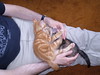
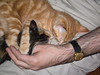
I shouldn't be remotely surprised if more such photos arrived on Flickr soon.
The rest of the week I'm taking off work, and pretty much everything else. I intend to spend the majority of it sleeping, reading and watching TV. However, I may also update this blog further, once I've finished reading The Amazing Adventures of Kavalier and Clay. I may even finally get round to uploading those pictures of gorillas. And more of the kittens, I shouldn't wonder.
(The mouse was dead. I don't like handling dead mice, but I like it a lot less when they turn out not to be dead after all. So that was something of a relief. We're probably going to have to find a bell for Mulder's collar, though.)
Sunday I divided between car travel, attending a barbecue and being a bed for kittens. The kittens have recently been adopted by the little sister-in-law and her chap, and look like this:
I shouldn't be remotely surprised if more such photos arrived on Flickr soon.
The rest of the week I'm taking off work, and pretty much everything else. I intend to spend the majority of it sleeping, reading and watching TV. However, I may also update this blog further, once I've finished reading The Amazing Adventures of Kavalier and Clay. I may even finally get round to uploading those pictures of gorillas. And more of the kittens, I shouldn't wonder.
05 July 2007
The Sound of Voodoo Drums
If you've been wondering what I've thought of the latest season of Doctor Who, the term I'd use would be "mixed", or more accurately "very mixed indeed, so much so as to generate whiplash when watched back-to-back". Some of the early episodes were very, very bad; the run of episodes from Human Nature to Utopia was the best New Who has ever been; and then the whole thing fell apart semi-disastrously at the end.
Ah, well. At least they haven't done anything perverse and idiotic like shunting Freema Agyeman's appealing and charismatic Martha off to Torchwood while bringing back bloody Catherine Tate as the full-time companion for Season Four. Oh, wait.
If, as is quite likely, you're more interested in knowing specifically what I thought of Season Three's treatment of religious themes, then by a mind-boggling coincidence my latest column for Surefish dwells extensively on that very topic.
In other news, those of you mourning the premature and sad demise of the Faction Paradox novels may well be interested in seeing this. Daniel O'Mahony is, I think I'm safe in saying, the most talented writer to have worked in the Faction Paradox arena, and to have a full-length novel from him set in the Faction universe will be a rare treat. I only hope that this is the first of many from Random Static.
30 June 2007
The Great Rock'n'Roll Dwindle
If you've been reading this blog for a while, you may have noticed that I almost never write about music. Up to this point, I haven't even had a tag for it.
This is partly because music is a rather marginal art-form in my life, compared with my preferred media of TV and books (then cinema, then whatever we're supposed to call actual art to distinguish it from other types of art, then probably comics.) It's partly also because I can rarely afford to buy CDs, let alone attend concerts -- except at Greenbelt every year, where I occasionally find myself essaying momentary music criticism in my reportage for Surefish.
Doing so makes me uncomfortable because -- and this is the main reason why I usually never blog about anything remotely related to this -- my taste in popular music is notoriously dreadful, lacking any kind of coherence, sophistication or class. I'm partial to -- among miscellaneous other things -- '80s syth-pop and glam rock, a certain amount of strenuously heavy metal, Simon and Garfunkel, Tom Lehrer, Dire Straits and Celtic folk-rock. These are not the preferences of someone whose opinion -- let alone whose CD collection -- anybody else wants to listen to at all.
Which brings me with crashing inevitability to last night, when B. and I attended the latest engagement in Meat Loaf's Bat Out of Hell III tour, just up the road from us at Ashton Gate.
(It was smaller than I expected. I always imagine football stadia as being bloody huge, but this one was almost cosy.)
The last time I attended a Meat Loaf concert was, not altogether coincidentally, also the last time I attended any kind of popular concert whatsoever, except for the free ones at Greenbelt. This was back in the early 1990s[1]: I was young, happy, in love (well, kind of, ish), and Mr Loaf, already in his mid-forties, sang like a portly, ill-kempt angel. His transports of cheap, theatrical sentiment, self-mocking yet so very sincere, spoke evocatively to the fierce romantic joy so recently and unexpectedly released in my buttoned-up public-school soul.
This time round I was fifteen years tireder. My back, legs and bladder ached from all the standing, and the gentlemen standing directly in front of me kept backing into my personal space, treating the quiet romantic passages as opportunities to chat loudly with one another or their mobile phones (with which they also filmed the more spectacular visual effects, thus impeding my view of same), and treating the loud apocalyptic passages as opportunities to do the same only VERY MUCH LOUDER.
Admittedly I'm still in love (and on a much more permanent and reliable basis than with my fondly-remembered companion from that concert half a lifetime ago), but otherwise it was a lot more difficult to lose myself in the moment, and the music.
I'm not the only one who's older, either. The problem with a rock icon nearly as old as your Dad[2] is that, however dedicated he is to touring, by the time you're wanting to recapture your lost youth he's bound to be getting on a bit. Meat Loaf has lost none of his enthusiasm, but his voice is a lot older and has trouble with the high notes: what was once an endearing shambling slouch when performing has become a bizarre bent-double posture as he strains to recreate the passion and power of his youthful lungs. To be honest, he looked a lot of the time as if he was in pain, which given his health issues did worry me a bit. But he's a trooper, and he soldiered on.
That said, the first half of the concert, a reprise of some of the songs from Bats Out of Hell I and II, seemed strangely enervated, as if even Loaf's heart wasn't really in it. I noticed that a lot of the songs had been arranged or abridged to allow for a reduced input from him, giving a lot of the lyrics to his (very good, and very nicely-shaped) female backing vocalists and playing up the role of the instrumentals.
Things picked up a lot when he moved onto the new material from Bat Out of Hell III.
I'm still undecided about the album, which I only got around to buying recently -- there's some excellent stuff on it, but it's a lesser album than Bats I and II to the precise extent that Jim Steinman was less involved in it. Meat Loaf without Steinman is a showman without a show; Steinman without Meat Loaf is "Total Eclipse of the Heart". Given that the original Bat Out of Hell only had seven songs on it, I don't see why Bat III couldn't have worked with just the Steinman songs and nothing else... but these days people like to feel they're paying for quantity rather than just quality. As it is, a good third of the album is irksomely bland and could be dispensed with.
Be that as it may, the performances of "Bad for Good", "If It Ain't Broke, Break It" and the astonishing "In the Land of the Pig, the Butcher is King" had all the violence and verve that had been missing from the first half of the concert (and which aren't nearly so apparent on the CD, either)[3]. And the finale -- a straight-down-the-line, album-template rendition of "Bat Out of Hell" itself -- was as gloriously, headbangingly rousing as it ever has been.
Afterwards we walked home aching, and were too tired to interact sensibly, and went to bed. As far as recapturing my aforementioned youth went, it was probably less of a success for me than it was for Mr Loaf. But I had fun anyway.
In spirit he's as magnificent as he was when I was twenty, and in my memory he always will be. But I can't help hoping I don't manage to dilute that memory further by seeing him perform in person again.
[1] My life appears to have developed a continuity error at this point: for my personal chronology to work out properly, I must have attended this concert in 1990 or 1991. But I could have sworn that Bat Out of Hell II, released in 1993, was on sale at the venue, along with its related T-shirts. Did I perhaps go to more than one Meat Loaf concert in the early '90s? It's unlikely, but possible. At this remove, however, my brain remains confused on the matter.
[2] In fact he's eight years younger. But Debbie Harry actually is as old as my Mum, which I find disturbing to contemplate.
[3] Are these songs written for Loaf's new vocal range? It's possible, but I don't know nearly enough about how these things work to say.
Excommunication
Yet again, thanks to the never-ending (because never-beginning) devotion to customer service of bloody Onetel, all my email accounts are down except the one my spam comes to. So if you've emailed me in the past day or so, I won't have got it, and if you're emailing me now it's best to try anything whatsoever at infinitarian dot com.
God knows how long this is going to last this time. Could be tomorrow, could be the week after next. I really must get my alternatives sorted out properly.
God knows how long this is going to last this time. Could be tomorrow, could be the week after next. I really must get my alternatives sorted out properly.
22 June 2007
TV Update: Doctors, Lawyers and Political Candidates
Meanwhile, I seem to have been neglecting the usual reports on my TV-watching habits for, well, it looks like most of this year.
This Life remains excellent drama, although rewatching it after many years I'm a little puzzled as to how intensely I felt it was speaking to me the first time round. Admittedly I had a fair number of unfortunate house-sharing experiences in the 1990s, but I'm sure it can't just have been that which made me feel that This Life represented the authentic voice of my generation.
Oh, well. Whatever it was, it's gone now. Still a damn good series, though.
Not, admittedly, as good as The West Wing, which fluctuating access to TV-on-demand recently allowed B. and me to watch the first half of the seventh season of. I think we're going to have to rent it to watch the rest. (Please, no-one tell me who wins the election -- though frankly Arnold Vinick would be vastly preferable to the Republicans who are currently in charge of the United States and, in an offhand sort of way, the world. Indeed, I almost wonder whether that wouldn't make a better ending to the series, avoiding obvious wish-fulfilment fantasies while showing that Bartlett's true legacy lies in making the far right unelectable. Don't tell me, though.)
And don't tell me what happens at the end of Season Three of Battlestar Galactica, either -- the falling-out between Virgin and Sky has meant that we still haven't managed to watch all of it, which I'm still enormously frustrated by.
Semi-finally, we seem to be watching the first season of 24. Why? I mean, it's absolute rubbish. Utterly implausible, bereft of sympathetic or believable characters, distasteful in its politics and featuring the most repellent hero I've seen since The Talented Mr Ripley. And yet I seem to be hooked. If anyone can explain this to me, I'd be profoundly grateful.
What else? Oh, the first episode of Jekyll was pretty good. And current Doctor Who is, of course, ace beyond my wildest imaginings. The last time there were four episodes this good in a row, the Doctor had a crewcut. And if the final two episodes of the season manage to maintain the same standard... well, I'm not sure there'll have been anything comparable, in T.V. terms, since about 1963.
Books Update: Great Western Trains
After boasting back in May that I'd read 18 books in 18 weeks, I've since managed a rather unimpressive nearly two. This brings me up to 20 (nearly) in 25, suggesting that if I want to keep up my book-a-week-for-2007 score I either need to read a lot of very short books in the coming months, or else take some time off work.
I actually finished Iron Council about a week ago, and have since embarked on The Amazing Adventures of Kavalier and Clay. (Weirdly, they both have golems in them.) Collapse I'm still working through, but I've very nearly finished the penultimate chapter, so I'm on the home stretch now.
Iron Council was splendid, all weird geography and earnest politics -- a return to form for China Miéville after the rather disappointing The Scar which I reviewed here. (Hmmm. I see I spent a large portion of last summer reading a Miéville book in parallel with a Jared Diamond, as well.)
Based on what others had told me, I was expecting Iron Council to be a fantasy Western, and it's true that there's a lengthy interlude in the middle of the book (in itself probably the length of a novel in pre-Tolkien terms) which conforms to that description. For most of the time, however, we're back in Miéville's byzantine / gothic / dickensian city-state, New Crobuzon, and it's this setting which is his true masterpiece. Returning there felt nostalgic, like visiting somewhere you spent some time a good many years ago (well, to be fair, Perdido Street Station is a bloody long book) and finding it different, but with its spirit of place entirely unaltered.
The story combines exploration and the frontier spirit with left-wing revolutionary rhetoric, which is an intriguing mix. The central image of a "free" train -- roving wherever its occupants decide, as they continually lay the track ahead of them and take it up behind -- is a powerful one, and a strong metaphor for a successful anarchistic society. Some of the action sequences could have been clearer (notably the big "golems vs elementals" battle, which would have benefited from a clearer definition of the difference between the two before it started), and the lack of resolution is frustrating (though intentionally so -- revolution, like resolution, is deferred indefinitely), but on the whole I found Iron Council a really satisfying read.
It was, however, an incredibly dense one. Miéville's prose is intense and convoluted, engaging the reader so urgently and passionately it feels more like wrestling than argument. Going from that to Michael Chabon's clear, calm prose is like stepping from a dark and claustrophobic closet into a light and airy attic room.
I should be able to review Collapse properly after I finish it, but I've found it a compelling read. As with Guns, Germs and Steel, Diamond's fascination with the minutiae of agricultural production has been tiring at times, but the book's overall thrust (which is essentially oh god oh god we're all overconsuming and wasting our natural resources and polluting our water and air and soil and ravaging our natural environment and if we don't do something about it RIGHT NOW we're all going to die) isn't really the kind of thing I feel I can afford to ignore.
Penguinage
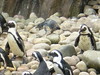
I'm still catching up with the Bristol Zoo photos, including these splendid penguins:
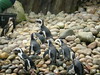
Most of these are African penguins, but there are also some little blue penguins, as mentioned in Douglas Adams and Mark Carwardine's Last Chance to See.
We also offer some blurry pseudo-underwater photos of seals...
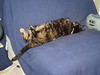
...plus yet more of my cats.
The baby gorilla's next, I promise. Full Bristol Zoo set here.
(Meanwhile I've changed my profile photo back to the well-worn previous one, at conjugal request. If you particularly enjoyed the inverse goatee, you can still admire it here.)
Most of these are African penguins, but there are also some little blue penguins, as mentioned in Douglas Adams and Mark Carwardine's Last Chance to See.
We also offer some blurry pseudo-underwater photos of seals...
...plus yet more of my cats.
The baby gorilla's next, I promise. Full Bristol Zoo set here.
(Meanwhile I've changed my profile photo back to the well-worn previous one, at conjugal request. If you particularly enjoyed the inverse goatee, you can still admire it here.)
15 June 2007
Another Place on the Web Where You Can Read Me Banging on about Stuff
Just a quick note to say that regular readers of this blog may be interested in the latest issue of Paul "Brax" Castle's Doctor Who webfanzine, Shooty Dog Thing, which has a seven-page interview with me in it.
It also has a lot of interesting and witty things to say about Doctor Who and Doctor Who fandom, which makes it worth reading in its own right. But I'm assuming that readers of this blog are at least vaguely interested in me and/or my writing. (If not, you're very welcome and everything but, er, why are you here?)
It also has a lot of interesting and witty things to say about Doctor Who and Doctor Who fandom, which makes it worth reading in its own right. But I'm assuming that readers of this blog are at least vaguely interested in me and/or my writing. (If not, you're very welcome and everything but, er, why are you here?)
09 June 2007
Prairie Puppies!

Flaming June
I hate hot bloody weather. People moan about the cold, but when it's cold you can just put on a jumper, or the central heating. What can you do when it's too hot and you've already discarded all the clothing decency allows? Lose weight, that's all. Bah.
That aside, it's been a pleasant couple of weeks. B. and I spent last weekend very enjoyably in London and St Albans, celebrating the respective birthdays of two friends, and staying at flat of the little-sister-in-law and her boyfriend.
Friday night in St Albans was a combination celebration for Not Invented Here's birthday and the 30th anniversary of Star Wars -- both of which we commemorated by watching this comedian act out a breakneck précis of the entire original trilogy in the space of fifty minutes.
I was less impressed with it than most of my companions (who were, in fairness, largely wowed). I felt he really needed a) better voice acting, b) more jokes and c) more visual texture, given that the show consisted essentially of a fast-moving man in a black boiler-suit and the occasional mildly clever lighting change. As it was, the experience was midway between being buttonholed in a pub by an entertaining madman whose company begins to pall after barely the first half-hour, and watching a five-year-old on a tartrazine high running around... well, acting out the entire Star Wars trilogy.
Still, it was entertaining enough, and the company (and the split-level meal before and afterwards) were fun.
On Saturday we met up for lunch with my old friend Z. and her husband W., whom we saw married last August, and who seem very happy still. We then had to climb into 1920s costume (which in my case involved shaving off the goatee bit of my beard to give myself a fine set of muttonchop whiskers [1]) and proceeded hither for my godcousin-in-law's 30th birthday bash [2]. There were canapés and beer, and many more old friends, and a lovely view over the Thames, and it was all thoroughly splendid.
Since then I've mostly been working in one manner or another, though with a brief break on Thursday night to visit some of the better class of drinking establishments in the Bristol area. Lunchtime today we spent with some Australian friends who are sadly about to move back to Australia. Tomorrow we're meeting up with my parents somewhere near Romsey, for some reason. It's all a manic social whirl.
Meanwhile, the borderline-insane idea for a Doctor Who reference book which I mentioned way back when has borne slow-growing contractual fruit. I'm not allowed to say very much about it at present, as the publishers don't want to spoil the surprise, but it'll likely take up a substantial chunk of my attention for the next year or so. I've spent most of my writing time in the past fortnight sorting out preliminary research and assembling a team of experts to help out with the fact-checking.
And speaking of Doctor Who -- as I usually don't, or try not to, or at least not very much, or at least not too much, here -- Paul Cornell's Human Nature and The Family of Blood were both stunningly good, to a degree approaching, with disturbing proximity, actual perfection [3].
You may recall that I'm not a big fan of David Tennant's Doctor, and indeed I'm not -- but I do think that Tennant's a fine actor (not as excellent as Christopher Eccleston, but frankly who is?) when he's not playing the Doctor, as he wasn't for most of the two-parter. It's beyond question the best story since Eccleston left, and I'm not sure it wasn't the best thing the new series has done altogether.
And tonight we have another episode from Steven Moffat, the writer of The Empty Child, The Doctor Dances and The Girl in the Fireplace. And supposedly the Doctor barely appears in it. Which, if all goes well, could make Human Nature through to Blink the best three-episode run of Who since Season One's Cornell-Moffat-Moffat hat-trick.
[Edit 8:25pm: ...Yes, wasn't wrong there.]
And now I'm talking about Doctor Who altogether too much, so I'll stop there.
[1] To be precise, according to this handy spotter's guide to facial hairstyles, they were somewhere between "Friendly Mutton Chops" and a "Franz-Josef".
[2] Godcousin-in-law [n.]: Person whose uncle is one's wife's godfather, but whom one's wife (as she then wasn't) got to know well at university without either of them being privy to this information, until it emerged later with consequences altogether too hilarious to recount here.
[3] We long-term fans were expecting this, of course, given that it was an adaptation of Paul's equally exceptional Doctor Who novel from 1996, Human Nature. ( And if for any reason you feel reluctant to take my word for it, you can read it online here...)
Publications
With luck and a prevailing wind, I should be posting a proper update on what I've been doing later today. In the meantime, may I draw your attention to the following:
1. My latest column is now up at Surefish, on the spirituality of aliens. I'm slightly disappointed that they've toned the title down from my original "I Baptised a Monster from Outer Space".
2. Dave Stone's novel The Two Jasons, which reprints (and is partly a sequel to) my short story "Sex Secrets of the Robot Replicants", is out now.
3. Big Finish have announced a few more details of my next-to-be-published project, Nobody's Children -- to whit, the titles of the three novellas in the collection. They're "All Mimsy Were the Borogoves" by Kate Orman, "The Loyal Left Hand" by Jonathan Blum and "Nursery Politics" by me. No cover as yet, but I'm sure it's just a matter of time.
Pressing Linguistic Questions of Our Day, No. 41,684
Shouldn't "piss-poor" be the opposite of "piss-rich"?
FIRST ROMAN MATRON: Ooh Livia, you mustn't go to that tanner to have your cloth bleached, they're piss-poor.
SECOND ROMAN MATRON: All right, Licia, I'll go to the one round the corner. They've got vats of the stuff.
31 May 2007
Public Service Announcement
Christians! Atheists don't disbelieve in God because they're scared to face the truth about their place in the world, or because it makes them feel less guilty about doing wrong things, or because they secretly know God exists but have chosen to reject God. It takes great courage to try to be a good person in the absence of a received morality, and to face the prospect of oblivion after death.
Atheists disbelieve in God simply because they consider that the available evidence suggests that God doesn't exist. You may well feel that this evidence is flawed or incomplete, but for God's sake do them the basic courtesy of treating their beliefs as an intellectual position rather than a spiritual defect.
* * *
Atheists! Christians and other theists don't believe in God because they've mindlessly absorbed what the church has told them, or because they're too stupid too understand reality, or because they're scared of death and need to invent a comforting fantasy. Theology is a complex, intellectually rigorous discipline, and the prospect of divine judgement with eternal consequences is no less intimidating than that of a simple cessation of life.
Christians believe in God because they consider that they have good reason to think that God exists, despite the evidence you see to the contrary. You may well feel that their reasons are mistaken ones, but for Dawkins' sake give them the respect due to people who have actually thought about all this.
* * *
The sooner everyone accepts this, and starts engaging with each other's points of view without feeling the need to insult, dismiss or belittle, the better.
(I trust we all feel suitably chastised now.)
28 May 2007
You Can't Leave That Lyin' There
B. and I visited Bristol Zoo on Saturday, for the first time in a while. Apart from anything else I'd been neglecting my parental duties towards the two-toed sloth whom goddaughter E. adopted for me back on my birthday. We also knew that one of the Zoo's female gorillas had a baby back in December, and thought that May would be a good time to see it.
I have lots of photos of various animals, but they're taking an age to upload, and I really want to spend some of today doing other things. The baby gorilla photos will have to wait till later, as will the baby prairie dogs, moorhen chicks and various less cute adult animals. (None of the sloth, though.)
For now you'll have to content yourself with photos of the shy sand cat,

the elusive red panda,

the stately lioness,

and the noble capybara.

Full set here, with more to follow later.
I have lots of photos of various animals, but they're taking an age to upload, and I really want to spend some of today doing other things. The baby gorilla photos will have to wait till later, as will the baby prairie dogs, moorhen chicks and various less cute adult animals. (None of the sloth, though.)
For now you'll have to content yourself with photos of the shy sand cat,
the elusive red panda,
the stately lioness,
and the noble capybara.
Full set here, with more to follow later.
26 May 2007
Message from Mars
I'm sorry if these updates are getting tedious, but this is a correction of sorts to an earlier post.
Masterfoods responded today to my original complaint about the newly non-vegetarian nature of Snickers and Mars bars. (Or rather, they replied to a "Mr Purfer_hallard", who they coincidentally seem to believe resides at my address.) Although most of what they had to say I knew already, it does turn out that Bounties and Twixia were never vegetarian in the first place.
While this certainly means that my earlier paranoid speculations were groundless, it also suggests that Masterfoods' decision to be "principled" in announcing their forthcoming departure from vegetarian standards, had not been matched by equally principled decisions in the past.
Oh well, you get the idea. They also reimbursed me for some full-of-meaty-goodness Snickerses I'd returned to them. Of course the cheque's made out to Mr Purfer_hallard.
23 May 2007
Typology
This was inspired by a typo on a mailing list, during a discussion of whether Human Nature and Human Nature could be fitted into Doctor Who continuity together.
SHARD UNIVERSE [Terminology] There are certain patterns of events which, because of their precise formation and structure in time, are capable of "seeding" history, in much the same way as a single shard of crystal can convert a beakerful of solution into crystals of identical shape and construction.I still love The Book of the War.
From a time-bound perspective, the phenomenon resembles nothing so much as eerily significant coincidence, as particular situations, and even names and dates, "echo" and recur throughout perceived history. A god becomes mortal; a demon is chained; an island civilisation falls before the wingbeats of angelic or demonic powers. From some perspectives, even the Homeworld itself might appear to have fallen more than once.
Non-time-active civilisations often perceive such events as the action of providence in history, and it is trure that many such "shards" are deliberately seeded by the Wartime powers and other time-active cultures to their own ends.
Others, however, are naturally occurring. It is thought that these apparently random seed events may themselves be echoes from previous or parallel universes where such recurrences have infested the timeline, resulting in a history of endlessly repeated near-identical episodes. These "Shard Universes" would be characterised by formulaic, clicéd scenarios, barely-distinguished individuals and obsessive returns to depressingly familiar tableaux and set-pieces.
[© Philip Purser-Hallard 2007]
Mars Retreats!
Despite the last couple of posts, I've no intention of turning Peculiar Times into a campaigning blog. I'm pleased, though, that Masterfoods have announced a partial U-turn on their decision to laugh maniacally while putting animal derivatives in their chocolate bars. I'm delighted that Snickerses and Maltesers will remain vegetarian, but continue to be annoyed that Bounties and Twices (that is the plural of Twix, presumably?) won't.
A cynic might choose to see this as an application of the familiar principle of overstating one's negotiating position in order to win concessions. Masterfoods are, after all, going ahead with their intention to make a large number of their products non-vegetarian, and most of the consumers who would normally be protesting are currently patting themselves on the back for a job well done. It seems a slightly extreme length to go to, but it would be a canny application of politics to marketing, and might well win some award or other.
What else? I'm expecting to finish the rewrites on Nursery Politics this week, which will be something of a relief. It's been dominating my brain for far too long now, to the detriment (I realise) of this blog.
There have been cygnets and moorhen chicks near work for two weeks now, zealously watched over by their respective parents, and the cygnets in particular have grown visibly during that period. Two weeks ago they were generic baby birds, tiny and grey and fluffy and easily mistaken for mutant ducklings. Today they're twice the size (though sadly reduced in number from nine to seven), and already showing signs of neck elongation.
Unfortunately I've repeatedly forgotten to take my camera in to work, so I have no photos. They're very sweet, though.
Finally, it seems I was premature in suggesting that I'd be able to finish Collapse and Iron Council within two weeks and thus keep up my book-a-week record for 2007 -- I'm barely halfway through either of them. Both are very good, though I find aspects of Jared Diamond's writing style and worldview mildly irritating. More of that later, I shouldn't wonder.
14 May 2007
Dear Masterfoods...
I left the following feedback on the Masterfoods Consumer Care web comments form. They'd "love to hear from you" too, apparently.
[2] This may not, therefore, be such a bad thing.
Honestly, though, in the name of Almighty God and all his terrapins and seraphim, where do they think they get off, doing this and then insisting that they're being "principled" by actually telling people about it?
In pleasanter news, I see Jeremy Paxman's started giving advanced notice of his facial expressions.
I am writing to protest in very strong terms against your decision to include animal derivatives in your chocolate bars, a decision I have just learned about through an article in The Guardian. This is completely gratuitous when all such products have previously been free of animal ingredients, and is tantamount to announcing that you do not care to retain the custom of the UK's millions of vegetarians.[1] This helps to explain why I am now on another diet.
I am a long-term customer, a regular consumer of Snickers and Twix bars and your Snickers, Mars and Maltesers choc ices[1], and I will not be buying any more of these products until you announce that they are once again being made in compliance with vegetarian standards[2].
I take particular exception to the reported statement of your spokesman that "If the customer is an extremely strict vegetarian, then we are sorry the products are no longer suitable". Refusing to eat animal products is not "extremely strict" vegetarianism – it is the definition of vegetarianism. This ignorance on your part gives the impression of even greater indifference towards your former vegetarian customers.
(I should point out that, while I will be very grateful for feedback on this specific issue, I do NOT give my permission for you to use my contact details for any other purpose, and will be seriously annoyed if you do so.)
[2] This may not, therefore, be such a bad thing.
Honestly, though, in the name of Almighty God and all his terrapins and seraphim, where do they think they get off, doing this and then insisting that they're being "principled" by actually telling people about it?
In pleasanter news, I see Jeremy Paxman's started giving advanced notice of his facial expressions.
09 May 2007
Well Wishers
Without wanting to come over all mouthpiecey, may I commend to you my occasional employers Christian Aid's forthcoming campaign week, as advertised on YouTube?
If only because I drink about six pints of precious fresh water a day, the only reason I filter it first is because otherwise I'm not keen on the taste, and I'd love to see those same luxuries extended to others.
If only because I drink about six pints of precious fresh water a day, the only reason I filter it first is because otherwise I'm not keen on the taste, and I'd love to see those same luxuries extended to others.
06 May 2007
Pressing Linguistic Questions of Our Day, No. 41,683
How come "linoleum" is shortened to "lino", but "petroleum" abbreviates to "petrol"? Hmm?
02 May 2007
Books Update: Expectations, Given Form
It's been a while since I last wrote a bit about what I've been reading, with the result that I'm now four books in deficit. All of them I came to with certain expectations, having read books by their respective authors before.
And here they are:
The Steep Approach to Garbadale is, shockingly, the twenty-first novel I've read by Iain Banks (along with a volume of shorts and a book about whisky), and there was much about it that was comfortingly familiar. Rather too much, I found in fact, as the narrative presented me with a hero emotionally crippled by his childhood love (as in The Crow Road and Walking on Glass), avoiding his sprawling, matriarchal family (The Crow Road again, and also Whit) who run a venerable, highly successful business (The Business) making a game which forms a metaphor for politics (The Player of Games) and taking lots of drugs (passim). What's more, this family has been guarding a terrible secret for a generation (The Wasp Factory and -- oh look -- The Crow Road) whose nature (which I won't reveal here) will also be familiar to long-term appreciators of Banks' oeuvre.
Banks' writing is always competent, and Steep Approach is less flabby and in need of editorial trimming than his last S.F. novel, The Algebraist. There are some lovely bits of writing relating to the hero, Alban's, youthful affair with his cousin, and to his long-dead mother's suicide. But overall it says very little of weight, has none of Banks's usual exuberant creativity, and feels much as if he's writing by the numbers. I've never met a Banks novel I've actively disliked (A Song of Stone and Canal Dreams come closest), but this one's something of a disappointment.
The Penelopiad, on the other hand, is classic Margaret Atwood without, as far as I know, being a retread of anything she's written before. Looking at The Odyssey through the eyes of Odysseus' long-suffering wife Penelope follows a standard feminist-revisionist approach (though it's one James Joyce, for instance, had flirted with before), but it's very productive. Penelope lends the novella a lively, sympathetic voice, sidestepping the victim status she might otherwise invite by tempering her complaints with hard-edged ruthlessness. Atwood gives the novella a second thread in the choric voices of the maids unjustly hanged by Ulysses for fraternising with Penelope's suitors, showing how Penelope herself is compromised by her privileged background as an aristocrat. It's a clever, erudite, witty and highly readable book, and reminded me of why I enjoy Atwood's writing so much.
The only previous work I'd read of Stephen Marley's was his 1995 Doctor Who novel, Managra, which was one of the very best published in Virgin's Missing Adventures range, and a major source of inspiration for Of the City of the Saved.... His Spirit Mirror is an earlier and sadly less deft novel.
The first in Marley's notorious (among Missing Adventures readers, anyway) yet little-read (ditto) "Chinese lesbian vampires" trilogy -- his first novel, bizarrely, being a life of the Virgin Mary -- Spirit Mirror has a lot to recommend it, including inventive ideas, strong characters and vivid descriptions both beautiful and horrific. Unfortunately it's all very po-faced, lacking the streak of wicked humour and deliberately outrageous invention which raises Managra to greatness. The second-century Chinese setting lends local colour -- though less than you might expect -- but ultimately the book is rather flat genre fantasy with some interesting moments.
(Oh, and although the novel contains both Chinese lesbians and vampires, there is no overlap between the two.)
Martin Day's one contribution to Virgin's Missing Adventures line was The Menagerie, a sadly lesser work than Managra, but he has since redeemed himself with contributions to the BBC's Doctor Who book ranges, notably Bunker Soldiers and The Sleep of Reason. I had hoped that Wooden Heart, like Gareth Roberts' Only Human, might be an exception to the dismal tendency of Who books since the new series to be shallow, vapid froth.
Sadly, it isn't quite. Day's work has always had a slight tendency to verbosity, which sadly comes out here in a book I can't imagine its target audience of 8-year-olds enjoying very much. There are some interesting themes relating to ethics and the nature of good and evil, which it's certainly surprising to see tackled by David Tennant's Doctor, but they never develop into anything truly worthwhile.
In the early days of the new series, we long-term Who book readers bemoaned the fact that none of the new Ninth Doctor tie-in books could match such TV episodes as Dalek and Father's Day for subtlety and complexity. Day's book isn't actually a great deal deeper or more complex than those, and yet it easily outdoes the current TV series for thematic sophistication. I find this disappointing.
After all that, then, the list of books I've read so far this year runs thusly:
And that's not counting humorous books read on the lavatory.
Still on my to-read list since last time are the following (new arrivals in bold, "less urgent" stuff in square brackets):
Non-Fiction:
a) I don't read nearly as many non-fiction books as I intend to.
b) An embarrassing amount of my reading is Doctor Who related.
c) Only women writers are fulfilling my expectations at present.
Perhaps I'd better start one of those Justina Robsons.
And here they are:
The Steep Approach to Garbadale is, shockingly, the twenty-first novel I've read by Iain Banks (along with a volume of shorts and a book about whisky), and there was much about it that was comfortingly familiar. Rather too much, I found in fact, as the narrative presented me with a hero emotionally crippled by his childhood love (as in The Crow Road and Walking on Glass), avoiding his sprawling, matriarchal family (The Crow Road again, and also Whit) who run a venerable, highly successful business (The Business) making a game which forms a metaphor for politics (The Player of Games) and taking lots of drugs (passim). What's more, this family has been guarding a terrible secret for a generation (The Wasp Factory and -- oh look -- The Crow Road) whose nature (which I won't reveal here) will also be familiar to long-term appreciators of Banks' oeuvre.
Banks' writing is always competent, and Steep Approach is less flabby and in need of editorial trimming than his last S.F. novel, The Algebraist. There are some lovely bits of writing relating to the hero, Alban's, youthful affair with his cousin, and to his long-dead mother's suicide. But overall it says very little of weight, has none of Banks's usual exuberant creativity, and feels much as if he's writing by the numbers. I've never met a Banks novel I've actively disliked (A Song of Stone and Canal Dreams come closest), but this one's something of a disappointment.
The Penelopiad, on the other hand, is classic Margaret Atwood without, as far as I know, being a retread of anything she's written before. Looking at The Odyssey through the eyes of Odysseus' long-suffering wife Penelope follows a standard feminist-revisionist approach (though it's one James Joyce, for instance, had flirted with before), but it's very productive. Penelope lends the novella a lively, sympathetic voice, sidestepping the victim status she might otherwise invite by tempering her complaints with hard-edged ruthlessness. Atwood gives the novella a second thread in the choric voices of the maids unjustly hanged by Ulysses for fraternising with Penelope's suitors, showing how Penelope herself is compromised by her privileged background as an aristocrat. It's a clever, erudite, witty and highly readable book, and reminded me of why I enjoy Atwood's writing so much.
The only previous work I'd read of Stephen Marley's was his 1995 Doctor Who novel, Managra, which was one of the very best published in Virgin's Missing Adventures range, and a major source of inspiration for Of the City of the Saved.... His Spirit Mirror is an earlier and sadly less deft novel.
The first in Marley's notorious (among Missing Adventures readers, anyway) yet little-read (ditto) "Chinese lesbian vampires" trilogy -- his first novel, bizarrely, being a life of the Virgin Mary -- Spirit Mirror has a lot to recommend it, including inventive ideas, strong characters and vivid descriptions both beautiful and horrific. Unfortunately it's all very po-faced, lacking the streak of wicked humour and deliberately outrageous invention which raises Managra to greatness. The second-century Chinese setting lends local colour -- though less than you might expect -- but ultimately the book is rather flat genre fantasy with some interesting moments.
(Oh, and although the novel contains both Chinese lesbians and vampires, there is no overlap between the two.)
Martin Day's one contribution to Virgin's Missing Adventures line was The Menagerie, a sadly lesser work than Managra, but he has since redeemed himself with contributions to the BBC's Doctor Who book ranges, notably Bunker Soldiers and The Sleep of Reason. I had hoped that Wooden Heart, like Gareth Roberts' Only Human, might be an exception to the dismal tendency of Who books since the new series to be shallow, vapid froth.
Sadly, it isn't quite. Day's work has always had a slight tendency to verbosity, which sadly comes out here in a book I can't imagine its target audience of 8-year-olds enjoying very much. There are some interesting themes relating to ethics and the nature of good and evil, which it's certainly surprising to see tackled by David Tennant's Doctor, but they never develop into anything truly worthwhile.
In the early days of the new series, we long-term Who book readers bemoaned the fact that none of the new Ninth Doctor tie-in books could match such TV episodes as Dalek and Father's Day for subtlety and complexity. Day's book isn't actually a great deal deeper or more complex than those, and yet it easily outdoes the current TV series for thematic sophistication. I find this disappointing.
After all that, then, the list of books I've read so far this year runs thusly:
- Margaret Atwood, The Penelopiad.
- Iain Banks, The Steep Approach to Garbadale.
- Thomas Bertonneau and Kim Paffenroth, The Truth Is Out There: Christian Faith and the Classics of TV Science Fiction.
- Frederick Crews, The Pooh Perplex.
- Frederick Crews, Postmodern Pooh.
- Martin Day, Doctor Who: Wooden Heart.
- Roger Fairclough (ed), The Prisoner: the Original Scripts Volume 2.
- Jon Courtenay Grimwood, Pashazade: the First Arabesk.
- Kelly Hale, Faction Paradox: Erasing Sherlock.
- Andy Lane, Torchwood: Slow Decay.
- Ken Macleod, The Star Fraction.
- Stephen Marley, Spirit Mirror.
- China Miéville, King Rat.
- Lawrence Miles and Tat Wood, About Time 2.
- Alan Moore and Melinda Gebbie, Lost Girls.
- Kate Orman, Doctor Who: Return of the Living Dad.
- J-P Stacey, A Pocketful of Lies.
- Charles Stross, Accelerando.
And that's not counting humorous books read on the lavatory.
Still on my to-read list since last time are the following (new arrivals in bold, "less urgent" stuff in square brackets):
Non-Fiction:
- [Brian Bates, The Real Middle Earth.]
- Michael Frayn, The Human Touch.
- Tom Holland, Persian Fire.
- Robert Markley, Dying Planet: Mars in Science and the Imagination.
- Terry Pratchett, Ian Cohen and Jack Stewart, The Science of Discworld III: Darwin's Watch.
- David Foster Wallace, Consider the Lobster: Essays and Arguments.
- Margaret Atwood, Oryx and Crake.
- Max Barry, Jennifer Government.
- Mark Chabon, The Amazing Adventures of Kavalier and Clay.
- [Mark Chadbourn, World's End.]
- Samuel Delany, Dhalgren.
- [Umberto Eco, Foucault's Pendulum.]
- Frank Herbert, Dune.
- [Gwynneth Jones, Bold as Love.]
- Ian McDonald, River of Gods.
- Christopher Priest, The Space Machine.
- Kim Stanley Robinson, the Mars trilogy.
- Justina Robson, Mappa Mundi.
- Justina Robson, Living Next-Door to the God of Love.
- Philip Roth, The Plot Against America.
- Norman Spinrad, The Iron Dream.
a) I don't read nearly as many non-fiction books as I intend to.
b) An embarrassing amount of my reading is Doctor Who related.
c) Only women writers are fulfilling my expectations at present.
Perhaps I'd better start one of those Justina Robsons.
27 April 2007
Forget Snakes on a Plane...
Kim Newman's history of the Hammer horror film in this month's Fortean Times mentions a "tragically unmade" project entitled Zeppelin vs Pterodactyls.
Pairs of Linked Columns
Recently I experienced what I seem to remember we used to call a "day off". In case you've never had cause to encounter one of these, it seems to involve getting up very late, sitting on a sofa watching old Doctor Who videos with a cat on your lap, and drinking beer occasionally.
That was last... Thursday, I think.
This indicates that things are beginning to get back to normal after the manic rush to finish Nobody's Children, but still very slowly. I keep being terribly busy, both at work and at home. My aspiration is that things will hopefully calm down a bit next week.
I might even be able to start blogging properly again. Let it be noted that I owe the assembled company mini-reviews of The Steep Approach to Garbadale and Margaret Atwood's rather excellent The Penelopiad. I really should read more Atwood. In the meantime I'm so tired I can barely type, so you'll have to bear with me.
That said... this month's column is up at Surefish, and follows on rather nicely from last month's. And I've sent off a revised proposal for the next long-term writing project, which is looking very hopeful now, and which I may say more about shortly.
Meanwhile, I've had a backlog of photos which I've just uploaded to Flickr.
I'm gonna spend my Easter with a Dalek:

Look! There are spiders!


And a couple of weeks ago now B. and I and all the members of B.'s extended family visited a very decent pub in Worcestershire...

...and a ruined abbey in nearby Gloucestershire.

View the whole set here.
That was last... Thursday, I think.
This indicates that things are beginning to get back to normal after the manic rush to finish Nobody's Children, but still very slowly. I keep being terribly busy, both at work and at home. My aspiration is that things will hopefully calm down a bit next week.
I might even be able to start blogging properly again. Let it be noted that I owe the assembled company mini-reviews of The Steep Approach to Garbadale and Margaret Atwood's rather excellent The Penelopiad. I really should read more Atwood. In the meantime I'm so tired I can barely type, so you'll have to bear with me.
That said... this month's column is up at Surefish, and follows on rather nicely from last month's. And I've sent off a revised proposal for the next long-term writing project, which is looking very hopeful now, and which I may say more about shortly.
Meanwhile, I've had a backlog of photos which I've just uploaded to Flickr.
I'm gonna spend my Easter with a Dalek:
Look! There are spiders!
And a couple of weeks ago now B. and I and all the members of B.'s extended family visited a very decent pub in Worcestershire...
...and a ruined abbey in nearby Gloucestershire.
View the whole set here.
19 April 2007
Hullo.
I'm still knackered from finishing the novella, and from my frenetic and unrestful week. This has included taking a six-year-old and a three-year-old to a chocolate factory (with the able assistance of their parents, admittedly), attending the theatre in aid of my mother-in-law's birthday celebrations and writing another column for Surefish. [ETA: I should clarify that the first two of these were pleasant as well as tiring.]
How are you?
On Tuesday I finally got round to updating my website to reflect the existence of Nobody's Children (and also of the forthcoming reprint of "Sex Secrets of the Robot Replicants"). I've even put in an extra bit in my F.A.Q. about them. I wonder if anyone ever reads that now Wikipedia exists.
I had been hoping to stick the whole of my rejected proposal for The Curse of Odin-Hotep, as promised, but I'm too knackered. Maybe later. In the longer term, the whole website's in urgent need of a design overhaul, but I lose the will to live whenever I even try to think about that.
Oh look, there I go again.
11 April 2007
"Mim," I Cry
The blurb for Nobody's Children is now up at the Big Finish site. Since I wrote large chunks of said blurb, I don't imagine anyone will mind my reproducing it here:
In unrelated but startlingly contiguous news, Dave Stone's novel The Two Jasons is a sequel to my short story "Sex Secrets of the Robot Replicants" in A Life Worth Living. And if you haven't read that short story... well, it's going to be reprinted as a prelude to Dave's book, so you can now. (Or you can just buy A Life Worth Living, of course.)
The website's overdue an update reflecting these releases, but I'm going to be tearingly busy for the next couple of weeks, catching up with everything I should have been doing for the past three or four months. Expect an increase in blog traffic soon... but not quite yet.
The war is meant to be over. The Draconian Empire has won the day, and the Mim have lost pretty much everything.As I'm sure I've mentioned before, the book consists of three novellas, by Kate Orman, Jon Blum and me. It's going to be fab. Do buy it.
That includes the borogoves of Proxima Longissima, the Mim's beloved children. The Draconians claim the borogoves are foundlings, abused and neglected by their parents. In the Empire they will be protected and provided for.
Fearing that his species faces extinction, one of last surviving Mim begs Bernice Summerfield to come and see for herself. Benny just wants to do right by her own son, Peter, and the brother or sister who may follow him. But soon the borogoves are, rather unexpectedly, her godchildren, and Benny becomes their best hope for a future peace.
As if dead oceans and burning deserts weren't hostile enough, Benny must enter the labyrinthine corridors of diplomacy - where right and wrong are questions of perspective, and even her own loved ones are not wholly innocent...
In unrelated but startlingly contiguous news, Dave Stone's novel The Two Jasons is a sequel to my short story "Sex Secrets of the Robot Replicants" in A Life Worth Living. And if you haven't read that short story... well, it's going to be reprinted as a prelude to Dave's book, so you can now. (Or you can just buy A Life Worth Living, of course.)
The website's overdue an update reflecting these releases, but I'm going to be tearingly busy for the next couple of weeks, catching up with everything I should have been doing for the past three or four months. Expect an increase in blog traffic soon... but not quite yet.
06 April 2007
Brainchildren
I've started the final push towards a finished version of "Nursery Politics", and thus of Nobody's Children. The whole process of writing this latest novella has been surprisingly gruelling -- I'm not really sure why, but I'm sure you'll have noticed me complaining about the fact.
It'll be over soon, though, and there's potentially good news about another project afterwards (not that I'm ready to think about that as yet).
While I've been doing this, B. has been finishing off and displaying her latest piece of art: Vesica Piscis, part of an Easter art exhibition run by a local church. It looks like this.

More photos are visible here... and for what a vesica piscis actually is, see here.
It'll be over soon, though, and there's potentially good news about another project afterwards (not that I'm ready to think about that as yet).
While I've been doing this, B. has been finishing off and displaying her latest piece of art: Vesica Piscis, part of an Easter art exhibition run by a local church. It looks like this.
More photos are visible here... and for what a vesica piscis actually is, see here.
31 March 2007
Books Update: Sex, Lies and Computronium
Well, I don't seem to have had much luck today getting on with writing my own book. So here's what I've been reading recently, when I've had the time...
Postmodern Pooh by Frederick Crews is the belated followup to The Pooh Perplex, which I was discussing nearly a month ago now. It's certainly not just more of the same, though -- where the original poked whimsical fun at the eccentricities of literary criticism up to the 1960s, critical theory has moved on, as has Crews himself. As I noted before, the satire here is cruel, harsh and very much in earnest. And frankly, modern academia deserves it.
Accelerando by Charles Stross is roughly as interesting as I hoped before I started reading it. This makes it both more interesting than I thought after the first chapter, and less interesting than I thought after the third.
It's the story of a 21st-century family over a hundred years, the conceit being that -- as the title suggests -- Stross' 21st century quickly becomes most S.F.'s very distant future. That first chapter shows the 2010s as a familiar (though well-drawn) post-cyberpunk milieu, with mind-computer interfaces, AIs and other bleeding-edge technologies just beginning to take effect as agents of countercultural social change. By the eighth chapter, set in the 2080s, most of the planetary solar system has been dismantled to create a colossal solar-powered computer on which humanity's incomprehensibly posthuman descendants can run their software personas, while those who choose to remain merely superhuman are using wormhole technology to construct interstellar habitats for their immortal selves, their descendants and their reincarnated ancestors.
Accelerando's scope and vision are breathtaking, and during the first two-thirds there's a constant sense of exhilaration as the future history speeds us through different genres of S.F. -- from cyberpunk into space-opera, from evolutionary speculation into eschatology -- while various familiar contemporary icons, brands and philosophies remain almost recognisable. Stross is a smart writer, and one with a soul as well (I loved his sympathetic liberal imam), a quality which is sometimes lacking in cerebral S.F. But ultimately the narrative slows once more as the focus slides away from the strictly unimaginable subjectivity of his posthumans to the cultural backwaters of those whose weak transhumanisms mean they remain fundamentally recognisable to us.
It's difficult, of course -- many would say impossible -- to write sympathetically about truly alien characters. But in sidestepping the attempt, Accelerando seems to be ducking the challenge its own bravado has set it -- meaning that ultimately (despite having easily five times as much imagination as many S.F. book series five times its length) it disappoints slightly. It's highly recommended, nonetheless, for what it does achieve.
A Pocketful of Lies by J-P Stacey is the self-published pamphlet of short stories I was plugging back in December, and which I've reprehensibly only just got round to reading. It's good, though, both as individual stories and in assembled form. Given the constraints on length, most of the stories are more by way of vignettes than actual narratives, though there are exceptions (and in fact the shortest pieces are the some of the best, the mock lonely hearts ads in particular). The best piece is the last, the distinctly Dickian paranoia-fantasy "Stay Calm", but I also liked the quieter, more lyrical "She Watched Television", a description of how someone spent her evening. A couple of the stories are less successful, but given that the book's free (and available as a PDF just over here) I don't see how you can go wrong.
Alan Moore and Melinda Gebbie's Lost Girls has received a certain amount of notoriety for its rewriting of out-of-copyright children's fantasy as unashamed erotica (or pornography, which is the term Moore and Gebbie prefer). Complaining that the constant, admittedly highly inventive sex makes the book feel rather one-note throughout would clearly be missing the point, on a par with moaning that the characters in Neuromancer keep banging on about computers. But still, it didn't do much for me on an erotic level.
The really clever stuff lies in the reinterpretation of the experiences of the three main characters -- Alice, Dorothy and Wendy. The women, who range in age from early twenties (Dorothy) to late fifties (Alice), meet in a Swiss hotel in 1913, where they tell each other stories and shag a lot, both other people and each other, in a fin de siècle kind of a way. It turns out that each as a girl created an elaborate fantasy-world in response to her early sexual awakening -- whether to romanticise it, to escape from it or (one suspects) a bit of both.
The book seems confused in its approach to the imagination: on the one hand celebrating it, on another it seems to see its main function as the construction of strictly sexual fantasies. Whatever evolutionary biologists may tell us, I find the idea of world-creating fantasy as an outworking of the libido depressingly reductionist. Furthermore, telling each other their true stories (and shagging a lot) appears to allow each woman to face up to her past, suggesting that fantasy is something you grow out of when you discover sex. I can't imagine that this is the message which the author of Promethea and V for Vendetta intended me to take away, but it's in this confusion that I feel the book falls down.
The book (which comes in three volumes and a slipcase) is a very beautiful object, and Moore's writing and Gebbie's art create some wonderful moments. It's full of trademark Moore tricks, including inventive tricks of layout, visual puns and some very clever pastiche. If it's an experiment which ultimately fails, then it's one which comes up with some very interesting results along the way. It's surely telling, though, that -- reading it so soon after Postmodern Pooh -- I found myself wishing for a parody where the elderly Christopher Robin recalls his youthful homosexual encounters with a predatory older "bear", while helping a melancholy classmate come to terms with his own "tail" and discovering one particularly memorable "pole".
Ahem.
Since finishing these various volumes, I've been (and still am) reading The Steep Approach to Garbadale -- which, to someone who's read all of Iain Banks's work to date, feels terribly familiar. I've also, rather unexpectedly, embarked on Spirit Mirror by Stephen Marley, which I picked off the shelf in a vague search for something a bit different. It's an orientalist fantasy about Chinese lesbian vampires in the second century A.D., so it certainly qualifies. So far I'm rather enjoying it.
30 March 2007
The Shape of Kingdoms to Come
My latest column's up at Surefish now. It's a bit more abstract and faffy this time, probably due to my having to squeeze it out in a gap between writing "Nursery Politics". I'm pleased with the title, though.
I'm not getting much feedback on these columns via Surefish, so I'm always interested to know what people here think of them. How many of you are actually reading them, for a start? Is the fact that they're about religion / written from a broadly christian perspective / hosted by Christian Aid putting people off, or is it generally true that if you're interested enough to read my witterings here then you'll have a look at them somewhere else as well?
(The previous columns are linked to from the current one, if anyone feels like catching up. I have to say I like the different artwork they've been using for the mastheads.)
25 March 2007
Feeling the Draft
Well, now my first complete draft of the Benny novella's finished, which is nice. Not unrelatedly, I'm knackered.
For those of you who enjoy statistics... this draft is 28,970 words long (and that will probably grow during rewrites), over a quarter of which is written in the character of Jason Kane, with a further seven characters getting some first-person narration. It's in eight chapters,with a prologue and an epilogue. And the word "murder" and its conjugates appear 19 times.
My contribution's entitled "Nursery Politics", and we're probably not calling the volume War Stories any more. I'm not sure I'm allowed to say what we are calling it.
[Edit 27-3-7: Ah yes, it looks like I am. It's called Nobody's Children.]
And now I have: a) the week off work for rewrites, and b) a rapidly-encroaching stinking cold. Given that the last time I took leave I ended up with a bout of food poisoning, I'm beginning to suspect that my employers are dosing me with biological agents whenever I take time off, to condition me against it and make me a more productive employee. It's particularly galling given that I've been feeling a bit ill, but not enough to actually take a day off, for most of 2007 so far.
Otherwise, I've been reading The Steep Approach to Garbadale, watching Blackadder and taking the occasional photo when I've had the chance. I took lots of the view of the city and Suspension Bridge from Bedminster Down when I walked up to the chemist there the other day, but the visibility was hopeless and they all turned out rubbish.
More later in the week, assuming I'm not bedridden or dead or anything by then.
22 March 2007
Top Tip
Chocolate Cheesecake Fans! For a tasty snack, simply spread cream cheese on milk chocolate HobNobs. Hey presto -- instant mini chocolate cheesecake bites!
Work's going slowly. I should be finishing the novella, but I've got bogged down in my latest Surefish column. (I was hoping I'd be able to write some articles on the 200th anniversary of slavery, as well, but time hasn't allowed.)
I owe this blog mini-reviews of Postmodern Pooh, Accelerando, A Pocketful of Lies and -- as soon as I finish it, which will probably be tonight -- Lost Girls.
I'm still reading The Steep Approach to Garbadale, but that's likely to keep me occupied for a while. It's debatable how much Banks has improved as a writer since his early days, but one admirable quality he's lost is that of concision.
20 March 2007
When Commuters Snap
I'm testing Flickr's blogging interface. I took this photo this morning, from the really rather grotty station where I take the train to work.
I'm rather pleased with how it came out -- the church looks gothic and ominous underneath the clouds. Less so when you know it's now converted into a clothing factory, but never mind.



I'm rather pleased with how it came out -- the church looks gothic and ominous underneath the clouds. Less so when you know it's now converted into a clothing factory, but never mind.
18 March 2007
Rosettastonishment
Wurgh. By dint of fuelling myself almost constantly with chocolate, coffee, crisps and beer over the past four days, I've fought my way through to roughly 2,000 words from the end of my novella.
Completing a first draft is scarcely the end of the process, of course, but for me it's the end of the really painful bit, so halle-shagging-lujah. I'm really going to need to clean up my diet once this story's finished, though.
To make up for my otherwise terseness here in the blogosphere, here's the final passage of what could have been Chapter One of The Curse of Odin-Hotep. It's, er, not very long.
On the Flickr front, I've discovered you can place your photos on a map, which is mildly exciting. If only I could remember where in Horsham I'd taken the three I took there, then, er, I could put them there.
As I say, more photos -- and indeed more blogging generally -- should follow once this book's out of the way.
Completing a first draft is scarcely the end of the process, of course, but for me it's the end of the really painful bit, so halle-shagging-lujah. I'm really going to need to clean up my diet once this story's finished, though.
To make up for my otherwise terseness here in the blogosphere, here's the final passage of what could have been Chapter One of The Curse of Odin-Hotep. It's, er, not very long.
Some hours later still, and many fathoms above the scurrying Archivists who were now scouring the Vault from top to bottom, a young woman named Arabella Monteith arrived to begin her day’s work at the British Museum.So, there you have it. When I get the time I imagine I'll put up the whole chapter -- along with the chapter breakdown so you can see where the story would have ended up if there'd, you know, actually been a story -- on my website somewhere.
Her job for that week was to check the engine-catalogue against the public holdings on display in the Egyptian Gallery, and she had high hopes that – if she performed it well, and continued to perform similarly tedious tasks with equal proficiency and without complaint for the rest of her life – she might conceivably find herself promoted to a junior assistant curatorship before she was fifty.
Reflecting that she might as well begin with one of the vaguely interesting artefacts, Arabella turned the knob on her handheld processing engine, and entered the Gallery as the micro-furnace warmed up.
She gazed at the Museum’s most famous exhibit, sitting proudly on its prominent plinth. Something about it troubled her.
Arabella leaned in, under the sightless eyes of the sarcophagi, to examine the display – then gasped in shock.
The sound echoed around the marbled gallery like the first whisper of stale air from a sealed tomb.
[Pax Britannia series elements © Abaddon Press 2005.]
On the Flickr front, I've discovered you can place your photos on a map, which is mildly exciting. If only I could remember where in Horsham I'd taken the three I took there, then, er, I could put them there.
As I say, more photos -- and indeed more blogging generally -- should follow once this book's out of the way.
14 March 2007
Photo Tropism
I mentioned ages ago that my admirable and generous parents had given me a spanking new digital camera for a combined birthday and Christmas present. It's only now, having sped my computer up appreciably by changing my antivirus software, that it's been practical for me to install the software to run the thing, and to actually do stuff with the photos I took in December.
Behold, therefore, my Flickr account. It's not very full as yet, but I have lots of plans for things I want to take photos of in Bristol, next month when it's sunnier and I've less pressing calls on my time.
The bits of reality which I'm really interested in capturing visually are the places where urban spaces go non-linear -- the gaps between the infrastructure, the weird architectural interfaces between radically different styles of construction, sites of sweeping vertical or historical disparity.
Blimey, hark at me. This is why I want to take photos, though, as the sensation these places give me isn't something that's easy to put into words (although Of the City of the Saved... made a stab at it). The shockingly inept photos I took of Manchester using B.'s camera last June should give you some idea of what I'm aiming at conceptually [1].
Horsham in December isn't really the best place in England to observe this kind of stuff, but I rather like this one, taken on my Dad's birthday:
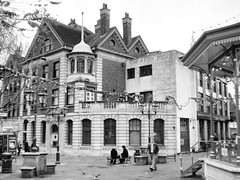
I've monochromed it because I tend to think buildings look better that way, unless the colours themselves are the interesting aspect.
I've already identified three cardinal rules:
1. Busier is not better.
2. Wait for the people to get the hell out of the way.
3. And the cars.
Given that I'm a blogger, another vital motivation is of course to take photos of my cats and inflict them on the world. Aaah.
1. Edit to add: They also look so much better now, after I've run them through the software that came with the new camera. These ones look better in colour than in monochrome, if only because the light is so bleached. The third one in particular I'd be rather pleased with if only I could get rid of my bloody finger.
Behold, therefore, my Flickr account. It's not very full as yet, but I have lots of plans for things I want to take photos of in Bristol, next month when it's sunnier and I've less pressing calls on my time.
The bits of reality which I'm really interested in capturing visually are the places where urban spaces go non-linear -- the gaps between the infrastructure, the weird architectural interfaces between radically different styles of construction, sites of sweeping vertical or historical disparity.
Blimey, hark at me. This is why I want to take photos, though, as the sensation these places give me isn't something that's easy to put into words (although Of the City of the Saved... made a stab at it). The shockingly inept photos I took of Manchester using B.'s camera last June should give you some idea of what I'm aiming at conceptually [1].
Horsham in December isn't really the best place in England to observe this kind of stuff, but I rather like this one, taken on my Dad's birthday:
I've monochromed it because I tend to think buildings look better that way, unless the colours themselves are the interesting aspect.
I've already identified three cardinal rules:
1. Busier is not better.
2. Wait for the people to get the hell out of the way.
3. And the cars.
Given that I'm a blogger, another vital motivation is of course to take photos of my cats and inflict them on the world. Aaah.
1. Edit to add: They also look so much better now, after I've run them through the software that came with the new camera. These ones look better in colour than in monochrome, if only because the light is so bleached. The third one in particular I'd be rather pleased with if only I could get rid of my bloody finger.
11 March 2007
Raiders of the Lost Archive
The hassle I've been having with my computer means I'm behind again on my writing schedule, despite having managed another chapter ("induplicitous", "miffed", "slaughter") this weekend. So, rather than updating here with details of what I've been doing recently (not that there's been a great deal of that), it's time for the next passage of my abortive pulp-steampunk novel, The Curse of Odin-Hotep.
The story so far: in an alternative history where Queen Victoria's British Empire has survived until the turn of the twenty-first century, the Vault is a repository of terrifyingly potent plot-devices which Her Majesty's Government has locked away for the protection of her subjects. However, in an utterly shocking twist, someone's sneaked in and stolen something anyway.
Now read on...
Some hours later, Private Percy Hoskins of the Royal Archivists was feeling terribly uncomfortable.There's only one more of these, and it isn't very long or particularly exciting. Still, Vivat Regina, eh?
Unlike most of his fellows, Percy found that the Vault made him nervous at the best of times. The rumours about the stuff hidden away down here were lurid, colourful and almost universally derided. Of course Percy, like his mates, affected to pooh-pooh them all, but sometimes, when he walked these crated alleys late at night, he couldn’t help thinking he heard things.
Things like a whistling sound, that could have been a distant voice or flute. Or a quiet ticking, as of some machinery whose timer had been accidentally activated by the self-immolation of a curious insect. Or the frantic scrabbling of claws or fingernails...
Percy had come to realise that he might, just possibly, have too much imagination for this job.
As an enlisted Archivist he had no choice but to take his monthly turn of duty in the Vault, of course, but for some time now Percy had seriously been considering applying for a transfer to another unit. Of course his mates would have a field day taking the pee, and Doris would – at the very least – look at him scornfully, but still, for the sake of his peace of mind, it had to be done.
It would have to be as far away as possible, of course. Even without him having to patrol the place personally, he’d know the Vault was still there. Some posting in the Colonial Police would do, somewhere hot. Venus would do him nicely, or perhaps Mercury.
The Moon, he thought, would feel a little close for comfort.
‘Are you still with us, Private?’ Lieutenant Flackson’s tone was curt and sarcastic.
‘Yes sir,’ said Percy, coming back to reality with a jolt. ‘Still here, sir.’
‘Perhaps, then,’ Flackson drawled, ‘you might comply with Sir Malcolm’s very reasonable request, and tell him what happened? If it isn’t too much trouble for you, Private.’
Percy was bright enough to see that the Lieutenant was scared witless – not that there was too much wit to lose, in Flogger Flackson’s case – and making up for it as best he knew, by taking it out on Percy. Shoot the messenger, that was old Flogger.
If he was honest – and Percy’s honesty was one of many things that held him back in his chosen career – he could hardly blame his superior for having the wind up. Sir Malcolm Myers was not a reassuring person. The civil servant’s high forehead was liver-spotted, and his black eyes glittered with impatience. His beaky nose jutted forward from his face as if he fancied pecking Percy’s eyes out. He reminded Percy of the ravens they’d seen when he took Doris on a day out to the Tower.
‘Well, sir,’ Percy began. ‘I was on routine patrol with Ginge –’ (he looked across at Private ‘Ginger’ Grainger, but received no support there) ‘– with Private Grainger, sir, when I hears this... creaking noise. Like...’ Like a coffin lid being lifted from the inside, he wanted to say. Like a door opening onto an ever-descending staircase down to Hell. He settled for something less controversial: ‘...like nails being levered out of a crate, sir.’
‘And this was when?’
‘Five, six hours ago now, sir. Round eleven o’clock.’
‘I see. And what did you do?’
‘Well, sir,’ said Percy again. He shifted uncomfortably and tried again to catch Ginge’s eye. As before, he failed. ‘At first, sir, I just sort of ignored it.’
‘Ignored it,’ Sir Malcolm repeated, without any special emphasis.
‘That’s right, sir. Sometimes, down here, you... hear things. Crates settling, I expect. Or... the ventilators going on the blink. Sometimes it’s the other blokes mucking around, trying to scare you.’
‘I see.’ Sir Malcolm’s voice was grim. ‘Go on.’
‘Yes, sir. I didn’t do nothing about it for a bit, for the reasons I just outlined, sir. But it went on, so I says to Gin– to Private Grainger, “Do you hear that?” And he says, “Hear what?” and I says –’
‘Sir Malcolm doesn’t require the minutes of your conversation,’ Flackson snapped.
‘No, sir. So he says, “No, I can’t hear nothing,” sir. So we went and looked. It sounded like it came from the next aisle –’
‘The aisle we’re in now?’ Sir Malcolm indicated the double-wall of crates surrounding them.
‘Yes, sir. We couldn’t see nothing amiss, though, so we reckoned it was just my ears playing tricks on me.’ Ginge had taken the pee out of him for it, obviously, but this bigwig didn’t need to hear about that. ‘It was only later, when I come back this way again with Bedford –’ (‘Beggar’ Bedford, who up to this point had been listening intently to Percy’s account, now shifted his focus abruptly to the same piece of middle distance as was occupying Ginger’s attention) ‘– that I noticed.’
‘Indeed,’ Sir Malcolm said, turning his beady eyes towards the Travers crate.
Each nail – and there were perhaps a dozen of them to an edge – stood out an inch or so proud of the crate’s closest surface. Thus loosened, the wooden face had slipped to one side very slightly, tracing a narrow line of ominous blackness. ‘And what did you do then?’
‘Orders says we ain’t ever to open up the crates, sir, not under any circumstances, unless there’s a senior officer present. So the Sarge called Lieutenant Flackson, sir, and he got hold of Captain Henshaw. And then the Captain put a call through to the Major, who got in touch with –’
‘Yes, thank you,’ said Sir Malcolm absently, ‘I am familiar with the chain of command.’ The mandarin stared across to where a sizeable proportion of it was standing, from Captain Henshaw right up to a bushy-sideburned General. ‘And during all of this time, it occurred to nobody to look inside the Travers crate and ascertain whether the contents were missing?’
It seemed the officers had all joined Grainger and Bedford in their middle-distance-watching club. Each face – pallid or florid, smooth-cheeked or white-whiskered – held an expression that implied that somebody here was in very serious trouble, and by Gad the face’s owner was glad it wasn’t him.
‘Well, sir,’ said Percy yet again, wondering how it had fallen to him to act as spokesman for the entire British Army, ‘nobody knew what was supposed to be inside, sir. It could have been –’ there didn’t seem to be any more delicate way of putting this ‘– it could have been something really bloody dangerous, sir. Pardon my French.’
Sir Malcolm’s upper lip twitched. ‘Hoskins,’ he said balefully, ‘I think that may well be the first sensible thing anybody’s said to me this morning. The contents of that crate could, indeed, be something bloody dangerous.’
He turned towards the Travers crate. ‘Let’s have a look at them, shall we?’
Percy swallowed.
‘Come on, then, man,’ Flogger barked behind him, ‘we haven’t got all day.’
Percy stepped forward and gripped the side of the crate. He lifted it away, keeping the wood between his body and whatever was inside the box. Behind him, as it came away, he felt Bedford, Grainger and the assembled officers flinch as one man.
He peered across the rim of his improvised shield at the crate’s interior. Some ancient strands of dried-up packing straw wafted free into the light, leaving behind them nothing but a yawning wooden emptiness.
Whatever it was that the Government had confiscated from T G Travers a century before, it seemed that someone else had taken it into their own safe-keeping.
[Pax Britannia series elements © Abaddon Press 2005.]
Arrrrhhh!
Since 2000 or so I've been using Norton for all my antivirus needs. Recently, however I've found it turning into an elderly prima donna: bloated and slow, demanding of attention, insistent on getting its own way and calling everything else to a halt whenever it deigns to perform.
With my yearly subscription about to expire, I decided I really didn't want to pay any more for the privilege of its company, so I've just been installing the splendidly-named Avast!, a freeware anti-virus application recommended me by friends (thanks chaps).
So far Avast! has been a lot more friendly (I'm running a scan while typing this, which would have been quite excruciating with Norton), though the siren noise it makes when it finds something amiss is a little terrifying.
It's also taken me all bloody afternoon to get it working properly, primarily because Norton simply refuses to work with these amateurs, and deliberately hangs around outstaying its welcome, perhaps in the hope of flowers from the audience. Gah. I think I've got rid of it all now, but it's been a grade-A pain.
And I'm particularly glad I've done it, as I now see from that Wikipedia article that Norton 2007 is completely incompatible with ZoneAlarm, which I'm also using. Bastards.
05 March 2007
Subscribe to:
Posts (Atom)