The Servants by M. M. Smith is a rather different offering from the author's previous books as Michael Marshall and Michael Marshall Smith -- some of which I've discussed here in the past.
It has the same core premise as Only Forward and Spares (and to some extent One of Us), of a solidified subconscious realm where the protagonist's psychological issues are worked out through surreally allusive imagery. Unlike those stories, however (and even despite the fact that it's set in Brighton, like certain key scenes in Only Forward), it's a tighter, more disciplined work. It eschews the genre-bending, heavily cyberpunctuated S.F. setting of those books for a mundane, though compelling, narrative of difficult family dynamics seen through the eyes of a painfully alienated present-day eleven-year-old.
If it wasn't quite so dark, and so demanding of emotional maturity from its readers, this could even be a "Young Adult" book. As it is, it seems to have most often been described as a ghost story. It's not, or not really -- there's no sense that the titular servants (who are sometimes to be found hard at work in the otherwise empty and long-abandoned basement area of Mark's stepfather's Brighton-seafront house) are the surviving spirits of the dead. Rather, they're a function either of Mark's subconscious or of the house itself -- or, this being a work of symbolism, of both. The Servants places us firmly inside Mark's head, and forces us for much of the time to see his well-meaning though sorely tried stepfather as the monster Mark needs to believe he is. The reconciliation between them, desperately needed by Mark's sick mother, is achieved only through her son's under-stairs work experience with the eponymous nonexistent domestics.
Although I doubt more than a dozen other people on the internet have read the thing, the story reminded me of nothing so much as David "A Voyage to Arcturus" Lindsay's psychological fantasy The Haunted Woman, where a specific room in a house awakens the higher consciousnesses of otherwise mundane human beings, whose everyday selves are tragically incapable of retaining the enlightenment they receive there.
Peculiarly enough -- and I swear I'd forgotten this until this moment -- that book was also set partly in Brighton, and features a major character named Marshall.
The Servants is shorter than Smith's other books and more focussed, inspired by a humanistic (I might almost be tempted to say "christian") view of the value of vocation and of losing oneself in service to another. It's a very effective demonstration of his paradoxical versatility as a writer.
Andrew Cartmel's Prisoner novel, Miss Freedom (no Amazon link, for reasons elucidated here) is a decent enough Prisoner story, but -- for all its aspirations to be "a classic 1960s-style spy novel, in the tradition of John Le Carré, Adam Hall and Len Deighton" -- little more than that. It certainly hasn't the intellectual pyrotechnics to match Jon Blum and Rupert Booth's The Prisoner's Dilemma. Dilemma had a real sense of urgency about it, of having something important to impart which could only be told as part of a Prisoner story; by comparison Miss Freedom is... not lazy exactly, but certainly languid.
There's certainly much that's taken directly from the seventeen TV episodes -- Number 6 faces a clinically insane Number 2 (Hammer into Anvil) and a beautiful woman of ambivalent loyalties (The Chimes of Big Ben and passim), who place him in a subsidiary reality (A, B and C, Living in Harmony) where he's encouraged to tell a spy story with himself as the central character (The Girl Who Was Death), etc etc etc. Such elements as might seem newish (there's a rescue mission afoot to spring Number 6 from the Village, and the ousted Number 2 was actually on his side) are actually ringing the changes on these established elements.
Cartmel clearly knows his Prisoner, but most of his story is essentially pastiche -- well-written and perfectly competent pastiche, but unambitious. The most interesting thing, perhaps, is the way Number 6 redrafts his spy story as he's telling it, constantly revisiting earlier story elements and rewriting them. The fact that his fiction comes dangerously close to overlapping his reality might indeed suggest -- again, not exactly a new idea to the Prisoner aficionado -- that the Village itself is the product of Number 6's shellshocked fantasies.
Cartmel's biggest innovation, though, is in making his psychotic New Number 2 a sexually-motivated serial killer, which makes for some deeply uncomfortable moments. Given that a criticism frequently levelled against Cartmel's previous fiction has been his willingness to play the "violence against women" card, I might almost have found this creepy, if there hadn't been some evidence that he was attempting to address this tendency with a degree of complexity on a thematic level.
Basically, though... with this one, you're not really missing much. I feel less guilty about picking up one of the only 100 copies in existence, now.
Showing posts with label the prisoner. Show all posts
Showing posts with label the prisoner. Show all posts
04 February 2009

23 January 2009
Miss Freedom? Yes, you probably have.
Ah. OK. I was going to point out, further to this post from the other day about the death of Patrick McGoohan, that I've actually discovered the second of the Prisoner novels published by Powys Media, Miss Freedom by former Doctor Who scriptwriter and novelist Andrew Cartmel, available at a not particularly steep price just over here.
But, as you can see, it isn't.
Which is a bit disconcerting, because I ordered one as recently as Monday, and now have it quite literally in my possession. It's number 70 of a limited edition run of 100 and is personally autographed, apparently by one "Ann Cxl".
So, er, yes... it looks as if I may have picked up the last one, in fact.
It's a lot shorter than The Prisoner's Dilemma -- just under half the page count, at the same font size -- and I've no idea about the quality, because I haven't read it yet. But it definitely exists, and some of Cartmel's other work (The Wise and Foreign Devils particularly) has been very good. Miss Freedom claims to be a 1960s-style spy thriller "in the tradition of John Le Carre, Adam Hall and Len Deighton". All in all I'm rather looking forward to it.
So, as I was going to say, if you're a Prisoner fan and want to join the elite group of Prisoner fans who actually own the thing...
...erm, you can't. But I have. Sorry about that.
15 January 2009
It's Your Funeral
Then he must no longer be referred to as Number 6, or a number of any kind. He has gloriously vindicated the right of the invididual to be individual, and this assembly rises to you... sir.
The President, Fall Out
The Prisoner is the only television programme in existence which inspires me to anywhere near the same degree of fannishness as Doctor Who.
My friend Anthony and I discovered it late -- some 25 years after its first broadcast, in fact -- during what must have been September of 1992. We tuned into Channel 4's late-night repeat of Arrival one Sunday evening, and were inspired at once by the surreal imagery, the Kafkaesque worldview and the complex, demanding plotting.
That term, Ants and I pressed various of our university comtemporaries into watching the programme with us every Sunday. At one point we attended a fancy dress party as Numbers 2 and 6, employing among other props a college scarf, cunningly modified with white cloth tape. (We even performed the opening dialogue once we'd drunk enough, although unfortunately that was also enough that Number 6 -- and for discretion's sake I won't specify which of us that was -- forgot his iconic final line.)
My 21st birthday was that term, and Ants got me Alain Carrazé and Hélène Oswald's The Prisoner: A Television Masterpiece. The inscription inside reads "Dear Phil, Congratulations on reaching Number 21". I can't remember what I got him.
We both remained addicted to the repeats through Christmas and into the New Year. I remember viewing the unbearably tense and intimate penultimate episode, Once Upon a Time, at a student flat of some friends early that January, and -- after it had ended on the series' only cliffhanger ("What do you desire?" "Number One." "I'll take you.") -- revealing nonchalantly that waiting in agonised anticipation for the next episode wouldn't be necessary, because I'd rented Fall Out from a video shop on the way round. (It was somewhere around 12:30am by then, but that's students for you.)
And it was Patrick McGoohan who made me do it.
Not single-handedly, of course -- but as the series' co-creator, producer, occasional director, writer of four keystone episodes and, of course, the actor playing the near-ubiquitous central character, he naturally had rather a lot to do with it.
By all accounts he was an awkward, cantankerous sod, and a swine to work with -- a fact he was well aware of, as his adoption of the nom-de-plume "Paddy Fitz" (ie "Irish Bastard") for his scriptwriting makes perfectly clear. The contributions of other participants to The Prisoner -- especially the less obviously visible ones like George Markstein -- are often underestimated, and McGoohan's reluctance to talk about the project since it finished has certainly added to the mystique surrounding his involvement. It's clear, however, that insofar as anyone can ever be an auteur in a collaborative medium like TV, McGoohan was one.
My love for The Prisoner has never diminished. There may be only seventeen episodes, but I must have watched each of them a dozen or so times (yes, even Do Not Forsake Me Oh My Darling), and I’ve watched the whole thing through in one sitting on at least four separate occasions. (That's certainly more than I’ve managed with the 752 episodes of Doctor Who.)
I've also read the three 1960s tie-in novels (Thomas M Disch's very fine I Am Not a Number! is really the only one worth bothering with), the 1980s graphic novel and the first (and only, to date) of the paperback tie-in novels published by Powys Media, Jon Blum and Rupert Booth's The Prisoner's Dilemma. (Jon has his own tribute to McGoohan at his LiveJournal.)
At one point I was even in with a chance of writing one of the Powys books myself; but the series seems by all appearances to be on indefinite hold, and quite possibly as dead as a dimetrodon. Island in the Ashes would have been an uncharacteristically sombre post-apocalyptic story, taking as its starting-point a nuclear war in the outside world, which the Village survives by virtue of its remoteness. Prisoners and warders would be forced to co-operate in order to build a viable community, and Number 6 would face the choice of collaborating or depriving the survivors of his indispensable talents. It would have tried him severely.
Whether McGoohan would have liked it, I don't know. As Jon suggests, though, that's not really the point.
In many ways, McGoohan's death isn't a sad one. He was 80 years old, a great-grandfather, a talented professional whose one towering achievement, long ago though it was, remains as a lasting monument to him. His retirement from acting, and his disinclination to discuss the one part of his life people were interested in, mean that his passing will have little appreciable impact on the world beyond his family and friends.
But... well. One of The Prisoner's great strengths is that the superficial message of the episodes isn't always the true one. Take Number 6's individualism, for instance.
However much he may insist that his life is his own, that he can live isolated from the Village and the world, a true individual in survivalist style, 6 is always shown suffering in the absence of human contact. He always returns to society, to the Village. And when he finally escapes -- if indeed he ever does -- it's in the company of friends.
He may not be a number, just one indistinguishable statistic in a crowd... but he's no island either. However much he may wish otherwise, he's part of humanity, and his humanity is part of him.
No man is an island, entire of itself; every man is a piece of the continent, a part of the main. If a clod be washed away by the sea, Europe is the less, as well as if promontory were, as well as if a manor of thy friend's or of thine own were. Any man's death diminishes me, because I am involved in mankind; and therefore never send to know for whom the bell tolls; it tolls for thee.
John Donne, Meditation XVII
The alternative to tyranny is not individualism: the alternative to authority is community.
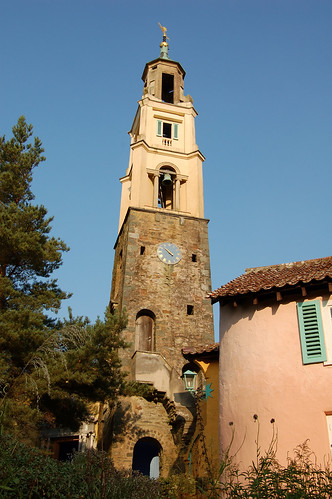
The bell on the campanile's tolling now. And I'm mourning the passing of Patrick McGoohan.
14 January 2009
24 November 2007
Three Things about The Prisoner
A.
One of the three non-fiction books I didn't have time to review last time I posted book-related stuff here was Fall Out: the unofficial and unauthorised guide to The Prisoner, by Alan Stevens and Fiona Moore, which I read... er, back in Septemberish, I think.
I said then that, of the three, one was good, one very good and one quite stunningly good. This was the good one.
Despite my evident obsession with The Prisoner I don't claim to have read all the available factual books about the series... but excepting the Scriptbooks (which are a special case, obviously) this is probably the best of the ones I've read.
(It's certainly deeper than The Prisoner: a television masterpiece by Alain Carrazé and Hélène Oswald, the first book about the series I ever read, which is pretty, glossy and almost entirely uninformative. Most of it consists of a detailed summary of the episodes, with occasional script extracts. I can only assume the French didn't have video recorders in 1992.)
I'd heard great things about Stevens' and Moore's Blake's Seven guide (which, being almost entirely unfamiliar with and indifferent to Blake's Seven, I haven't read myself), and may accordingly have set my expectations a little high. I'd have preferred rather more analysis and less of a summary of the (undeniably entertaining) behind-the-scenes soap opera of McGoohan's single-handed struggle against everybody else who worked on the series ever, but never mind -- it's a fine treatment of the subject matter.
As well as the in-depth episode guides and analyses, there are some good (if short) essays on aspects of the series: the vexed question of the "correct" episode order, a piece on the series' treatment of gender, sexuality and ethnicity, some analysis of the baffling figure of Number 1 and the like. There's also some excellent introductory material, setting The Prisoner in its cultural context rather in the manner of the About Time series. It also gets points for dealing with the Prisoner apocrypha: the original novels (including the recent, and excellent, The Prisoner's Dilemma, the 1980s comics (whose late-Cold-War peculiarities it has some fun with), and the unmade scripts and story pitches included in the Scriptbooks.
It's not the towering work of intellectual analysis the show has been crying out for for throughout the past 40 years, but it's well worth a read.
B.
I'm still enjoying my 40th anniversary Prisoner DVDs. The picture quality is gloriously crisp and sharp, enabling me to read text (on the ID cards Number 6 gets handed in Arrival, for instance) that I never even knew was there.
The extras include a rather splendid documentary full of interviews with writers, behind-the-scenes people and surviving cast members (with the exception, naturally, of Patrick McGoohan, who's always preferred to coast along on a surfboard of enigma rather than tell people what he actually meant by anything).
One thing that stuck in my mind from the documentary was Vincent Tilsley, the scriptwriter of The Chimes of Big Ben, taking about his later, more inglorious Prisoner episode, Do Not Forsake Me Oh My Darling, and in particular explaining why it's such rubbish. (You'll note that Jonny Morris, who wrote the BBC episode guide I'm linking to here, disagrees that it's rubbish. This is because, entertaining though his reviews are, every single one of his opinions are deeply wrong. Except about The Girl Who Was Death, which is indeed the best episode of the series.)
I've talked before about -- and speculated, I suspect rather unjustly, about McGoohan's part in -- the alterations which were made to this script between writing and broadcast. There's no denying, though, that the premise is a fundamentally lame one. Tilsley states that his reason for falling back on such a hackneyed plot device as recasting the central character via mind-swap machine was that he was told to write a Prisoner story with neither Patrick McGoohan nor Portmeirion in it, and panicked.
Personally, I'd say there was a much more interesting story to be told with those constraints: invert the premise of the series, to show an outsider attempting to break into the Village.
One of the Prisoner's old adversaries, a spy from the other side of the Iron Curtain, is trying to track him down. This spy has found evidence that his Soviet masters are opearating a secret hidden facility where ex-agents from both sides are held against their will, brainwashed and tortured. The spy is appalled by this treatment of his fellows, but has been warned off any interference by his masters. He now wants to bring this to the attention of the West, and is attempting to locate the most trustworthy and honourable of his opponents, the man we know as Number 6.
However, all his attempts to make contact with the man lead him, inevitably, to the very facility whose existence he's discovered. By now he strongly suspects that East and West are co-operating in order to run the prison camp -- perhaps indeed that there's a high-level conspiracy on both sides to maintain the status quo. Eventually deciding to spring Number 6 from the facility, he locates it in the middle of nowhere and breaks in... only for us to realise that he hasn't found the Village after all, but a completely different-looking facility with the same setup. Now he's there, of course, he can never leave -- except that the agency behind the Village has determined that his personal relationship with Number 6 could be very useful to them, and offer him a turn at being Number 2. We leave him pondering his stark choice: whether to become a warder -- or a prisoner...
Of course, this sort of one-off episode is something culty drama series do all the time these days -- see for instance the highly Prisoneresque Babylon 5 episode The Corps Is Mother, the Corps Is Father -- so I have the advantage of chronology.
But even so -- a mind-swap machine? Give me a break.
C.
Random stream-of-consciousness alert: I've never been convinced by any of the religious readings of The Prisoner, as despite McGoohan's well-documented Catholicism, there's barely any hint at such a reading being remotely plausible. (There's a metaphorical reference in The Chimes of Big Ben to church doors obstructing freedom -- though whether freedom is to be found inside or outside the church is left altogether ambiguous -- and a vaguely crucifixish pose struck by the Prisoner whilst being beaten up in Free for All. That's about it.)
Fall Out (the book), though, makes a halfway decent argument for the idea that Number 1 in Fall Out (the episode) being God. Or something.
If such a reading were to make any sense, it would have to be a Gnostic one, I think, with Number 1 representing the fallen demiurge who's made the Village in his own image and who is confused by the Villagers with the true God of whom the identical-looking Prisoner is a representative. Number 6 himself would therefore be a saviour from outside the created order, come not to bring peace but a machine-gun, liberating the few individuals capable of true enlightenment.
Or something.
On the other hand, this could well be my usual obsessions showing through. After all, pretty much all SF's Gnostic, according to my thesis... and that doesn't seem very likely really, does it?
09 November 2007
Wye, O Wye
Since my last update here I've had a birthday (my 36th, although I prefer to think of it as two eighteenth birthdays rolled into one) and a weekend away wallowing in second-hand bookshops at Hay-on-Wye. I've also read any number of books, reviews of which should be arriving shortly in a mammoth update of more or less everything I've read since August.
The birthday was happy, as these things are traditionally supposed to be, with presents of DVDs from parents and spouse and an Amnesty International T-shirt from my in-laws (which is more welcome than you might imagine, especially since they're holding on to my real present until Christmas). The DVDs from B. included Edge of Darkness, which I've heard a lot about but never seen, so I'm looking forward to a great deal.
Mum and Dad gave me the 40th anniversary Prisoner DVD boxed set, a welcome upgrade to the rather dog-eared 25th anniversary VHS boxed set which I've been watching on and off for the past one-and-a-half decades. The picture quality is gorgeously crisp, there's an hour and a half documentary full of interviews (Peter Wyngarde seems to be the only surviving Number 2 who hasn't turned fat, having opted instead to look astonishingly like Ben Kingsley), PDFs of the scripts, commentaries and all kinds of goodies including the original edit of Arrival. I'm thrilled with the whole thing.
The weekend in Hay was really lovely: relaxing insofar as we were staying in a lovely B&B and had nothing more strenuous to do than wander aimlessly round bookshops and cafés; tiring in that there were -- as you may have gathered -- rather a lot of bookshops to be wandered aimlessly around in our two days there. I believe we visited 20, and came back with some 42 books, not counting presents:

(The top row's mine, the bottom row B.'s. The ones in between we agreed to buy between us.)
Some of these are titles I'd been looking for for a while; some I'd vaguely heard of and looked interesting; some just caught my eye serendipitously in the shops. Some will be useful for reference purposes; some will tell me profound things about the human condition; some will be fun.
Of the bookshops, by far the most impressive is the colossal Hay Cinema Bookshop, filling four enormous warehouse-like rooms (well, former cinema screens, but it amounts to the same thing) on two floors with all the literature, history, cultural studies, theology and the like you could possibly dream of seeing assembled in one place (though they're admittedly a bit thin on the sciences). S.F. alone (or rather S.F. and Fantasy, because in reality you're never allowed to browse S.F. alone) takes up half a dozen sets of floor-to-ceiling shelves. Equally huge is the stock of the older and more rambling (but also rather smellier and less well-organised) Richard Booth's Bookshop.
The ones where I bought the most stock were probably (if I'm identifying them correctly from the map) The Sensible Bookshop, which had S.F. and mainstream fiction trailing up and down its staircase like a comet's tail, and the optimistically-named The Bookshop, a Bookends subsidiary which combines decent-quality secondhand stuff with remaindered copies of books you actually want to buy, at very reasonable prices. (Admittedly, the staff there have never heard of feminism. Quite literally, as B. discovered when asking after a Germaine Greer she was wanting.) The most pleasant bookshop to be in -- just in case you're wanting further recommendations -- was probably Addyman's Annexe.
Browsing in secondhand bookshops is, I think, one of the closest approaches one can make to Heaven in this life. Or perhaps I just need to get out more. Either way, it was a gloriously relaxing way to spend a weekend.
I've already read the tenth book from the left in my row above (and will be blogging about it shortly -- it's Ken MacLeod's The Human Front, which is one of the ones I'd been looking for for ages), and got stuck well in to the fourth and eleventh, Vikram Seth's The Golden Gate and Richard Morgan's Altered Carbon. Both are set in San Francisco, oddly enough, but in rather different time periods. They're otherwise staggeringly different. I'll tell you more about them later.
(Bizarrely, Hay-on-Wye is now twinned with Timbuktu. I wish I could tell you more about this, but I can't. I approve on general principles, though.)
The birthday was happy, as these things are traditionally supposed to be, with presents of DVDs from parents and spouse and an Amnesty International T-shirt from my in-laws (which is more welcome than you might imagine, especially since they're holding on to my real present until Christmas). The DVDs from B. included Edge of Darkness, which I've heard a lot about but never seen, so I'm looking forward to a great deal.
Mum and Dad gave me the 40th anniversary Prisoner DVD boxed set, a welcome upgrade to the rather dog-eared 25th anniversary VHS boxed set which I've been watching on and off for the past one-and-a-half decades. The picture quality is gorgeously crisp, there's an hour and a half documentary full of interviews (Peter Wyngarde seems to be the only surviving Number 2 who hasn't turned fat, having opted instead to look astonishingly like Ben Kingsley), PDFs of the scripts, commentaries and all kinds of goodies including the original edit of Arrival. I'm thrilled with the whole thing.
The weekend in Hay was really lovely: relaxing insofar as we were staying in a lovely B&B and had nothing more strenuous to do than wander aimlessly round bookshops and cafés; tiring in that there were -- as you may have gathered -- rather a lot of bookshops to be wandered aimlessly around in our two days there. I believe we visited 20, and came back with some 42 books, not counting presents:
(The top row's mine, the bottom row B.'s. The ones in between we agreed to buy between us.)
Some of these are titles I'd been looking for for a while; some I'd vaguely heard of and looked interesting; some just caught my eye serendipitously in the shops. Some will be useful for reference purposes; some will tell me profound things about the human condition; some will be fun.
Of the bookshops, by far the most impressive is the colossal Hay Cinema Bookshop, filling four enormous warehouse-like rooms (well, former cinema screens, but it amounts to the same thing) on two floors with all the literature, history, cultural studies, theology and the like you could possibly dream of seeing assembled in one place (though they're admittedly a bit thin on the sciences). S.F. alone (or rather S.F. and Fantasy, because in reality you're never allowed to browse S.F. alone) takes up half a dozen sets of floor-to-ceiling shelves. Equally huge is the stock of the older and more rambling (but also rather smellier and less well-organised) Richard Booth's Bookshop.
The ones where I bought the most stock were probably (if I'm identifying them correctly from the map) The Sensible Bookshop, which had S.F. and mainstream fiction trailing up and down its staircase like a comet's tail, and the optimistically-named The Bookshop, a Bookends subsidiary which combines decent-quality secondhand stuff with remaindered copies of books you actually want to buy, at very reasonable prices. (Admittedly, the staff there have never heard of feminism. Quite literally, as B. discovered when asking after a Germaine Greer she was wanting.) The most pleasant bookshop to be in -- just in case you're wanting further recommendations -- was probably Addyman's Annexe.
Browsing in secondhand bookshops is, I think, one of the closest approaches one can make to Heaven in this life. Or perhaps I just need to get out more. Either way, it was a gloriously relaxing way to spend a weekend.
I've already read the tenth book from the left in my row above (and will be blogging about it shortly -- it's Ken MacLeod's The Human Front, which is one of the ones I'd been looking for for ages), and got stuck well in to the fourth and eleventh, Vikram Seth's The Golden Gate and Richard Morgan's Altered Carbon. Both are set in San Francisco, oddly enough, but in rather different time periods. They're otherwise staggeringly different. I'll tell you more about them later.
(Bizarrely, Hay-on-Wye is now twinned with Timbuktu. I wish I could tell you more about this, but I can't. I approve on general principles, though.)
07 February 2007
Books Update: Shirtopener
During the last week or so I've mostly been reading telefantasy tie-in titles.
The Prisoner: The Original Scripts Volume 2, edited by Roger Fairclough, is just as fascinating as the first volume was. As there, Fairclough's editorial apparatus is a little erratic: it's sometimes difficult to tell where informed speculation ends and fannish wish-fulfilment takes over, for instance. Furthermore, in this volume Fairclough really goes to town with the script annotations, so that while reading Hammer into Anvil we are told among other things that "As filmed, Number 2 doesn't sit in his chair" or "As filmed, the Prisoner doesn't ask for adhesive tape" -- facts which are: a) fantastically trivial and b) easily observed by anybody in possession of the D.V.D.s (or even, like me, the ancient 1993 V.H.S. boxed set).
The scripts themselves, however, are just as absorbing as those in the first volume, with the genuinely substantial scripting changes, both subtle and huge, being fascinating to follow. It's really interesting seeing how It's Your Funeral originally incorporated a Manchurian Candidate brainwashing plot, for instance, or how the flirtation between the Prisoner and Number 86 in A Change of Mind was ruthlessly edited out by Patrick McGoohan. Even The Girl Who Was Death lost what would have been some gloriously funny and surreal sequences (including one where a gardener who has been spraying bushes with a canister marked "Insecticide" suddenly begins pursuing Number 6 with a canister marked "Homicide").
The most astonishing discovery in this volume, though, is that the original script for Do Not Forsake Me, Oh My Darling -- the sorry runt of the seventeen-episode family, full of precisely the kind of melodramatic plot, clichéd sub-S.F. devices and over-reliance on obvious back-projection which were so prevalent in the spy series of the era, and which The Girl Who Was Death would mock so mercilessly just two episodes later -- is actually really good. Somehow this intelligent, subtle script, where a well-paced plot develops gradually through revealed clues and the more extreme elements emerge naturally through the action rather than being baldly stated upfront -- this quintessential Prisoner script, in fact -- was mangled during the production process until it became the drivelly mess that ended up on screen.
(For what it's worth, most of the changes made to the scripts in these volumes were largely McGoohan's responsibility, and are generally improvements, or at least not obviously detrimental. On the other hand, Do Not Forsake Me, Oh My Darling was edited and mostly produced in McGoohan's absence. Make of this what you will.)
Like its sister volume, this is well worth the substantial cover price. Highly recommended.
Less weightily, Torchwood: Slow Decay by Andy Lane isn't bad by TV tie-in fiction standards, and certainly better than most of the televised Torchwood stories. Lane has a good grasp on the regular characters (better than most of the scriptwriters, or indeed some of the actors) and a way of coming up with clever, intriguing images which illuminate them and their situations. His prose is smoothly functional, and his horror scenes are appropriately unpleasant.
Unfortunately the plot is formulaic and predictable, and based irritatingly on a very obvious and stupid fallacy. (Highlight whitespace to be spoiled: A parasite in the human gut, however alien, will not make the host appear to lose either weight or volume by eating all their food for them. Instead the hosts, containing as they do a massive, bloated parasite, will look like big, heavy starving people. This makes the idea of using said parasites as a diet tool utterly idiotic.)
It's an O.K. tie-in book, but not a patch on the adult Doctor Who novel ranges of the past... speaking of which, I'm currently re-reading for work-related reasons (writing work, obviously, not administration work) Kate Orman's Return of the Living Dad, which I haven't looked at for many years, and which really is fabulous. I'm also in the early stages of John Courtenay Grimwood's Pashazade: The First Arabesk, which took a while to get into but which I'm now enjoying.
And that's this week's book news.
08 December 2006
Traditional Yuletide Celebrations
The lead article in this month's Fortean Times reminds me, oddly enough, of our recent discussion of shared themes in The Wicker Man and The Prisoner. There J-P suggests that both Summerisle and the Village represent countercultures become mainstream, rebellion becoming authority -- a familiar idea to anyone with a passing interest in Soviet history.
FT's article on Hitler's attempts to replace the German Christmas with an all-Aryan patriotic winter festival, with rituals based loosely on the Norse winter festivities, reminds me that the Nazis, like the Summerisle family, had a yen for neo-pagan reconstructionism. It may be that Summerisle's attempts to replicate "the old religion", and the twentieth-century totalitarian states of which the Village is a microcosm, might not have seemed that far apart to scriptwriters who'd been paying attention during the 1930s.
(I don't have any further conclusions to draw from that, I just thought it was interesting.)
FT's editorial, taking its cue from the lead article, concerns recent campaigns by groups such as the Christian-Muslim Forum to counter the insidious liberal-secular conspiracy to "abolish Christmas" for fear of offending other faiths. By a weird coincidence, it arrived the same day as both The Guardian and Andrew Rilstone ran lengthy articles refuting the idea that any such conspiracy exists, and pointing out that the "evidence" for it is, by and large, absolute bollocks. Both pieces are worth reading.
I've sent a letter to the editors expressing surprise that Fortean Times, of all publications, is unable to spot an urban myth when it sees one.
03 December 2006
I Am Not a Number, I Am the Green Man
Yesterday I finished reading the first volume of the Prisoner script book (a birthday present from B.), and watched the director's cut of The Wicker Man (part of the three-disc DVD boxed set, a birthday present from J-P[1]).
Both are really very splendid. It's fascinating to see how the original scripts for the first eight Prisoner episodes changed -- usually for the better, though sometimes not -- generally at the instigation of Patrick McGoohan, who had some very definite ideas about the sorts of thing his character would and wouldn't do[2]. Robert Fairclough's editorial apparatus is somewhat erratic and poorly-formatted, but the actual material is well worth any Prisoner fan's time.
The Wicker Man director's cut is also (mostly) an improvement -- not that the original is in any way shabby, but the extra time gives more opportunity for the tension to mount, and the pre-credits sequence set before Sergeant Howie comes to Summerisle makes more sense of some of the later revelations. It's a phenomenally fine film, as I mentioned here last year when I first got around to experiencing it.
However, reading the T.V. scripts and watching the film so close together made me aware of how extensive the similarities are between the two works' underlying conceptions. In that earlier entryI noted in passing their shared evocation of paranoia, but the parallels seem to go rather deeper than that.
[NB: What follows includes SPOILERS for a 33-year-old film and a 38-year-old television series. If you've somehow managed to avoid learning about the plot of either during your life so far, and you still think you might want to watch them one day, then I suggest you go and look at some kittens.]
Both The Prisoner and The Wicker Man are set in isolated microcultures. Both set a single righteous man against the community as a whole. In each the central character is a representative of authority -- Number 6 is a covert government agent, Sgt Howie a police officer. Each protagonist is pious, self-righteous and unlikeable as well as genuinely heroic, while their antagonists are charismatic and seductive as well as sinister. Like the film, many episodes of the T.V. series centre around a deception played out as a trap for the hero, in which the entire community is complicit, including the apparently innocent victim acting as bait. In both, pageantry, ritual, processions and music play a significant part.
(Also, of course, both villages are populated by middle-aged British character actors of the 1960s and 70s -- including John Sharp and the ever-hammy Aubrey Morris -- but that's perhaps of rather less interest.)
The Wicker Man was made five years after The Prisoner, but belongs identifiably to the same era. It's possible that the TV series was an influence on the film, but if so Anthony Shaffer and Robin Hardy don't discuss the fact. What's more the script clearly has a lot in common with Shaffer's other work (especially Sleuth) and that of his brother.
I suspect the similarities help to explain why The Wicker Man, like The Prisoner, immediately grabbed my imagination and gave it a good shaking the moment I first saw it. (Quite why these patterns fit the inside of my head so well is another matter.) What's currently interesting me, though, is whether these similarities translate to shared themes at a deeper level.
Clearly the two works belong to different genres and media: The Wicker Man has a horror film's freedom, even in the 70s, to deal overtly with matters of sex and religion, while The Prisoner has its own genre-based concerns of dystopian politics and social satire.
There's little in The Wicker Man to suggest that Sgt Howie's justifiable paranoia has anything of the Cold War about it. The Summerisle villagers are feudal rather than communist, religious rather than secular and reconstructionist rather than revolutionary. What Howie finds awaiting him is a version of the culture which (supposedly) preceded Western christendom, not that which threatened to succeed it.
On one level, however, Lord Summerisle and his subjects, however enthusiastic about their island's past, are clearly nothing but a bunch of hippies. Howie's appalled reaction is in many ways that of a conservative member of the establishment faced with the licentiousness and disrespect for convention of the younger generation. This is particularly obvious when he interrupts the multiple couplings on the village green, but is equally apparent in his appalled reaction to discovering that the island's schoolchildren are not being taught christian values. In the 1970s, neo-paganism was already part of the counterculture.
Number 6's Village, too, is seen in these terms more often than one might expect. Though natural rebels against the Village's totalitarianism, hippyish characters are shown as being part of its apparatus in A Change of Mind; in the original script for The General, "a fair proportion" of the brainwashed students are said to be "long haired and bearded"[3]; and even in the final episode, Fall Out, where the scruffy, flower-adorned, hip-talking Number 48 appears as an archetypal rebel, his revolt is ultimately subsumed into the Prisoner's paradoxical reassertion of the authoritarian status quo.
One of establishment shibboleths of the time, of course, was precisely that the Soviets were infiltrating Western society through its rebellious youth subcultures. Odd bedfellows though they may have been, Summerisle's neo-pagans and A Change of Mind's Maoist-seeming "Social Group" would have been seen by some as aspects of the same deliberate erosion of traditional (but not too traditional) British values.
More interesting, however, are the themes of faith and sacrifice. While The Prisoner's Village has obvious cultish overtones, the one nod towards making its inhabitants religious is in their obscure use of a salute apparently used by the early church. Where Sgt Howie is explicitly a pious, judgmental, conservative christian, Number 6 is the secular model, espousing similar values without ever commenting on their provenance. Indeed, some explicit references to religion were excised from the script for The Chimes of Big Ben, apparently at the request of the devout McGoohan.
The boundaries between Number 6 and the actor who played him are often difficult to discern, which has led some critics to attempt interpretions of the series as religious allegory. These are rare, though, and tend to be no more convincing than those of secularist critics who see the oppressive Village as representing organised religion.
The ritual with which The Wicker Man culminates sees Howie becoming, in theory "king for a day", allowing him to stand as a sacrifice to propitiate the gods and restore the fruitfulness of the island's crops. The Prisoner's Village shows no interest in agriculture, choosing to replace it with technology. Nevertheless, its rulers never seem to last for very long.
For the most part, each episode of The Prisoner features a different Number 2. Some of them are seen retiring peaceably, or handing over the reins to their predecessors: others, however, are evidently punished for their failure. Of the two who do come back, Colin Gordon's character ends A., B. and C. convinced that he is about to be hauled over the coals by Number 1, before returning for a lucky escape from death in The General[4]. Leo McKern's Number 2 survives The Chimes of Big Ben without mishap, but the events of Once Upon a Time culminate uniquely in his death.
Lord Summerisle's trick, of course, lies in persuading the villagers to sacrifice Howie instead of the true king, his lordship himself: the sacrifice's "kingship" is an entirely notional one. In this respect, the Prisoner episode which comes closest to embodying the same ideas is the election episode, Free for All. At the end of this story, Number 6 has been elected to the position of Number 2, his opponent and predecessor having conceded defeat. A triumphal procession leads him to the Green Dome, where he finally attempts to take charge of the Village.
It's a trick, of course.
Thanks to the Village, Number 6 has become both a king and a fool. He represents the law, being both a covert agent of the British government and the rightfully-elected head of state of the Village. Given his attitude to intimacy, he may even be a virgin. He hasn't, of course, come to the Village of his own free will (although the eventual revelation of Number 1's identity in Fall Out may cast doubt even on that), but in other respects Lord Summerisle would consider him the perfect sacrifice for the continued smooth operation of the Village.
Number 6 isn't burned alive. Instead he's beaten up, more brutally than usual, with his arms held spreadeagled in a crucifix position, before his formerly compliant aide (who seemed, like Rowan Morrison, to be an innocent in all of this) takes the reins of office and returns him ignominiously to his home-from-home. Despite experiencing not-infrequent birth imagery, and being declared dead at least once, Number 6 is never given a death scene of his own.
However, the point about sacrificial godkings -- not that this would have been of much comfort to the late Sgt Howie -- is that their death is seen as a precursor to rebirth. As Miss Rose explains to him, the "life force" of the dead lives on in the form of animals, trees and -- as they hope will happen in Howie's case -- in crops. In the light of this, the fact that McKern's Number 2 is resurrected by technology in Fall Out begins to look rather less like the christian allegory some have painted it as, and more like an S.F. recapitulation of just this type of ritual.
McGoohan's Number 6 and McKern's Number 2 aren't the same person, of course. But Fall Out is, in some readings, a strongly psychoanalytical text, and it certainly presents both men as archetypes of rebellion. Might they -- and Number 48, the Butler, and for that matter anybody else in the Village up to and including "Rover" -- not be aspects of the same person, just as Number 1 is?
If The Prisoner is interested in ancient pagan models of sacrifice and rebirth, then it's evidently in a far less overt way than The Wicker Man. On the other hand, the recurrence of remarkably similar patterns, in a ritual context, suggests that at the very least there's some subconscious referencing going on[5].
Both The Prisoner and The Wicker Man are enormously dense texts, with complex, sometimes apparently contradictory things to say about their subject matter, both overt and hidden. The idea that they might be able to illuminate each other may, I admit, turn out to be slightly mad. Still, I'm reasonably convined that they have more in common than would appear on the face of things.
[1] Lots of people at the party asked me, "Is that the new one?" No, it bloody isn't.
[2] The most egregious example is the nonsensical ending of the otherwise excellent episode Dance of the Dead, which would have ended with Number 6 embracing his Observer, waltzing with the dead-eyed, historically-costumed Villagers in a ritual masque... were it not for McGoohan's insistence that he was only going to dance with Mrs McGoohan. This man was considered for the part of James Bond.
[3] Fairclough's marginal note explains: "A reference to the emerging 'hippy' look that youth culture was beginning to adopt in the mid 1960s. Such a period-specific look was dropped when the scene went before the cameras." It's a shame that nobody thought to do the same when "The General" itself was revealed to be a light-bulb flashing, tape-spooling, punch-card-regurgitating giant metal box of a computer.
[4] Originally these two episodes were intended to be shown together in reverse order, with Gordon's Number 2 barely surviving the events of The General and then spending A., B. and C. on borrowed time. The script of The General was amended to allow him to live.
[5] Not, obviously, to The Wicker Man itself -- but quite possibly to Robert Graves' The White Goddess or James Frazer's The Golden Bough.
Subscribe to:
Posts (Atom)