10 August 2012

Burning Issue

I promised myself I'd add at least one ordinary, discursive, non-publicity post here before the next book came along that I needed to pimp. Obviously events overtook me there.

Julian "Jay" Eales, who way back in the twentieth century published me in the Doctor Who 'fanthologies' Perfect Timing 2 and Walking in Eternity, is editing a Faction Paradox anthology for Obverse Books, a follow-up to A Romance in Twelve Parts named Burning with Optimism's Flames.  He's been releasing teasers for the stories at his blog, Factor Fiction.  The final story in the collection -- and therefore the final teaser, posted today -- is 'De Umbris Idearum', written by me.

As a reader as well as a contributor (and indeed as a fellow editor), I'm enormously impressed with the talent Jay's assembled for the collection. Simon Bucher-Jones, Jonathan Dennis and Kelly Hale have all written fantastic stuff for Faction Paradox and elsewhere in the past, including The Book of the War and Kelly's fantastic Erasing Sherlock. Sarah Hadley is another relic of those ancient fanthologies, whose short stories I greatly enjoyed at the time. Stephen Marley wrote the astoundingly fine Doctor Who novel Managra, which has been a huge source of inspiration to me (it features numerous characters from different eras of history -- plus Popes, vampires and clones of fictional characters -- interacting in a huge second-millennium-Europe theme park, which may give you some idea). And, of course, I'm very pleased indeed to see the three new-to-Obverse writers who I recruited for Tales of the City -- Helen Angove, Elizabeth Evershed and Juliet Kemp -- returning for this volume. I'm not familiar with the work of the other five contributors, but if they're up to the same standard then Burning with Optimism's Flames will be a real treat for its readers.

My story's a grand historical epic of Popes, cults and heretics, ranging across twelve centuries. It's the first Faction Paradox story I've written which doesn't involve the City of the Saved in any way, although both Mother Imogen Tantry, later Pope Beatrix II (from The Vampire Curse and "A Hundred Words from a Civil War") and Father Self of Faction Paradox (seen in flashback in Of the City of the Saved...) appear. It looks as if it's appearing last in the volume, so I'm going to have a hard set of acts to follow.

I'll update you all when Burning with Optimism's Flames becomes available to pre-order. Meanwhile I've set up a page for the book at my website, which gives you very slightly more information about the story.

22 June 2012

I'll Be Bound

Paper copies of Tales of the City [NB: note new link to dedicated ordering page] are now available, and some of them are in my possession. The wonderful cover looks even better wrapped around a crisply-printed, well-laid-out book full of narrative goodness, without (as far as I can see so far, anyway) any of the accidental printing glitches I feared. (B. has however found a space missing after a full stop, which will be entirely my fault and for which I can only apologise.)

I'm delighted, obviously -- although the ebook's been out for a while, and has even garnered one highly positive review, my understanding of publishing was formed long enough ago that a book never feels published to me until its contents can be pinned down and contained between covers. It's never felt more appropriate to refer to paper books as "bound".

To celebrate, I've updated my website with the extras for the book, including the author biogs (previously posted here), a City of the Saved chronology and... what I'm nervous about calling, but has to be considered in purely chronological terms to be, the Last Ever City of the Saved story. It's called "God Encompasses", and it follows on directly from the events of "A Hundred Words from a Civil War" and "Apocalypse Day". (Both "God Encompasses" and the City chronology contain SPOILERS for Tales of the City, so caveat lector.)

It's not anyone's intention that this should be the last City of the Saved story published, however. I've massively enjoyed the editing process for Tales, and I hope it will be the first of, if not many then at least several, collaborations of the kind with Obverse Books. News of further City volumes should hopefully be posted here in due course.

01 June 2012

Trailers of the City #6

Since the ebook of Tales of the City is due out today, with the physical codices to follow in a week or two, it's time for the last in my occasional series of trailers for the anthology.The sixth and final full-length story is by Mr Dave Hoskin:
Dave Hoskin is a writer living in Melbourne. His fiction has appeared in Doctor Who – Short Trips: Transmissions, Bernice Summerfield: Something Changed, Faction Paradox: A Romance in Twelve Parts, Midnight Echo and World's Collider. His non-fiction has appeared in The Big Issue, Metro, Australian Book Review and Overland. His favourite colour is jam, his favourite band is world peace, and his favourite pastime is closed for renovations. Currently he has no bruises, but several scars. Some of them are visible to passersby.
I first encountered Dave's work in Something Changed, to which I thought his contribution was outstanding. His name didn't stick with me, though, until 'iNtRUsioNs', his splendidly disturbing piece in Transmissions -- again, one of the best stories in a far stronger collection. His Faction Paradox story 'Tonton Macoute' (the story of the Faction's cook, a pragmatic gourmet who takes on the qualities of the entities he eats, up to and including things like gods) -- and in particular the follow-up drabble Dave contributed to 'A Hundred Words from a Civil War', in which the resurrected Macoute finishes his preparations for eating the City itself -- convinced me that he was an author I wanted to write a full-length City of the Saved story.

Dave's story in Tales of the City is a quieter, more personal affair: 'Bruises' is a police noir with a strange theological twist -- not an unfamiliar genre in City terms, but one which Dave accomplishes particularly effectively. It takes the City's cheerily utopian and pluralist ethos to some very dark places... which is just what's needed as the book approaches the epilogue, 'Apocalypse Day'.

It starts like this:
     She started by licking the bruise off my face.
To read the story, buy the Tales of the City ebook, or order the physical volume, from Obverse Books.

30 May 2012

Urban design

I'm finally in a position to reveal the highly talented Cody Quijano-Schell's cover design for Tales of the City, and it's fantastic:


Click to see a larger version, in all its brilliant weirdness. (Also available at my website.)

The ebook is due out this Friday, 1 June, with the physical volume to follow a week or two later. Place your order here.

23 May 2012

Books update: Deserts, Sheikhs, Monks and Magicians

It's probably about time I wittered on about books other people have written for a change.


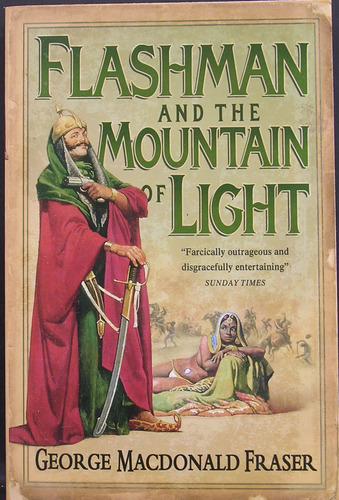
Since January I've read a further seven and a bit of George MacDonald Fraser's Flashman books, bringing me (in publication order) up to about quarter of the way through Flashman and the Mountain of Light. I'm enjoying them hugely, though I've found it improves them to intersperse them with other things. I'll blog about all twelve once I'm finished, I think.

I believe I'd already read Michael Chabon's Manhood for Amateurs when I blogged that last piece, but it managed to slip my mind. It's a series of memoir-essays, rather than the handbook which the title promises for navigating masculinity, fatherhood and husbanddom in a post-feminist world (a shame, as I could really have done with one of those). It's very sweet though, and beautifully written, especially when talking about familiar elements of geekdom such as Lego and Doctor Who (Chabon is, inevitably, a fan). The only downside, and it's an equally characteristic one, is that it sometimes becomes doubly impenetrable by talking not only about sport but specifically about American sports.

Frank Herbert's Dune is... well, long, isn't it? And there's an awful lot of it that's primarily about sand. To tell the truth, I was disappointed in this, one of SF's undoubted towering classics which I'd never quite got round to reading before. The worldbuilding is astonishing -- possibly unmatched outside Tolkein, in fact -- but most of it is kept off the page, in oblique hints in the appendices and glossary or at most in the dialogue of subplots which only temporarily diverge from the grand epic scenes of trudging on and on through some more sand. In fact, one gets a much, much stronger sense of Herbert's remarkable universe through watching David Lynch's magnificent film than by reading the book.Creating the Imperium but setting your story on Arrakis makes about as much sense to me as imagining the whole of Middle-Earth, then writing a huge novel set entirely in Forodwaith.

The writing isn't particularly impressive either, often aiming for a grandeur which it never quite lives up to, and getting lost in its own abstractions. I was amused by the fleeting mention of a Fremen warrior called Geoff. I reckon he deserves his own web comic.

Another SF book failing for me to live up to its (more recent) hype was Lavie Tidhar's Osama, a poetic but ultimately rather predictable alternative-world fantasy with a Dickian twist. It gains kudos for dealing directly with the eponymous bogeyman of our age, who in a world free of terrorism has become the hero of a series of pulp thrillers whose author the protagonist, an equally Dickian private eye, must track down. The twist will not surprise anybody who's been keeping their eye on popular BBC time-travel series over the past few years, though, and ultimately I was left with the impression of a book which thinks itself cleverer and more daring than it is.

I read SJ Parris's Heresy as research for a thing I can't talk about yet, and found it distinctly under par. It's a mystery set in Elizabethan Oxford, where a serial killer's carrying out murders modelled on Foxe's Book of Martyrs, but is hugely less fun than that makes it sound. The formulaic plot relies on intelligent people being dense and making stupid decisions, and there's only the most desultory of attempts to help the reader inside the renaissance mindset. (To give you some idea, one character uses the word "paranoid" -- a solecism which this reviewer makes a valiant, but ultimately bollocks, effort to justify.)

Stonemouth, like Iain Banks' last non-genre novel, The Steep Approach to Garbadale, reads like a greatest hits collection: a family of gangsters; a young protagonist returning home; his long-lost love; violence, drugs and shagging; landscape and buildings; the merest hint of incest; a suspension bridge... Banks effortlessly gets inside the head of a generation for whom the internet and mobile phones have literally been around all their lives, in a way I'm not confident I could do at nearly 20 years younger. It's a good read -- fun, and evocative, and ultimately touching -- but don't expect any of the exuberant originality which makes Banks' truly great works great.

From Obverse Books this year I've read the latest Iris Wildthyme collection, Wildthyme in Purple, whose theme of pulp fiction leads to some surprising approaches, verging from pastiche to metafiction to massivel multitextual crossover; The Diamond Lens (Obverse Quarterly volume 1.3), which reprints some fascinating and genuinely excellent SF and fantasy short stories by the almost entirely neglected Fitz-James O'Brien; and Zenith Lives! (OQ volume 1.4), which revives the Sexton Blake villain Monsieur Zenith the Albino, in assorted tales by some familiar Obverse hands and -- in a startling coup -- Michael Moorcock.

In theory, Shada, Gareth Roberts' novelisation of Douglas Adams' unfinished Doctor Who story, combines two of my favourite things. In practice, the story is so familiar from partial releases including a scriptbook that it's rather less exciting than the combination would suggest. That said, it's not at all bad -- veteran Who novelist and latterly scriptwriter Roberts is doing his best (which can be pretty good) to do justice to something written by a genius on an off-day (which is also, mostly, good). He does a lot of work to firm up the characters and tidy the wobbly plot, explaining in an afterword that he was working with later versions of the script than have previously been published (so it's difficult to know what exactly he added, except when it's obviously novelistic). He also talks about a process of archaeologically extracting Adams' pre-deadline intentions from early drafts, abandoned plotlines and unfollowed hints, and again it's impossible to know how accurate his guesses are.

The book's not entirely satisfying: it's obviously not a pure transcription of the nonexistent TV story, but it's too tied to those roots to take flight as a novel. I enjoyed it, though.

Last year I read Terry Pratchett's The Wee Free Men and A Hat Full of Sky, and earlier this year I finished off the Tiffany Aching sequence with Wintersmith and I Shall Wear Midnight. They're very good books, full of humanity and realism (witchcraft is a painful, thankless path of discipline and service, and if you take pleasure in it, it probably means you've turned evil). If I had to quibble, I'd say that the wonderfully-drawn character of Tiffany becomes slightly less interesting as she leaves adolescence for womanhood, although this may be because the fourth book, Pratchett's penultimate to date, lacks focus in rather the same way as his more recent and disappointing Snuff.

Another book intent on deglamorising magic -- and, much though I love Pratchett, one that seems to me to be in a different league altogether -- is The Magicians by Lev Grossman. This is one which does live up to its hype; The Magicians is a very strong novel in its own right, as well as being both a brilliantly-imagined fantasy and a clever critique of fantasy in general.

Thoroughly readable on the surface as fantasy of escapism in which (as closely as the demands of copyright law will allow) students at the US equivalent of Hogwarts graduate and find their way into Narnia, it's actually a fiercely intelligent deconstruction of the cosy comforts of this kind of conventional story. It does this partly through treating its situations with rigorous realism and logic, and partly through the character of its protagonist Quentin -- a teenager (and later a man) who's never satisfied with what he has and always suspects the universe is keeping something better from him. His addictive character could be said to typify the Western consumerist mindset to which modern fantasy is obliged to cater (although it must be said that The Magicians is also a bestseller, and that The Magician King, the second book in what looks suspiciously like a trilogy, is already sitting on my Kindle awaiting my attention).

Grossman's glittering, crystalline prose is perfectly pitched to serve the clarity of his purpose: in the end, one suspects, the only reason this is a fantasy at all is because the real world it depicts is ultimately equally unsatisfying.

If I had to recommend one of these books, this would be the one.

[Edit 26/5/12: Somehow managed to forget Shada. Have included it now. Also linked Foxe's Book of Martyrs.]

22 May 2012

Hyde Bound

I've updated my website today, with the blurb for Tales of the City, which currently looks like this:
After the end – ours and the universe’s – there is the City of the Saved. A repository for the uploaded souls of all humanity, the City is a technological utopia, a secular heaven. Heroes and villains, angels and monsters may be found in the City, but many ordinary people live here, too.

Well, all of them in fact.

In these stories, the first by writers other than the City’s creator Philip Purser-Hallard, we meet six of them. A hitchhiker, a lecturer, a tourist, a socialite, a twin, a cop: ordinary men and women living an extraordinary afterlife.

These are their tales.
(Sadly it now looks as if 1 June was an optimistic publication date, and the actual release of  Tales of the City is likely to be closer to the end of the month.) 

The updates make liberal use of the new City of the Saved logo, as designed by Cody:


I've also uploaded a bunch of recent microfiction from my Twitter account, @trapphic, including some new additions to my sequence of Victorian literature mashups, which I'd thought were pretty much played out:
‘Miss Havisham was an amateur. Henry Higgins, a dilettante. To make someone a real lady,’ the Baron avers, ‘you must start with the basics.’

* * *

‘You!’ gasped Edward Hyde, cringing. ‘But – how?’ ‘We have our friend to thank for that,’ noted Henry Jekyll, nodding at the Time-Traveller.
I've been busy with multiple other things as well, including a brief introduction for Obverse Books' forthcoming Faction Paradox titles, a draft of a short story (slightly longer than 'A Hundred Words from a Civil War', though not as long as 'Minions of the Moon'), an imminent change of day-job and a small child with chicken-pox. Some of these have been more enjoyable than others.

Cross Talk

You may be wondering, since I haven't blogged on the subject recently, how I've been adapting to my newfound atheism.

I haven't mentioned it for a while because, after the frankness of those two early posts, I've been feeling as if I'd rather prefer to get on with my crisis of faith in private, instead of tweeting it on a minute-by-minute basis. Suffice it to say that not a great deal has actually changed: my worldview was sufficiently secularised before that not having itunderpinned by a literal belief in a deity hasn't really made a terribly seismic difference.

I'm still wearing the wooden cross I've worn under my clothing since some friends brought it back for me from Lourdes when I was eighteen. The habit had become so ingrained it took me months to spot that this was even anomalous -- and about five minutes to conclude that my reasons for wearing it had far more to do with its sentimental value than with what I'd believed. I'm even attending an Anglican church only slightly more sporadically than I used to (atheism being generally accepted as no real bar to ordination these days, let alone communicant status). I've always found church ritual soothing, a link to a historical context of British communities across the generations, and that hasn't changed either.

It's possible I'm not a very effective atheist, but that's not really surprising. I was never a terribly effective christian either.

The main difference I've found in my thinking -- and it shames me to admit this -- is that I find forgiving people far more difficult these days. If you'd asked me a year ago to name a specifically 'christian' virtue -- ie, one which christianity is unusual in promoting, and which has therefore possibly been marginally more prevalent in christian circles than elsewhere, historically speaking[1] -- it would have been forgiveness, which Jesus was so keen on that he reportedly practised it even at the moment of his death. It's a vital social value, which assists in the general smooth running of the comomnwealth by keeping individuals and groups from constant feuding. It would certainly be indispensible in a utopia, which is one reason why it's difficult to imagine a utopia without faith. 

In any case, it's not something I'd feel happy to think I'd lost. 

However, I've come to understandthat the forgiveness I used to try to practice (not terribly effectively, I admit -- see above) had more than I realised of schadenfreude in it. The peculiar eschatology I'd constructed had no truck with the idea of eternal damnation -- that I'd dismissed, once I was old enough to escape the usual childhood terrors, as a barbaric dogma -- but it had metabolised the idea of purgatory into something typically idiosyncratic. I believed that, after death, each individual (myself not excluded, obviously) would be presented with a moment of absolute self-knowledge, in which it was revealed to them -- not as mere fact, but as an empathetic recognition -- exactly what they'd done and been in life. Every petty selfishness, every thoughtless action, every glib dismissal, sneering gibe, assault, murder or act of genocide would be seen clearly for what it was, and for the effect on its recipients.

Having received this insight, I blithely assumed, everybody would repent and turn to God.  There'd be no need for hell after that, because who could withstand such self-knowledge and retain their pride?

As I say, it was eccentric.  But it comforted me, when I saw people getting away with selfish, shitty behaviour -- especially the kind of thoughtless use of power which screws up entire populations for generations -- to know that it would rebound on them in the end.

It wasn't a vengeful thought particularly, just a feeling that this was the right, the just, way for the world to be run. Margaret Thatcher or Ronald Reagan or Autgusto Pinochet or Rupert Murdoch might die peacefully in bed, surrounded by admiring well-wishers, but they'd damn well have their complacency stripped away from them afterwards. And, given genuine repentance and a heartfelt apology for the vicious crap they'd inflicted on the poor plebs around them during their lifetimes, I'd be magnanimously willing to share Heaven with the (formerly) evil fuckers. 

It sounds odd, I admit, but to be honest I'm not sure it's possible to sustain a religious universalism under a benign God without something of the kind. 

Now that comfort isn't available to me any more, I find myself raging day after day, appalled that whatever horrific idea Cameron and Clegg and Osborne (yes, and Murdoch) think up next to ravage the country with, the bastards are going to get away with it. They may face some uncomfortable verbal criticism, but unless God moves in some pretty fucking mysterious ways, it'll be water off a duck's back to them. Unlike the sick and disabled people, the single mothers, the nurses and teachers, whom these wankers are screwing on a daily basis to serve the interest of their plutocratic arsehole friends[2], they'll never see a moment's serious consequence to their actions. 

That isn't just, it isn't right, it isn't reasonable. It's not how I want the world I live in to be. 

When people say (atheists, I mean, and as a criticism) that religion is comforting, they usually mean that it allows believers not to be scared in the face of their own death. To be honest, I still don't see that as an issue.  I fear the pain that I imagine will precede death, but not the cessasion of my personality. Perhaps when you've grown up fearing hell, the prospect of oblivion seems like a neutral option. 

But my religion was a comfort to me, and it was one which for years helped me avoid confronting a basic truth:

The world is unjust, and it doesn't get any better, and that's the fault of specific people. Nobody -- apart from us -- is going to teach them any better. And until they make amends, the bastards don't deserve forgiveness.

[1] And yes, I'm fully aware of the large body of potential counterexamples.
[2] It's possible I swear rather more these days, as well.

19 May 2012

Trailers of the City #5

Here's the fifth and penultimate trailer for Tales of the City, the anthology of short stories I've edited set in the City of the Saved and due to be published by Obverse Books on (at last estimate) 1 June.

Dale Smith's biog, rather unexpectedly, says this:  
Dale Smith: I need you to kill a man, they said. Two hundred, I said, and how do I find him? There was some website – www.dalesmithonline.com – but the only thing you got from that was that he had already died, sometime before the invention of the broadband modem. But I found him. ‘I know how to live forever,’ he whispered as I stabbed him. Nothing personal, just work. But his name wouldn’t die. Dale Smith, Dale Smith, Dale Smith: he was everywhere. He was dead, and he wouldn’t die. That’s why I’m here. I need you to kill a man.
Dale's modesty covers the fact that he's the most distinguished contributor to the book, with two Doctor Who novels, a number of plays, some short stories (for Obverse and others) and the single best novella published under the Time Hunter banner under his belt. I've always admired his writing, which is intelligent, emotionally engaging and unafraid to take risks, with an interesting predilection for biotechnology. 

I knew as soon as I saw Dale's pitch for Tales of the City that I had to publish it: the central character alone was so perfect for the City setting that I was cross at not having thought of her myself. It's called 'About a Girl' and if I had to classify it by genre, I'd call it a cyberpunk horror rockumentary.  Here's the first sentence:
     They called themselves The Twenty-Seven.
That might be enough information for some of you to guess the story's starting-point, but you're unlikely to guess the rest. To read the story, order Tales of the City from Obverse Books.

04 May 2012

Trailers of the City #4

Update: Tales of the City has been moved up to form the first volume of year 2 of the Obverse Quarterly, ahead of the David-Bowie-themed Iris Wildthyme collection Lady Stardust. This means both that the expected publication date is early next month, and that I need to get a move on with these teasers.

  So:
Helen Angove began her working life as an electrical engineer on the south coast of England, took a brief detour as a pricing analyst for an electricity supply company (which was as much fun as it sounds) and then veered off in a different direction altogether by becoming a priest in the Church of England. Now, however, she is living with her husband and two children in Southern California, and is against all the dictates of common sense exploring the possibility of writing as a viable career choice. She has known Philip Purser-Hallard for longer than either of them might care to remember, and holds him responsible for inculcating in her a long-lasting love of science fiction. Her love of Jane Austen, on the other hand, she developed entirely on her own, and the blame for deciding to combine the two can be laid at the feet of no one else.
As that biog implies, I've known Helen longer than any of the other contributors -- since our teens, in fact, so that as she says we influenced each other's tastes in reading rather early.  Her writing is thoughtful and evocative and humane, and -- as she remains shockingly unpublished prior to now -- I'm delighted to be able to include a sample of it in Tales of the City. 

Helen's story, 'Highbury', is a comedy of manners, albeit with a nasty twist.  (I've actually thought for ages that the City of the Saved was a perfect setting for such a story, to the extent that my very first City proposal opened at a Jane Austen tea party with cyborgs and neanderthals in attendance.) Here's the first sentence:
     A gentleman should be allowed to consider a library a place of refuge: a room where he can have the reasonable expectation of temporary retreat from the distractions of domestic life and the interruptions of the fairer sex.
To read the rest of the story, order Tales of the City from Obverse Books.

25 April 2012

The Art of Faction

Incidentally, I wrote this about Faction Paradox on a mailing list this morning, and am reasonably pleased with it. Brief though it is, I thought I might as well post it here, to add a tiny bit of texture to the wall-to-wall plugging.

I think the steadily accreting continuity of Faction Paradox detracts from its core appeal. It upsets me when I see fans on Gallifrey Base replying to some newbie saying "Ooh, Faction Paradox -- what's that? Where should I start?" by handing out a reading list they have to work through before they understand it properly. The correct answer is, "Well, the best books are [give a couple of choices here] -- read those and see whether you like them."

In my view, the successful Faction Paradox stories have shared three things:
  1. A interest in history, coupled with an understanding that it's ultimately negotiable; 
  2. A subversive politics which sees all forms of authority (including that of the storyteller) as fundamentally questionable; 
  3. A syncretic aesthetic based in anachronism, cult imagery and outsider art, which articulates points 1 and 2 above. 
It's doing --- on a wider historical and cultural canvas --the kinds of things steampunk did before it lost all interest in intelligent discourse and became a fashion statement.

Some of the best Faction Paradox stories have combined all this with an exhaustive knowledge of Faction continuity (Newtons Sleep being the obvious example), while others (Warlords of Utopia, Erasing Sherlock) have basically ignored it. Both approaches work fine.

In other words, if what you like about Faction Paradox is voodooesque cultists standing around posing in period dress and skull-masks -- it's OK. You get it. That's fine.

Trailers of the City #3

This is the third trailer for the forthcoming short-story anthology Tales of the City, set in the City of the Saved and available for pre-order from Obverse Books. Here's the biog of Juliet Kemp, the author of the third story in the book:
Juliet Kemp lives in London and writes things down a lot. She has had previous stories published in the anthology Hellebore and Rue and in Eclectic Flash. She has a website at http://julietkemp.com where she talks about plants, building things out of pallets, and anything else that catches her interest.
I've known Juliet for some years now, and have been impressed by the quality of the fiction of hers I've read. Two of her stories, 'Things Found on a Beach' and 'Falling after Icarus', are available to read online (you can even buy the latter for the Kindle), so you can judge for yourself as well. (Juliet also writes articles and technical manuals for computer programmers, which I admit I haven't attempted to read.)

Her Tales of the City story, 'Lost Ships and Lost Lands', is a traveller's tale, a shipboard adventure with a twist, taking place in a District of the City unlike any we've seen before. The first sentence goes like this:
     The train rattled away and back out of Cerulean District, leaving Brianna alone on the open platform.
(You may spot a minor continuity issue here with Of the City of the Saved..., which I've taken the bold editorial step of ignoring completely.) 

To read the rest of the story, order Tales of the City from Obverse Books.

[NB: The splendid new City of the Saved logo is by Obverse's equally splendid in-house graphic designer, Cody Quijano-Schell, and will be appearing on my website shortly.]

10 March 2012

Trailers of the City #2

Second in an occasional series publicising the forthcoming Tales of the City anthology -- although yes, I have to admit I haven't posted anything here since the last one.
Elizabeth Evershed is a freelance writer based in London. Since graduating from Durham University in 2009 with a PhD in late medieval and early Renaissance literature, she has worked in various capacities as a tutor and researcher, proofreader and copy-editor, and freelance consultant on plain English in the public sector. She is a regular contributor to Literature Online, where she has written critical biographies of a wide range of science fiction and fantasy authors from JRR Tolkien to China Miéville. The world of the City has provided her with a rare opportunity to combine science fiction, quasi-historical and campus fiction in ‘The Socratic Problem’, as well as have some fun sending up famous philosophers. Elizabeth writes comic literary fiction in her spare time and has just completed her first novel.
I've known Liz for a while: she was one of the founder members of a writers' group called Subway to which I belonged in the early noughties. (The group produced an anthology, Emerge, which included 'Scapegoat', my second published piece of fiction.)

Though Subway was a product of the internet era, we occasionally met in person for readings, workshops and social events, and I knew from these that Liz was a gifted, witty and highly intelligent writer. When pondering which authors I might bring in as contributors from outside Obverse Books' usual talent pool, Liz was one of those at the top of my list. I was delighted when she said yes, and I very much hope it won't be the last work she does for Obverse.

'The Socratic Problem' is, as I expected, a very clever and funny piece. It's a campus story, dealing with academic rivalries and clashes of ideas as the City's University of the Seven Ages appoints a historical celebrity as its Visiting Lecturer. Here's the first sentence:
     No doubt about it: Inigo Faber was having a dog of an afterlife, and, as dog days went, this was an uncommonly hairy one.
To read the rest of the story, order Tales of the City from Obverse Books.

07 March 2012

Trailers of the City #1

Here's what Blair Bidmead, whose Happily Ever After is a High-Risk Strategy opens Tales of the City, has to say in his author biog:
Blair Bidmead, author of 'Happily Ever After Is a High-Risk Strategy', has had three short stories published previously – 'Party Kill Accelerator!' (in The Panda Book Of Horror), 'Now Or Thereabouts' (in Faction Paradox: A Romance In Twelve Parts) and 'Are You Loathsome Tonight?' (in Señor 105 & the Elements of Danger). He has a novel on the go, another in mind and a webcomic in his not-too-distant future. A musician, an artist and a (semi-) retired hedonist, Blair lives in London with his wife and two young children and is tired, but sickeningly happy. He thinks that talking in the third person only feels right when the Rock does it.
Blair was an unpublished author a few years ago, but his three published stories have been excellent, and are getting better. I'm particularly fond of 'Are You Loathesome Tonight' -- a smackdown between a Mexican masked wrestler and a dinosaur version of Elvis, taking place in 1970 Las Vegas and with a narrator who may well be Hunter S. Thompson -- which manages to be even madder than that brief synopsis makes it sound.

What really sold me, though, on the idea of getting Blair to write a City of the Saved story was his guest drabble in 'A Hundred Words from a Civil War', which convinced me in the space of 100 words that he understood and loved the City as a setting. (It's drabble number XXX, on p209 of the print edition of A Romance in Twelve Parts.)

A mix of not-necessarily-obvious genres was one thing I was keen to see in Tales of the City, and Blair's is a road trip story, with a hitchhiker cadging a lift with a surprising pair of travelling companions. Here's the first sentence of 'Happily Ever After is a High-Risk Strategy':
     So there I was; dawn at the truck stop by the ziggurat at the mouth of the Mesopotamian Interstate.
To read the rest of the story, order Tales of the City from Obverse Books.

Ordering

If you've been keenly following the progress of Tales of the City, the City of the Saved anthology I'm editing, you may be pleased to know that the book is now available for pre-order as an individual title from the publishers, Obverse Books.

You can also subscribe to year 2 of the Obverse Quarterly at that link, of which Tales of the City is the second volume -- the others being a collection of Iris Wildthyme stories themed around David Bowie songs, the adventures of some time-travelling policemen and an anthology of unrelated detective stories. Individual titles are £9.99 while a year's sub comes in at £28... so, if only three of those sound worth buying to you, it's cheaper to get the subscription to all four books.

I'm going to be posting sporadic teasers for Tales of the City every month or so between now and when it's published. Since our rumoured eighth contributor sadly never materialised, the final lineup of stories is as follows:
Akroates by Philip Purser-Hallard
Happily Ever After Is a High-Risk Strategy by Blair Bidmead
The Socratic Problem by Elizabeth Evershed
Lost Ships and Lost Lands by Juliet Kemp
Highbury by Helen Angove
About a Girl by Dale Smith
Bruises by Dave Hoskin
Apocalypse Day by Philip Purser-Hallard
Leaving my own endpieces aside, each teaser will focus on one of these, taking them in the order they're presented in the book (which is also chronological order). The first one follows...

15 February 2012

Recycling, mostly

Recently, when not serving the needs of either the Government or my two-year-old, I've mostly been working on the editing of Tales of the City, which is coming out very nicely indeed. I'm impressed by the quality, scope and variety of the stories the six authors and I have managed to assemble together, and I'm confident it's going to be a really strong anthology. The other author who I vaguely mentioned might be joining the party now definitely isn't, so that link now gives the official list (although the order of the stories may well change).

I have a long list of other creative projects which are either ongoing or which exist in embryo and I'd like to work on properly at some point, including:
  • The sort-of-slipstream-fantasy novel I've mentioned writing at various points over the past year (due a rewrite and polish once Tales is out of the way);
  • An illustrated anthology of @trapphic stories (which I'm trying to think of a less awful name for than The Volume of Trapphic);
  • A collection of my Christmas stories (which ideally needs 24 pieces in Advent calendar format, so either I'm going to have to write more than one a year or it'll have to wait until I'm 60ish;
  • Some ideas for other anthologies I'd like to edit if this one comes off, both in the City of the Saved and outside it;
  • Speculative story ideas for potential future Faction Paradox, Iris Wildthyme or Señor 105 anthologies from Obverse Books;
  • A quartet of more or less SFish novels which I had planned out in detail and was working on before I decided to write the other novel instead, and which at present go by the working titles A Giant in the Earth, The Air of Utopia, The Knowledge of Fire and By the Waters of Albion;
  • A non-genre novel I wrote a chapter of years ago called Fragile Monsters, which I'd kind of like to spend more time on at some point.
The "fire" book in the elements quartet is based on an idea I originally submitted for a Doctor Who novel in the late 1990s, which gives you some idea of how long, and how productively, this stuff has been hanging around[1].

In fact, the Doctor Who proposal (then called A Memory of Fire) had a somewhat epic history: conceived as a seventh Doctor story unreliably narrated by the eighth Doctor (who would have been doing his best to conceal a piece of treacherous duplicity by his past self), it went through a number of permutations at BBC Books' behest, including an eighth Doctor novel in which the original narrative appeared as a flashback, a fifth Doctor novel narrated by the sixth Doctor[2] and the original idea presented as a short story (this was shortly before the BBC stopped publishing Doctor Who short story collections), before they finally rejected it[3]. Since I hadn't at this point been published professionally at all, their interest was encouraging as well as frustrating.

Eventually, at BBC Books' recommendation, I submitted it to Telos Publishing instead (this was shortly before they stopped publishing Doctor Who novellas) and on the back of it was commissioned to write Peculiar Lives, with which it shares nothing whatsoever except a narrator who ends up somewhat regretting his past actions.

I still have these variorum proposals, including three variant plots, two variant prose samples, the complete 4,000-word short story ("Faith Healer"), and an explanatory note outlining the relevance of the theories of Carl Jung and Rupert Sheldrake. The only thing that's stopping me putting the whole lot on the web is a) the hope that one day I'll use some of the most striking concepts (specifically, two posthuman species called the Orpheids and the Dhebeth) in The Knowledge of Fire, and b) the same lack-of-time issue which has prevented me putting online the outline of my abandoned Prisoner novel Island in the Ashes and my proposal for a pulp-steampunk novel, The Curse of Odin-Hotep, whose sample chapter I did once post to this blog.

By contrast, everything on the list is stuff I'd like to get around to doing some day, when time and energy allow. So possibly when the two-year-old has turned eighteen.

[1] The "air" novel is also based on a rejected Who proposal (Unearthing the Princess), as are elements of Of the City of the Saved... (Sabaoth) and Nobody's Children (Relativity, or Baby Rachel and the Sexually Dimorphic Punk Polecats from Outer Space). I submitted rather a lot of these.

[2] Who I passionately dislike, so I was rather relieved when they didn't want to use that one.

[3] It's actually slightly more complicated than this. The original novel proposal, the short story and the novella proposal -- though not the other variants nor my still-intended The Knowledge of Fire -- incorporate elements which I developed for my earliest Doctor Who novel proposal, Word Perfect, submitted to Virgin Books circa 1995, and which derived ultimately from The Space Monastery, a script I sent in to the Doctor Who production office in 1987 when I was 15. None of this is stuff I still intend to use, though. Especially The Space Monastery.

28 January 2012

Books Update (part 94)

With my novel in the hands of various friends awaiting their (hopefully critical) feedback, and the bulk of the stories for Tales of the City not due until Tuesday, I find myself quite unusually at something of a loose end on a writing day. This has led me to notice that it's been over six months now since I last posted any kind of book review here.

This is shocking, really, because I've certainly been reading stuff, and not just heavily illustrated books about fire engines either.

All the more so recently, in fact, because I got a Kindle for my birthday. It turns out many of the habits I've picked up over years of reading paper books don't transfer to electronic devices, so that it's actually much quicker for me to read the same amount of text on a screen than it would be bound between two covers. (This despite the fact that a Kindle display is black-on-white, unbacklit and -- apart from the technological framing device -- pretty much indistinguishable from reading something on the page anyway.)

Reviewing everything in depth that I've read in the past six months (even if I could remember all of it, which I suspect I can't) would take a terribly long time, and probably be boring to read. So I'll give a few one-paragraph reviews of the more interesting stuff, and then head into Twitteresque one-liner territory for brief responses to the others.

(NB: All links in this post are to paperback editions of the books in question, regardless of the format I read them in. If you'd prefer me to start linking to the Kindle versions, do let me know.)

I thgought China Miéville's Embassytown was great -- cerebral SF of what we might now call "the old school", the New Wave tradition of the '60s and '70s with its interest in anthropology and politics and its worthy literary aspirations. Intriguingly for the Marxist Miéville, it's a recapitulation of the biblical Fall myth among other things, though mostly it reads as a homage to Ursula le Guin, who reviewed it in glowing terms in The Guardian. It's not flawless -- the protagonist is blurry, and the depiction of the disintegration of the titular society too protracted, going through supposedly distinct but actually very vague stages, rather as if working from a sociology textbook for post-apocalyptic societies. Overall, though, it's engrossing and ingenious.

Among the many, many books which it's scandalous I never read before reaching adulthood, let alone middle age (I'm on Dune at the moment), is The Mists of Avalon by Marion Zimmer Bradley. I'd always understood that this was an epic feminist reworking of the Arthurian saga, and it's certainly true that using solely female characters for viewpoint[1] gives an interestingly skewed perspective on the tradition. However... the opening hundred or so pages (the novel is, dauntingly, 1009 pages plus an unnumbered prologue in length) are entirely structured around which of two men Arthur's mother Igraine fancies, with much wittering on about ancient reincarnated souls from Atlantis, and it doesn't get a great deal better. Morgaine is by far the most interesting character, and even she's obsessed with Lancelot, Arthur and later Accolon. It's possible that the female characters' preoccupation with romance is meant to be making a feminist point about their role in such societies, but overall the book reads like a shambling hybrid of sword-and-sorcery and Mills-and-Boon. It does get better, picking up particularly with the political intrigues of the final quarter... but it's quite a slog, and not a rewarding one.

(Which reminds me, ask me about Dune in a few week's time.)

Another I'm ashamed of not having read before is Richard Matheson's I Am Legend, a seminal reinvention of the vampire myth whose influence in the media of the late 20th and early 21st centuries is as visible as that of Dracula[2]. It's a powerful exploration of loneliness and paranoia, but its revolutionary nature lies in its insistence on treating vampirism as a rational phenomenon, suseceptible to analysis through microscopes and epidemiology. It's a short read (I polished it off in a couple of evenings) but a compelling and impressively scary one.

Jill Paton Walsh's latest continuation of Dorothy L. Sayers's sublime Lord Peter Wimsey series, The Attenbury Emeralds, is a slight thing with a needlessly convoluted plot (not unlike Sayers' own Five Red Herrings, which is my personal least favourite of her works). The device of having the first half of the book consist of a lengthy flashback narrated in dialogue by Lord Peter and his manservant Bunter is weirdly alienating at first, but one gets used to it. The detective story itself is uninvolving in any case, the real joy of the book being the author's unashamedly fannish enjoyment of the characters, whose continuing lives are lovingly recounted. There's a particular turn of events near the novel's end which changes the status quo entirely in a way which few sequelists-of-other-authors would have dared. I've read reviews which suggest that these scenes also bear some interesting thematic freight, but on the whole the book has nothing of the depth of Sayers' more cerebral and sophisticated works.

The Islanders by Christopher Priest is a fascinating example of the "novel written as reference book" genre -- in this case, a guidebook to the Dream Archipelago, the setting of his earlier novel The Affirmation and a number of short stories. Like The Dictionary of the Khazars or The, ahem, Book of the War, the book constructs overarching stories across its multiple entries, with various strands (the lives of certain artists, a murder mystery) linking up in sundry ways at multiple points in the non-narrative. More than either of those, however, this book renders these links problematic and difficult, to the extent that any attempt to tease out a definitive "truth" founders in the gaps between the entries[3]. The book makes much of the Archipelago's inconsistent, or at least unfathomable geography, and the difficulty of navigating a straight course between these island-entries may be designed to mirror that. I decided long ago that trying to get them to make literal sense was not the best way to enjoy Priest's books, and with that proviso this is a fascinating book, often beautifully written.

The Girl with the Dragon Tattoo I thought was pretty poor -- apart from some attention-grabbing (but quite distasteful) violence, it had very little to recommend it. It's badly structured, with dull prose (in which people constantly note the dimensions and contents of the rooms they're in as if already planning a film set) and an apparent belief that corporate accountancy fraud is thrilling in itself. I've read worse bestsellers, but not ones I'd been led to believe were actually good.

OK, time to speed up.

Flashman was enormous fun -- the trick of making its anti-hero appealing is to give him absolutely no illusions about his own despicableness. I'll definitely be seeking out the further volumes, to further my knowledge of nineteenth-century military history as well as to enjoy the often hilarious writing.

Simon Armitage's verse translation of Sir Gawain and the Green Knight is very enjoyable, too -- a sympathetic and populist modernisation of a poem whose chief barrier to accessibility is its language.

Michelle Paver's Dark Matter is a frankly terrifying story about a haunted Arctic expedition, and one man who finds himself alone in the perpetual night with a pack of huskies and an angry ghost. One for reading in the daytime, preferably in company.

Bad Things is Michael Marshall Smith by the numbers -- perfectly-paced storytelling with entertaining prose, but ultimately with nothing new to say. Think "Blair Wicker Man Project", and you essentially don't need to read the novel.

Terry Pratchett's Snuff is terribly disappointing, at least by the standards of previous City Watch books (because, let's face it, the Discworld series as a whole has always been hit-and-miss). In the light of his well-publicised medical condition, it's difficult not to see this as Pratchett losing his touch altogether, but I'm hoping it's a blip.

To end on a happier note, David "not that one" Mitchell's The Thousand Autumns of Jacob de Zoet is excellent -- a fascinating story of European contact with the isolationist Japan of the 1790s, dealing sympathetically with both Japanese and Dutch culture (though somewhat less sympathetic to the English when they turn up), and tinged round the edges with smudges of the fantastic. It's well worth a read.
[1] Well, nearly. In fact, there's half a page (p981 in my edition) which is written from Mordred's point of view. In all I counted seven female viewpoint characters -- Igraine, Morgaine, Vivane, Gwenhwyfar, Morgause, Niniane and Elaine -- which is three more than most reviewers seem to mention.
[2] I certainly should have read it before writing The Vampire Curse, which covers some of the same ground. Oops.
[3] On the most obvious level, one character who is, according to the narrative, dead long before the guidebook is written, also supplies its Preface.

18 January 2012

Secret Architects

It occurs to me that, given my usual enthusiasm for plugging things here, I've done relatively little banging on about Tales of the City, the short story anthology I'm editing as part of Obverse Books' Obverse Quarterly series. At first this was because there wasn't much to say about it that could be considered definite, but since the publishers informally announced the author lineup that hasn't been the case, and it's remiss of me not to have posted it here before now.

The stories and contributors to the anthology are, then:
‘Happily Ever After Is a High-Risk Strategy’ by Blair Bidmead
‘The Socratic Problem’ by Elizabeth Evershed
‘Lost Ships and Lost Lands’ by Juliet Kemp
‘Highbury’ by Helen Angove
‘Bruises’ by Dave Hoskin
‘About a Girl’ by Dale Smith
I'm really pleased with this lineup -- all of these are authors who I know will turn in some very fine writing, and who submitted excellent storylines to boot.

There'll also be a prelude and a postlude by me (whose substance will depend to some extent on how much space is left after everybody else's final drafts). There's an unconfirmed possibility of an eighth contributor, but we're not going public with their identity just yet.

A web page for the book is now up at my site. It's currently rather minimalist, but I hope to expand it with some extras in the coming months. I've also added an index to the City material generally.

[Edit to add: That's a placeholder cover, in case it's not obvious. It's clipped from the cover of Of the City of the Saved..., after vacillating over whether to use the only other picture I've got of the Cityscape.]

08 January 2012

Snippet

Looking through old documents recovered from my previous computer, I found this, which I have absolutely no memory of.

Titled "Website vague idea thing.doc", it appears to be my early stab at a bonus story for my website, bringing elements from "Nursery Politics" and "The Ruins of Time" at the same point in Of the City of the Saved... that I eventually used for another website bonus story, "Unification Theory". It's incomplete, obviously, but you may, as I did, find it briefly diverting.
     ‘Ma’am,’ says one of the more heavily-armoured of the security personnel, ‘sir. May I see your invitations, please?’

     The left-hand member of the black-upholstered duo (the man, though the bodily divergence between the two is hardly striking) pulls a white card from the inner pocket of his frock-coat, as from a shoulder-holster. ‘Mr Smits,’ he says, then nodding to his right, ‘Ms Lefèvre. We’re with one of the research institutes,’ he asserts blandly.

     Naked of mask, his smoke-glassed eyes reflect the parsecs-distant skyline.

     The security man runs the invitation through a handheld scanner, then inclines a plated head. ‘Very good, sir. Sorry to have bothered you.’ He trundles away.

     When he is out of earshot, the woman called Lefèvre by the man calling himself Smits mutters, ‘I told you we were too conspicuous. We should have dressed to blend in.’

     ‘That’s not our way,’ says Smits. ‘The Director never approved of undercover work. We’re here to watch the Houseworlder. It doesn’t matter if he knows we’re here.’

     The colleagues stare for some time at the dark-skinned, white-djellabaed figure of Professor Handramit, sharing a quiet cigarette at the parapet with one of his hosts. His human shape unnerves the agents, even more than the collateral security man’s contaminated biodata.

     ‘At least we know who this one is,’ Lefèvre says at length. ‘Not like that herm they found in Tormance.’

     Smits shifts uneasily. ‘That’s just a rumour.’

     ‘Whatever,’ his colleague says. ‘I believe Mr Sideras.’

     It is a rumour which none of the Institute’s personnel likes to think about. Supposedly, the alien whom Mr Sideras found in Tormance District had been passing for some years as a normal working hermaphrodite: making wooden furniture to sell, socialising at the colour bars, on amicable terms with customers and neighbours. Had it not been for the exquisitely-honed paranoia of Sideras’s colleague Ms Gowan, the carpenter’s dried skin-secretions on a recently-built kneelchair and a portable biodata-analysis kit, the interloper might have gone undetected for many more years.

     If correct, the story of the hermaphrodite would suggest quite inescapably that somebody is resurrecting humanoid aliens – people, to use the word in its loosest sense, who appear human, yet are the heirs to no human ancestry whatsoever – and sending them to act as spies among the honest panhuman populations of the City.

     Unnervingly, this specimen remains at large. The attempt at arrest did not favour Sideras and Gowan, and the latter has since entered seclusion. The rumour runs that she is, somehow, paralysed: not harmed, of course (that being categorically impossible) but preserved, intact and perfect, in a condition of stasis, as if for her the passage of time has been indefinitely suspended.

     Within the City this, too, should be a categorical impossibility, although the fact is less well known.

20 December 2011

Dyschronismus Carol

It's time for the now-traditional web release of the story I sent out last year in my Christmas cards. 2010's offering was a science-fiction reworking of a traditional Christmas story.

DYSCHRONISMUS CAROL
by Philip Purser-Hallard


     Marley was dead, to begin with. Luckily we could fix that.

     Protean Pete visited him on his deathbed – 24/12/1836, seven years pastward of our scheduled intercession – and made him the offer. We’d take a working CC of his mind at point of death (generations before the process was perfected, so Marley was a winner there) and timecap him back with us to our own century, once we’d wrapped up business in his.

     The boss could find him work – probably market-trend analysis, given his talents. He’d fit right in with the other post-mortal employees in TC:Corp’s central storage coil.

     Immortality came with a condition, natch. Marley had to use his intimate knowledge of our subject to give him a specially tailored spookshow.

     Jacob Marley hadn’t been a ruthlessly successful player in the C19 money-markets without knowing a sweet deal when he saw one. Even before Pete gave him our reasons, helping haunt his best friend didn’t give Jacob a moment’s qualm. Once he was convinced Pete himself wasn’t a delirium phantom, we had him on-team.

     Turned out he was quite the creative collaborator, too. His custom facetop burrowed right into our subject’s psyche and cracked it open along the faultlines.

     Jacob’s overlay of local fiscal imagery over Judaeo-Christian folk-eschatology would have scared the living oxytocin out of any Victorian capitalist. As Marley’s ghastly holophantasm groaned and wailed and ghouled it up in his chains of ledger-books and cash-boxes, our timecap’s psychometers all told us we were getting through to Ebenezer Scrooge.

* * *

     Big Ish, Protean Pete and me are the frequent flyers on TC:Corp’s emergency intercession squad. We spend so much time in the past we joke about settling down there. I’m certain Ish has a second wife in Medici Florence.

     Pete’s a premature post-mortal, a carbon-copy still active long after his original started renting six-by-two cellar-space. During fieldwork he resides in the timecap’s minicoil – luckily there’s enough storage for Marley to join him without getting too cosy.

     Ish is our musclebrain – not the insult it sounds. Germ-work and soma-drugs have boosted Ish’s brain and his muscles, till he can think as speedily and nimbly as he can... well, throw a small horse. He’s eight feet tall, built like a structural pillar which happens also to be a chess grandmaster.

     Then there’s me. I deal with the crude mechanics of intercession – where to point the timecap, which bits to push when, and the effect that has on the whole assemblage. Time itself is a mechanism, and some of us were just made to tinker.

     They call me the Mechanic, obviously. We intercessors pride ourselves on technical skill, not imagination.

     The Responsive Intercession Department’s been part of TC’s corporate responsibility wing since the boss introduced the Model A Time Capsules – back in ’47, our time. The engineers build in multiplural redundancies and safeties, natch, so users won’t impinge on the history they visit... but there’s always someone determined to crush the butterflies.

     Some of them have agendas. However well-intentioned, they’re liable to crumple history into a scrunched-up moebius strip of causality. Our single least popular assignment’s the Hitler bodyguard unit.

     This impingement seemed targeted, and at the origins of TC:Corp itself, no less. Stopping the inventors of time-travel using their own product? You’re looking at a major dyschronismus – a grandfather paradox of the kill-the-ancestors variety.

     Those never end well. Some of them never end at all.

     The boss (and I mean the boss, Mr TC:Corp himself) dispatched us as soon as the alarms started pulsing. He knew he had a limited window open before causality started caving in on top of him.

     If our intercession here in 1843 didn’t come out right, chances were we no longer had a future to call our own.

     It seemed the miserable hermit existence our subject was leading wasn’t what history demanded of Ebenezer Scrooge. Never one of the C19’s big noises, he was still part of the soundscape – a background hum which had suddenly changed its pitch.

     Whatever it was our rogue timecappers had altered (and there were plenty of possibilities in Ebenezer’s new biog, from his ma’s early death to the awkward breakup with his one-time best girl) it had changed him from a legendary philanthropist, his name a byword for generosity and bonhomie, into a crabby, embittered old man.

     Unless we could reboot his outlook on the world, Scrooge would die without giving away an ounce of love or money to another person ever again. And the consequences of that could – would – be catastrophic.

     A miserly, misanthropic Scrooge was a danger to history. Our job was to enrich his soul, awaken his long-suppressed childlike wonder, and generally act as agents of redemption in his withered, dried-up gourd of a heart.

     Well, it was more life-affirming than most jobs. It certainly beat working the Hitler detail.

* * *

     Stakes aside, it was a standard intercession. Jacob’s phantasmodrama was the warm-up, what we call in intercessor jargon stave 1. Pete took stave 2, the life-flashes-before-your-eyes session. Ish was on stave 3, AKA it’s-a-wonderful-life-and-you’re-not-living-it, and I was stave 4, the near-death-experience. As usual.

     Staves 2-4 use the timecap’s look-don’t-touch settings to let the subject walk around his own past and future, helping the process along with airborne psychoactives to unlock subconscious imagery. From Scrooge’s POV, stave 2 showed him characters from storybooks wandering round his childhood memories.

     Where most PM-CCs use some idealised version of their old body for their holographic interface, Protean Pete flickers between forms like reflections in a boating-lake. For stave 2, he uses this wrinkled-child facetop which, I tell you frankly, creeps me out. Fact is, I can’t remember what Pete looked like when he was alive, and my memory’s better than most.

     Big Ish gave stave 3 his full holly-green-giant act, a pagan god of edible dead things. He’d calibrated the timecap to show Scrooge what the rest of Victorian society – and especially his employees and family – were doing on Christmas Day 1843. His ho-ho-ho, sit-on-my-knee-old-man routine was meant to point the subject towards his own inner Santa.

     Then it was my turn. I’m no actor, but for an NDE you don’t need to be – a black cloak and an ominous silence pretty much cover it. Most people find the way I move disquieting, too, and that helps – though what really scares the oxies out of most subjects is being shown the circumstances of their own deaths.

     In the timeframe we’d gotten locked into, Scrooge died alone, unhappy and unmourned, his minimalist funeral attended only by his scant relatives and hangers-on hoping for a free meal. His gravestone was just about the bleakest thing I’d ever seen.

     By the time I left him, he was begging to be allowed to change the future.

* * *

     Of course it was never really about Scrooge. I tried to tell Marley that while we waited for the boss to see us.

     Stave 5 – dipping into the subject’s future life, checking its new course – had been textbook. We found Scrooge making his money ethically (which alone would have marked him out from his fellow Victorian financiers) then distributing it among... oh, you know. Dogs’ homes, starving families, orphans in dire need of outings to the seaside. That style of thing.

     Then it was back home to ’57, and routine decontamination in the Responsive Intercession Dept at TC:Corp central. The usual diagnostic ticklist of random historical events checked out against the secure records held in the timecap’s coil – dyschronismus averted.

     Then they told us the boss had asked to see all four of us.

     I don’t know what those rogue timecappers had against the boss, but we all understood that in sabotaging Scrooge’s biog, they’d been targeting him. Now he was safe, so were TC:Corp, and us, and history.

     The boss isn’t your usual post-mortal. He’s one of the earliest, for starters – 40 years dead, following an 80-year mortal span. He’s not one to haunt the coils, staring through a facetop at the outside world. He’s had a dedicated microcoil implanted in a mechanical frame – quite like mine, in the same way a Rolls-Royce Silver Cloud’s ‘quite like’ a Morris Minor.

     The boss is also the richest man in the world, natch.

     ‘I’m pleased to meet you, Mr Marley,’ he said as we entered his office, Pete and Marley projecting from a portacoil on Ish’s wrist. ‘My friends were always speaking of you during my childhood. I was born after you died, of course – although I suppose I must now say that you apparently died.’

     ‘You have me at a disadvantage, sir.’ Jacob’s holophantasm – appearing now as a handsome young Regency beau – bowed. ‘Doubly so, as I must thank you most humbly for your employees’ goodness in saving my life. Pray tell me, how should I address you, and who were our mutual friends to whom you allude?’

     The boss smiled. That expensive face of his can do that.

     ‘You knew my father,’ he said. ‘He was the clerk at Scrooge and Marley’s. I’m Timothy Cratchit, Bob Cratchit’s youngest son.’

* * *

     Cratchit Senior was the clerk we’d focussed on during the intercession, staves 3 and 4 particularly. Our subject took a special interest in his family, and ‘Tiny Tim’ in particular, which had continued well into stave 5.

     That, too, was history the way it should have been. As a kid, the boss was Ebenezer Scrooge’s protégé. He suffered from one of those stereotypically grim Victorian wasting diseases, and without our subject’s influence (and especially his affluence), he’d have died in childhood.

     Scrooge’s own nephew predeceased him, and it was Timothy Cratchit – already a financial genius at 16, thanks to the old man’s tutelage – who inherited his monetary empire, and put it towards alleviating those diseases of poverty which he and so many others had suffered.

     Now what was once Scrooge and Marley’s is TC:Corp – and the boss had to explain quite firmly to Jacob that no, having willed it away on his deathbed, he wasn’t entitled to a slice of the pie.

     The research Timothy Cratchit funds has led to cures and therapies, drugs and prosthetics: more recently, to biological technologies including germ-work and soma-drugs, and cybernetics like the mind-machine interface and the coils. Without the boss, mechanical men like me couldn’t exist. Nor could custom-builds like Ish, or PM-CCs like Pete and Marley.

     The timecaps were a tangential by-product, beginning in the study of human time-perception. It would be tempting to guess that it was Scrooge’s tales of seeing past and future that prompted Cratchit to pursue that like of research. But that would be the other kind of grandfather paradox, the become-your-ancestor type, and those can be just as chronoclysmic. So let’s hope that that isn’t how it happened.

     In any case, TC:Corp marketed its first Time Capsules in 1947. Ten years ago, our time.

     Without Cratchit – without Scrooge – who knows how long it would have taken the human race to get so advanced? It could have been another century or more before we had this kind of technology.

* * *

     So there we were – Big Ish, Protean Pete and me – politely trying not to look too bored while Cratchit and Marley caught up on old times, remembering life in C19 London and their joint best friend, Ebenezer Scrooge. It wasn’t long, though, before the boss was off on his favourite topic – himself, and his life’s work.

     ‘I might well have died, Mr Marley, as a child,’ he said. ‘Had it not been for dear Mr Scrooge – well, I dare not speculate. In any case, it is my firm conviction that God has spared me for this work.’

     This kind of talk makes us uncomfortable, natch, but C19 Christianity was Jacob’s native culture.

     ‘Should I understand, Mr Cratchit,’ he asked, ‘that you see yourself as a collaborator with the Almighty? One whom He has tasked with the perfection of His creation?’

     ‘Precisely, sir,’ Cratchit said sententiously. ‘With His help, I believe that I am to deliver all of humankind from the scourge of death.’

     Thing is, he may be right. Thanks to Scrooge – thanks, ultimately, to us three frequent fliers and Marley – ‘Tiny Tim’ did NOT die. Ever.

     And thanks to him... well, it’s just possible that no-one else will have to either.

     ‘God has already blessed you and me, Mr Marley, but we must not be the last. It is my dearest wish to ensure that God blesses everyone.’

     He’s always saying that.

© 2010 Philip Purser-Hallard
Past years' stories can be found here:
  • Sol Invictus (2006): A troubled couple experience some midwinter reality slippage.
  • Polarity (2007): Have you ever wondered who lives at the South Pole?
  • Blitzenkrieg (2008): An arms manufacturer develops a seasonal delivery system.
  • Stella Maris (2009): Three wise women attend an inauspicious birth.
They seem to be getting longer, slightly worryingly. You'll have to wait until next year for 2011's, which features a character from The Vampire Curse.

Merry Christmas, one and all.