Much of today was spent aggravating my periodical back issues, by carrying around heavy boxes of periodical back-issues.
Well, I thought it was ironic.
30 June 2006

26 June 2006
Search Me, Mate
The Amazon.com pages for Of the City of the Saved... now contain, it seems, the entire contents of the novel, from copyright notice to back blurb. (WARNING: not every page of same is necessarily work-safe or child-friendly. Nor was it ever meant to be, frankly.)
The same is true of The Book of the War and the other Faction Paradox novels.
"Surprise Me!", it says. Well, yes, now you come to mention it.
I'm not sure how I feel about this. From a legal point of view it's unassailable, since it's evidently been done with the permission of Mad Norwegian Press, who in accordance with normal U.S. practice for shared-universe novels hold the copyright in the text. On the other hand, I have grave reservations about any online content provider archiving entire scanned texts of in-copyright works (I'm equally dubious about Google Book Search), and I can't help feeling even more so when the text in question is one I spent a year writing.
I can't currently see that there'd be any impediment in place to a sufficiently dedicated reader doing repeated searches until they'd managed to access, and thus read, every page in the book without paying for it. It would be a lot of hassle, but it would be free -- and while my browser at least refuses to cache or print the pages in question, I know too much about computer geekdom to suppose that workarounds for these restrictions don't exist.
And, while free access to information may well be very admirable and demotic in an anarchist sort of way, somebody doing such a thing would be depriving Mad Norwegian of revenue, and thus slightly reducing the likelihood of the Faction Paradox line of novels continuing -- as well as my (admittedly remote) chances of ever seeing any royalties from the book.
Still, the facility's there if you want it. Use it wisely.
[Edit to add: The initial link is to an excerpt only. However, if you search on a character name (like "Urbanus") or a reasonably common word (like, say, "city"), you'll find it links you to occurrences throughout the book.]
South-West's Thesps in Vests on Nests
On Saturday B. and I went with young goddaughter E. to see Seussical the Musical at the Tobacco Factory. Despite the fantastic-sounding premise, it turned out to be a bit of a mess -- though E. thoroughly enjoyed it, which is obviously the main thing.
It was difficult to see quite who the script was pitched at. It was lengthy and slow-moving for a kids' show, with a tendency to make the liberal-humanist ethic underpinning most of Dr Seuss's work more overt than was absolutely necessary -- yet the rambling plot, free-associating seemingly at random between a score or more Seuss books, seemed altogether too incoherent for an adult attention span.
The lyrics themselves were obviously great, being mostly derived directly from the books, and the music was catchy enough. My favourite moment was the throwaway gag of having General Ghengis Khan Schmitz's platoon of conscript Whos use Green Eggs and Ham as a marching-chant, Full Metal Jacket style:
Script aside, though, this particular production had its own problems. It turned out to be mounted by drama students from the Bristol Academy of Performing Arts, which in itself is unexceptionable... but in this case seemed to have burdened the production with an overwhelmingly female-dominated cast, a minimal budget, some indifferent performances (including extremely variable American accents) and set-pieces geared a little too obviously towards conferring appropriate course credits on all the cast-members.
The biggest difficulty, sadly, was in actually hearing the lyrics -- some performers were better at projecting their voices than others, but all of them could have benefited from being miked up. The omission was particularly odd given that the band was already playing over a loudspeaker system from the lobby.
The other big letdown was the design work. The designers had decided that their best approach would be an all-white set with a handful of generic props and items of furniture (representing beds, nests and the like), and the cast in white boiler suits... rather than, say, making any effort to imitate Seuss's illustrations, which are surely around 50% of the books' appeal -- or, of course, 100%, in the event of the words being for some reason inaccessible. The only exceptions were the Cat in the Hat (dressed in black, with a tail and red-and-white striped hat and cuffs) and the bird characters (who were festooned with admittedly Seussian pink fluff. One of them had a feathered bra underneath her open-to-the-waist boiler suit, which I found strangely mesmerising.)
Perhaps there are separate licensing issues with respect to Seuss's illustrations and words, but it seems faintly insane for a production to use one but not the other.
Never mind. Young E. pronounced it "lovely", and that's what counts.
Anyway, inspired by this I've been doing some background reading on Theodore Seuss Geisel, and discovered somewhat to my surprise that he went to Lincoln College -- the alma mater of such other distinguished men of letters as Tom Paulin, John le Carré and John Wesley.
He was also a political cartoonist before he became a children's author, which is really weird. (His caricatures of Japanese people in particular are disturbingly of-their-time, although this one is grimly hilarious.)
And finally (and predictably)... we are, I'm sure, all long since familiar with this. My Doctor Who mailing-list compatriot John Seavey has come up with the shorter but equally clever this. And this and this go some way towards resolving a problem that's been troubling me for years.
It was difficult to see quite who the script was pitched at. It was lengthy and slow-moving for a kids' show, with a tendency to make the liberal-humanist ethic underpinning most of Dr Seuss's work more overt than was absolutely necessary -- yet the rambling plot, free-associating seemingly at random between a score or more Seuss books, seemed altogether too incoherent for an adult attention span.
The lyrics themselves were obviously great, being mostly derived directly from the books, and the music was catchy enough. My favourite moment was the throwaway gag of having General Ghengis Khan Schmitz's platoon of conscript Whos use Green Eggs and Ham as a marching-chant, Full Metal Jacket style:
"I do not like green eggs and ham..."Etc.
"I DO NOT LIKE GREEN EGGS AND HAM!"
"I do not like them, Sam-I-am..."
"I DO NOT LIKE THEM, SAM-I-AM!"
Script aside, though, this particular production had its own problems. It turned out to be mounted by drama students from the Bristol Academy of Performing Arts, which in itself is unexceptionable... but in this case seemed to have burdened the production with an overwhelmingly female-dominated cast, a minimal budget, some indifferent performances (including extremely variable American accents) and set-pieces geared a little too obviously towards conferring appropriate course credits on all the cast-members.
The biggest difficulty, sadly, was in actually hearing the lyrics -- some performers were better at projecting their voices than others, but all of them could have benefited from being miked up. The omission was particularly odd given that the band was already playing over a loudspeaker system from the lobby.
The other big letdown was the design work. The designers had decided that their best approach would be an all-white set with a handful of generic props and items of furniture (representing beds, nests and the like), and the cast in white boiler suits... rather than, say, making any effort to imitate Seuss's illustrations, which are surely around 50% of the books' appeal -- or, of course, 100%, in the event of the words being for some reason inaccessible. The only exceptions were the Cat in the Hat (dressed in black, with a tail and red-and-white striped hat and cuffs) and the bird characters (who were festooned with admittedly Seussian pink fluff. One of them had a feathered bra underneath her open-to-the-waist boiler suit, which I found strangely mesmerising.)
Perhaps there are separate licensing issues with respect to Seuss's illustrations and words, but it seems faintly insane for a production to use one but not the other.
Never mind. Young E. pronounced it "lovely", and that's what counts.
Anyway, inspired by this I've been doing some background reading on Theodore Seuss Geisel, and discovered somewhat to my surprise that he went to Lincoln College -- the alma mater of such other distinguished men of letters as Tom Paulin, John le Carré and John Wesley.
He was also a political cartoonist before he became a children's author, which is really weird. (His caricatures of Japanese people in particular are disturbingly of-their-time, although this one is grimly hilarious.)


And finally (and predictably)... we are, I'm sure, all long since familiar with this. My Doctor Who mailing-list compatriot John Seavey has come up with the shorter but equally clever this. And this and this go some way towards resolving a problem that's been troubling me for years.
12 June 2006
Postmanchester
Since our trip away, life's gone back to being very busy, as easily as if I'd never left Bristol. I've been training teachers at work -- if you see me offline, do feel free to ask me how much fun that was -- and doing post-submission work on the recent stories. This is rather more complicated than usual in the case of Collected Works, because of the need to keep straight my background material for the anthology as a whole. (Keen-eyed readers who are also familiar with the common themes in my work -- I'm looking at you, Stuart -- may be able to spot the elements I contributed in the blurb.)
Other than that, while B. was in London on Friday I spent a very hot evening in the pub with goddaughter E.'s parents R. and M. and brother L. (though not E. herself, as she was round at a friend's house), and discovered that in addition to Bath Ales, the Wellington fantastically now does heavenly Dark Budvar. Also a rather nice peppers-in-pastry thing, and chips. My post-Manchester diet didn't go so well that day.
Last night B. and I went round to said goddaughter's family and watched her doing her violin practice. This was lovely, touching and caused us both to swell with pride at her skill -- yet was also, oddly, as excruciating as listening to a five-year-old attempting to play the violin. Possibly a bit of cognitive dissonance going on there. We played a couple of rather interesting Italian games that R. and M. picked up in Verona, and investigated another -- Inkognito, about spies in Venice -- which looked terribly complicated.
Today I'm all sticky and sweaty, but not for any enjoyable reason. Never mind.
Manchester
So at the end of half term B. and I went to Manchester for a three-day weekend, having settled on it as a city we hadn't visited before (or for about fifteen years, in my case) which looked as if it would bear exploration.
This turned out to be an excellent choice. The sunshine helped of course, but the city is gorgeous -- lots of old (mostly Victorian, but some older) architecture mixed in with really interesting modern stuff:


The vast glass pylon at the top there is apparently the tallest residential block in the U.K. Or possibly Europe. I forget.
OK, so there are presumably grotty bits of Manchester as well, but fortunately as tourists we weren't required to visit those. It's just a shame our (cheap) camera is quite so rubbish at colours when there's bright sunlight. Also that I can't take a straightforward photo without sticking my idiotic finger in the way.
But the city was great in so many ways -- frequent free buses, a tram service (no photos of the trams, but I think my friend Patsy may have been involved in designing them, unless I'm thinking of Sheffield), lots of open green areas and trees and exciting bits of waterway just lying about the place. Also a gigantic BBC-sponsored TV screen opposite the major shopping centre.
Our hotel was located close to Castlefield, a district which counts as an urban heritage park in its own right, and more excitingly featured in several episodes of Queer as Folk. It also contains the Industrial Museum, where we learned the fantastic fact that Manchester used to have a network of pipes which delivered high-pressure steam around the city for purposes of hydraulic power. Apparently they're now used for fibre-optic cable networking. We also got accidentally locked inside the Power Hall at closing time on the Friday, which was less diverting.
Most of Friday we spent exploring the city, scouting out interesting locations and sampling therather disappointing Samuel Smith's beer at Sinclair's Oyster Bar. Oh, and briefly meeting up with B.'s aunt, who was inexplicably in town at the time.
For a great deal of Saturday we were at the city Art Gallery, famous for its Pre-Raphaelites but also playing host to an exhibition of artwork from the Miffy books. Then some more wandering around before going out to a stunningly posh restaurant where we were served with gorgeous food (the sweet potato chips were particularly to die for) and some startlingly expensive wine. Which was wonderful, even though I had to curtail my sampling of the cheeseboard to head off to...
...a very peculiar piece of open-air "industrial theatre" called Insect, which involved gigantic animated sculptures of insects, men dressed as ants, crickets and what may have been dung-beetles, copious fireworks and a great big crane. This review gives rather more detail of the story than was apparent to those of us in the audience at the time -- and these photos show rather more of the action than B. and I could actually see. But it was thoroughly spectacular nevertheless.
Sunday was unusually packed, involving a visit to the cathedral (which was rather surprisingly hosting a display of morris men and owls) and to Urbis, the museum of city living which we found entirely fascinating. (B. in particular remained fascinated by the exhibition of design and advertising long after I wasn't, but fortunately there was lots to do elsewhere.) The building showcases modern urban architecture with its exciting funicular elevator and is full of almost indefinitely interactive displays and exhibits. Highly recommended to anyone with an interest in the subject.
Having discharged our intellectual duties, we placated our inner hedonists with a pub crawl, visiting a handful of the pubs recommended in the 2006 Good Beer Guide:
1. The Marble Arch, which we wanted to visit mainly because of its in-house vegan microbrewery. Its products we found very good, especially the Lagonda I.P.A., but rather too similar to one another to sustain our interest. Although they weren't doing the chocolate one, and we didn't dare risk the ginger.
2. The Salisbury -- not recommended by the Guide, but standing in for The Font, which at 7 in the evening we found to be: a) playing louder music than we could comfortably coexist with, and b) nevertheless closed. The Salisbury was a Goth pub (I've no idea why I seem to be gravitating to those recently), but made up for it with Deuchars I.P.A.
3. Peveril of the Peak, a pub which apparently inherited its peculiar name from an old coaching-run.

Apart from the quality, this photo doesn't do justice to the weirdness of finding the Peveril's authentically garish tile facade marooned in its tiny island of antiquity surrounded by office blocks. The interior was equally tiled and enjoyably twee; the atmosphere was friendly, if quiet; the beer was OK, but would have been more exciting if we hadn't already visited the Marble Arch, who had provided the guest ales.
4. The Knott Bar, our favourite of the ones we visited. Architecturally exciting, being located in a reclaimed railway arch, with delicious food, splendid beer and a very convivial atmosphere (except for a half hour when for some reason a bunch of wankers arrived, shouted obnoxiously then buggered off). I have to confess I'm not entirely sure what we drank here, but it was nice. I have a vague memory of the sunset over Stonehenge, but I think that was probably just the tap badge.
5. The Briton's Protection, which because of the extreme niceness of the Knott we only reached when we were already quite tired. The series of small bars were pleasantly cosy, but we found the barman offputting and unhelpful, and the beer so-so. After our first, we went home to bed instead.
Monday morning we came back to Bristol. It's particularly important, when staying at a hotel, to fill up on the breakfast for which you'll be paying anyway -- if necessary to the extent that you don't feel the need for lunch. Vegetarians in particular need to ensure that they get a fair share of the eggs, mushrooms, hash browns, waffles, pastries, toast, marmalade, honey, youghurt and juice as well as the cereal, so as not to end up subsidising the bacon, sausage, black pudding and kipper consumption of the other guests.
For this reason -- and the brace of pizzas on Friday, and the expensive meal out on Saturday night, and the beer complemented with regular helpings of chips on Sunday -- I did appear when I returned from Manchester to have put on half a stone. But God, it was worth it.
11 June 2006
A Noun: "Cement"
Goodness. It's been an unexpectedly hectic week, both at work and in polishing those submitted stories I mentioned recently. With luck I should be able to write up my very pleasant, highly calorific trip to Manchester today or tomorrow, in between other stuff. In the meantime...
Big Finish have announced one of the anthologies in which said stories are appearing -- and this time they've very kindly made me one of the named authors on the blurb, meaning I don't have to keep quiet about it until the list of stories is released. The book in question is Collected Works edited by Nick Wallace, in the same series as A Life Worth Living.
This is the book to which I've contributed a handful of interludes, and a final story co-written with the very gifted Nick. If that doesn't sound sufficiently exciting for you, the other named authors are Mags Halliday, Simon Bucher-Jones, Kate Orman, Jon Blum (whose joint website with Kate seems to have vanished for some reason), Lance Parkin, Dale Smith, Mark Michalowski and Simon Forward. From what I've seen of everybody's contributions, it's going to be fantastic.
I'll be updating the website at some point, but possibly not till after the story list has been announced.
02 June 2006
Imbalance of Power
Yesterday I composed a post about my recent reading, viewing and partygoing, with a few words about the weaknesses in season six of Buffy, and an explanation of my theory concerning alternative world history in Tim Burton's Charlie and the Chocolate Factory.
Then my beloved wife started looking for what turned out to be a nonexistent electrical fault, and accidentally cut power to the whole house, including my PC. So, er, that's gone now.
I'll stick with the observation that makes me look the most intellectual, which is that I'm 40 pages into Jared Diamond's astonishingly ambitious macrohistory, Guns, Germs and Steel: a Short History of Everybody for the last 13,000 Years, which attempts to explain in terms of environmental, geographical, zoological and botanical factors why Europeans ended up throwing their weight around enslaving people and similar all over the rest of the world, rather than, say, Papuans.
It's a fascinating topic, and one I really want to know more about. Unfortunately the book is... well, pretty damn thick, and thus rather intimidating. I very much want to have read it, but going through the the actual reading process is a daunting prospect. It'd be a good candidate for making available via direct cerebral download or RNA memory-extension. I think I may be reading it for quite some time.
Now B. and I are off to Manchester, to stay in a hotel and go to pubs and eat nice food and do such touristy things as we can find to do. I'm overdue a decent city-break, and I'm looking forward to it.
More bloggery next week, with any luck.
01 June 2006
Spiceworld: The Movie
On Monday night I watched David Lynch's Dune for the first time in roughly twenty years. I'd forgotten how bloody good it was.
Wikipedia tells me that Dune made huge losses, and my Encyclopedia of Science Fiction opines moreover that "seldom has a big-budget genre film been so execrated by fans and film critics alike", adding that "its narrative is confused to the point of incoherence" [p357]. Which is odd.
If anything, I thought the film erred on the side of telling us too much -- the access we were given to the characters' secret thoughts in voiceover (an odd approach in itself, when shared across quite so many characters as this) was overdone, to the extent that I wondered if it might have been a late afterthought following studio panic. Very likely Frank Herbert's novel is more coherent (certainly it has the space to be, being over 600 pages long as opposed to just over two hours), but I had no problem following the complex, factionalised politics, the deep and complex history or the technological innnovations.
As for the occasional impressionistic storytelling... well, it's a David Lynch film. Compared with Mulholland Drive or Firewalk with Me it's a masterpiece of lucidity.
What really impressed me, though -- and I know this is exactly what you'd all expect me to say -- was the worldbuilding. In this Lynch is assured, deft and totally coherent, creating a faceted, intricately-etched galactic society where the numerous factions (each with their own cultures, costumes, histories, technologies and in some cases languages) relate to one another as parts of a convincing, utterly vivid whole. He's helped in this, presumably, by the deep and detailed background of the novel -- but he transforms it into something wholly visual, told through architecture and landscape and costume and colour and artwork and (inevitably, this being Lynch) body morphology.
It's a full-immersion world, one which takes you in and, for the space of two hours, allows you to walk around inside somebody else's imagination. There are moments (the personal forcefields, the Spacer Guild control room) when the special effects in retrospect look rather... well, improvable, but the magnificent visual imagination of the film persuades the eye to accept them at face value. The set pieces -- the Sandworm scenes particularly -- can only be described as Star Wars with brains.
(The film's also, as I've only now realised, an enormous visual influence on Babylon 5, and in particular the culture of the Centauri. The palaces, the uniforms, the bald prophetesses -- even the visual content of the latter's prophecies -- are lifted pretty much entire. Well, I suppose Lynch wasn't using them any more, and it does make the culture in question far more convincing than just another set of generic aliens.)
It's the only work of media SF which has truly managed to convince me that long historical millennia have elapsed since everything I was familiar with passed away. That's a magnificent trick to pull off. (The one point on which it sadly falls down is that almost every member of this galactic society -- even those called things like "Shaddam" and "Yueh" -- is noticeably white, whereas the world they live as part of is clearly derived at a great distance from Arabic-Islamic culture.)
In the face of the sheer intelligent spectacle of the film, the achievements of the cast become largely irrelevant -- fortunately, as many of them aren't all that good. It's entertaining to see young Sting ogling young Kyle McLachlan, though, and even more so to see a slightly pre-Next Generation Patrick Stewart with long flowing hair... at the back.
When I first saw Dune I would have been thirteen: I have the January 1985 reprint of the book (with an image from the movie on the front), which I must have bought after watching it for the first time. I can't remember now how far I managed to get into it -- not very far, I imagine, despite how much the film had thrilled me. To the thirteen-year-old me it seemed dull and wordy, and for years I was convinced that this was actually the case.
Seeing the film again -- and having so many of my adult SF-reader buttons pressed by it -- has convinced me to give it another try. I may even seek out the Sci-Fi Channel miniseries and see how it measures up.
I may not go as far as reading all the prequels, though.
Wikipedia tells me that Dune made huge losses, and my Encyclopedia of Science Fiction opines moreover that "seldom has a big-budget genre film been so execrated by fans and film critics alike", adding that "its narrative is confused to the point of incoherence" [p357]. Which is odd.
If anything, I thought the film erred on the side of telling us too much -- the access we were given to the characters' secret thoughts in voiceover (an odd approach in itself, when shared across quite so many characters as this) was overdone, to the extent that I wondered if it might have been a late afterthought following studio panic. Very likely Frank Herbert's novel is more coherent (certainly it has the space to be, being over 600 pages long as opposed to just over two hours), but I had no problem following the complex, factionalised politics, the deep and complex history or the technological innnovations.
As for the occasional impressionistic storytelling... well, it's a David Lynch film. Compared with Mulholland Drive or Firewalk with Me it's a masterpiece of lucidity.
What really impressed me, though -- and I know this is exactly what you'd all expect me to say -- was the worldbuilding. In this Lynch is assured, deft and totally coherent, creating a faceted, intricately-etched galactic society where the numerous factions (each with their own cultures, costumes, histories, technologies and in some cases languages) relate to one another as parts of a convincing, utterly vivid whole. He's helped in this, presumably, by the deep and detailed background of the novel -- but he transforms it into something wholly visual, told through architecture and landscape and costume and colour and artwork and (inevitably, this being Lynch) body morphology.
It's a full-immersion world, one which takes you in and, for the space of two hours, allows you to walk around inside somebody else's imagination. There are moments (the personal forcefields, the Spacer Guild control room) when the special effects in retrospect look rather... well, improvable, but the magnificent visual imagination of the film persuades the eye to accept them at face value. The set pieces -- the Sandworm scenes particularly -- can only be described as Star Wars with brains.
(The film's also, as I've only now realised, an enormous visual influence on Babylon 5, and in particular the culture of the Centauri. The palaces, the uniforms, the bald prophetesses -- even the visual content of the latter's prophecies -- are lifted pretty much entire. Well, I suppose Lynch wasn't using them any more, and it does make the culture in question far more convincing than just another set of generic aliens.)
It's the only work of media SF which has truly managed to convince me that long historical millennia have elapsed since everything I was familiar with passed away. That's a magnificent trick to pull off. (The one point on which it sadly falls down is that almost every member of this galactic society -- even those called things like "Shaddam" and "Yueh" -- is noticeably white, whereas the world they live as part of is clearly derived at a great distance from Arabic-Islamic culture.)
In the face of the sheer intelligent spectacle of the film, the achievements of the cast become largely irrelevant -- fortunately, as many of them aren't all that good. It's entertaining to see young Sting ogling young Kyle McLachlan, though, and even more so to see a slightly pre-Next Generation Patrick Stewart with long flowing hair... at the back.
When I first saw Dune I would have been thirteen: I have the January 1985 reprint of the book (with an image from the movie on the front), which I must have bought after watching it for the first time. I can't remember now how far I managed to get into it -- not very far, I imagine, despite how much the film had thrilled me. To the thirteen-year-old me it seemed dull and wordy, and for years I was convinced that this was actually the case.

Seeing the film again -- and having so many of my adult SF-reader buttons pressed by it -- has convinced me to give it another try. I may even seek out the Sci-Fi Channel miniseries and see how it measures up.
I may not go as far as reading all the prequels, though.
31 May 2006
Surfacing
Yesterday I sent off the final(ish) drafts of the short stories for Big Finish anthologies which have been keeeping me occupied me of late (and keeeping me so scandalously from you, dear reader).
Between them they come to well over 20,000 words, which explains why they've seemed such a marathon effort. That's over half the length of Peculiar Lives, which took me six months to write, and more than a sixth that of Of the City of the Saved..., which took me well over a year.
Of course there's still a certain amount of faffing to be done with both of them, as the editors get back to me with comments and suggestions as to how they might be improved, or made to fit better into their respective anthologies. In addition, one piece is actually a co-write with that volume's editor, so in that case there'll almost certainly be more toing-and-froing between us before we're satisfied with the result.
Still, at present I'm very happy with how both pieces have turned out. One's a straightforward short story -- albeit rather longer than usual at 8,600 words -- written to some fairly stringent (if largely self-imposed) restrictions which I'll talk about some more once it's been published. It shouldn't be too long before this one's announced, so I'll update you on that once the information's been released. I don't think it's giving too much away, though, to say that this one's the reason I've been watching quite so much early Doctor Who recently.
The other piece is actually five interludes to be scattered throughout a (different) anthology, together with the aforementioned co-written short story which forms its finale. This one's been particularly interesting to work on, as I've been developing an ongoing plotline which has repercussions in the other contributors' stories, and hopefully takes some cues from them as well. The plan is that this will result in a well-integrated and coherent collection which will read as a whole rather than a series of unrelated pieces. We'll see how well that comes off, but from everything I've seen so far the Ed in question is managing it most impressively.
It's also the first time I've co-written a piece of prose, which adds to the novelty value (at least for me -- probably not so much for you). Again, more information on this once the book's been announced (though I'm not sure at present quite when that will be), and once it's published I'll also update the website with some details of the unusual writing process.
Meanwhile, The Albino's Dancer, the Time Hunter novella which follows next-but-one in the series after Peculiar Lives, is due out imminently (the Telos website suggests 15 June). To celebrate the fact, its author Paul Dale Smith has updated his website with various bits and pieces, including a rather lovely imaginary Foreword to the novella. This makes excellent use of the various metafictional references in the Time Hunter sequence, and pleasingly references my own book and its narrator, Erik Clevedon. (There are also at least two pieces of fiction hidden as "easter eggs" on PDS's Albino's Dancer pages, which I'll leave you to find by yourselves.)
I read The Albino's Dancer a little while ago, and it's highly recommended -- certainly the best Time Hunter novella since Kitsune, (leaving aside Peculiar Lives, which I'm not really qualified to comment on). It's a witty, complex book that treats both the characters and the reader with respect, and has a plot like intricate origami. It comes highly recommended from me, and you can preorder it here.
09 May 2006
A Momentary Break in the Static
I'm sorry, once again, about the radio silence from these parts. I'm snowed under with various aspects of work and life at present, and keeping the blog updated is -- just for the moment -- rather more than I can manage on a regular basis.
Things which I am up to include two short fiction projects for Big Finish, both of which are for different reasons rather longer, rather more interesting and considerably bittier to write than the usual fare. I'm enjoying them both very much, but they are taking up large chunks of the available time. Expect to see moderately exciting announcements reasonably soon now.
I'm still hoping that time will soon allow me to post more regularly, and more interestingly, here and on Parrinium Mines. But, er, not the moment. Sorry.
If you were wondering, Club Sabbath was tremendous fun, despite some teething troubles -- it's probably already going down in urban legend as the night with as many M.C.s as there were comedians, after several of Lawrence's associates found their improv skills in demand following his early and impromptu vanishing act. What with the masks, it's always possible some of the punters present didn't notice.
Still, everyone involved was funny -- sadly Danielle Ward wasn't able to be there, but I was glad to have the opportunity to discover that Natalie Haynes is just as hilarious.
What's more, the London Stone is a surprisingly atmospheric and strange venue, belying the gothy kitsch of its owners' website. The whole of the cellar bar is painted to resemble a library in the idiom of Edgar Allen Poe, with the toilets hidden amusingly behind concealed doors in the painted bookshelves. Along with the predictable skulls and candles there's a large display case full of alchemical instruments. It's very odd.
The beer's hopeless, mind you. Still, it was tremendous fun to meet up with numerous splendid people, including Vigornian, Puffinry, Mags and The Ladylark, and to talk Doctor Who with some of them.
Back in Bristol, B. and I have discovered another rather decent pub in our near vicinity. This one is a bit gentrified, and some of the rooms do look a little like a furniture catalogue... but it does Bristol Beer Factory beers, and Wild Hare organic lager, and Pieminister's fantastic pies (the "Mighty Aphrodite" with aubergine, pepper and feta being particularly recommended), and is thus deserving of our custom.
Otherwise, things are manic yet strangely uninteresting. Our Buffy and Six Feet Under retrospectives have now progressed to seasons Six and Five respectively, and I'm reading books by two S.F.-or-affiliated authors about whom I've raved here previously: Priest's The Affirmation (a sequel of sorts to The Dream Archipelago, although predictably one which subverts it entirely) and McAuley's Fairyland , both of which are fantastic.
(My copy of Fairyland has "Philip Hallard 1997" written in the flyleaf. Frustratingly, I've only just got round to reading it.)
And -- while I usually make it a policy not to bang on about Doctor Who here more than my general career path makes necessary -- I can't resist pointing out that The Girl in the Fireplace was a beautiful, intricately-crafted clockwork miniature of an episode, single-handedly restoring my faith in the series after what I've felt to be a very rocky start to this season and to David Tennant's tenure as the Doctor. Praise be to Steven Moffat.
The Professor's Banoffee Pie
(So named for historical reasons which need not concern us here. Serves a smallish party, or a very greedy family.)
You will need:
around ½ a packet of digestive biscuits
[possibly butter and golden syrup]
toffee [see below]
8 to 10 bananas (overripe and/or bruised are fine)
1 pint of whipping cream
instant coffee
ground coffee.
Making the toffee
The classic technique is to buy a couple of tins of condensed milk, and carry out the following surprising procedure on them.
Place the tins -- full, intact and unpierced -- in a large pan of boiling water. Boil them persistently for around four hours, topping up the water frequently. Provided you remember that last bit, the tins will not explode.
At the end of this, take the tins out and place them in cold water to cool. When you open them you will, I promise, find that the inside of them has turned into toffee of a spreadable consistency.
Alternatively, if you're no longer a cheapskate student, you can buy this stuff instead. Mmm.
Assembling the pie
Put the biscuits in a bag and smack them about with a rolling pin until they've gone all crumbly. This can be a good way of working out frustration with work, or with your love life.
Either put the biscuit crumbs neat into a greased dish, or else microwave them for a couple of minutes, stirring every 30 seconds or so, with a spoonful of syrup and a couple of knivesful of butter, to turn them into a biscuit base. Neat works fine, though.
Spread liberally with toffee. Don't forget to clean the knife afterwards. Mm.
Mash the bananas.
Yes, I said mash them. Sliced-banana banoffee is an abomination unto the Lord.
No, it's not going to end up too sweet. It's all under control, I promise.
Now spread mashed banana over the layer of toffee. God, that looks good. Yes. Yes.
Add a couple of spoonsful of instant coffee to the cream (you can use decaff if you're feeding children or unusually susceptible guests). Whip the cream until it's stiff and fluffy, like a randy bunny-rabbit.
Spread liberally over the layer of banana. Sprinkle with a spoonful of ground coffee (again, decaff if necessary). The bitterness of the coffee will offset the sweetness of the banana, bringing the sweetness of the whole within manageable levels.
Put in the refrigerator to set. Probably not for too long, though. It doesn't keep at all well, more's the pity.
23 April 2006
Club Sabbath
It's probably time I plugged this:

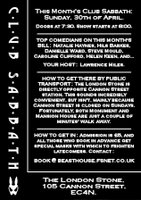
[Click on little images for big images.]
It's a standup comedy club night in a London pub, organised and compèred by my one-time editor and occasional collaborator Lawrence Miles.
[Edit to add:]
The pub is The London Stone 105 Cannon Street EC4N, which is located just opposite Cannon Street station -- although the nearest stations actually open on a Sunday are Monument and Mansion House, apparently.
(The pub seems to be named after an actual London Stone, which I'd never heard of before. It shows signs of being a goth pub -- or, even more worryingly, a wannabe-goth pub -- but that shouldn't affect the quality of the comedy one way or the other. Decent beer doesn't look noticeably likely.)
It's happening next Sunday evening, 30 April. Doors open at 7:30 (although quite how that works in the context of a pub I'm not too sure), and the comedy begins at 8. Price on the doors is £5, although it's been widely rumoured that anyone bringing a remote-control Dalek will get in at half price.
Lawrence's sense of humour is weird, eclectic and borderline psychotic, and the guest comedians -- Natalie Haynes, Hils Barker, Danielle Ward, Steve Mould, Caroline Clifford and Helen Keen -- seem to be well thought of. I've heard Ward on the radio, anyway, and she's certainly very funny. So it should be good for a laugh.
I'll be there, at least.
19 April 2006
Increase Your Mirth by 20%
Like Peculiar Times, Spamusement seems to have entered something of a lull recently.
I thought of this because one of the most ubiquitous pieces of junk email that I've been getting recently persists in informing me that "Ratess will skyrocket soon".
I wonder when it's going to happen? I imagine her sitting in her little cockpit, tiny flying-goggles on her furry face, as she courageously faces her pioneering destiny.
Profound Apologies...
...for leaving this blog so long between updates at the moment. Life has been getting overly manic, what with two short fiction projects (which I'll tell you about once they're announced) due in at the end of next month. I'm quite pleased with what's come out of my head so far, but I'm not progressing as fast as I'd wish, and the two-week Easter break was altogether a bit of a panic.
I'm not going to get any more chatty in the short term, I'm afraid, but once those stories (and, with luck, the various other things that are busying me so incessantly at present) are out of the way, I should be able to waste your bandwidth with drivelly musings and book reviews once more. I have, at the very least, another good idea for an Invisible City to regale you with.
Sadly, real life (or, more accurately, fiction) will also be getting in the way of updating last year's Doctor Who viewing blog, Parrinium Mines, with my opinions on this year's series... at least for the moment. I'm still hoping I can come back to them later in the year, reviewing The Christmas Invasion through to Doomsday in time for this year's Christmas special. (I'm afraid my thoughts on The Christmas Invasion and New Earth are not entirely complimentary, but with any luck that will change as the season progresses and, erm, K-9 returns. Yes, that's probably likely.) I've also been watching, for research purposes, more episodes of very early Doctor Who than the human brain was designed to withstand, so hopefully I can also update those of you who choose to read Parrinium Mines on those at some stage.
Meanwhile I'm not getting a lot of time to read, but About Time 1 and The Dream Archipelago are keeping me entertained between them. And Season 5 of Buffy, while messy and overplotted, still makes me cry at the end, even though I've seen it four or five times already.
More anon. But, you know, possibly not very anon.
05 April 2006
Scribonia
Scribonia, known to poets as the Tattooed City, is indistinguishable in most respects from any other provincial city. It has its business and its retail districts, its blocks of flats and townhouses, churches and mosques, its libraries and City Hall, in which its citizens talk and shop and sleep and go about their business. Examining the city from the air, or from a satellite, one would perceive little of note.
Close up, however, is a different story. For every building of Scribonia – each wall and windowsill, each slate and steeple – is covered with writing. Loops and curlicues and upstrokes smother every shopfront, every station and tenement. Fountains and statuary, pavements and rooftops: each surface, from the bridges’ lowest foundations to the steeple of the tallest church, is etched with curled, reticulated characters – the arcane alphabet used only by Scribonia’s Guild of Graffitists.
Scribonia’s public services department tries its best, but even with some thousands of the population in its direct employ, scrubbing and cleaning at the bricks and flagstones every day, they cannot keep pace with the assiduous encroachments of the Guild.
Nobody knows who runs the Guild, or if it even exists. Everyone assumes that the artful vandalism must be co-ordinated: the only sane alternative is that every citizen, municipal cleaners included, secretly carries around a can of paint or marker pen to fill in any gaps they find in the all-pervading script. It may be that – as one dissident politician has concluded – the city itself is generating the inscriptions, dreaming the writing into existence every night through the subconscious workings of its fevered citizens.
Nonetheless, many Scribonians yearn to join the hypothetical Guild, and aspiring graffitists often overlay the dense designs with their own crude scrawlings.
Others – the majority – have become obsessed with understanding what the graffiti says. Its alphabet bears no resemblance to any others known: and yet its students have detected patterns, repetition, dialogue – even the work of individual hands. Many have tried to learn the language: if any have succeeded, they do not acknowledge the fact. It may be that success confers de facto membership of the Guild, with all the burden of secrecy that implies.
One school of interpretation, known as the Esotericists, believes that the graffiti is a blueprint: a detailed description, complete with architectural measurements and outlines, of another city. This city coexists with Scribonia, pervading it in this encoded form. Parts of the written city are demolished daily by the tireless sponges of the scrubbers, yet they can be rebuilt, or new structures created to take their place, with a few flicks of a Guildmember’s pen.
What is this city like? The Esotericists agree that it must be a far more elevated, purer place than grimy, dull Scribonia: a city of pure thought, of inspiration, where style is given life, unhampered by the demands of substance.
One day, they say, this city will not merely deface the present Scribonia: one day, its sheer weight of information will come to overwrite the mundane city, and Scribonia’s dull matter will give way to the immaterial design. A new age of enlightenment will follow, and the citizens will exist in an eternal harmony of intellect.
There will be no place for graffiti then, of course.
--
Visit the Gazetteer of Invisible Cities at Blind Atlas
30 March 2006
Beer Pressure
Had a thoroughly enjoyable time last weekend with Silk and his good lady Kate, who it's very lovely to see back together again after a recent period of dithering. We'd been planning, originally, to go to the Bristol Beer Festival, but unfortunately the tickets sold out in record time months ago. The centrepiece of the weekend was therefore a linear pub crawl from North Bristol back to our house, starting at about 1pm and finishing at 10:30pm because we wanted to get chips on the way home.
Present: self, B., Silk, Kate, my friend Anthony and Kate's friend Vaughn. Ants was with us until 7ish, when he had to return home to Petersfield and his wife and daughter. Vaughn joined us in a pub or two. B.'s stamina failed her at about 8:30 (well, she's been working hard recently), and she took a bus home.
Itinerary of pubs visited:
1. The Hare on the Hill. Very pleasant small pub owned by Bath Ales, whose available varieties we sampled all of between us. I had the S.P.A. Bath are my favourite local brewers' since Smiles went tits-up (of which more anon), and The Hare is one of their four pubs in Bristol, all of which are excellent. They do very nice crisps, too.
2. Micawber's Ale House. A solid traditional pub with some good real ales and musical tastes running oddly to 70s disco. I had a pint of Brains S.A., I think, although at this point I still hadn't had lunch and was getting a bit light-headed. We therefore repaired to...
3. Zerodegrees. Local branch of a chain of two microbreweries-cum-nightclubs (apparently a third is opening in Reading sometime soon), which I've had cause to mention here before. This was included largely for the excellent pizzas, of which we had several. On the beer front I drank the black lager, which is always Mmmmm, and the overly sweet mango beer, which I wasn't nearly drunk enough to enjoy.
4. A diversion to the recently-reopened Smiles Brewery Tap, which was deeply disappointing. Smiles closed down last year and has been bought out by Highgate, who don't seem on the evidence we sampled to be brewing the beers to anything like the same standard. (It's also no longer brewed on the premises, making the pub's name a bit of a misnomer.) They sold us chocolate, though.
5. The Bank. We'd never been here before, but it stood in at the last minute for The Three Sugar Loaves, which was unexpectedly closed. I can't remember what I had to drink -- whatever the guest ale was, I assume, but things were becoming pleasantly fuzzy by this stage. We played dominoes, and listened to Guns'n'Roses singing "Live and Let Die" on the juke box.
6. The Cornubia. One of the major highlights of Bristol's real ale scene. The Cornubia always has half a dozen different real ales on tap, and half of them are generally very obscure. I have no idea what I drank here, but it was bloody good. We ran into some loud refugees from the Beer Festival, and a random Doctor Who author was working behind the bar. Ants left and Vaughn joined us, after a certain amount of getting lost.
7. The Shakespeare. One of no fewer than four pubs of that name in Bristol. (B. and I used to go to pub quizzes at The Shakespeare when we lived nearby, and we occasionally met up for lunch at the daringly-named Ye Shakespeare when we both worked in town. I hadn't heard of The Shakespeare until just now, though.[Edit 31/2/6: No, I'm wrong -- we went there when we went to Glasnost one time. I hadn't realised that was what it was called, but under the circumstances I should probably have expected it. Anyway...]) The one in Prince Street has a banner outside boasting of its real ales, and does indeed do some very nice ones. Reconstructing my probable state of mind at the time, I imagine I had the Greene King I.P.A., but I can't swear to it. I remember crisps, though. Vaughn and B. both left us after this one. Personally I was impressed that any of us had lasted this long.
8. The Coronation. One of our two locals, in the sense that it's within reasonable walking distance of us and we go there sometimes. (They do a free cheeseboard on a Sunday.) Owned by Hop Back, and selling a fine selection of their splendid beers. Again, I forget what I had -- possibly the Odyssey. Distressingly, though, they'd stopped doing food.
9. The Tobacco Factory. Our other kind-of-local, and our last stop before the chip shop. They sell Bristol Beer Factory beers, which are very tasty. I drank the Red, which for some reasons isn't listed on the website, but is my favourite of their beers.
By this point I was feeling extremely hungry, so we bought chips and pasties, came home and watched as many episodes of series one of Look Around You as we could before we fell over.
We followed this up on Sunday with a relatively tame trip to The Boston Tea Party and Bristol City Museum.
Present: self, B., Silk, Kate, my friend Anthony and Kate's friend Vaughn. Ants was with us until 7ish, when he had to return home to Petersfield and his wife and daughter. Vaughn joined us in a pub or two. B.'s stamina failed her at about 8:30 (well, she's been working hard recently), and she took a bus home.
Itinerary of pubs visited:
1. The Hare on the Hill. Very pleasant small pub owned by Bath Ales, whose available varieties we sampled all of between us. I had the S.P.A. Bath are my favourite local brewers' since Smiles went tits-up (of which more anon), and The Hare is one of their four pubs in Bristol, all of which are excellent. They do very nice crisps, too.
2. Micawber's Ale House. A solid traditional pub with some good real ales and musical tastes running oddly to 70s disco. I had a pint of Brains S.A., I think, although at this point I still hadn't had lunch and was getting a bit light-headed. We therefore repaired to...
3. Zerodegrees. Local branch of a chain of two microbreweries-cum-nightclubs (apparently a third is opening in Reading sometime soon), which I've had cause to mention here before. This was included largely for the excellent pizzas, of which we had several. On the beer front I drank the black lager, which is always Mmmmm, and the overly sweet mango beer, which I wasn't nearly drunk enough to enjoy.

4. A diversion to the recently-reopened Smiles Brewery Tap, which was deeply disappointing. Smiles closed down last year and has been bought out by Highgate, who don't seem on the evidence we sampled to be brewing the beers to anything like the same standard. (It's also no longer brewed on the premises, making the pub's name a bit of a misnomer.) They sold us chocolate, though.
5. The Bank. We'd never been here before, but it stood in at the last minute for The Three Sugar Loaves, which was unexpectedly closed. I can't remember what I had to drink -- whatever the guest ale was, I assume, but things were becoming pleasantly fuzzy by this stage. We played dominoes, and listened to Guns'n'Roses singing "Live and Let Die" on the juke box.
6. The Cornubia. One of the major highlights of Bristol's real ale scene. The Cornubia always has half a dozen different real ales on tap, and half of them are generally very obscure. I have no idea what I drank here, but it was bloody good. We ran into some loud refugees from the Beer Festival, and a random Doctor Who author was working behind the bar. Ants left and Vaughn joined us, after a certain amount of getting lost.
7. The Shakespeare. One of no fewer than four pubs of that name in Bristol. (B. and I used to go to pub quizzes at The Shakespeare when we lived nearby, and we occasionally met up for lunch at the daringly-named Ye Shakespeare when we both worked in town. I hadn't heard of The Shakespeare until just now, though.[Edit 31/2/6: No, I'm wrong -- we went there when we went to Glasnost one time. I hadn't realised that was what it was called, but under the circumstances I should probably have expected it. Anyway...]) The one in Prince Street has a banner outside boasting of its real ales, and does indeed do some very nice ones. Reconstructing my probable state of mind at the time, I imagine I had the Greene King I.P.A., but I can't swear to it. I remember crisps, though. Vaughn and B. both left us after this one. Personally I was impressed that any of us had lasted this long.
8. The Coronation. One of our two locals, in the sense that it's within reasonable walking distance of us and we go there sometimes. (They do a free cheeseboard on a Sunday.) Owned by Hop Back, and selling a fine selection of their splendid beers. Again, I forget what I had -- possibly the Odyssey. Distressingly, though, they'd stopped doing food.
9. The Tobacco Factory. Our other kind-of-local, and our last stop before the chip shop. They sell Bristol Beer Factory beers, which are very tasty. I drank the Red, which for some reasons isn't listed on the website, but is my favourite of their beers.
By this point I was feeling extremely hungry, so we bought chips and pasties, came home and watched as many episodes of series one of Look Around You as we could before we fell over.
We followed this up on Sunday with a relatively tame trip to The Boston Tea Party and Bristol City Museum.
24 March 2006
Quickie
Just a brief post, to confirm that I haven't forgotten about this blog's existence. I've got an action-packed (well, pub-packed) weekend in the offing, so I probably won't get time to update it again until next week now.
In the meantime, and following on from the Invisible Cities meme, allow me somewhat belatedly to commend to you the blog of the incredibly gifted Simon Bucher-Jones, complete with songs, poetry and his own entry in that same pseudocartographic canon. Some good people -- nominally including myself -- are also attempting to collect, index and create material of this general ilk at Blind Atlas. There should be more exciting stuff arriving there at some point soon.
In the meantime, and following on from the Invisible Cities meme, allow me somewhat belatedly to commend to you the blog of the incredibly gifted Simon Bucher-Jones, complete with songs, poetry and his own entry in that same pseudocartographic canon. Some good people -- nominally including myself -- are also attempting to collect, index and create material of this general ilk at Blind Atlas. There should be more exciting stuff arriving there at some point soon.
15 March 2006
Luton Beds England
...So how many U.K. county abbreviations are also verbs? I can think of Bedforshire (see above), Wiltshire ("Swindon Wilts"), Huntingdonshire ("Ramsey Hunts"), Buckinghamshire ("Aylesbury Bucks") and I suppose Staffordshire (er, "Lichfield Staffs"). Including homophones allows for Hertfordshire ("Watford Herts"), Lincolnshire ("Boston Lincs") and, just possibly, Worcestershire ("Malvern Worcs") and Warwickshire ("Kirsty Kingsbury Warks").
Yorkshire only counts if you believe The Meaning of Liff ("Jasmine yorked politely, loathing him to the depths of her being"), which is obviously cheating.
It's only the shires that even have abbreviations, isn't it? Except that I think Glamorgan may be "Glam". Ironically.
I'm ashamed to say that there are entire counties in Scotland I've never even heard of. They made Kincardineshire up, surely?
I'm really tired.
13 March 2006
Masks and Machines
I've made a smallish update to the website today, adding to the A Life Worth Living pages my rejected story submissions for Big Finish's most recent follow-up volume, Something Changed. There are plot spoilers for the book, but as it's been out a while now I'm assuming that that shouldn't be a huge problem for anybody, given the appropriate amount of warning.
While I fully respect the editor Simon Guerrier's judgement about which submissions were going to fit into the volume and which wouldn't, I do feel slightly wistful reading these again, as any of the three would have been huge fun to write. Ah, well.
You can read the first chapter of Something Changed online at the Big Finish site.
B. and I went to see Neil Gaiman and Dave McKean's stunning Mirrormask at the Watershed on Saturday. It's a mindblowingly good film -- if you've ever marvelled at the visual texture and general bloody weirdness of McKean's art, then seeing it translated into a fully realised animated world with actors walking around in it is unmissable. Gaiman's schizoid fairy-tale of a script was equally magnificent, although I'm not entirely sure about the ending.
[SPOILERS follow -- highlight the whitespace to read:]
During her time in the otherworld, Helena has been watching the Shadow Princess living her life for her: arguing with her father, dating unsuitable boys, burning her artwork and generally acting out. Helena's trapped sensation as she gazes out at this, helpless to intervene, is a powerful metaphor for the the tiny trace of rationality left in our psyches during our years of hormone-fuelled teenage excess -- which in Helena's case we know to be exacerbated by her mother's illness.
Unfortunately, the metaphor is de-clawed, and the plot rendered somewhat nonsensical, by the revelation at the end that only a night has passed while Helena has been in the otherworld, and that her mother is recovering fine from her operation. I couldn't help feeling that a more fitting, more emotionally honest and generally more Gaimanesque ending would have had Helena returning to a world where her mother's operation had been a failure, and where the Princess's actions had consequences for Helena to deal with.
[SPOILERS finish.]
Still a marvellous film, though, and one I'd recommend to more or less everybody likely to be reading this.
Subscribe to:
Posts (Atom)