29 March 2009

Missing [Peculiar] Time[s]

This morning I experienced lost time as a result of a government conspiracy. I'm still optimistic that Gillian Anderson will come into the room at some point and show me her mosquito bites.

It's particularly annoying, though, as I'd been intending to placate you all with a nice long post to make up for my silence during the rest of this month. Now I have to be somewhere else too soon, so sadly it'll have to wait. I'm aware that my pledge to update this blog regularly this year is looking pretty hollow now -- oops.

In the meantime... four teasers for the stuff I should have been blogging about, haven't been and hopefully will be soon.
1. I've read Werewolves in their Youth by Michael Chabon and The Casebook of Carnacki - Ghost Finder by William Hope Hodgson. They're good. I'm also -- cue angel trumpets and hallelujahs -- within 45 pages of finishing Blue shagging Mars.

2. I've been writing a couple of articles for a book about Doctor Who and getting paid for it. More on this once the book in question's been announced.

3. Riding the trough of the wave as always, I've started using Twitter. It's not the hugest time-waster on the web, but like a number of other bloggers I've been finding that my thoughts tend to be more easily entered there in condensed form, rather than elaborated at length here. (In future I'll try to make sure I do both. I may also put a Twitter feed in here, if I can work out how.)

4. Did I mention B. and I are expecting a baby in August? (Er, I may not have done. We are. An actual baby. You know, a human one. With nappies and stuff.) This has been demanding an unpredictably large proportion of my attention of late.
Finally, Obverse Books have now revealed the final cover for Iris Wildthyme and the Celestial Omnibus, and I've updated my website accordingly. You may notice (especially if you've just read the entry below) that the blurb's rather familiar: this is because the editors decided that I'd put it as well as they could, and asked my permission to swipe it for the cover. This means that now I've put the official blurb up, my Iris Wildthyme page and my Celestial Omnibus page inevitably read almost identically to one another. I may have to write something else to go on the first one.

Note "new stories from Paul Magrs, Philip Purser-Hallard and Steve Cole amongst many others", though. Stuart wrote that bit, not me...

25 February 2009

Magnum Omnibus

I've updated my website today with a page about the forthcoming Iris Wildthyme anthology, Iris Wildthyme and the Celestial Omnibus.

This has meant a certain amount of rearrangement of other material, including a new Iris Wildthyme Short Stories page to go with my Bernice Summerfield and Doctor Who ones. I'm rather pleased with the description of Iris I wrote for it:
What is there left to say about Iris Wildthyme –- transtemporal adventuress (and sometime Time Lady) extraordinaire, metafictional explorer of texts and subtexts, double-decker-dwelling interstellar bag-lady, amnesia-prone political and sexual revolutionary, writer of wrongs, wronger of rights (especially copyrights), all-round champion of freedom, occasional nightclub singer and frequent barroom floozy?

Well, there’s always something.
The site now incorporates a preview of the cover art for The Celestial Omnibus by former B.B.C. costume designer June Hudson, and the new Iris Wildthyme logo by Anthony Dry.

I've also updated the F.A.Q., although it duplicates information available elsewhere on the site and I'm now convinced that nobody except me ever reads it, ever. I'll get round to purging it at some point.

Meanwhile, allow me to recommend the Iris Wildthyme season 2 CD boxed set -- three excellent stories (and one reasonably decent one[1]) featuring Katy Manning as Iris and David Benson as Panda, packaged gorgeously in the artwork of the aforementioned Mr Dry[2].

[1] No, of course I'm not going to say which one.
[2] "Mr Dry lived in Dryland. Everything in Dryland was very, very dry. Dry sand -- dry river beds -- even dry books! One day, Mr Dry bought a novel called Wetlands..." Sorry, I've started free-associating now.

20 February 2009

Obverse Gear

You remember -- well, probably you don't, as I was a bit busy to blog much at the time, and only mentioned it once -- that I spent a substantial chunk of December writing a 5,000-word short story for a new anthology? And that I was going to announce it here when the publishers had made their own announcement?

Well...

Obverse Books, a new publishing venture owned by the estimable Stuart Douglas, has just announced the author line-up for its debut anthology Iris Wildthyme and the Celestial Omnibus, featuring -- naturally -- transtemporal heroine and barroom floozy extraordinaire Ms Iris Wildthyme, created by Paul Magrs. The collection includes my short story "Battleship Anathema", along with stories by Faction Paradox authors Mags L Halliday and Jon Dennis, sundry Doctor Who authors and the category-defying Mr Magrs himself.

Iris's history has been a convoluted one, taking in Paul's Phoenix Court series of magic-realist novels, the original Doctor Who novels and short stories which Paul has written, her own series of CD audio drama adventures[1] -- and one previous short story anthology, Wildthyme on Top, published by Big Finish and including my Shakespeare-rewrites-Iain-M-Banks story "Minions of the Moon", of which I'm still absurdly proud.

I'll be creating a Celestial Omnibus web page on my site shortly. For the moment, though, suffice it to say that my story involves Iris trying to revisit the scene of a series of colourful -- indeed, garish -- space-opera adventures she experienced some thirty years ago, but finding that the people and starships she left behind have become strangely drab and gritty during her absence...

[1] As luck would have it, the postman put my copy of the Iris Wildthyme Series 2 CD box set into my hands an hour or so ago. It's a thing of quite remarkable beauty, the intricately detailed Target novel theming of the covers being offset wonderfully by the shocking pink box and vaguely Buffyesque logo. An awful lot of love and care has gone into designing it, and I'm really looking forward to hearing the stories.

17 February 2009

The Archetype Ark

This morning a Facebook application reminded me: "Valentine's Day is just around the corner! Send a cuddly anima".

Clearly the timekeeping processes at work here could do with some attention, but given the existence of fluffy microbes and plush subatomic particles, the idea of cuddly Jungian archetypes seems, in retrospect, almost inevitable.

They'll probably branch out into Freudian psychic apparatus next. Here, stroke my ego.

11 February 2009

66 out of 149 out of 1000

I missed blogging about it at the time, but a few weeks ago The Guardian, ever hungry to add value to their news coverage, started publishing a series of supplements which between them make up a list of recommendations for 1000 Novels Everyone Must Read.

Inevitably the category of this list which most interests me is the rather impressive Science Fiction and Fantasy section. The whole thing's online:
Introduction
Part One
Part Two
Part Three
Sidebar: The Best Dystopias
Sidebar: Radical Reading
Sidebar: Imagined Worlds
Sidebar: The Best Gothic Novels
Sidebar: The Best of JG Ballard
Sidebar: Novels that Predicted the Future
The Full List of 1000
As those sidebar headings make clear, the net's cast fairly wide here, which I approve of -- it's far better that the Guardian's readership be educated to see the continuity between Asimov and Heinlein on the one hand and Rushdie and Self on the other, than that they be encouraged to believe in S.F. as a ghetto literature. It's lovely to see the fantastical and science-fictional elements in such non-genre novels as Cloud Atlas, Ada or Ardor and The Handmaid's Tale embraced in the mainstream press rather than explained away.

Admittedly there are one or two occasions when I think they've been too inclusive -- the authors' other work notwithstanding, it's difficult to see The Wasp Factory or Kavalier and Clay, for example, as fantasy or S.F. -- but I'd far rather that than the alternative. Similarly, I don't agree with all the choices -- in Banks's case again, Consider Phlebas is probably his least good S.F. I'd have preferred a Philip K. Dick Top 3 to a Ballard one and in particular I don't think Do Androids Dream of Electric Sheep? is Dick's best, rather than his best-known, work. (The Man in the High Castle's an excellent choice, mind you.)

Nevertheless, many of the right books and nearly all the right authors are listed, and the selection as a whole gives an excellent overview of the history of the novel in these genres -- in English, at least -- from their origins to the present day. The people who put the list together are literate, knowledgeable, intensely well-read and deeply respectful towards the genres they're writing on. Which of course is entirely as it should be, but still, it isn't altogether the sort of thing we S.F. readers have come to expect.

However, this is the internet, so let's skip over the detailed analytical discussion and dive straight for the tickable booklist. (I presume there are people on the web memeing up the entire list of 1000, but frankly I have too much lust for life.)

I've separated out the sidebar entries and stuck them on at the end (except for the "Novels that Predicted the Future" list, which doesn't seem to count). Books I've read are in bold, books I own are underlined, books I want to get around to reading are italicised and books I have no interest in whatsoever are struckthrough. Is that reductionist enough?
1. Douglas Adams: The Hitchhiker's Guide to the Galaxy (1979)
2. Brian W. Aldiss: Non-Stop (1958)
3. Isaac Asimov: Foundation (1951)
4. Margaret Atwood: The Blind Assassin (2000)
5. Paul Auster: In the Country of Last Things (1987)
6. Iain Banks: The Wasp Factory (1984)
7. Iain M. Banks: Consider Phlebas (1987)
8. Clive Barker: Weaveworld (1987)
9. Nicola Barker: Darkmans (2007)
10. Stephen Baxter: The Time Ships (1995)
11. Greg Bear: Darwin's Radio (1999)
12. Alfred Bester: The Stars My Destination (1956)
13. Poppy Z. Brite: Lost Souls (1992)
14. Algis Budrys: Rogue Moon (1960)
15. Mikhail Bulgakov: The Master and Margarita (1966)
16. Edward Bulwer-Lytton: The Coming Race (1871)
17. Anthony Burgess: A Clockwork Orange (1960)
18. Anthony Burgess: The End of the World News (1982)
19. Edgar Rice Burroughs: A Princess of Mars (1912)
20. William Burroughs: Naked Lunch (1959)
21. Octavia Butler: Kindred (1979)
22. Samuel Butler: Erewhon (1872)
23. Italo Calvino: The Baron in the Trees (1957)
24. Ramsey Campbell: The Influence (1988)
25. Lewis Carroll: Alice's Adventures in Wonderland (1865)
26. Lewis Carroll: Through the Looking-Glass, and What Alice Found There (1871)
27. Angela Carter: Nights at the Circus (1984)
28. Michael Chabon: The Amazing Adventures of Kavalier and Clay (2000)
29. G.K. Chesterton: The Man Who Was Thursday (1908)
30. Arthur C. Clarke: Childhood's End (1953)
31. Susanna Clarke: Jonathan Strange and Mr Norrell (2004)
32. Michael G. Coney: Hello Summer, Goodbye (1975)
33. Douglas Coupland: Girlfriend in a Coma (1998)
34. Mark Danielewski: House of Leaves (2000)
35. Marie Darrieussecq: Pig Tales (1996)
36. Samuel R. Delaney: The Einstein Intersection (1967)
37. Philip K. Dick: Do Androids Dream of Electric Sheep? (1968)
38. Philip K. Dick: The Man in the High Castle (1962)
39. Umberto Eco: Foucault's Pendulum (1988)
40. Michel Faber: Under the Skin (2000)
41. John Fowles: The Magus (1966)
42. Neil Gaiman: American Gods (2001)
43. Alan Garner: Red Shift (1973)
44. William Gibson: Neuromancer (1984)
45. Charlotte Perkins Gilman: Herland (1915)
46. William Golding: Lord of the Flies (1954)
47. Joe Haldeman: The Forever War (1974)
48. M. John Harrison: Light (2002)
49. Robert A. Heinlein: Stranger in a Strange Land (1961)
50. Frank Herbert: Dune (1965)
51. Hermann Hesse: The Glass Bead Game (1943)
52. Russell Hoban: Riddley Walker (1980)
53. James Hogg: The Private Memoirs and Confessions of a Justified Sinner (1824)
54. Michel Houellebecq: Atomised (1998)
55. Aldous Huxley: Brave New World (1932)
56. Kazuo Ishiguro: The Unconsoled (1995)
57. Shirley Jackson: The Haunting of Hill House (1959)
58. Henry James: The Turn of the Screw (1898)
59. P.D. James: The Children of Men (1992)
60. Richard Jefferies: After London; Or, Wild England (1885)
61. Gwyneth Jones: Bold as Love (2001)
62. Franz Kafka: The Trial (1925)
63. Daniel Keyes: Flowers for Algernon (1966) [I own and have read the short story, but this is a list of novels.]
64. Stephen King: The Shining (1977)
65. Marghanita Laski: The Victorian Chaise-Longue (1953)
66. Joseph Sheridan Le Fanu: Uncle Silas (1864)
67. Stanislaw Lem: Solaris (1961)
68. Doris Lessing: Memoirs of a Survivor (1974)
69. David Lindsay: A Voyage to Arcturus (1920)
70. Ken MacLeod: The Night Sessions (2008)
71. Hilary Mantel: Beyond Black (2005)
72. Michael Marshall Smith: Only Forward (1994)
73. Richard Matheson: I Am Legend (1954)
74. Charles Maturin: Melmoth the Wanderer (1820)
75. Patrick McCabe: The Butcher Boy (1992)
76. Cormac McCarthy: The Road (2006)
77. Jed Mercurio: Ascent (2007)
78. China Miéville: The Scar (2002)
79. Andrew Miller: Ingenious Pain (1997)
80. Walter M. Miller Jr: A Canticle for Leibowitz (1960)
81. David Mitchell: Cloud Atlas (2004)
82. Michael Moorcock: Mother London (1988)
83. William Morris: News From Nowhere (1890)
84. Toni Morrison: Beloved (1987)
85. Haruki Murakami: The Wind-up Bird Chronicle (1995)
86. Vladimir Nabokov: Ada or Ardor (1969)
87. Audrey Niffenegger: The Time Traveler's Wife (2003)
88. Larry Niven: Ringworld (1970) [Not entirely sure I own this one -- if I do, it's in the loft.]
89. Jeff Noon: Vurt (1993)
90. Flann O'Brien: The Third Policeman (1967)
91. Ben Okri: The Famished Road (1991)
92. Chuck Palahniuk: Fight Club (1996)
93. Thomas Love Peacock: Nightmare Abbey (1818)
94. Mervyn Peake: Titus Groan (1946)
95. John Cowper Powys: A Glastonbury Romance (1932) [I sincerely tried -- it's just so huge...]
96. Christopher Priest: The Prestige (1995)
97. François Rabelais: Gargantua and Pantagruel (1532-34)
98. Ann Radcliffe: The Mysteries of Udolpho (1794)
99. Alastair Reynolds: Revelation Space (2000)
100. Kim Stanley Robinson: The Years of Rice and Salt (2002)
101. JK Rowling: Harry Potter and the Philosopher's Stone (1997) [My wife owns this one, but I disown it.]
102. Salman Rushdie: The Satanic Verses (1988)
103. Antoine de Sainte-Exupéry: The Little Prince (1943)
104. José Saramago: Blindness (1995)
105. Will Self: How the Dead Live (2000)
106. Mary Shelley: Frankenstein (1818)
107. Dan Simmons: Hyperion (1989)
108. Olaf Stapledon: Star Maker (1937)
109. Neal Stephenson: Snow Crash (1992)
110. Robert Louis Stevenson: Strange Case of Doctor Jekyll and Mr Hyde (1886)
111. Bram Stoker: Dracula (1897)
112. Rupert Thomson: The Insult (1996)
113. Mark Twain: A Connecticut Yankee at King Arthur's Court (1889)
114. Kurt Vonnegut: Sirens of Titan (1959)
115. Robert Walser: Institute Benjamenta (1909)
116. Sylvia Townsend Warner: Lolly Willowes (1926)
117. Sarah Waters: Affinity (1999)
118. H.G. Wells: The Time Machine (1895)
119. H.G. Wells: The War of the Worlds (1898)
120. T.H. White: The Sword in the Stone (1938)
121. Gene Wolfe: The Book of the New Sun (1980-83)
122. John Wyndham: Day of the Triffids (1951)
123. John Wyndham: The Midwich Cuckoos (1957)
124. Yevgeny Zamyatin: We (1924)

125. George Orwell: Nineteen Eighty-Four (1949) [Yes, they did get the title right.]
126. Ray Bradbury: Fahrenheit 451 (1953)
127. Frederik Pohl and C.M. Kornbluth: The Space Merchants (1953)
128. Angus Wilson: The Old Men at the Zoo (1961)
129. Thomas M. Disch: Camp Concentration (1968)
130. Margaret Atwood: The Handmaid's Tale (1985)
131. Joanna Russ: The Female Man (1975)

132. Virginia Woolf: Orlando (1928)
133. Angela Carter: The Passion of New Eve (1977)
134. Ursula K. Le Guin: The Left Hand of Darkness (1969)
135. Geoff Ryman: Air (2005)

136. C.S. Lewis: The Chronicles of Narnia (1950-56)
137. J.R.R. Tolkien: The Hobbit (1937)
138. J.R.R. Tolkien: The Lord of the Rings (1954-55)
139. Philip Pullman: His Dark Materials (1995-2000)
140. Terry Pratchett: The Discworld series (1983- ) [Well, nearly all of them.]
141. Ursula K. Le Guin: The Earthsea series (1968-1990) [Edit to add: I've just realised that I've only read the first trilogy, not the more recent supplemental volumes, so this one might strictly be a "no".]

142. Horace Walpole: The Castle of Otranto (1764)
143. William Beckford: Vathek (1786)
144. M.G. Lewis: The Monk (1796)
145. Nathaniel Hawthorne: The House of the Seven Gables (1851)
146. Charles Brockden Brown: Wieland (1798)

147. J.G. Ballard: The Drowned World (1962)
148. J.G. Ballard: Crash (1973)
149. J.G. Ballard: Millennium People (2003)
Why they stop at 149, I've no idea. (Or maybe I've left one off -- do feel freel to check.) Never mind.

By my count I've read 66, which comes to a moderately respectable 45%. What about you?

06 February 2009

Recent Products of My Brain

Forecast, adj.: Having a bifurcated bottom (cf fork-tongued).

Pillowcase, n.: The enzyme responsible for digesting pillocks.

A: I just found my wife hiding behind an evergreen oriental shrub.
B: Japonica?
A: Well, something must have.

[Edit 7-2-9 to add:]

A: I think my wife's joined a Japanese organised crime syndicate.
B: Yakuza?
A: No, I wouldn't dare.

04 February 2009

More Books, More Spooks

The Servants by M. M. Smith is a rather different offering from the author's previous books as Michael Marshall and Michael Marshall Smith -- some of which I've discussed here in the past.

It has the same core premise as Only Forward and Spares (and to some extent One of Us), of a solidified subconscious realm where the protagonist's psychological issues are worked out through surreally allusive imagery. Unlike those stories, however (and even despite the fact that it's set in Brighton, like certain key scenes in Only Forward), it's a tighter, more disciplined work. It eschews the genre-bending, heavily cyberpunctuated S.F. setting of those books for a mundane, though compelling, narrative of difficult family dynamics seen through the eyes of a painfully alienated present-day eleven-year-old.

If it wasn't quite so dark, and so demanding of emotional maturity from its readers, this could even be a "Young Adult" book. As it is, it seems to have most often been described as a ghost story. It's not, or not really -- there's no sense that the titular servants (who are sometimes to be found hard at work in the otherwise empty and long-abandoned basement area of Mark's stepfather's Brighton-seafront house) are the surviving spirits of the dead. Rather, they're a function either of Mark's subconscious or of the house itself -- or, this being a work of symbolism, of both. The Servants places us firmly inside Mark's head, and forces us for much of the time to see his well-meaning though sorely tried stepfather as the monster Mark needs to believe he is. The reconciliation between them, desperately needed by Mark's sick mother, is achieved only through her son's under-stairs work experience with the eponymous nonexistent domestics.

Although I doubt more than a dozen other people on the internet have read the thing, the story reminded me of nothing so much as David "A Voyage to Arcturus" Lindsay's psychological fantasy The Haunted Woman, where a specific room in a house awakens the higher consciousnesses of otherwise mundane human beings, whose everyday selves are tragically incapable of retaining the enlightenment they receive there.

Peculiarly enough -- and I swear I'd forgotten this until this moment -- that book was also set partly in Brighton, and features a major character named Marshall.

The Servants is shorter than Smith's other books and more focussed, inspired by a humanistic (I might almost be tempted to say "christian") view of the value of vocation and of losing oneself in service to another. It's a very effective demonstration of his paradoxical versatility as a writer.

Andrew Cartmel's Prisoner novel, Miss Freedom (no Amazon link, for reasons elucidated here) is a decent enough Prisoner story, but -- for all its aspirations to be "a classic 1960s-style spy novel, in the tradition of John Le Carré, Adam Hall and Len Deighton" -- little more than that. It certainly hasn't the intellectual pyrotechnics to match Jon Blum and Rupert Booth's The Prisoner's Dilemma. Dilemma had a real sense of urgency about it, of having something important to impart which could only be told as part of a Prisoner story; by comparison Miss Freedom is... not lazy exactly, but certainly languid.

There's certainly much that's taken directly from the seventeen TV episodes -- Number 6 faces a clinically insane Number 2 (Hammer into Anvil) and a beautiful woman of ambivalent loyalties (The Chimes of Big Ben and passim), who place him in a subsidiary reality (A, B and C, Living in Harmony) where he's encouraged to tell a spy story with himself as the central character (The Girl Who Was Death), etc etc etc. Such elements as might seem newish (there's a rescue mission afoot to spring Number 6 from the Village, and the ousted Number 2 was actually on his side) are actually ringing the changes on these established elements.

Cartmel clearly knows his Prisoner, but most of his story is essentially pastiche -- well-written and perfectly competent pastiche, but unambitious. The most interesting thing, perhaps, is the way Number 6 redrafts his spy story as he's telling it, constantly revisiting earlier story elements and rewriting them. The fact that his fiction comes dangerously close to overlapping his reality might indeed suggest -- again, not exactly a new idea to the Prisoner aficionado -- that the Village itself is the product of Number 6's shellshocked fantasies.

Cartmel's biggest innovation, though, is in making his psychotic New Number 2 a sexually-motivated serial killer, which makes for some deeply uncomfortable moments. Given that a criticism frequently levelled against Cartmel's previous fiction has been his willingness to play the "violence against women" card, I might almost have found this creepy, if there hadn't been some evidence that he was attempting to address this tendency with a degree of complexity on a thematic level.

Basically, though... with this one, you're not really missing much. I feel less guilty about picking up one of the only 100 copies in existence, now.

On the Fly

The other day at work I was strolling along the top-floor corridor towards the Gents', texting my other half as I went. When I arrived at the urinal, I found my flies already undone.

It's possible, of course, that I hadn't zipped up again after a previous visit. That would be embarrassing, but only mildly so. We all do it occasionally, after all.

What bothers me far more is the possibility that whilst wandering along the corridor past colleagues of varying seniority, contentrating on pressing buttons on my phone but subliminally aware that I was heading for the lavatory, I might have absent-mindedly unzipped as I walked, to save time later.

30 January 2009

Holland Takes On Norway

I've had a frustratingly unproductive week -- I've only produced only about 700 words of a sample chapter. The rest of the time I've been waiting in for building contractors, journeying fruitlessly into town and arsing around on the internet. Not a good set of outcomes, although the 700-odd words do seem to me to be rather good ones.

Meanwhile, I've finished two books written (presumably rather faster) by other people, both of which I've been meaning to blog upon. I've probably only got time for one now, so I'll pick Millennium: the End of the World and the Forging of Christendom by Tom Holland.

Like its predecessors, Rubicon: The Triumph and Tragedy of the Roman Republic and Persian Fire: The First World Empire and the Battle for the West (both of which I wrote a little about here), it's a chatty, pacy, well-written narrative of a turning-point in western history. If you want a clear sense of the turmoil in European thought of the 9th to 11th centuries which led to the eventual revolutionary idea of the separation of Church and State, this would be the book to read.

Unfortunately, that wasn't really what I was after. What I most admire in Holland's work is the way he makes cultures which are radically foreign to any modern worldview seem familiar and sympathetic, and in this book the distance wasn't really there to start off with. Our western Anglophone culture is of course post-Hellenic and post-Roman in the same way as it's post-Christian... but it was christian an awful lot more recently than it was either of those other things. The machinations of kings, popes, knights and even emperors (of the "Holy Roman" variety, at least) seem rather banal and mundane, in a way which even republican Rome, despite its familiarity, never does.

Inevitably perhaps, my favourite parts of the book are those which deal with the borders of christendom -- the Islamic Caliphates (whose appearances are sadly brief) and heathen-turning-christian Viking nations. Somehow the Vikings -- who are almost certainly prominent among my actual ancestors -- seem "alien" in that ancient-history way, whereas their contemporaries of the Romance and Saxon cultures simply don't. This despite the fact that the contemporary history of Britain at the time (which Holland fortunately covers extensively) is largely a power-struggle between different Viking factions for control of these islands.

As Holland points out, the Normans (who were of course of Viking descent, "Norman" being a rather unconvincing romanisation of "Norseman") didn't conquer an England that was still ruled over by Saxons: both Harold Godwinson and Edward the Confessor had Viking mothers, and had in any case inherited the throne from a bunch of Norwegians. The last King of England of pure Anglo-Saxon heritage (which is to say, of course, that he was descended from an ethnically slightly different bunch of Odin-worshippers) was the ill-remembered Edmund Ironside, who died a full 50 years before the Conquest.

The Viking stuff was fascinating, and brought home to me the extent of their cultural influence -- which extended from Vinland to Kiev, and as far south as Byzantium itself -- in a way I'd never realised before (despite reading Henry Treece's splendid Viking Saga trilogy as a lad). If only someone had been able to unite them so that they stopped spending most of their history chopping one another up with axes, the Vikings could have built an empire spanning the Northern hemisphere from America to Russia -- something which has never been achieved in our history.

(I suspect this may in fact be what Harry Harrison and John Holm were writing about in their own trilogy, beginning with The Hammer and the Cross, none of which I've never read. Certainly it's an occupational hazard of being an S.F. writer that reading actual history always diverts one into alternatives.)

Unfortunately, the Viking material accounts for barely a third of the book, the rest being taken up by the aforementioned pope-jockeying. There's a certain amount of entertainment to be had from the shocking corruption, quick succession and occasional startling simultaneity of the contemporary popes, but it palls quickly.

Holland has also developed an irritating verbal tic which I didn't notice in either of his previous books: the construction "[X amount of time] later, and [Y event happened]" is repeated on average once a page, and the repetition of all those needless "and"s quickly becomes tiresome. A canny editor could have cut nearly half a thousand words just by excising them. If I'd been more involved in the narrative I'm sure I wouldn't have noticed it -- indeed, it's entirely possible that this is what happened with Rubicon and Persian Fire. Ah well.

I did at least learn that the Olympic year of 2012 will be the 1100th anniversary of Queen Elizabeth II's great-to-the-32nd-grandfather converting to christianity from the worship of Odin One-Eye, All-Father, Victory-Bringer, Master of Ravens and Wolf of Battle, the Hanged God. Which is nice.

Vikings are cool. Fact.

28 January 2009

When I Survey...

I know that at least some of you have enjoyed the theoretically regular monthly columns on science fiction and faith which I've been writing for Christian Aid's webzine, Surefish, over the past couple of years.

At present new material from Surefish, including my column and those of various pals of mine, is on hold while Christian Aid considers the future of Surefish's authored content... the (perfectly reasonable) question being the extent to which commissioning said content serves the charity's ends, at a time when public giving to charities in general is inevitably in retreat.

As part of this review there's a reader survey currently in progress, inviting the opinions of regular readers on the material they read at the website. Without in any way wishing to skew the results of the survey, I would urge those of you who have been reading the site (even if it's just my column) just to pop across and register the fact. There may even be Divine chocolate in it for you.

Of course it would be unconscionable of me not to point out that this exercise, whatever its personal implications, is inestimably less important than Christian Aid's non-partisan, humanitarian Gaza Crisis Appeal, to which I naturally encourage you to give whatever money you might feel able to spare.

I don't believe in pressuring or guilt-tripping my readers, though, so follow the dictates of your conscience on that one. Just remember that a fairy dies every time you don't fill in that survey.

25 January 2009

The Post with No Name

All names have meanings, at least originally. (Admittedly some of them mostly mean "Look how stupid my parents are.")

"Philip Alexander Purser-Hallard", for instance, means "Lover of Horses, Saviour of Men, Steward, Steward" in Greek, Anglo-Norman and Anglo-Saxon[1]. Even in English, a good many names are more transparent than that, as both Heath Ledger and River Phoenix could attest if they didn't have that other thing in common.

In some cultures, personal names routinely have entirely transparent meanings, so that the most common Chinese surnames mean things like "Fruit", "King" and "Willow Tree". Generally, however, when people have transparent names, we refer to them by the same sounds they use when speaking their own language, rather than attempting to translate them.

The major exception to this, bizarrely enough, would appear to be members of the Lakota tribes of Native North Americans, such as Sitting Bull, Crazy Horse, Red Cloud et al, all of whose names sound -- unless you have a problem with "foreign" words per se -- perfectly reasonable in Lakota.

The other borderline instances -- that I can think of, at least -- are fictional Chinese women, such as Rupert Bear's friend Tiger Lily (who may in any case be named after Peter Pan's friend Tiger Lily, who is -- very broadly speaking -- a Native American). There's a walk-on Hong Kong masseuse in Die Another Day who's named Peaceful Fountains of Desire, but that seems to be a throwaway racist / sexist joke for the old-guard Bond fans. In any case, the intention is to make the exotic seem less threatening (and therefore fit for childhood companionship and / or shagging) by familiarising it.

Sitting Bull and co I'm less sure about. Is the idea that people who name themselves after everyday objects must be inherently more primitive than people with perfectly sensible names like, say, Earp or Custer? The practice doesn't seem to extend even to other Native American tribes, so I'm guessing it's something very specific about the Lakota's interaction with Anglophone settlers.

I wonder whether a history of North American colonisation written in, say, Spanish would talk about "Tatanka Iyotanka" or "Toro Sentado"[2]?
[1] Actually, I'm not altogether sure what "Hallard" means. This site gives two entirely different etymologies, but family tradition tends to go with the first one, "hall-ward" -- supposedly meaning something along the lines of a butler or estates manager. Although it could equally mean the bloke who guarded the door, I'm amused by the idea that it means essentially the same as B.'s original surname of "Purser".
[2] Any linguistic solecisms are my own. [Edit: And actually, a quick google would have given me my answer there.]

23 January 2009

Miss Freedom? Yes, you probably have.

Ah. OK. I was going to point out, further to this post from the other day about the death of Patrick McGoohan, that I've actually discovered the second of the Prisoner novels published by Powys Media, Miss Freedom by former Doctor Who scriptwriter and novelist Andrew Cartmel, available at a not particularly steep price just over here.

But, as you can see, it isn't.

Which is a bit disconcerting, because I ordered one as recently as Monday, and now have it quite literally in my possession. It's number 70 of a limited edition run of 100 and is personally autographed, apparently by one "Ann Cxl".

So, er, yes... it looks as if I may have picked up the last one, in fact.

It's a lot shorter than The Prisoner's Dilemma -- just under half the page count, at the same font size -- and I've no idea about the quality, because I haven't read it yet. But it definitely exists, and some of Cartmel's other work (The Wise and Foreign Devils particularly) has been very good. Miss Freedom claims to be a 1960s-style spy thriller "in the tradition of John Le Carre, Adam Hall and Len Deighton". All in all I'm rather looking forward to it.

So, as I was going to say, if you're a Prisoner fan and want to join the elite group of Prisoner fans who actually own the thing...

...erm, you can't. But I have. Sorry about that.

No Really, Some of My Best Friends Are Human

Clicking idly along a string of links from a friend's LiveJournal brought me to the "Are You a Humanist?" quiz at the British Humanist Association website.

Now, it's possible I'm reading too much into a harmless piece of fun on the internet. But the notes do state that the quiz is "a more or less serious set of questions designed to help you think about whether you are committed to a religious view of the world, and how this affects your moral beliefs," so I feel entitled to be equally "more or less serious" in investigating its assumptions.

Although the quiz is of the "which of these statements do you agree with?" type, the introductory spiel does specify that you're allowed to choose as many answers as apply. That being the case I actually get twenty answers from the ten questions, but never mind. While I get three or four each of the As, Bs and Cs, I end up with nine Ds -- and it would have been a full 10 if question 3 hadn't appended a stunningly mendacious question-begging rider to the end of that option ("How did the Universe begin? D. The scientific explanations are the best ones available -- no gods were involved.").

Since the Ds are clearly the desirable answers, why doesn't this make me a humanist? According to the interpretive notes, "Humanists don't agree about everything, and you may have collected some other answers too, though if they include As and Bs you’re unlikely to be a humanist."

Well, possibly. It's clear that some of the As ("I can tell right from wrong by... A. reading a holy book or listening to a religious leader") are supposed to be expressive of an uncompromisingly fundamentalist position (so much so, in fact, that it's obvious the quiz compiler has never bothered actually listening to any religious people, but instead has been conversing with a tiny straw man they carry round in their pocket for the purpose). Others, however ("Animals should be treated... A. with respect because they are part of God' s creation"), are ones from which even the most liberal of christians could hardly withhold their assent. (Admittedly I also agree with both the C and D options there, albeit I wouldn't claim C as a philosophical position.)

It's clear enough that the quiz is designed to distinguish between humanists and people "committed to a religious view of the world" -- the elephant in the room being the assumption that these two philosophies are incompatible. Said assumption being in turn, and with all due respect to the B.H.A. and the invaluable social service they provide in the form of, for instance, funeral services for families of a non-religious persuasion, a quivering pile of bollocks.

The fundamentals of humanism -- which emerged as an essentially christian movement during the Renaissance -- are the value and dignity of human life, and the centrality of human freedom and aspirations to the decisions we make about the present and future. I mean, surely. Aren't they?

All of which are things I believe absolutely, based on my religious faith. I'm also very happy to get behind the B.H.A.'s "Vision" of "A world without religious privilege or discrimination, where people are free to live good lives on the basis of reason, experience and shared human values." Honestly, how could I not?

You see, that thing about humanity being created in God's image (see question 8, where it seems the strongest argument the B.H.A. can muster in response is the frankly feeble "Other people matter and should be treated with respect because... D. we will all be happier if we treat each other well")... it's not an anomaly, or a concession, or a platitude. It's the absolute bedrock of anything I'd recognise as christianity.

Christian humanism is a vibrant and fertile philosophical tradition in its own right, as even Wikipedia seems to be aware. (Hell, even the B.H.A. website itself acknowledges that such thinking has existed.) So why does the B.H.A. elect to define humanists as "atheists and agnostics who make sense of the world using reason, experience and shared human values"? Why not just people who do that, for God's sake? Or for Allah's sake, or the Buddha's, or for the sake of our common humanity, or for the sake of future generations or of society or...

...well, for pity's sake, basically. If the B.H.A. are honestly committed to "A world without religious privilege or discrimination," why do they actively exclude the large numbers of people whose humanism derives from, or walks hand-in-hand with, a religious faith? Can it really be sheer prejudice?

Or do they really want to be the British Atheist Foundation? Because, honestly, I wouldn't have a problem with that, if they had the nerve. Meanwhile, they're co-opting a word I've used for years to describe myself, and telling me I'm not allowed it any more. And that pisses me off.

15 January 2009

It's Your Funeral

Then he must no longer be referred to as Number 6, or a number of any kind. He has gloriously vindicated the right of the invididual to be individual, and this assembly rises to you... sir.

The President, Fall Out

The Prisoner is the only television programme in existence which inspires me to anywhere near the same degree of fannishness as Doctor Who.

My friend Anthony and I discovered it late -- some 25 years after its first broadcast, in fact -- during what must have been September of 1992. We tuned into Channel 4's late-night repeat of Arrival one Sunday evening, and were inspired at once by the surreal imagery, the Kafkaesque worldview and the complex, demanding plotting.

That term, Ants and I pressed various of our university comtemporaries into watching the programme with us every Sunday. At one point we attended a fancy dress party as Numbers 2 and 6, employing among other props a college scarf, cunningly modified with white cloth tape. (We even performed the opening dialogue once we'd drunk enough, although unfortunately that was also enough that Number 6 -- and for discretion's sake I won't specify which of us that was -- forgot his iconic final line.)

My 21st birthday was that term, and Ants got me Alain Carrazé and Hélène Oswald's The Prisoner: A Television Masterpiece. The inscription inside reads "Dear Phil, Congratulations on reaching Number 21". I can't remember what I got him.

We both remained addicted to the repeats through Christmas and into the New Year. I remember viewing the unbearably tense and intimate penultimate episode, Once Upon a Time, at a student flat of some friends early that January, and -- after it had ended on the series' only cliffhanger ("What do you desire?" "Number One." "I'll take you.") -- revealing nonchalantly that waiting in agonised anticipation for the next episode wouldn't be necessary, because I'd rented Fall Out from a video shop on the way round. (It was somewhere around 12:30am by then, but that's students for you.)

And it was Patrick McGoohan who made me do it.

Not single-handedly, of course -- but as the series' co-creator, producer, occasional director, writer of four keystone episodes and, of course, the actor playing the near-ubiquitous central character, he naturally had rather a lot to do with it.

By all accounts he was an awkward, cantankerous sod, and a swine to work with -- a fact he was well aware of, as his adoption of the nom-de-plume "Paddy Fitz" (ie "Irish Bastard") for his scriptwriting makes perfectly clear. The contributions of other participants to The Prisoner -- especially the less obviously visible ones like George Markstein -- are often underestimated, and McGoohan's reluctance to talk about the project since it finished has certainly added to the mystique surrounding his involvement. It's clear, however, that insofar as anyone can ever be an auteur in a collaborative medium like TV, McGoohan was one.

My love for The Prisoner has never diminished. There may be only seventeen episodes, but I must have watched each of them a dozen or so times (yes, even Do Not Forsake Me Oh My Darling), and I’ve watched the whole thing through in one sitting on at least four separate occasions. (That's certainly more than I’ve managed with the 752 episodes of Doctor Who.)

I've also read the three 1960s tie-in novels (Thomas M Disch's very fine I Am Not a Number! is really the only one worth bothering with), the 1980s graphic novel and the first (and only, to date) of the paperback tie-in novels published by Powys Media, Jon Blum and Rupert Booth's The Prisoner's Dilemma. (Jon has his own tribute to McGoohan at his LiveJournal.)

At one point I was even in with a chance of writing one of the Powys books myself; but the series seems by all appearances to be on indefinite hold, and quite possibly as dead as a dimetrodon. Island in the Ashes would have been an uncharacteristically sombre post-apocalyptic story, taking as its starting-point a nuclear war in the outside world, which the Village survives by virtue of its remoteness. Prisoners and warders would be forced to co-operate in order to build a viable community, and Number 6 would face the choice of collaborating or depriving the survivors of his indispensable talents. It would have tried him severely.

Whether McGoohan would have liked it, I don't know. As Jon suggests, though, that's not really the point.

In many ways, McGoohan's death isn't a sad one. He was 80 years old, a great-grandfather, a talented professional whose one towering achievement, long ago though it was, remains as a lasting monument to him. His retirement from acting, and his disinclination to discuss the one part of his life people were interested in, mean that his passing will have little appreciable impact on the world beyond his family and friends.

But... well. One of The Prisoner's great strengths is that the superficial message of the episodes isn't always the true one. Take Number 6's individualism, for instance.

However much he may insist that his life is his own, that he can live isolated from the Village and the world, a true individual in survivalist style, 6 is always shown suffering in the absence of human contact. He always returns to society, to the Village. And when he finally escapes -- if indeed he ever does -- it's in the company of friends.

He may not be a number, just one indistinguishable statistic in a crowd... but he's no island either. However much he may wish otherwise, he's part of humanity, and his humanity is part of him.

No man is an island, entire of itself; every man is a piece of the continent, a part of the main. If a clod be washed away by the sea, Europe is the less, as well as if promontory were, as well as if a manor of thy friend's or of thine own were. Any man's death diminishes me, because I am involved in mankind; and therefore never send to know for whom the bell tolls; it tolls for thee.
John Donne, Meditation XVII

The alternative to tyranny is not individualism: the alternative to authority is community.

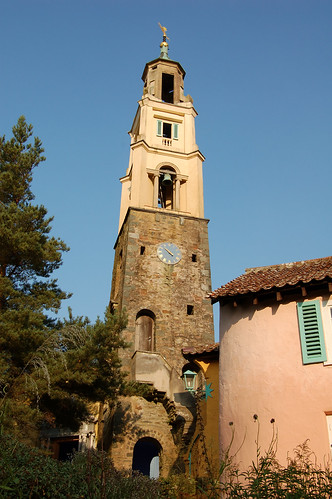
The bell on the campanile's tolling now. And I'm mourning the passing of Patrick McGoohan.

Today's Other News

Humanity may not be alone in the universe (Telegraph).
Kate Winslet has nice breasts (Guardian).

Ms Winslet's undeniably well-proportioned, but I'm not sure the same can be said about the Guardian's news coverage.

12 January 2009

Fun with Sentences

Some educationalists criticised the programme [Teletubbies] for encouraging young children to mimic the infantile sounds of its characters and Christian leaders in the US, who claimed that one of its characters, Tinky Winky, was gay.
[The Guardian, 4 January 2009]
I suspect that this sentence originally began "The programme was criticised by some educationalists...", and was recast from the passive by a subeditor who wasn't quite paying attention. But I do like the idea of toddlers imitating the "infantile sounds" made by Jerry Falwell et al.

08 January 2009

Greeks, Spooks, Terrorists and Supermen

In my general remissness recently, I've omitted to mention any books not written by me or my friends since... well, it looks like October, which is actually more recently than I thought, but the time before that was August. I clearly have been slacking.

At present I'm still immured in Kim Stanley Robinson's One Mars Two Mars Red Mars Blue Mars trilogy. (Incidentally, I've discovered since that October post that the TV adaptation I mentioned of Red Mars is being co-developed by someone whose screenwriting credits include Armageddon, Die Hard with a Vengeance and The Young Indiana Jones Chronicles. So I take back everything I said about it being potentially a complex, serious political drama and therefore a good idea.)

I'm now some 70 pages into the final book -- no, sorry, the final novel -- in the sequence. It's taking me a long time, admittedly, but I submit that this is only partly my fault. Parallel with this I'm reading Tom Holland's Millennium: the End of the World and the Forging of Christendom. More on both when I finish them (which, in Blue Mars's case, is looking like sometime around the date of Robinson's first Mars landings in 2020).

Meanwhile, here are brief (Note to self: yes, brief, because I haven't got all day here) mini-reviews of some of the other stuff I've managed to get read during the past few months.

The Execution Channel by Ken MacLeod: I read this so long ago now that it's difficult to remember what I thought about it, except that I found it enjoyable and disturbing in equal measure. It's set in a divergent near-future where Al Gore won the 2000 US Presidential election was allowed to take office after winning the 2000 US Presidential election -- but the world's gone to hell in a handbasket anyway. It's quite a clever take on the near-future story, and produces an appropriately hideous and apocalyptic world of nuclear terrorism, rampant misinformation and state intervention in private affairs.

MacLeod makes the transition from "proper SF novel" to "proper SF novel pretending to be a thriller" with consummate ease, assisted no doubt by his obsessive interest in politics. Although the final twist where... er, very broadly "the good guys win", was an excessively silly one. I hope this new direction doesn't mean an end to his space-opera and further-future stories, because those are ace.

The Extraordinary Voyage of Pytheas the Greek: the man who discovered Britain by Barry Cunliffe: An impressive reconstruction of the exploratory voyages of a natural scientist from the Greek colony of Massalia (now Marseille) who have left the womb of the Mediterranean to visit not only southern Britain but apparently Lewis, Shetland, the Baltic coast and even Iceland, as early as the fourth century BCE (Equally astonishing is the throwaway detail of a clockwise circumnavigation of Africa by a Phoenician fleet under commission from Pharaoh Necho II a good couple of centuries earlier.)

Cunliffe's an archaeologist, meaning that his narrative takes in the architecture and technologies Pytheas might be expected to have encountered, as well as the few remaining fragments of Pytheas's own writings which exists (mostly as quotes from other writers insulting him). It's dry in places, but the story is utterly fascinating.

The Intruders by Michael Marshall: The books of crime writer Michael Marshall -- also known as SF writer Michael Marshall Smith -- are always highly entertaining to read, thanks to his urgent, chatty style and his brilliance at turning a phrase. ("It began to rain then, with sudden firmness, as if it had meant to start earlier but forgot.") Approximately every three books, he also comes up with a new story to tell, and this is one of those.

The nature of that story means that the book is very difficult to classify in one genre or another, but that's been true of all his books to date. (Those sold as SF are actually dark-fantasy stories set in cyberpunk futures, while the Straw Men trilogy, marketed as crime thrillers, involve Neanderthals surviving in the Pacific Northwest and an ancient brotherhood of serial killers who've been secretly running the world since prehistoric times.) My only quarrel with The Intruders arises to some extent from this genre ambiguity, in that the crime-novel protagonist is exasperatingly slow to understand, and then to believe in, the horror-fantasy plot he's living through. Otherwise it's an excellent read.

(I've recently picked up Smith's The Servants, a ghost story published -- in my edition, at least -- under the name M. M. Smith, so I'm looking forward to that one, too.)

The Dark Knight Strikes Again by Frank Miller and Lynn Varley: Politically disturbing sequel to 1986's mould-breaking graphic novel The Dark Knight Returns. This one has many more superheroes in it, which is always fun, but takes the earlier book's only mildly disconcerting view of Bruce Wayne as a Nietzschean superman to absurdly Mussolinian levels, with Batman defeating his enemies, and wresting control of the world from its corrupt leaders, just through being a helluva lot harder than anybody else. Especially the real Superman, whom Batman makes his bitch halfway through the novel.

Given that the character's shown himself by the end to be a bullying, abusive tyrant, it's a little difficult to cheer on his new world order. One to avoid, sadly.

Spook Country by William Gibson: Gibson's previous non-SF novel, Pattern Recognition, doesn't seem to have been particularly well received, but I adored it for the inventiveness of its real-world concepts (the protagonist's neurotic brand-sensitivity renders her "allergic" to specific trademarks, a concept which could be played for laughs but instead comes across as rather poignant) and its sparsely lyrical descriptions, particularly of n American visitor's view of London. B. gave me both it and Spook Country for my birthday back in November, and a reread confirmed me in my love for it.

This follow-up (and incidental sequel) is possibly rather better, although I was less immediately enamoured of it. What I thought was the main innovation -- the extensive descriptions of the highly cyberpunkish medium of locative art -- turns out to be an exaggeration of something that actually exists, while the Chinese-Cuban organised crime family who practice a highly disciplined blend of Soviet spycraft and Santeria were a little too weird to be really involving. The two non-Cuban viewpoint characters were both thoroughly engaging, though, and the way the plot slowly assembles itself in front of the reader who has access to all three narratives -- while never quite making sense to any of the protagonists -- is masterful. It's interesting to see Gibson's traditional thematic concerns modulating themselves to a more realistic world, though -- it must have been a fascinating discipline for him.

The Graveyard Book by Neil Gaiman: Very lovely in a number of ways, this episodic story of the adventures of a boy brought up in a graveyard by ghosts, werewolves and vampires, and his eventual confrontation with the secret society who killed his parents, feels a little like Gaiman by the numbers. This isn't to say that there's anything here that's directly familiar from his previous books (in the way that, say, Odd and the Frost Giants involved his third, slightly different portrayal of the Norse god-triad of Odin, Loki and Thor)... just that given the premise it's very much the kind of book I would, by now, expect Neil Gaiman to write. I'd like to see him try something really adventurous -- ideally an adult novel of the quality of American Gods, but in a different genre. I'd love to see him tackle some proper SF worldbuilding, for instance... but a realistic novel like Gibson's pair would be excellent too.

I'm sure I read more books than that during the second half of last year, so I'm fairly certain there are more that have been left off. (Well, there's Shining Darkness and The Eyeless for a start. I ought to get round to reviewing those at some point, but they don't fall into the category of "not written by friends of mine".)

If I remember any, I'll try to get round to adding reviews of them in future. Meanwhile, I probably also owe you some witterings about film and TV, but those are going to have to wait for a few days.

Matt's Myth Is the Doctor

My perhaps overly mystical response to the casting of the eleventh Doctor -- complete with musings on the heroes of British myth-cycles, the writings of Ian Fleming and Joseph Campbell, and world mythology ranging from Egyptian to Native American -- is now available online at Surefish. I hope you enjoy the reading as much as I enjoyed writing of it.

Surefish are having a bit of a reorganisation at present, and it's not perfectly clear what the long-term future of these columns will be. All I can say for now is that if they're discontinued I'll be archiving them at my website to make sure they remain available.

07 January 2009

The Home Life of Our Own Dear Queen

(Well, not technically, as she was spayed long ago.)

SCULLY: Ah, about time. Excuse me...
HUMAN: Hello, Scully.
SCULLY: Excuse me, waiter!
HUMAN: Hello, sweetheart. Did you miss me?
SCULLY: What? No. Listen, I was served my starter --
HUMAN: Aren't you good? Patient little cat.
SCULLY: Yes, quite. Listen, I was served my starter at 6:30 this morning, and I'm still waiting for my main.

[HUMAN makes strange kissing clucking noises.]

SCULLY: Stop that. And well, I can't help noticing that it's 5:30pm now.
HUMAN: You're noisy today, aren't you?
SCULLY: I have to warn you, I don't consider this adequate service.
HUMAN: Chatty little cat.
SCULLY: If you take this attitude I shall be forced to complain to the management in the strongest possible terms...
HUMAN: Isn't she a chatty little catling?
SCULLY: ...just as soon as she gets home.

[HUMAN starts on the clucking noises again.]

SCULLY: God, the staff they take on in these places.

[SCULLY stalks off in annoyance, leaving HUMAN bewildered.]

04 January 2009

...when the Doctor's younger than you are

Well, there's no getting away from it[1], it's 2009. And I said I'd be making a New Year's resolution to post here more. So let's give it a go.

I spent most of yesterday writing a Surefish column -- due up sometime this week, with any luck -- on the casting of the new Doctor Who. Although in fact it's less about the specific casting of young Matt Smith than about the recasting of the Doctor in general, and how it compares with the periodic renewals of Sherlock Holmes, Robin Hood and certain pagan fertility gods. Oh, and that Jesus chap. Actually, I don't think I've squeezed quite so many abstruse references into a column before, so that might be worth looking out for. (Or not. Your call.)

The casting itself is something I'm having trouble forming an opinion on. Some of my fellow Book of the War authors have jumped both ways on this, neither of them being directions I'm altogether inclined to leap in myself.

I wasn't previously aware of Smith's work, not having seen any of the items on his disconcertingly brief TV CV. I know Party Animals got a certain amount of praise, but how much of that was due to Smith's performance I have no idea. Even if I had heard of him... well, there were plenty of names being touted around who would have excited me far more.

Chiwetel Ejiofor, for one. Paterson Joseph and Idris Elba, for two other ones. Excellent actors all, each with a degree of maturity and gravitas which it's very difficult to imagine emanating from a 26-year-old.

What I find baffling, really, is this: even if Smith is (as outgoing showrunner Russell T Davies and his successor Steven Moffat both seemed to be asserting on last night's Doctor Who Confidental), a brilliant, innovative actor who's perfect for the part -- why couldn't he have waited another 10 or 20 years before being given it? (It's not as if, with the best will in the world, his looks are going to spoil... although in fact that weird, otherworldly face is one of his best credentials for the role.)

The Smith Doctor may or may not be an outstanding interpretation, but I'd be a hell of a lot more excited to be looking forward to the Joseph, Ejiofor and Elba Doctors -- and then, if he was ready for it, the Smith one -- than the Smith one right now. Are the showrunners really that impatient? (And yes, I know Peter Davison was only 29 when he got the part... but for pity's sake, when William Hartnell was cast he was twice Smith's age. What's wrong with a happy medium?)

I can't entirely work out how to view the Eccleston-Tennant-Smith progression, either[2]. Consider a respected, globally recognised cinema and TV actor with an impeccable artistic pedigree, giving way to a rising star with a solid theatrical background... who's followed in turn by an unknown with a couple of TV credits.

One possible interpretation -- and I've seen it espoused online -- is that the series is doomed, and has been on the way out since Eccleston left. The other is that, as it's got bigger, it's become less reliant on the recognition of its star... and that, in fact, being cast as the new Doctor is now all the credentials an actor needs.

If nothing else, the sequence of Eccleston (40 years old at the time of casting), Tennant (34), Smith (26) rather suggests that the future twelfth Doctor is currently recuperating from a critically-lauded pre-Christmas stint as a Wise Man, or possibly a Sheep.

Anyway. Personally I'd have much preferred to see an older Doctor introduced as a contrast to Tennant's breezy laddishness... but the fact that the new Doctor is even younger doesn't necessarily mean more of the same. Moffat is (as his 2008 Children in Need mini-episode Time Crash amply demonstrated) a big fan of the aforementioned Peter Davison's interpretation of the character, often described as "an old man in a young man's body". Tennant, by contrast, rarely gives us any indication of the Doctor's great and venerable age, choosing instead to give us his best impersonation of a four-year-old on tartrazine.

If Smith's all Moffat cracks him up to be, he may well be capable of pulling off as effective a version of this character as Davison. That would certainly be something to see -- and, of course, it genuinely requires a young man in the part.

It's a hell of a gamble to have taken, though.

[1]Except possibly through extensive calendar reform. According to these chaps it's actually 02009, which I rather like.

19 December 2008

Polarity

I realise I've really let this blog slide the past few months. Work's been ludicrously busy, as has stuff-outside-of-work, and I've been stupidly tired for most of the available time. (I have, however, also written a 5,000-word short story for an anthology, which I'll link to here once my involvement's been announced.)

Next year's likely to be busy as well, for a variety of reasons, but I'll be making a New Year's resolution to post here considerably more often. You're unlikely to be hearing any more from me until 2009, though. Until then, compliments of the festive season to one and all, and a happy New Year's celebrations.

Meanwhile, here's a Christmas story which I've also uploaded to the website.

As I did in 2006 with "Sol Invictus", I sent this story out in my Christmas cards last year, so if we're on Christmas-card terms you'll already have seen it. (Sorry about that, but on the plus side you should be getting a copy of "Blitzenkrieg" this year, which the ordinary blog-reading public will have to wait until December 2009 to see.)

POLARITY

Because everything in nature has an opposite...

* * *

Sualcatnas lives in the Antarctic, surrounded by an army of giants who do her bidding. A thin young woman, pale-faced and austere, she takes the work she does very seriously.

* * *

In early summer, the elderly or very ill will meet Sualcatnas. (Some say she travels the world in a raft pushed by leopard seals. Others believe that Sualcatnas has no need of such showy pomp, just as she takes no account of good or bad in those she deals with.)

* * *

They will not recognise her, however. She will be disguised as somebody they know, or as a normal working person going about their job.

* * *

She will ask them – the old, the infirm, the soon-to-die – which of their possessions they treasure most. She will listen attentively as they recount the story of the ring with which their long-dead love proposed to them; the silver cutlery their grandmother left them in her will; their memory of their son playing with his first dog in the garden.

* * *

Sualcatnas will nod, in sympathetic interest. ‘Oh,’ she will say, her attention captivated. ‘Oh. Oh.’

* * *

At midsummer or later – some time later, perhaps, for those who have been visited in past years – the old will be reminded of their ring, their family silver or their treasured memory, and search for it, in their house or their mind.

* * *

It will be gone. Sualcatnas has stolen it from them.

* * *

Sualcatnas is necessary, because the universe demands order. If we were to rid ourselves of Sualcatnas, we would be depriving ourselves of her opposite.

* * *

In the Antarctic, the giants toil to break down the spoils of Sualcatnas’s annual heist. They smelt them back to their component parts, the materials and emotions they contain.

* * *

A tunnel connects Sualcatnas’s realm with another, brighter land. Each year the raw components of her swag are shipped along this tunnel, through the centre of the Earth to the Arctic, where they are reconstituted into colourful new objects, bursting with the potential of new memories.


© Philip Purser-Hallard 2007

18 December 2008

Dante's in Queneau

For years I was convinced that the translator into English of Raymond Queneau's Exercises de Style -- which I've owned a copy of since (so my inscription in the flyleaf tells me) 1998 -- was the same person as Dorothy L. Sayers's god-daughter and biographer, who finished Sayers's mammoth and magisterial translation of Dante Alighieri's Divine Comedy after her death.

I appear to have thought this because a) I knew Sayers's translator friend was called Barbara, and b) I had a vague feeling I knew the name Barbara Wright from somewhere.

Oops.

I've discovered my error since my friend J-P Stacey -- whose self-published collections A Pocketful of Lies and Stones and Bones I've noted approvingly in past years -- embarked on an eccentric project of adapting Queneau's eccentric book in the medium of song.

Quenau's original Exercises in Style (to use the English title) tells the same inconsequential story of two men on a bus 99 times in different styles. The basic concept's already been adapted to a different medium in the graphic anthology 99 Ways to Tell a Story: Exercises in Style by comic book writer / artist Matt Madden.

In turn, J-P's elected to give the traditional drinking song "Show Me the Way to Go Home" a similar treatment by rewriting it in each of the 99 styles employed by Quenau, ensuring -- this being the killer -- that each version is singable to the same tune as the original. Admittedly it's a reasonably flexible meter, but it's still an admirably deranged ambition.

J-P's been web-publishing some of these versions as an online Advent Calendar, enabling you to read (so far) some 17 variant versions, plus a stray adaptation of The Rime of the Ancient Mariner written to the same meter. He's helpfully provided sound files to demonstrate how they should be sung. You can also order a print copy, my particular one of which arrived with me this morning.

I have to admit that I rather prefer J-P's short stories that are actually about stuff, but Exercises in Song is still a highly entertaining project. I'm particularly fond of "Telegraphic", "Official Letter" and one from the book which hasn't appeared online yet, "Cross-examination". [Edit: It has now, so I've added the link...] The Anglo-Saxon version's rather good too.

In honour of the three extra "Literary Classics" exercises incorporated in the print version -- and of my own aforementioned confusion -- I decided to attempt a one-off exercise of my own. I make no claims as to its artistic merits (especially relative to J-P's fractal efforts), but thought I might as well reproduce it here:

Divine Comedy

Great poet, lead me out
of this dark allegorical copse.
I tried to medicate my mid-life crisis with beer --
now I'll abandon all my hops.

Now no matter where we pass,
from Malebolgia to Mars,
you will always hear me praising the love
that moves the sun and all the stars.

I thank yew.

[Edit to add: I'm not sure whether this alternative second stanza is better or not:
Now no matter where we are,
in Inf. or Purg. or Par.,
you will always hear me singing of love
that moves the sun and every star.]

03 December 2008

As Promised...

...the not-particularly-long-awaited DVD-style extras pertaining to my novella in The Vampire Curse are now online at www.infinitarian.com, along with a handful of other things I've had hanging around.

First of all, we have notes on my novella, "Predating the Predators". DO PLEASE READ The Vampire Curse first, though, as these notes contain SPOILERS for the novella. You don't in any sense need to read these in order to understand the novella -- they're just intended as background, including some explanations of authorial choices and a few deleted passages to tantalise yourselves with. ("Predating the Predators" is actually one of the more self-explanatory things I've written, so these are pretty limited compared with, say, my annotations to the considerably shorter "Minions of the Moon".)

Also containing SPOILERS -- for both "Predating the Predators" and Of the City of the Saved... -- is "Unification Theory", a supplementary short story, featuring characters from "Predating the Predators" in the City. It's the first of these website extras that's been a crossover between different series I've written for, and I now need to resist the temptation to do the same with the rest of them. If I stick at this one (which, as the notes reveal, there was a moderately good reason for), I think it just about stops short of being self-indulgent.

And speaking of self-indulgent... a week or so ago, as well as updating my About the Author and FAQ pages to reflect The Vampire Curse's existence, I also added all the "About the Author" or "About the Contributors" biogs I've had published in various books to date. This comes with the facility to jump forward from one to the next (starting, as luck would have it, with Of the City of the Saved... and finishing with The Vampire Curse), so you can see how my self-image and verbosity have varied down the years since, er, 2004.

Since I was revamping the Short Stories page anyway, I've added another story, "Dave @1I8Σπ: A Romance of the Year 2006", which was originally published here on this very blog. Come Christmas I'll be putting up another short story, "Polarity", which went out with my Christmas cards last year, just as "Sol Invictus" did the year before. (Mind you, I'll be posting that here as well, just as I did with "Sol Invictus" last year.)

Finally, my latest Surefish column is up, and I've remembered to update the Surefish index on the website to reflect the fact. This one gives my usual woolly-minded christian perspective on the aspect of the SF writing process which I call worldbuilding, and JRR Tolkien referred to as "sub-creation".

[ETA: Damn -- it's just been pointed out to me that there's a linking error in the column. The reference to unreadable utopian fiction is meant to link to Wikipedia's article on utopian fiction, and not to CS Lewis's Cosmic Trilogy...]

Right, then. Hope some of that that's vaguely interesting to some of you...

24 November 2008

Curses!

One day soon -- potentially as soon as 2036, unless the retirement age has been bumped up by then -- I'm going to get round to posting some actual content here, rather than continually pimping my own writing.

In the meantime, though... I have in my hand a physical copy of The Vampire Curse -- the three-decker novella collection about Professor Bernice Summerfield and a number of vampires, featuring the novellas "The Badblood Diaries" by Mags L. Halliday, "Possum Kingdom" by Kelly Hale and "Predating the Predators" by me.

It was posted to me at the weekend by the publishers, and I'm impressed by their speed of turnaround since I mentioned having first sight of the cover in, erm, my last entry here. Which admittedly was a few weeks ago now, but I mean, it's bound and everything.

I'm currently putting the finishing touches to my website extras -- a bunch of annotations to the text, as per my usual custom, together with an exclusive short story featuring characters from The Vampire Curse in the City of the Saved. (Well, I had to do it sooner or later.) I'll update here once those are up at the website -- I probably ought to hold off until people have had a chance to read the thing, at least.

05 November 2008

Cursing Graphically

And in slightly less momentous news... Big Finish have released Adrian Salmon's very fine cover for The Vampire Curse. Which means I've been able to update my pages too, with a larger version of the cover and the actual back cover blurb. I've updated Peculiar Tomes, as well, and put in links to pre-order through Amazon.co.uk and Amazon.com.

Now I'd better get round to writing those extras I promised.

Heart on Sleeve Time...

This made me smile. But only after this had reduced me to floods of tears:
"And to all those watching tonight from beyond our shores, from parliaments and palaces to those who are huddled around radios in the forgotten corners of our world – our stories are singular, but our destiny is shared, and a new dawn of American leadership is at hand. [...] And to all those who have wondered if America's beacon still burns as bright – tonight we proved once more that the true strength of our nation comes not from our the might of our arms or the scale of our wealth, but from the enduring power of our ideals: democracy, liberty, opportunity, and unyielding hope."
I don't think I've ever been so moved by a political speech. It's a weird feeling to be having, but just at the moment I kind of love the United States.