Yes yes, I've been looking after a baby (or, as it now appears, a one-year-old proto-toddler) for the past four months, so haven't had time to update my blog. And yes, I am indeed coming back to it now because I've got a forthcoming piece of published writing to promote.
So I'm a lazy self-publicist. It's not as if anyone else is going to be arsed to publicise me, is it?
Anyway. What's happened since March?
...Oh, various things. The child Smith turned out to be a damn good choice of eleventh Doctor, figureheading the best season of Doctor Who since the departure in 2005 of the blessed St Christopher. The UK general election appears to have resulted in, approximately, the Ewoks becoming the Emperor's trusted henchmen. The second and third episodes of Sherlock pissed away the premise of the very brilliant first at an alarming rate. I've reread Bruce Sterling's highly influential (on me, anyway) Schismatrix, and found its brilliance undiminished. Fantom Films are releasing three more titles in their series of Time Hunter talking-book CDs, raising hopes that they'll be releasing my Peculiar Lives in this format at some point soon.
And Obverse Books -- publishers of Iris Wildthyme and the Celestial Omnibus among other titles -- have announced that they've got a licence to publish Faction Paradox short stories, and that they damn well intend to use it.
Specifically, in February next year Obverse will be publishing Faction Paradox: A Romance in Twelve Parts. It will feature my longish short story "A Hundred Words from a Civil War", which I've been writing for the past few weeks in gaps between serving Her Majesty's government as a junior manager on the Death Star Project and being used as a climbing-frame by a tiny screeching dervish.
(In answer to the question perhaps two of you are asking -- no, it's not literally a hundred words long. It's a drabbleplex, a word which I made up just last week to describe the kind of thing it is. Just as a drabble is a piece of fiction consisting of exactly 100 words, so a drabbleplex is a piece of fiction consisting of exactly 100 drabbles.)
I'll have to update my website properly at some point soon with details of this. In the meantime, consider yourselves provisionally informed.
12 August 2010

28 March 2010
Some Days It Saves Time Just to Hate Everybody
If I ever discard the mutant remnants of my christian faith, abjure my God and admit to the world "Yes, you were right, I've been following a stupid fairy story and what's more I knew that all along, I'm so sorry I wasted your time with it and incidentally I take full personal responsibility for such atrocities as the Inquisition, the Crusades and Godspell..."
(Deep breath...)
...it won't be because of a realisation that the Bible doesn't describe scientific fact, because that's very, very obvious and I assimilated it into my faith a long, long time ago. It won't be due to the fact that textual transmission simply doesn't allow for the Bible to be the inspired Word of God in any consistent sense, because although I came to this realisation a fair while later, it was still a good decade ago, and my faith appears to have evolved to fit the modified mental niche that it created. It won't be thanks to a fear that by professing a moderate christianity I'm somehow empowering those who profess more dogmatic, fundamentalist and oppressive forms of the faith, because it's obvious to me that pulling out and abandoning Jesus' legacy to such people would empower them far more.
No, if I ever do apostasise myself it'll be because I'm so bloody tired of being stuck in the middle between the aforesaid extremists who make absurd politically motivated claims in my name, and the mostly reasonable atheists and agnostics who think it's fair to look at the behaviour of said extremists and tar the rest of us with a brush of idiocy.
Consider the first letter here, for example. In it, some men who hold unelected seats in the upper chamber of the national legislature by virtue of their position in the hierarchy of the state-established church sponsored by the monarch, complain that society discriminates against them because of their faith. I'm aware that Anglican bishops aren't usually the kind who come to mind when talking of the lunatic fringe, but note that slily casual reference to "Christian beliefs on marriage, conscience and worship" -- they're talking about their "right" to institutionalised homophobia.
You might think christians would be reconciled to powerlessness, given how the faith started, but 2,000 years of history have had their effect. In the minds of some, it seems that any erosion of the traditional power of christian authority to dictate the lives of others counts as persecution, however ludicrous this may look to outsiders. (Jonathan Bartley of Ekklesia has described the historical and political basis of this far better than I can.)
Those outsiders, of course, then think it's reasonable to make comments along the lines of "Not so nice when the bigot-boot's on the other foot, is it, Jesus-boy, eh? Eh? Ah!" and "Goodness me, what a lot of silly people these christians obviously are." Which, for those moderate christians who can entirely see their point but would rather not be poked with it ourselves, is terribly wearying.
(The less moderate atheists and agnostics are less moderate in their responses, of course. This can be hurtful and annoying, but there's still a gap between "hurtful and annoying comments which nobody makes much of a fuss about" and "culturally sanctioned persecution" which many of the christians in the early Roman Empire or the People's Republic of China would be able to help us explore.)
Certain parts of mainstream culture in the UK are all too happy to pounce on any possible instance of anti-christian "discrimination", while studiously ignoring discrimination against other faiths (or worse, portraying other faith groups' calls for inclusion as being themselves a form of anti-christian persecution). It's all too easy to add the words "...in our own country" onto the end of such complains, thus playing directly into the hands of the BNP.
In the end, churches in the UK are rarely the targets of hate crimes, unlike the mosques, synagogues and gurdwaras which the aforementioned BNP target. (When they are it's either due to long-held sectarian divisions within christianity itself, or because some psycho parishioner has a grudge against the vicar.)
Until I see a smoke-damaged church with "XTIANS OUT 666" scrawled on it, I'll feel that these bishops, and other christians giving voice to this kind of politically naive and damaging rhetoric, lack a basic sense of proportion.
(Deep breath...)
...it won't be because of a realisation that the Bible doesn't describe scientific fact, because that's very, very obvious and I assimilated it into my faith a long, long time ago. It won't be due to the fact that textual transmission simply doesn't allow for the Bible to be the inspired Word of God in any consistent sense, because although I came to this realisation a fair while later, it was still a good decade ago, and my faith appears to have evolved to fit the modified mental niche that it created. It won't be thanks to a fear that by professing a moderate christianity I'm somehow empowering those who profess more dogmatic, fundamentalist and oppressive forms of the faith, because it's obvious to me that pulling out and abandoning Jesus' legacy to such people would empower them far more.
No, if I ever do apostasise myself it'll be because I'm so bloody tired of being stuck in the middle between the aforesaid extremists who make absurd politically motivated claims in my name, and the mostly reasonable atheists and agnostics who think it's fair to look at the behaviour of said extremists and tar the rest of us with a brush of idiocy.
Consider the first letter here, for example. In it, some men who hold unelected seats in the upper chamber of the national legislature by virtue of their position in the hierarchy of the state-established church sponsored by the monarch, complain that society discriminates against them because of their faith. I'm aware that Anglican bishops aren't usually the kind who come to mind when talking of the lunatic fringe, but note that slily casual reference to "Christian beliefs on marriage, conscience and worship" -- they're talking about their "right" to institutionalised homophobia.
You might think christians would be reconciled to powerlessness, given how the faith started, but 2,000 years of history have had their effect. In the minds of some, it seems that any erosion of the traditional power of christian authority to dictate the lives of others counts as persecution, however ludicrous this may look to outsiders. (Jonathan Bartley of Ekklesia has described the historical and political basis of this far better than I can.)
Those outsiders, of course, then think it's reasonable to make comments along the lines of "Not so nice when the bigot-boot's on the other foot, is it, Jesus-boy, eh? Eh? Ah!" and "Goodness me, what a lot of silly people these christians obviously are." Which, for those moderate christians who can entirely see their point but would rather not be poked with it ourselves, is terribly wearying.
(The less moderate atheists and agnostics are less moderate in their responses, of course. This can be hurtful and annoying, but there's still a gap between "hurtful and annoying comments which nobody makes much of a fuss about" and "culturally sanctioned persecution" which many of the christians in the early Roman Empire or the People's Republic of China would be able to help us explore.)
Certain parts of mainstream culture in the UK are all too happy to pounce on any possible instance of anti-christian "discrimination", while studiously ignoring discrimination against other faiths (or worse, portraying other faith groups' calls for inclusion as being themselves a form of anti-christian persecution). It's all too easy to add the words "...in our own country" onto the end of such complains, thus playing directly into the hands of the BNP.
In the end, churches in the UK are rarely the targets of hate crimes, unlike the mosques, synagogues and gurdwaras which the aforementioned BNP target. (When they are it's either due to long-held sectarian divisions within christianity itself, or because some psycho parishioner has a grudge against the vicar.)
Until I see a smoke-damaged church with "XTIANS OUT 666" scrawled on it, I'll feel that these bishops, and other christians giving voice to this kind of politically naive and damaging rhetoric, lack a basic sense of proportion.
15 March 2010
It's Not Real Fiction...
Frankly, I’m not sure what I think of ebooks.
I understand the convenience, of course: the portability not merely of single volumes but of entire libraries; the fact that said collections take up no more space in the house than a hard disk, rather than drastically reducing the cubic meterage of half the rooms in the house with stacks of dust-amassing shelves.
I admit to using the things occasionally myself – I’ve got a handful of books as text files sitting on the computer, including The Golden Bough and the Bible, which are more readily and helpfully searchable than the paper copies sitting on the shelf just behind my left elbow.
I can’t sit down and read one, though – my eyes get tired too quickly, I’m easily distracted by the other functions of whatever I’m reading them on, I skip too quickly down the non-page and miss important details. I just haven’t the knack and I’m guessing, at 38, that I’m unlikely to acquire it.
More fundamentally than that, though, I love books. Not texts. Books – with covers, font design, pagination, tangible size and weight, texture and smell and rustling whispery noises as the pages turn. I like my great shelves full of the things which I can stroke and pat and line up neatly. I like being able to browse, at home or in a library or bookshop – to select a title to read, buy or borrow based only partly on such data-susceptible factors as the author’s name, title, wordcount, publisher and price. I like the tangible quality of books, and unlike such quantifiable descriptors it’s fundamentally imponderable.
(Well, OK – as an SF author I have to concede that a perfect virtual reproduction of reality is theoretically possible, and within such a world might well choose to construct a library of recreated virtual volumes which one might then explore and read as if one were actually there. But it would seem a technically huge, startlingly pointless and spiritually arid exercise.)
I grew up in my parents’ house surrounded by books – first theirs and then mine – and for that reason I love them and associate them with comfort and security. More than the physical objects, though, I love the imagination, skill and knowledge that they represent. I strongly doubt that one could inculcate a child with that same love by showing them a directory full of text files, even displayed on such a snug and shiny technology as the Amazon Kindle.
 On the other hand, if you want to purchase a digital rendition of my immortal prose, then I wouldn’t dream of stopping you. And if you do indeed feel this way, you may be interested to know that my Time Hunter novella Peculiar Lives is now available for $17.61 on the Kindle.
It won’t quite simulate the experience of reading a yellowing Penguin Science Fiction reprint of that original, posthumous volume by Erik Clevedon from 1951. But then, despite my hopeful aspirations, it never really did – even the hardback edition didn’t quite manage that dingy clothbound ex-library feel. If an ebook better fits your reading habits, then do please take advantage of the opportunity.
Personally I want my son to grow up loving the things I love, so while he’s young I won’t be exchanging for their megabyte equivalent the three or four thousand hardbacks and paperbacks which – rather inconveniently, I admit – occupy such a large proportion of our living-space.
(Incidentally, there’s still a reasonable chance that Peculiar Lives will also be released on CD at some point – Fantom Films are supposed to be announcing the next few titles in their range of Time Hunter audiobooks sometime next month. I’d expect those to be The Clockwork Woman, Kitsune and The Severed Man – two at least of which are thoroughly fabulous. It’s a hopeful sign, although it may oblige me to give you the benefit of my opinions on audiobooks.)
I understand the convenience, of course: the portability not merely of single volumes but of entire libraries; the fact that said collections take up no more space in the house than a hard disk, rather than drastically reducing the cubic meterage of half the rooms in the house with stacks of dust-amassing shelves.
I admit to using the things occasionally myself – I’ve got a handful of books as text files sitting on the computer, including The Golden Bough and the Bible, which are more readily and helpfully searchable than the paper copies sitting on the shelf just behind my left elbow.
I can’t sit down and read one, though – my eyes get tired too quickly, I’m easily distracted by the other functions of whatever I’m reading them on, I skip too quickly down the non-page and miss important details. I just haven’t the knack and I’m guessing, at 38, that I’m unlikely to acquire it.
More fundamentally than that, though, I love books. Not texts. Books – with covers, font design, pagination, tangible size and weight, texture and smell and rustling whispery noises as the pages turn. I like my great shelves full of the things which I can stroke and pat and line up neatly. I like being able to browse, at home or in a library or bookshop – to select a title to read, buy or borrow based only partly on such data-susceptible factors as the author’s name, title, wordcount, publisher and price. I like the tangible quality of books, and unlike such quantifiable descriptors it’s fundamentally imponderable.
(Well, OK – as an SF author I have to concede that a perfect virtual reproduction of reality is theoretically possible, and within such a world might well choose to construct a library of recreated virtual volumes which one might then explore and read as if one were actually there. But it would seem a technically huge, startlingly pointless and spiritually arid exercise.)
I grew up in my parents’ house surrounded by books – first theirs and then mine – and for that reason I love them and associate them with comfort and security. More than the physical objects, though, I love the imagination, skill and knowledge that they represent. I strongly doubt that one could inculcate a child with that same love by showing them a directory full of text files, even displayed on such a snug and shiny technology as the Amazon Kindle.
 On the other hand, if you want to purchase a digital rendition of my immortal prose, then I wouldn’t dream of stopping you. And if you do indeed feel this way, you may be interested to know that my Time Hunter novella Peculiar Lives is now available for $17.61 on the Kindle.
 It won’t quite simulate the experience of reading a yellowing Penguin Science Fiction reprint of that original, posthumous volume by Erik Clevedon from 1951. But then, despite my hopeful aspirations, it never really did – even the hardback edition didn’t quite manage that dingy clothbound ex-library feel. If an ebook better fits your reading habits, then do please take advantage of the opportunity.
Personally I want my son to grow up loving the things I love, so while he’s young I won’t be exchanging for their megabyte equivalent the three or four thousand hardbacks and paperbacks which – rather inconveniently, I admit – occupy such a large proportion of our living-space.
(Incidentally, there’s still a reasonable chance that Peculiar Lives will also be released on CD at some point – Fantom Films are supposed to be announcing the next few titles in their range of Time Hunter audiobooks sometime next month. I’d expect those to be The Clockwork Woman, Kitsune and The Severed Man – two at least of which are thoroughly fabulous. It’s a hopeful sign, although it may oblige me to give you the benefit of my opinions on audiobooks.)
19 February 2010
Books Update: Woods, Banks, Burns, and Secret Horrors
My living-room's full of women and babies at the moment. And stray toys which squeak underfoot. And discarded food. If I hide up here long enough, they might go away.
I may also be able to bring you up to date on the books I've managed to finish since 10 January, because I know how much that sort of thing always interests you.
 I asked for The Corner: a year in the life of an inner-city neighbourhood by David Simon and Edward Burns last birthday, as I suspect many readers have, expecting to get some insight into The Wire, the greatest and most close to platonic perfection of the 21st century's TV drama series to date. There is some of that -- mostly a good view of the scaffolding underlying the writers' creative processes, and in particular the raw materials used for creating some of their most memorable characters. But mostly this is a painstaking anatomical study of addiction, of despair, of grinding poverty and alienation, and of the occasional, heartbreakingly hard-earned, redemptive breakthrough.
It's a powerful piece of writing, and a tribute to the compassionate values which underlie liberal journalism at its best. But if you were depressed by the bleak view of human nature, and of inner-city Baltimore in particular, seen in The Wire -- where characters at least struggle against the inevitable, some of them from positions of remote nodding acquaintance with power -- well, you probably want to read something a bit cheerier and more pinkly fluffy than this. Dostoyevsky, say.
 Transition is a science-fiction book by Iain Banks, and as such has been hailed as breaking down the barriers between Banks's "M" and "non-M" writing personas. This is a cosmetic readjustment at best. The "M." tag has attempted to label one specific, narrow portion of the spectrum through which Banks's work runs: from, on the one hand, realistic novels where multi-generational dysfunctional families interact in ways which illuminate broader global issues, to, on the other, sci-fi stories about robots and aliens and spaceships crashing and SHIT BLOWING UP. The former type could be written by a slightly geekier Ian McEwan, the latter by a literate E.E. 'Doc' Smith.
The books tagged with an "M." tend to be the most unambiguously space-operatic, with the occasional oddity such as the post-cyberpunk jargonplay of Feersum Endjinn or the allusive pseudo-Mediaevalism of Inversions. The "M.-less" books, on the other hand, are a ragbag of realism (Espedair Street, Whit, Dead Air, The Steep Approach to Garbadale), detective novel (The Crow Road, Complicity) and gothic conspiracy theory (The Wasp Factory, The Business), including a couple of post-apocalyptic futures (the frankly tedious Canal Dreams and A Song of Stone) and reality-warping fantasies (Walking on Glass, The Bridge) which would have looked quite at home with an "M." on them.
So it is with Transition. The premise may be that a shadowy conspiracy known as "the Concern" has been manipulating the diverse histories of many worlds across the multiverse to unknown, but presumed benevolent, ends... but underneath it all the story's about capitalism, religious fanaticism and cultural imperialism: in short, The Way We Live Now. SF at its best does illuminate the real world, of course, and much the same agenda is at work in Banks's Culture novels. As I say, this is a spectrum of shades, not an author turning his literary credentials (or indeed his imaginative faculties) on and off with a keystroke.
The book itself is awkwardly-shaped, its actual story amounting to little more than one extended capture-escape-capture-escape cycle, with most of the interesting material told in flashback. Unfortunately, two strands of this -- illustrating respectively capitalism and fanaticism -- are imperfectly integrated with the rest of the novel, being the first-person backstories of minor characters whose contributions to the plot are tangential at most. The sheer bulk of this material means that the central storyline relating to the Concern proper, the rebellion against it and the speculation as to its true agenda, feels perfunctory. There are some authentically Banksian edifices here (literally so sometimes, as with the palace hollowed out of one universe's Mount Everest by a long-dead Emperor of the World), but they don't appear to have been subjected to much city planning. If I were feeling uncharitable I'd say Transitions was a much shorter novel and two fundamentally plotless novellas, in search of a competent editor.
This is a shame, because the story of the Concern is a fascinating one, which could have been developed at far greater length and over a wider range of excitingly architected worlds. It even feels as if the author's keeping secrets from us. Why, for instance, is the chief rebel against the Concern occasionally referred to as "the younger Mrs Mulverhill" when an older woman of that name is never mentioned? Is there an unspoken connection between Mulverhill and Madame D'Ortolan, the Wicked Queen running the Concern? Why do their surnames suggest "mother" and "daughter", and if the reason is the obvious one why are their ages the wrong way round? It feels as if Banks knows the answers to these questions, and is teasing us -- perhaps with a sequel in mind, although he's not been one for the direct follow-up in the past. Unfortunately there's not enough of substance in the book to justify it spilling over in this way.
Transition is fun, nonetheless, and works on the basic level of a fix for the many of us long since addicted to Banks's work. But it continues a recent trend towards less coherent recycling of past themes and ideas, and the cosmetic novelty of its presentation fails in the end to disguise that.
 The Panda Book of Horror ed Stuart Douglas and Paul Magrs is Obverse Books's follow-up to Iris Wildthyme and the Celestial Omnibus. There's no doubt that Obverse hit the ground running with The Celestial Omnibus, which although it sold modestly was near-universally acclaimed by those who read it (and coincidentally also contains my latest published fiction to date). The Panda Book of Horror, a sly parody of the old Pan Books of Horror Stories of the '70s, consolidates and improves on that success. Having a unifying theme tightens the volume up no end, and although I've never been a big reader of the horror genre I enjoyed those stories which attempt to follow it just as much as those which parody it with a rib-nudge and a cackle.
None of the stories are less than splendid, but the opening and closing numbers are particularly good: Ian Z. Potter's "The Unholy Ghost" features clever, very funny prose and an eye-watering last-minute plot twist, while Mark Clapham's "Channel 666" turns nostalgia TV into an all-too-convincing manifestation of Hell and follows up with an equally brilliant conclusion. My favourite story, though, was Matt Kimpton's "Shadows of the Time Before", which depicts an eldritch Lovecraftian universe of creeping horror and squamous decay, whose rugose inhabitants are appalled at the cheerful irruption of a boozy, shabby party-vixen like Iris Wildthyme into their lives.
 That same Mark Clapham edited Secret Histories, the other book of short stories I've read this year. The unifying conceit of this one is that all the stories are told by the heroine -- Bernice Summerfield, of whom you'll certainly have heard me speak (and very likely seen me write). This collection's more of a piecemeal affair, although there's a rather notional through-plot and a few of the stories have closer links. Nonetheless, there's some fine writing here from Lance Parkin, Jim Smith (a sterling story featuring Bernice's old friend Mycroft Holmes), Jon Dennis and the increasingly inimitable Cody Schell. I think my favourite here was Mark Michalowski's elegantly evocative "The Illuminated Man", an everyday story of Edwardian circus folk.
(And yes... for the sake of full disclosure all the authors and editors I've mentioned with respect to these anthologies are friends of mine. Except Matt Kimpton, who I don't believe I know from Y-chromosomal Adam.)
 Most recently, I've reread Mythago Wood by Robert Holdstock, who reminded me of its existence by dying last November. I remember reading it as a teenager and being wholly enthralled by the central conceit -- a stand of ancient woodland whose near-impenetrable interior opens tardistically into the vast forested landscape of the human collective unconscious, replete with unreconstructed archetypes. The central story is itself deliberately mythic, with two brothers in the 1940s falling out over a woman (albeit the archetypal form of a Brythonic folk-heroine) after the death of their father (who lives on in Freudian form in the forest as an ancient, murderous beast-god). I enjoyed revisiting it, and was reminded of one possible source of my fascination with stories where different periods of history and prehistory rub shoulders. The "mythago" characters we meet in this book range from World War I back to the last Ice Age.
I seem to remember I tried the sequel, Lavondyss, and didn't get on with it. Well, I'd only have been 16 or so. I might well try it again, although I'm slightly daunted by the fact that Holdstock seems to have squeezed out five more books in the series, the most recent being published last July. Still, in the "interminable series by authors I actually quite like" stakes, it can't possibly rival the Mars trilogy.
I may also be able to bring you up to date on the books I've managed to finish since 10 January, because I know how much that sort of thing always interests you.
 I asked for The Corner: a year in the life of an inner-city neighbourhood by David Simon and Edward Burns last birthday, as I suspect many readers have, expecting to get some insight into The Wire, the greatest and most close to platonic perfection of the 21st century's TV drama series to date. There is some of that -- mostly a good view of the scaffolding underlying the writers' creative processes, and in particular the raw materials used for creating some of their most memorable characters. But mostly this is a painstaking anatomical study of addiction, of despair, of grinding poverty and alienation, and of the occasional, heartbreakingly hard-earned, redemptive breakthrough.
 It's a powerful piece of writing, and a tribute to the compassionate values which underlie liberal journalism at its best. But if you were depressed by the bleak view of human nature, and of inner-city Baltimore in particular, seen in The Wire -- where characters at least struggle against the inevitable, some of them from positions of remote nodding acquaintance with power -- well, you probably want to read something a bit cheerier and more pinkly fluffy than this. Dostoyevsky, say.
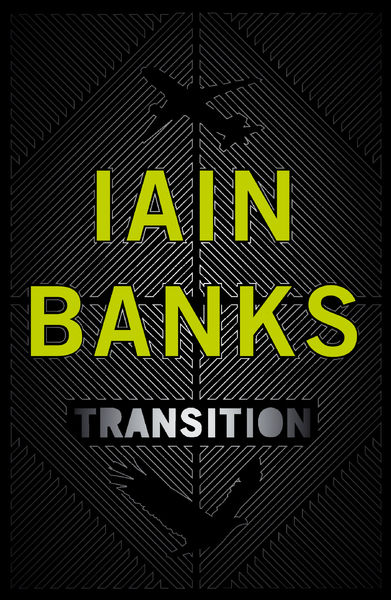 Transition is a science-fiction book by Iain Banks, and as such has been hailed as breaking down the barriers between Banks's "M" and "non-M" writing personas. This is a cosmetic readjustment at best. The "M." tag has attempted to label one specific, narrow portion of the spectrum through which Banks's work runs: from, on the one hand, realistic novels where multi-generational dysfunctional families interact in ways which illuminate broader global issues, to, on the other, sci-fi stories about robots and aliens and spaceships crashing and SHIT BLOWING UP. The former type could be written by a slightly geekier Ian McEwan, the latter by a literate E.E. 'Doc' Smith.
 The books tagged with an "M." tend to be the most unambiguously space-operatic, with the occasional oddity such as the post-cyberpunk jargonplay of Feersum Endjinn or the allusive pseudo-Mediaevalism of Inversions. The "M.-less" books, on the other hand, are a ragbag of realism (Espedair Street, Whit, Dead Air, The Steep Approach to Garbadale), detective novel (The Crow Road, Complicity) and gothic conspiracy theory (The Wasp Factory, The Business), including a couple of post-apocalyptic futures (the frankly tedious Canal Dreams and A Song of Stone) and reality-warping fantasies (Walking on Glass, The Bridge) which would have looked quite at home with an "M." on them.
So it is with Transition. The premise may be that a shadowy conspiracy known as "the Concern" has been manipulating the diverse histories of many worlds across the multiverse to unknown, but presumed benevolent, ends... but underneath it all the story's about capitalism, religious fanaticism and cultural imperialism: in short, The Way We Live Now. SF at its best does illuminate the real world, of course, and much the same agenda is at work in Banks's Culture novels. As I say, this is a spectrum of shades, not an author turning his literary credentials (or indeed his imaginative faculties) on and off with a keystroke.
The book itself is awkwardly-shaped, its actual story amounting to little more than one extended capture-escape-capture-escape cycle, with most of the interesting material told in flashback. Unfortunately, two strands of this -- illustrating respectively capitalism and fanaticism -- are imperfectly integrated with the rest of the novel, being the first-person backstories of minor characters whose contributions to the plot are tangential at most. The sheer bulk of this material means that the central storyline relating to the Concern proper, the rebellion against it and the speculation as to its true agenda, feels perfunctory. There are some authentically Banksian edifices here (literally so sometimes, as with the palace hollowed out of one universe's Mount Everest by a long-dead Emperor of the World), but they don't appear to have been subjected to much city planning. If I were feeling uncharitable I'd say Transitions was a much shorter novel and two fundamentally plotless novellas, in search of a competent editor.
This is a shame, because the story of the Concern is a fascinating one, which could have been developed at far greater length and over a wider range of excitingly architected worlds. It even feels as if the author's keeping secrets from us. Why, for instance, is the chief rebel against the Concern occasionally referred to as "the younger Mrs Mulverhill" when an older woman of that name is never mentioned? Is there an unspoken connection between Mulverhill and Madame D'Ortolan, the Wicked Queen running the Concern? Why do their surnames suggest "mother" and "daughter", and if the reason is the obvious one why are their ages the wrong way round? It feels as if Banks knows the answers to these questions, and is teasing us -- perhaps with a sequel in mind, although he's not been one for the direct follow-up in the past. Unfortunately there's not enough of substance in the book to justify it spilling over in this way.
Transition is fun, nonetheless, and works on the basic level of a fix for the many of us long since addicted to Banks's work. But it continues a recent trend towards less coherent recycling of past themes and ideas, and the cosmetic novelty of its presentation fails in the end to disguise that.
 The Panda Book of Horror ed Stuart Douglas and Paul Magrs is Obverse Books's follow-up to Iris Wildthyme and the Celestial Omnibus. There's no doubt that Obverse hit the ground running with The Celestial Omnibus, which although it sold modestly was near-universally acclaimed by those who read it (and coincidentally also contains my latest published fiction to date). The Panda Book of Horror, a sly parody of the old Pan Books of Horror Stories of the '70s, consolidates and improves on that success. Having a unifying theme tightens the volume up no end, and although I've never been a big reader of the horror genre I enjoyed those stories which attempt to follow it just as much as those which parody it with a rib-nudge and a cackle.
 None of the stories are less than splendid, but the opening and closing numbers are particularly good: Ian Z. Potter's "The Unholy Ghost" features clever, very funny prose and an eye-watering last-minute plot twist, while Mark Clapham's "Channel 666" turns nostalgia TV into an all-too-convincing manifestation of Hell and follows up with an equally brilliant conclusion. My favourite story, though, was Matt Kimpton's "Shadows of the Time Before", which depicts an eldritch Lovecraftian universe of creeping horror and squamous decay, whose rugose inhabitants are appalled at the cheerful irruption of a boozy, shabby party-vixen like Iris Wildthyme into their lives.
 That same Mark Clapham edited Secret Histories, the other book of short stories I've read this year. The unifying conceit of this one is that all the stories are told by the heroine -- Bernice Summerfield, of whom you'll certainly have heard me speak (and very likely seen me write). This collection's more of a piecemeal affair, although there's a rather notional through-plot and a few of the stories have closer links. Nonetheless, there's some fine writing here from Lance Parkin, Jim Smith (a sterling story featuring Bernice's old friend Mycroft Holmes), Jon Dennis and the increasingly inimitable Cody Schell. I think my favourite here was Mark Michalowski's elegantly evocative "The Illuminated Man", an everyday story of Edwardian circus folk.
 (And yes... for the sake of full disclosure all the authors and editors I've mentioned with respect to these anthologies are friends of mine. Except Matt Kimpton, who I don't believe I know from Y-chromosomal Adam.)
Most recently, I've reread Mythago Wood by Robert Holdstock, who reminded me of its existence by dying last November. I remember reading it as a teenager and being wholly enthralled by the central conceit -- a stand of ancient woodland whose near-impenetrable interior opens tardistically into the vast forested landscape of the human collective unconscious, replete with unreconstructed archetypes. The central story is itself deliberately mythic, with two brothers in the 1940s falling out over a woman (albeit the archetypal form of a Brythonic folk-heroine) after the death of their father (who lives on in Freudian form in the forest as an ancient, murderous beast-god). I enjoyed revisiting it, and was reminded of one possible source of my fascination with stories where different periods of history and prehistory rub shoulders. The "mythago" characters we meet in this book range from World War I back to the last Ice Age. I seem to remember I tried the sequel, Lavondyss, and didn't get on with it. Well, I'd only have been 16 or so. I might well try it again, although I'm slightly daunted by the fact that Holdstock seems to have squeezed out five more books in the series, the most recent being published last July. Still, in the "interminable series by authors I actually quite like" stakes, it can't possibly rival the Mars trilogy.
Collapsed Columns
I miss writing my columns on science fiction and faith for Surefish. They were a useful writing discipline and they allowed me to stretch my brain in a way I'm not doing so much these days. Plus they were a reliable source of monthly cash, which isn't trivial.
Partly because of this, and partly to help pay for the B&B accommodation we're inevitably going to need this year with a just-over-a-year-old-baby, I've put in a proposal to deliver two talks on SF-ish topics at Greenbelt this August. The 2010 Festival's theme is "The Art of Looking Sideways", which is as good a definition of speculative fiction as I've heard yet.
Both putative talks are the same kinds of thing I used to cover for Surefish (in fact I think I skimmed over both topics briefly in the course of the 25 columns), only obviously at rather greater length. (For a clue as to the subject-matter of one of them, read this post following last year's festival. You can even hear my spur-of-the-moment preparatory thinking during the questions at Kester Brewin's talk, if you pay to download it here. It's at exactly 50 minutes in, if you're bonkers enough.)
Assuming the organisers are interested in what I have to say -- and that they don't insist on exclusive rights to the material or anything -- I should be able to put up a transcript of both talks at some point, as I did with my earlier ones.
In the interest of appearing something vaguely resembling a competent professional when Greenbelt look into my credentials, I've updated my website so that the links to those columns actually work properly. Surefish changed all the indexing a while ago, and half the links fell off the map. (There's one I still can't find -- I think it may have been deleted, presumably by accident. I've put it up at the site instead, just to preserve it for that ever-hungry posterity who hound my every keystroke. In the long run I may do that with all of them -- I don't think Surefish are getting very much web-traffic that way any more.)
Partly because of this, and partly to help pay for the B&B accommodation we're inevitably going to need this year with a just-over-a-year-old-baby, I've put in a proposal to deliver two talks on SF-ish topics at Greenbelt this August. The 2010 Festival's theme is "The Art of Looking Sideways", which is as good a definition of speculative fiction as I've heard yet.
Both putative talks are the same kinds of thing I used to cover for Surefish (in fact I think I skimmed over both topics briefly in the course of the 25 columns), only obviously at rather greater length. (For a clue as to the subject-matter of one of them, read this post following last year's festival. You can even hear my spur-of-the-moment preparatory thinking during the questions at Kester Brewin's talk, if you pay to download it here. It's at exactly 50 minutes in, if you're bonkers enough.)
Assuming the organisers are interested in what I have to say -- and that they don't insist on exclusive rights to the material or anything -- I should be able to put up a transcript of both talks at some point, as I did with my earlier ones.
In the interest of appearing something vaguely resembling a competent professional when Greenbelt look into my credentials, I've updated my website so that the links to those columns actually work properly. Surefish changed all the indexing a while ago, and half the links fell off the map. (There's one I still can't find -- I think it may have been deleted, presumably by accident. I've put it up at the site instead, just to preserve it for that ever-hungry posterity who hound my every keystroke. In the long run I may do that with all of them -- I don't think Surefish are getting very much web-traffic that way any more.)
29 January 2010
OK, So This Is Important...
...too important to bury at the bottom of that last post, in fact.
I've been told that Haloscan, the comment-hosting service I've been using for this blog since long before Blogspot (as it then was) got its own act in gear, is closing down. I have the choice of either upgrading to a paid service -- which hardly seems worth it now Blogger are hosting a moderately effective comments service of their own -- or letting all the extant comments disappear. Which I've now done.
I've exported the 1500 or so comments made so far to a file, and Haloscan tell me (rather optimistically, in my view) that Blogger may get round to creating an import tool in the future. In the meantime, I'm sorry to say that any comment you may have made here in the past has disappeared, and -- while I very much hope this isn't the case -- it's possible that they may never reappear.
In the meantime, I can only encourage you to carry on commenting using the Blogger tool. Thank you...
I've been told that Haloscan, the comment-hosting service I've been using for this blog since long before Blogspot (as it then was) got its own act in gear, is closing down. I have the choice of either upgrading to a paid service -- which hardly seems worth it now Blogger are hosting a moderately effective comments service of their own -- or letting all the extant comments disappear. Which I've now done.
I've exported the 1500 or so comments made so far to a file, and Haloscan tell me (rather optimistically, in my view) that Blogger may get round to creating an import tool in the future. In the meantime, I'm sorry to say that any comment you may have made here in the past has disappeared, and -- while I very much hope this isn't the case -- it's possible that they may never reappear.
In the meantime, I can only encourage you to carry on commenting using the Blogger tool. Thank you...
A Bunch of Five Four
1. Today I'm trying to finish my working synopsis for the prospective novel I was calling The Arrow and the Circle, and have now renamed (under what may be the too obvious influence of Christopher Priest) The Devices. Once I know what the shape the plot takes, writing a 120,000-or-so-word novel in which it all happens should be, er, simplicity itself.
This clearly calls for diligent application and undivided concentration on my part. Hence this blog post.
 2. I've managed to keep @trapphic, my Twitter account for microfiction, going at a steady rate since reviving it for the New Year. For those who can't be bothered to join Twitter (and you're not missing a huge amount, unless you're the kind of person who's desperate to be informed whenever Stephen Fry scratches his right ear), I've appended more stories to the already lengthy back-catalogue on my website. I'm quite pleased with some of them -- the Quaestor's tale[1] in particular is one I'd like to revisit at greater length.
Being an enormous narcissist, I'm always interested to see (either from comments on Twitter itself or, more commonly, after reproducing the stories on Facebook) which of the stories receive most approval from readers. Some of the ones I've been most pleased with turn out to be overly complicated, the way they hang together neatly in my head failing to reproduce itself in anybody else's. (This failure is, naturally, mine entirely as the person trying to communicate the ideas in question.) I was, for instance, much more impressed with my own account of an alternative history of Vikings and Egyptians on Mars, recounted in Anglo-Saxon alliterative verse, than anybody else seems to have been[2], while what I thought was a throwaway metafictional joke turned out to be the most popular story I've posted yet[3].
 3. A couple of weekends ago B., R. and I made the trip to London, to attend both a friend's birthday party and the British Museum's Moctezuma: Aztec Ruler exhibition, which closed last Sunday. We'd been intending to visit the latter back in December, but the difficulties of reliably transporting a baby 100 miles in a car intervened. This time, through careful booking of advance train tickets and two nights in a rather good hotel, the whole enterprise became substantially more feasible.
The exhibition was impressive, although limited by the failure of many Mexica artifacts to survive the Spanish Conquista. The sophistication and variety of what was on display was a strong reminder of the complexity of the Aztec civilisation and its occupied territories, as well as of the relativity of human cultural values. Despite their ability to make a simple carving of a bunny rabbit look terrifying, there was evidently nothing special about the Mexica that was "savage", "primitive" or "inhuman". And yet they built a culture around ripping the hearts out of living victims in numbers that ran into at least the hundreds of thousands. It's a conundrum which is difficult to get one's head around (and has produced two extremely good, though very different, Doctor Who stories). The exhibition naturally offered no glib answers, but seeing items which were routinely used by the people in question helped to make the abstract question considerably more concrete.
I was amused by the exhibition's use of the term "deity impersonator", which made what I assume was a fairly straightforward sacramental role sound like an exotic drag act.
(The party was also lovely, and R. extremely popular at it -- although we had of course to leave for our hotel bed, and his cot, relatively early. We also managed to meet up with one of his godfathers on the morning of the Sunday, which was nice.)
4. In "Prose I Didn't Write" news, I've recently managed to finish two more books: The Corner by David Simon and Edward Burns, and Transition by Iain "Look, no M!" Banks. I want to say more about both of them soon, but... well, I really ought to be getting on with writing that thing of my own. I'm now reading The Panda Book of Horror, Obverse Books' follow-up to last year's Iris Wildthyme and the Celestial Omnibus which I bored you all about at the time.
5. [Edit: See separate post above.]
This clearly calls for diligent application and undivided concentration on my part. Hence this blog post.
2. I've managed to keep @trapphic, my Twitter account for microfiction, going at a steady rate since reviving it for the New Year. For those who can't be bothered to join Twitter (and you're not missing a huge amount, unless you're the kind of person who's desperate to be informed whenever Stephen Fry scratches his right ear), I've appended more stories to the already lengthy back-catalogue on my website. I'm quite pleased with some of them -- the Quaestor's tale[1] in particular is one I'd like to revisit at greater length.Being an enormous narcissist, I'm always interested to see (either from comments on Twitter itself or, more commonly, after reproducing the stories on Facebook) which of the stories receive most approval from readers. Some of the ones I've been most pleased with turn out to be overly complicated, the way they hang together neatly in my head failing to reproduce itself in anybody else's. (This failure is, naturally, mine entirely as the person trying to communicate the ideas in question.) I was, for instance, much more impressed with my own account of an alternative history of Vikings and Egyptians on Mars, recounted in Anglo-Saxon alliterative verse, than anybody else seems to have been[2], while what I thought was a throwaway metafictional joke turned out to be the most popular story I've posted yet[3].
3. A couple of weekends ago B., R. and I made the trip to London, to attend both a friend's birthday party and the British Museum's Moctezuma: Aztec Ruler exhibition, which closed last Sunday. We'd been intending to visit the latter back in December, but the difficulties of reliably transporting a baby 100 miles in a car intervened. This time, through careful booking of advance train tickets and two nights in a rather good hotel, the whole enterprise became substantially more feasible. The exhibition was impressive, although limited by the failure of many Mexica artifacts to survive the Spanish Conquista. The sophistication and variety of what was on display was a strong reminder of the complexity of the Aztec civilisation and its occupied territories, as well as of the relativity of human cultural values. Despite their ability to make a simple carving of a bunny rabbit look terrifying, there was evidently nothing special about the Mexica that was "savage", "primitive" or "inhuman". And yet they built a culture around ripping the hearts out of living victims in numbers that ran into at least the hundreds of thousands. It's a conundrum which is difficult to get one's head around (and has produced two extremely good, though very different, Doctor Who stories). The exhibition naturally offered no glib answers, but seeing items which were routinely used by the people in question helped to make the abstract question considerably more concrete.

I was amused by the exhibition's use of the term "deity impersonator", which made what I assume was a fairly straightforward sacramental role sound like an exotic drag act.
(The party was also lovely, and R. extremely popular at it -- although we had of course to leave for our hotel bed, and his cot, relatively early. We also managed to meet up with one of his godfathers on the morning of the Sunday, which was nice.)
4. In "Prose I Didn't Write" news, I've recently managed to finish two more books: The Corner by David Simon and Edward Burns, and Transition by Iain "Look, no M!" Banks. I want to say more about both of them soon, but... well, I really ought to be getting on with writing that thing of my own. I'm now reading The Panda Book of Horror, Obverse Books' follow-up to last year's Iris Wildthyme and the Celestial Omnibus which I bored you all about at the time. 5. [Edit: See separate post above.]
STORY NOTES:
[1] Within the reservation my badge meant nothing. The tribal authorities ran the show. ‘You’re on Catuvellauni land now, Quaestor,’ I muttered.
[2] Our sky-craft’s snake-prow glints proudly / As we stand sturdy on Tiw’s red world. / Bronze bowmen hail us, bragging of Horus. / We fight...
[3] ‘Once I’d had the idea, the book wrote itself. After our creative differences and arguments about royalties, it erased itself out of spite.’
22 January 2010
What happens when you give a literary critic a board book
When I said it had been ages since I finished a book, I wasn't, of course, counting books which are about twelve pages long and made of cardboard. I've read an awful lot of those recently, a couple of them upwards of a hundred times.
 I may at some point do a list of recommendations, for anyone who's interested, but I did want to mention one in particular: Peepo! by Janet & Allan Ahlberg. Uniquely among the Very Young Children's Books I've encountered recently, it has an entire layer to the narrative which wouldn't be fully apparent to any reader except an adult, and which I've found haunting me oddly over the past few weeks.
Peepo! is on the face of it a charming, only slightly twee narrative in verse about a baby's day and what he sees -- his family and their surroundings, mostly -- at various points during it. There's occasional adult commentary as part of this ("And a dog in the doorway / Who shouldn't be there"), and it's assumed that the baby can identify his parents, sisters and grandmother, but for the most part his viewpoint is presented -- realistically enough -- as a collection of unrelated visual experiences. He wakes up, watches his family perform various domestic tasks, is taken to the park, given a bath and put to bed. On the surface, there's no more to it than that.
The adult reader will presumably spot at least that the illustrations and a few of the words ("And his father in the doorway / With a bucketful of coal") put the story in a period context, that of a working-class family sometime in the early twentieth century. Only a fairly close examination, though, will reveal that this is specifically the early 1940s, and the sergeant's jacket hanging over a bedroom chair in the second illustration. The trip to the park in the afternoon is with the sisters and grandma, and the group return to find the mother asleep and the father, who began the day in civvies, wearing khaki shirt and trousers.
Having said his (presumably passionate) goodbye to his wife[1], the father bathes his son, kisses him goodnight and -- again presumably -- leaves his family to go and fight. The baby, of course, has no more idea of this than the book's infant readers, although the final question of the text ("Fast asleep and dreaming / What did he see?") might invite us to consider his future.
For an adult reader who spots this hidden story, the book becomes a very different experience from that which any child -- even one a fair bit older than our R.'s nearly six months -- is likely to get out of it.
Which is what you need, really, when reading the same twelve cardboard pages over and over again and optimistically aspiring not to lose your mind.
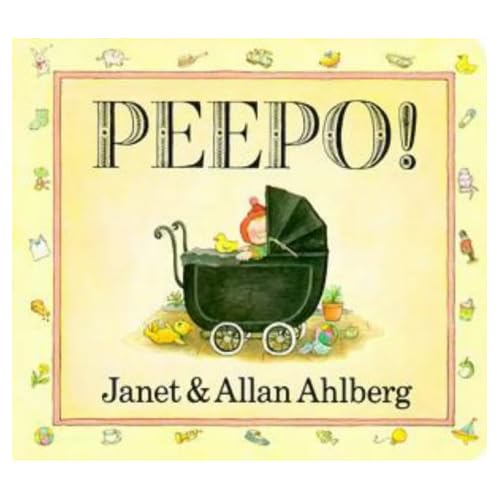 I may at some point do a list of recommendations, for anyone who's interested, but I did want to mention one in particular: Peepo! by Janet & Allan Ahlberg. Uniquely among the Very Young Children's Books I've encountered recently, it has an entire layer to the narrative which wouldn't be fully apparent to any reader except an adult, and which I've found haunting me oddly over the past few weeks.
 Peepo! is on the face of it a charming, only slightly twee narrative in verse about a baby's day and what he sees -- his family and their surroundings, mostly -- at various points during it. There's occasional adult commentary as part of this ("And a dog in the doorway / Who shouldn't be there"), and it's assumed that the baby can identify his parents, sisters and grandmother, but for the most part his viewpoint is presented -- realistically enough -- as a collection of unrelated visual experiences. He wakes up, watches his family perform various domestic tasks, is taken to the park, given a bath and put to bed. On the surface, there's no more to it than that.
The adult reader will presumably spot at least that the illustrations and a few of the words ("And his father in the doorway / With a bucketful of coal") put the story in a period context, that of a working-class family sometime in the early twentieth century. Only a fairly close examination, though, will reveal that this is specifically the early 1940s, and the sergeant's jacket hanging over a bedroom chair in the second illustration. The trip to the park in the afternoon is with the sisters and grandma, and the group return to find the mother asleep and the father, who began the day in civvies, wearing khaki shirt and trousers.
Having said his (presumably passionate) goodbye to his wife[1], the father bathes his son, kisses him goodnight and -- again presumably -- leaves his family to go and fight. The baby, of course, has no more idea of this than the book's infant readers, although the final question of the text ("Fast asleep and dreaming / What did he see?") might invite us to consider his future.
For an adult reader who spots this hidden story, the book becomes a very different experience from that which any child -- even one a fair bit older than our R.'s nearly six months -- is likely to get out of it.
Which is what you need, really, when reading the same twelve cardboard pages over and over again and optimistically aspiring not to lose your mind.
[1] I say "wife", that being the default assumption of the era, but in fact the mother's hands are clearly visible in several of the illustrations and this is the only one where she appears to be wearing a ring. In this interview Allan Ahlberg mentions his own experience of illegitimacy in the '40s, adding -- probably redundantly, in fact -- that "I was the Peepo! baby".
10 January 2010
In Other News...
- I've reinvigorated @trapphic on Twitter: if you're not a subscriber, you can consult the feed here for the latest 140-character microfictions spattered from my disintegrating brain.
- I realise I'm... erm, 56 years late to the party, but the two surviving episodes of The Quatermass Experiment are shockingly awesome.
- I don't know if anyone else has noticed, but it's bloody cold out.

Books Update: Chinatown
For the first time in a couple of months, I've managed to finish a book: The City & the City by China Miéville, which my grandmother-in-law was kind enough to obtain for me for Christmas.
I love Miéville's three New Crobuzon books: Perdido Street Station, The Scar and Iron Council, complex, intelligent tales of radical politics in a baroquely embellished fantasy world. If I had a quarrel with them it was that the quality of the worldbuilding vastly outstripped that of the stories. Their plots wouldn't look out of place in a Terry Pratchett novel (which, much though I love them, are rarely primarily concerned with plot): it's the creation of the city of New Crobuzon, and to a lesser extent the surrounding world of Bas-lag, that's been Miéville's real masterwork to date.
 In The City & the City, for my money, he outdoes himself. The presentation of the titular cities constitutes one the cleverest, strongest and most innovative settings in the whole of urban fantasy (if indeed that's what this book is -- see below for a few thoughts). Besźel and Ul Qoma are independent city-states located somewhere on the fringes of Europe. As you'd expect, each has its own distinct cultural and political history, which is expressed by its unique populations through the usual urban semiotics of architecture, dress, currency, signage, behaviour and bylaws. The mind-altering part is that the cities -- Besźel vaguely Eastern European, with Communism and Orthodox Christianity in its past, Ul Qoma approximately Ottoman-Byzantine and implicitly post-Islamic -- occupy the same geographical space as one another, their territories being interspersed, distributed and in many cases making use of the same thoroughfares, open spaces and even buildings.
Because they are, after all, in different cities, the two groups of citizens refuse to acknowledge one another's presence, or those of the clumps of foreign cityscape in their midst. A psychological habit as familiar yet as extreme as Orwell's doublethink enables them to "unsee" one another, subliminally registering their neighbour city (sufficiently to navigate around its traffic, for instance), but refusing to acknowledge the evidence for it in any other than the crudest practical ways. The narrator, Inspector Borlú, recalls policing an unusually wild music festival during the '60s, and unseeing the strollers in the congruent Ul Qoman park genteelly picking a delicate path between copulating Besź couples.
Locals learn the skill from childhood, eventually internalising it as instinct; visitors to one city or the other need to be painstakingly trained to avoid the heinous crime of "breach". The twisted ramifications of this collective denial include the checkpoint which constitutes the cities' only official border, and where it's uniquely legitimate to look from one into the other; and Besźel's "Ul Qoma town" district, where the locals implicitly understand the parodic inflections from one city which overwrite the other's characteristic stylings, to the utter confoundment of visitors.
It's a rare novel that you can feel rewiring your brain as you read it, but The City & the City qualifies. Its brilliance lies not merely in the task of conceptualising the cities, which is stunningly inspired yet always rigorous, but in the fact that none of this is explicitly spelt out for the reader: we learn what we learn through implication alone, as the conventionally-minded Besź Borlú describes an everyday life which makes perfect sense to him.
Compared to this, the actual story -- of Borlú and his Ul Qoman counterparts investigating the disappearance or murder of foreign archaeologists who may, just conceivably, have discovered the existence of a third city occupying the gaps between the two -- is, while clever and entertaining, hardly the point.
Miéville is a fantasy writer, and yet I'm not convinced that The City & the City is a fantasy. To be sure, his setting is a fictional one, but that's merely a matter of degree. A story set in a fictional world is by assumption fantasy even if its inhabitants are insurance underwriters and equalities compliance officers (unless that world is explicitly located elsewhere in our universe, in which case it's science fiction)... but in most cases a fictional city is understood to be no more fantastic an invention than a fictional family, organisation or person. Besźel and Ul Qoma exist in the contemporary world, with European investment and American diplomats in evidence (Besźel has a fully-fledged U.S. embassy, while Ul Qoma remains under a slightly embarrassing embargo). The missing academics are all American or Canadian. Characters refer to Google, Coke and Nikes with all the enthusiasm one might find in Prague or Ankara.
There's nothing supernatural, magical or miraculous in the entire novel: indeed, it feels like an attempt to reclaim the familiar fantasy trope of the hidden city-within-a-city for the mundane world. With the exception of one whimsical detail -- the anomalous relics of the pre-Cleavage Precursor civilisation, themselves no less plausible than the Baghdad Battery or the Antikythera Mechanism -- all the apparent weirdness proves to be purely psychological in origin. The central conceit is extreme but far from impossible -- nearly every city-dweller practises less extreme and formalised types of "unseeing" on a daily basis -- although Miéville never delves into its potential for political allegory, leaving this (with consummate restraint, given his socialist sympathies) as an exercise for the newly-rewired reader.
Neither is this quibbling about genre in any way the point, of course. The City & the City is a book that will change your mind: not in terms of convincing you of a particular agenda, but of subtly altering the way you perceive and understand the world. If I could write just one book in my career that achieved as much, I'd be a very happy author.
I love Miéville's three New Crobuzon books: Perdido Street Station, The Scar and Iron Council, complex, intelligent tales of radical politics in a baroquely embellished fantasy world. If I had a quarrel with them it was that the quality of the worldbuilding vastly outstripped that of the stories. Their plots wouldn't look out of place in a Terry Pratchett novel (which, much though I love them, are rarely primarily concerned with plot): it's the creation of the city of New Crobuzon, and to a lesser extent the surrounding world of Bas-lag, that's been Miéville's real masterwork to date.
In The City & the City, for my money, he outdoes himself. The presentation of the titular cities constitutes one the cleverest, strongest and most innovative settings in the whole of urban fantasy (if indeed that's what this book is -- see below for a few thoughts). Besźel and Ul Qoma are independent city-states located somewhere on the fringes of Europe. As you'd expect, each has its own distinct cultural and political history, which is expressed by its unique populations through the usual urban semiotics of architecture, dress, currency, signage, behaviour and bylaws. The mind-altering part is that the cities -- Besźel vaguely Eastern European, with Communism and Orthodox Christianity in its past, Ul Qoma approximately Ottoman-Byzantine and implicitly post-Islamic -- occupy the same geographical space as one another, their territories being interspersed, distributed and in many cases making use of the same thoroughfares, open spaces and even buildings. Because they are, after all, in different cities, the two groups of citizens refuse to acknowledge one another's presence, or those of the clumps of foreign cityscape in their midst. A psychological habit as familiar yet as extreme as Orwell's doublethink enables them to "unsee" one another, subliminally registering their neighbour city (sufficiently to navigate around its traffic, for instance), but refusing to acknowledge the evidence for it in any other than the crudest practical ways. The narrator, Inspector Borlú, recalls policing an unusually wild music festival during the '60s, and unseeing the strollers in the congruent Ul Qoman park genteelly picking a delicate path between copulating Besź couples.
Locals learn the skill from childhood, eventually internalising it as instinct; visitors to one city or the other need to be painstakingly trained to avoid the heinous crime of "breach". The twisted ramifications of this collective denial include the checkpoint which constitutes the cities' only official border, and where it's uniquely legitimate to look from one into the other; and Besźel's "Ul Qoma town" district, where the locals implicitly understand the parodic inflections from one city which overwrite the other's characteristic stylings, to the utter confoundment of visitors.
It's a rare novel that you can feel rewiring your brain as you read it, but The City & the City qualifies. Its brilliance lies not merely in the task of conceptualising the cities, which is stunningly inspired yet always rigorous, but in the fact that none of this is explicitly spelt out for the reader: we learn what we learn through implication alone, as the conventionally-minded Besź Borlú describes an everyday life which makes perfect sense to him.
Compared to this, the actual story -- of Borlú and his Ul Qoman counterparts investigating the disappearance or murder of foreign archaeologists who may, just conceivably, have discovered the existence of a third city occupying the gaps between the two -- is, while clever and entertaining, hardly the point.
Miéville is a fantasy writer, and yet I'm not convinced that The City & the City is a fantasy. To be sure, his setting is a fictional one, but that's merely a matter of degree. A story set in a fictional world is by assumption fantasy even if its inhabitants are insurance underwriters and equalities compliance officers (unless that world is explicitly located elsewhere in our universe, in which case it's science fiction)... but in most cases a fictional city is understood to be no more fantastic an invention than a fictional family, organisation or person. Besźel and Ul Qoma exist in the contemporary world, with European investment and American diplomats in evidence (Besźel has a fully-fledged U.S. embassy, while Ul Qoma remains under a slightly embarrassing embargo). The missing academics are all American or Canadian. Characters refer to Google, Coke and Nikes with all the enthusiasm one might find in Prague or Ankara.
There's nothing supernatural, magical or miraculous in the entire novel: indeed, it feels like an attempt to reclaim the familiar fantasy trope of the hidden city-within-a-city for the mundane world. With the exception of one whimsical detail -- the anomalous relics of the pre-Cleavage Precursor civilisation, themselves no less plausible than the Baghdad Battery or the Antikythera Mechanism -- all the apparent weirdness proves to be purely psychological in origin. The central conceit is extreme but far from impossible -- nearly every city-dweller practises less extreme and formalised types of "unseeing" on a daily basis -- although Miéville never delves into its potential for political allegory, leaving this (with consummate restraint, given his socialist sympathies) as an exercise for the newly-rewired reader.
Neither is this quibbling about genre in any way the point, of course. The City & the City is a book that will change your mind: not in terms of convincing you of a particular agenda, but of subtly altering the way you perceive and understand the world. If I could write just one book in my career that achieved as much, I'd be a very happy author.
16 December 2009
Blitzenkrieg
Looking back at my last post of 2008, I see I opened with the words "I realise I've really let this blog slide the past few months."
Well, I didn't have a baby then. (Frankly, the me of December 2008 didn't know he was born. He barely knew his son was going to be.) Now I do, I really know what it's like to be very much too bloody busy to maintain an online presence.
That said, I'm going to make more of an effort in 2010 to keep this blog up to date. As well as trying to actually write one of those novels I've been picking vaguely away at since, erm, forever. I hereby pledge that I'll have a first draft of what I'm currently calling The Arrow and the Circle written by the beginning of 2011.
(Probably. Very likely. Certainly any year now, I should think.)
Meanwhile, here's something I prepared earlier. Since 2006 I've been writing an annual Christmas story to send out with my Christmas cards to family and friends, and since 2007 I've been archiving the previous year's story here and on my website. Unless you're on my Christmas card list, you'll have to wait until 2010 to read the story I've written this year, "Stella Maris". For now, however -- both here and here -- you can read last year's story, "Blitzenkrieg".
In retrospect, it's a little obvious. Frankly I prefer both "Stella Maris" and "Polarity". However it does the job of wishing the recipient a damn well bloody merry Christmas.
Speaking of which, one of the above to you all.
Well, I didn't have a baby then. (Frankly, the me of December 2008 didn't know he was born. He barely knew his son was going to be.) Now I do, I really know what it's like to be very much too bloody busy to maintain an online presence.
That said, I'm going to make more of an effort in 2010 to keep this blog up to date. As well as trying to actually write one of those novels I've been picking vaguely away at since, erm, forever. I hereby pledge that I'll have a first draft of what I'm currently calling The Arrow and the Circle written by the beginning of 2011.
(Probably. Very likely. Certainly any year now, I should think.)
Meanwhile, here's something I prepared earlier. Since 2006 I've been writing an annual Christmas story to send out with my Christmas cards to family and friends, and since 2007 I've been archiving the previous year's story here and on my website. Unless you're on my Christmas card list, you'll have to wait until 2010 to read the story I've written this year, "Stella Maris". For now, however -- both here and here -- you can read last year's story, "Blitzenkrieg".
In retrospect, it's a little obvious. Frankly I prefer both "Stella Maris" and "Polarity". However it does the job of wishing the recipient a damn well bloody merry Christmas.
Speaking of which, one of the above to you all.
BLITZENKRIEGI've topped up the microfiction page as well, despite the fact that I haven't had time to update trapphic for months either. I'll try to be a more conscientious blogger, microblogger and site owner in the New Year.
by Philip Purser-Hallard
‘My, what a crowd. Good morning, gentlemen – and ladies, if there are any of you here.
‘Ah – good morning to you, ma’am.
‘Welcome all, to the third day of the International Defence and Security Solutions trade fair here in the beautiful Dock Lands of old London town – and to what I sincerely hope will be an unforgettable presentation on behalf of my company, Mistletopia Systems Inc.
‘Because, gentlemen – and ma’am – I’m here today to talk to you about SLAY.
‘SLAY stands for Strategic Localisation of Armament Yield – a modest name for a technology which will change the face of global, international and domestic conflict forever.
‘The SLAY prototype was developed at an independent R and D site in Northern Europe – now a subsidiary of Mistletopia Systems. At first the technology was directed to civilian ends, but the developers retained proprietary ownership. When we at Mistletopia became aware of its enormous applications in the defence sector, we instigated a takeover – a hostile one, of course.
‘That technology now belongs to us – lock stock and barrel, you might say. But with it we’ve built something a little more effective than a quaint old musket!
‘SLAY is unique. My colleague sitting behind me here will deal with the technical details, but I’ll say this. Strategic Localisation means that SLAY can deliver any payload, any time, with pinpoint accuracy, to any building in the world.
‘I’ll repeat that. Any building – anywhere.
‘Yes sir, ha ha, that does include this one.
‘The system has been extensively tested on residential targets, making it the future solution of choice for dealing with troublesome elements both domestic and abroad. However, it can also be adapted to gain access to any structure not hermetically sealed.
‘Ventilation ducts, sewerage systems, chimneys – you name it, SLAY can find its way through.
‘Class of payload? Not an issue. Conventional explosives, chemical or biological munitions, tactical nuclear warheads – SLAY can deliver any package with equal ease.
‘And that’s not all. Fuelled by nothing more complex than fructose, fat and carbohydrates, SLAY is the cheapest, lowest-maintenance payload delivery system yet devised. It’s also by far the fastest system currently on the market. “More rapid than eagles”, as one poetic observer described it.
‘With SLAY you can strike at any number of targets simultaneously – that’s right, sir, I did say simultaneously – and at no more than 24 hours’ notice.
‘The advantages of SLAY to the discerning government are obvious. All you need do is make a list – better check it, of course! – and SLAY will do the rest. At midnight, local time, the targets you nominate – plus anyone unwise enough to share a building with them – will receive from you that very special package.
‘Is the head of a rogue state being naughty? Is an ally refusing to play nice? With SLAY, the solution is in your hands.
‘They’ll soon know who’s coming to town. By deploying SLAY, you send a powerful message to those who would oppose you: We know when you’re sleeping. You’d better watch out.
‘And to your allies: Be good, for goodness’ sake.
‘You’ll be wondering about the technical details of the SLAY system – the history of its development, its deployment in the civilian arena, the specifications of SLAY’s eight individual component systems. For that I’ll have to hand over to my colleague. It’s his first time at IDSS and he’s not accustomed to the cut-and-thrust – excuse the expression! – of our industry.
‘He was reluctant to be here today, in fact, before we explained to him the consequences for his workforce if he were to refuse. He’s operating in our world now, though, so please be gentle with him. At least at first!
‘Ma’am, gentlemen – please welcome my good friend Nick Claus...’
©Philip Purser-Hallard 2008
16 October 2009
Books Update: Detectives, Outlaws, Archaeologists and Druids
Aargh. Blogger just swallowed my entire post, like the gigantic devouring worm at the heart of the world. I'll do my best to retype it while it's relatively fresh in my mind.
So. You were probably expecting me to say this, but I haven't had a great deal of opportunity to read or write of late. In the ten weeks since B. and I successfully procreated, I've managed a handful of books and a bare few thousand words in those respective areas.
 I'm generally less impressed than I expected to be by the first three books of Ian "definitely not Robert" Rankin's Rebus series[1]. The first of them, Knots and Crosses (which I happened to start in the hospital delivery suite) is probably the most interesting, but then it's a vaguely psychological novel whose protagonist is a policeman, rather than anything resembling a crime novel in the genre sense. Certainly its plot twists aren't the least expected I've seen: [SPOILERS] We learn early on that Rebus has a) an unidentified enemy who mysteriously seems to know him, b) repressed memories from a traumatic period in his past, and c) a brother who's a professional hypnotist. Goodness, I wonder how those elements might end up fitting together?
 On its own terms, Knots and Crosses is a reasonably good story about the repression of guilt and the chaotic eruption of the same. As the first in a bestselling series of detective novels, it's distinctly peculiar. It doesn't give the impression that Rankin intended to write one sequel, let alone sixteen.
Hide and Seek covers similar ground: it's slightly more polished, but as a crime novel it noodles about aimlessly, conveying little sense that Rankin is interested in crime and police work rather than his psychologically aberrant characters.
 Tooth and Nail is interesting primarily for its Scottish perspective on London -- and it takes an unholy delight in smashing the place up during the climax -- but the story depends on two huge cheats[2]. Rebus is losing his original personality at an alarming rate, while developing a habit of solving crimes by having the solution wander randomly into his lap. Inspector Morse he's not.
Now I have Strip Jack[3] sitting not six feet away, waiting for me to open it, and I'm not entirely sure I won't to return it to the library unread. Especially since I found a copy of Tales of the Dying Earth in a secondhand bookshop the other day, and that looks a lot more enticing right now.
 I'm sure I read Roger Lancelyn Green's The Adventures of Robin Hood when I was a kid, but I remembered very few of the specifics apart from that deathbed bury-me-where-the-arrow-falls-twang-argh scene. It's fun, and does a good job of summarising what we know of the Robin Hood legend from the various literary sources. I found it very readable, but it's over five decades old, and I'm not sure how accessible it would be for a modern child. Hopefully the progeny will be able to enjoy it at some point, though. I'm also meaning to get around to rereading Geoffrey "not Henry Treece" Trease's unashamedly Marxist interpretation of the legend, Bows Against the Barons. Which should be fun.
 I've mentioned Simon Guerrier's weighty reference book Bernice Summerfield: The Inside Story here before. Now that I've read it, I can reveal that it's interesting in parts, but way too long. I did enjoy the history of Bernice during the Virgin era -- although to be honest I'd have been more interested in a history of those books which didn't focus quite so centrally on the one character, marvellous though she is. However, when Simon moves on to the Big Finish books and especially the plays, -- this being the area with which he's been personally involved and where he presumably has better access to the material -- the book becomes painfully bloated, padding out the interesting material with anecdotes about actors hanging around recording studios eating lunch. Much as I love Benny in all her guises, I'd have preferred a substantially shorter and more focussed work, which didn't appear quite so skewed towards her current publisher.
(I agonised about whether it was fair to Simon to write all this on my blog. Then I remembered the box-quote on p194[4], and realised that it would be terribly ironic if I didn't.)
 And speaking of detectives, fantasy, British folklore and characters personally known to Mycroft Holmes... Druid's Blood by Esther M. Friesner is possibly the weirdest reinterpretation of the Sherlock Holmes mythos I've yet encountered, being set (supposedly -- see below) in an alternative history where British druidic magic has kept the island safe from invasion since Julius Caesar's time. It came recommended by Paul Magrs -- and I can see why he likes it, its joyous eclecticism being very reminiscent of his own more playful novels. Unfortunately I'm not convinced it's all that good -- it's certainly not up to the standard of Paul's own Brenda and Effie sequence.
The story's founded in a solid (if rather formulaic) fantasy plot, and it takes an interesting view of Holmes, Watson and the relationship between them. There's also a lot more shagging than one usually finds in Victorian pastiche, and it even makes a rather tentative attempt to tie Holmes the folk-hero in with the far more ancient tradition of the dying and resurrected god.
However, the book has a number of issues which I found very difficult to clamber over.
I'd recommend it as a curiosity, though, rather than as a fantasy novel, an alternative history novel or a piece of the Holmes apocrypha.
So. You were probably expecting me to say this, but I haven't had a great deal of opportunity to read or write of late. In the ten weeks since B. and I successfully procreated, I've managed a handful of books and a bare few thousand words in those respective areas.
I'm generally less impressed than I expected to be by the first three books of Ian "definitely not Robert" Rankin's Rebus series[1]. The first of them, Knots and Crosses (which I happened to start in the hospital delivery suite) is probably the most interesting, but then it's a vaguely psychological novel whose protagonist is a policeman, rather than anything resembling a crime novel in the genre sense. Certainly its plot twists aren't the least expected I've seen: [SPOILERS] We learn early on that Rebus has a) an unidentified enemy who mysteriously seems to know him, b) repressed memories from a traumatic period in his past, and c) a brother who's a professional hypnotist. Goodness, I wonder how those elements might end up fitting together? On its own terms, Knots and Crosses is a reasonably good story about the repression of guilt and the chaotic eruption of the same. As the first in a bestselling series of detective novels, it's distinctly peculiar. It doesn't give the impression that Rankin intended to write one sequel, let alone sixteen. Hide and Seek covers similar ground: it's slightly more polished, but as a crime novel it noodles about aimlessly, conveying little sense that Rankin is interested in crime and police work rather than his psychologically aberrant characters.
Tooth and Nail is interesting primarily for its Scottish perspective on London -- and it takes an unholy delight in smashing the place up during the climax -- but the story depends on two huge cheats[2]. Rebus is losing his original personality at an alarming rate, while developing a habit of solving crimes by having the solution wander randomly into his lap. Inspector Morse he's not. Now I have Strip Jack[3] sitting not six feet away, waiting for me to open it, and I'm not entirely sure I won't to return it to the library unread. Especially since I found a copy of Tales of the Dying Earth in a secondhand bookshop the other day, and that looks a lot more enticing right now.
I'm sure I read Roger Lancelyn Green's The Adventures of Robin Hood when I was a kid, but I remembered very few of the specifics apart from that deathbed bury-me-where-the-arrow-falls-twang-argh scene. It's fun, and does a good job of summarising what we know of the Robin Hood legend from the various literary sources. I found it very readable, but it's over five decades old, and I'm not sure how accessible it would be for a modern child. Hopefully the progeny will be able to enjoy it at some point, though. I'm also meaning to get around to rereading Geoffrey "not Henry Treece" Trease's unashamedly Marxist interpretation of the legend, Bows Against the Barons. Which should be fun. I've mentioned Simon Guerrier's weighty reference book Bernice Summerfield: The Inside Story here before. Now that I've read it, I can reveal that it's interesting in parts, but way too long. I did enjoy the history of Bernice during the Virgin era -- although to be honest I'd have been more interested in a history of those books which didn't focus quite so centrally on the one character, marvellous though she is. However, when Simon moves on to the Big Finish books and especially the plays, -- this being the area with which he's been personally involved and where he presumably has better access to the material -- the book becomes painfully bloated, padding out the interesting material with anecdotes about actors hanging around recording studios eating lunch. Much as I love Benny in all her guises, I'd have preferred a substantially shorter and more focussed work, which didn't appear quite so skewed towards her current publisher. (I agonised about whether it was fair to Simon to write all this on my blog. Then I remembered the box-quote on p194[4], and realised that it would be terribly ironic if I didn't.)
And speaking of detectives, fantasy, British folklore and characters personally known to Mycroft Holmes... Druid's Blood by Esther M. Friesner is possibly the weirdest reinterpretation of the Sherlock Holmes mythos I've yet encountered, being set (supposedly -- see below) in an alternative history where British druidic magic has kept the island safe from invasion since Julius Caesar's time. It came recommended by Paul Magrs -- and I can see why he likes it, its joyous eclecticism being very reminiscent of his own more playful novels. Unfortunately I'm not convinced it's all that good -- it's certainly not up to the standard of Paul's own Brenda and Effie sequence. The story's founded in a solid (if rather formulaic) fantasy plot, and it takes an interesting view of Holmes, Watson and the relationship between them. There's also a lot more shagging than one usually finds in Victorian pastiche, and it even makes a rather tentative attempt to tie Holmes the folk-hero in with the far more ancient tradition of the dying and resurrected god.
However, the book has a number of issues which I found very difficult to clamber over.
1. The worldbuilding. Personally, I like alternative histories which think through the logic of events in their reimagined timeline. This isn't one of those. We get some sense of what's been happening in Britain over the past eighteen or so centuries, but there's no attempt to explain how ancient British monarchs such as Bran the Blessed and Arthur have been succeeded by such later specimens as Richard III, Henry VII, Elizabeth I, Charles II, George IV and ultimately Victoria. Given that this world's Britons have remained ethnically distinct from the Welsh and Scots Picts, let alone the French, Germans and Dutch, for the royal bloodline to have thrown up these same individuals beggars belief.Druid's Blood is interesting, and quite a lot of fun at times -- Friesner seems in general to write comedic fantasy, and although I wouldn't describe Druid's Blood that way, the fact does make rather more sense of its peculiarities.
2. The worldbuilding. Nor is there the slightest consistency to it. Consider: Oscar Wilde is real in this world, as are George and Ada Byron, all of whom are much as history remembers them (apart from another set of inconsistencies, which I'll come to shortly). Arthur Conan Doyle is real, but his name's Arthur Elric Boyle. H.G. Wells is real, and has a time machine. Jack the Ripper is real, but turns out to be the goddess Kali (who at least has the merit of being a previously unidentified suspect). John H. Watson is real, but his background's entirely different from Doyle's fictional character, and his surname's Weston. Bram Stoker's Renfield is real and runs an upmarket restaurant (which is quite a funny in-joke until Friesner starts labouring it). Sherlock Holmes is called Brihtric Donne, and is -- strictly speaking -- fictional, being an imposter who's taken his identity from Weston's (not Boyle's) stories in the Strand.
So -- is Friesner presenting a world where what we know as fiction is reality, as in Alan Moore's League of Extraordinary Gentlemen? Or one where fictional characters coexist with their creators, like Kim Newman's Anno Dracula? Or one where writers' own fantastical experiences infuse their fiction, like -- say -- most of the portrayals of authors in Doctor Who? Or a history that's meant to be vaguely plausible, including a mechanism whereby the fictional Holmes can appear? She doesn't seem to have a clue.
3. The worldbuilding. And she doesn't even know what period of history she's trying to cover! While we're clearly in a pastiche nineteenth century (never identified as such because Britain is, of course, pagan rather than christian[5]), the characters in Druid's Blood include Lords Wellington (1769-1852), Byron (1788-1824) and Kitchener (1850-1915), and the authors Dickens (1812-1870), Wilde (1854-1900) and Wells (1866-1948). You don't have to be a literary historian to work out what's wrong with this picture. Surely if something as contingent as the royal line of succession has stayed constant, most people would need to have the same dates of birth and death in Donne's world?
Admittedly the fantasy elements on display include magical longevity (the long-retired Charles II is also a character, for instance), as well as resurrection and time travel... but the few clear historical markers we're given (Victoria is a genuinely young woman, Dickens is working on, ahem, The Mystery of Edwin Druid, the Ripper is stalking the East End[6]) are equally contradictory.
Despite appearances, fantasy simply isn't a genre where anything goes. Any fantasy world needs its own rigorous rules -- rather more so, in fact, than fiction that's in closer contact with recognisable reality. It's setting those rules where the creativity of fantasy lies. Friesner just can't make up her mind what her rules are, and worse, she doesn't seem to feel it's particularly important. Consequently, the reader is left struggling to understand how this world works, and not altogether sure that he or she cares. Why should we, when the author can create new elements by fiat any time she wants to?
4. Cultural cringe. Although she's clearly read widely -- The Mabinogion, Caesar's Gallic Wars and possibly even The Golden Bough as well as the Holmes canon -- Friesner remains one of those charming anglophile Americans who doesn't know British culture nearly as well as she thinks she does, and isn't afraid to demonstrate it. Aside from getting a vague sense that Cornwall was located somewhere in Wales, itself possibly an island off the Devon coast, and that Stonehenge stands a short distance outside London, I kept wincing at her Vandykean attempts at local dialect and some startling uses of vocabulary.
Some examples, off the top of my head and without referring to the book: "tweeny" is used as a formal job title, "bobs" is used as the plural of "bob" (as in shilling), an aristocrat who shows no particular signs of being also a judge is addressed as "m'lud", and -- most wrongly of all -- "public school education" is used as if it refers to an education which members of the public might get at school. To be sure, this is a different world -- but the intent is clearly that it's the same as the real Victorian England except in certain identified respects. In that context, these errors are just embarrassing.
6. An earworm. Finally -- and, one might suggest, least importantly -- I had the New Vaudeville Band song "I Was Lord Kitchener's Valet" running through my head all the while I was reading it. Which was annoying.
I'd recommend it as a curiosity, though, rather than as a fantasy novel, an alternative history novel or a piece of the Holmes apocrypha.
[1] Usually referred to as the "Inspector Rebus" series, but in Knots and Crosses he's only a sergeant.
[2] SPOILERS: The serial killer turns out to be a walk-on character whom we met briefly in one scene... and due to some vague guff about schizophrenia isn't even the same gender as the viewpoint character in the murder scenes.
[3] He abandons the themed titles after the first three novels, which is a shame.
[4] "I have a somewhat robust attitude to criticising others' writing" -- Philip Purser-Hallard.
[5] In fact there's no mention whatsoever of christianity, even in discussion of the outside world's history. One might construct a chain of events whereby the repulsion of Claudius's invasion attempt eventually meant that, say, Constantine never adopted christianity as the imperial religion, but there's not a hint of such a thing here.
[6] These would be roughly the 1840s, the late 1860s, and 1888.
24 September 2009
Intelligence Update
I'm predictably late in blogging the fact, but I feel we -- where "we" means cinema audiences -- have been almost unprecedentedly privileged this summer in having the opportunity to see two new pieces of intelligent, well-made SF drama.
I'm talking, of course, of Moon and District 9: set respectively in a cramped mining station on a relatively near-future Moon, and in a boderline-alternative history where South Africa became home to a population of extraterrestrial refugees in the late 1980s. Neither creates an original SF premise -- indeed, both are rather derivative, in ways I'll explore shortly -- but they do what the best of SF cinema does, using familiar tropes as springboards for clever, thought-provoking human stories with real intellectual significance.
Of the two, I prefer Moon, although I wouldn't argue with those who point out that District 9's the more important film. Moon is unexpectedly written and directed by Duncan Jones -- a man who evidently now rejects the only other fact I and the rest of the world knew about him, that his father had given him the name Zowie Bowie[1] -- and stars Sam Rockwell, who I only remember as Zaphod in the regrettable film version of The Hitchhiker's Guide to the Galaxy.
I went in without notably high expectations, and emerged raving. Moon is low-key, non-blockbustery SF drama reminiscent of the best examples of the genre before Star Wars ruined it for adults: Dark Star, for instance, Silent Running, or even the monolithic 2001: A Space Odyssey. (It also reminded me of Solaris, which is odd as I've somehow managed never to see either film version, or indeed read the novel.) Well-imagined, claustrophobic sets complement a small cast; although there's plentiful well-written dialogue, the central revelations are conveyed through almost-silent visual sequences. Although the special effects are excellent (and must have been very demanding to achieve), the script is such that most of the time I didn't even notice they were there.
Moon is definitely a film whose plot you want to avoid having spoiled, so I'm putting the rest of my comments in white (highlight the text to read it). Rockwell's role, whereby he needed to portray the clone protagonist and his clone antagonist / ally as essentially the same person after different life-experiences, must have been a daunting one, and he pulls it off brilliantly well. The other iterations of the character, in their brief appearances, are also distinguished in subtle shades. Purely from this point of view (and leaving aside the effects work which must have been involved in creating, for instance, the scene where Sam plays table-tennis against himself), the film's a tour de force.
It's also, of course, a clever meditation on the nature of human identity and where it resides -- while the Sam clones are unquestionably entitled to the same rights as the original Sam, and their callous exploitation at the hands of Lunar Industries is an atrocity, it's also clear that each of them is his own person, sharing a base personality and many memories but with a unique identity.
The one element of the film which doesn't quite fit the rest is the one which reminded me of Solaris: the soon-to-be-dying Sam's visions of the original Sam's daughter, appearing as the teenager she now is, despite being as far as he knows a toddler. This adds an odd, but appealing, edge of mysticism to an otherwise hard-edged piece of humanist storytelling.
Oh, and I loved the way Kevin Spacey's A.I. character subverted expectations by turning out noble in the end. I'm desperately hoping someone's going to get me the DVD for Christmas.
District 9 is a very different animal. You couldn't accuse it of being low-key, although the early exploration, through documentary and found footage, of its only slightly alternative world gives a pleasingly bleak and deceptively low-budget feel. The aliens are a generic underclass (the middle-class human characters being a significant though unremarked mixture of white and black), and our view of the slum from which they variously beg for drugs, thieve from humans, set fire to stuff and scrabble for a living on rubbish heaps, would dehumanise them quite effectively without the deliberately alienating insectoid design.
I'll spoiler-protect this one, too, although I think it needs it less -- if only because it's obvious from about 20 minutes in (if not before) that there's only one direction in which the story can go.
I was disappointed when this storytelling device was abandoned -- from the early scenes I'd been anticipating something more in the style of Cloverfield (except better, obviously -- perhaps I mean more like The Office, only with aliens). In fact the film falls broadly into three chapters, only the first of which uses the faux-documentary effect. The second is rather tedious gross-out body-horror (a genre I have little time for, to be honest, so I probably wasn't its best audience), and the third a less-dumb-than-usual action-movie climax.
I've had an interesting discussion with Not Invented Here about how these disparate styles are unified by the protagonist's journey. In the opening scenes Wikus van der Merwe is a corporate lackey, his worldview as objectifying as that of the documentary cameras. As a likeable and rather wet hero who acts as a willing instrument of fascism because it's his job and he doesn't want to fuck it up, he's one of the most effectively shocking portrayals of evil I've seen in film. Later, he descends into poverty as one of the underclass and becomes radicalised by the experience -- and as N.I.H. points out, the appropriation of these other SF subgenres, body-horror and schwarzeneggerish action, mirror that in metaphor rather nicely.
However, I felt that these three elements were insufficiently well married together, and in particular that they resulted in distressingly incoherent worldbuilding. The objectified, frankly disgusting aliens of the first third are humanised for us, not through subtle revelations, but through subtitling their dialogue to make it clear that their thought-processes are exactly like ours, and by giving one of them a cute big-eyed spielbergsque lobster-child. It's a copout, and compromises the integrity of the first part. Some of the differences can be rationalised by the fact that Wikus's alien friend and his son are clearly of the officer caste in the aliens' hive-system, but even so it's very tricky to reconcile the grim, shit-smeared arrival of the aliens in the opening montage (in which Close Encounters of the Third Kind is cleverly evoked in order to be scoffed at) with the disneyesque departure of their representatives at the end.
Nor does the central mcguffin have any logic behind it -- no matter how biological the enineering of the aliens' technology may allegedly be (and it all looks mechanical or electronic to me), it makes no sense that exposure to their fuel would mutate a human into one of them. As a method of alienating the protagonist, it's rather less sensible than the plan of the Nigerian gangster characters to take on the aliens' characteristics by eating their body-parts.
These elements felt as if they needed more thought -- which, in what was overall such a thoughtful film, seemed to me a bit of a letdown. Unlike Moon, which felt damn near perfect, I didn't feel it hung together completely as a narrative.
When District 9's most obviously about apartheid, and more generally about the casual subjugation of individuals whom society views as less than human, it's quite devastating. As Not Invented Here's also said, the significance of such a film coming out of South Africa itself (albeit with international money) can't be underestimated. It's just a shame that the film as a whole doesn't, or so I felt, follow through on that initial promise.
I'll still be getting it on DVD, I suspect.
I'm talking, of course, of Moon and District 9: set respectively in a cramped mining station on a relatively near-future Moon, and in a boderline-alternative history where South Africa became home to a population of extraterrestrial refugees in the late 1980s. Neither creates an original SF premise -- indeed, both are rather derivative, in ways I'll explore shortly -- but they do what the best of SF cinema does, using familiar tropes as springboards for clever, thought-provoking human stories with real intellectual significance.
Of the two, I prefer Moon, although I wouldn't argue with those who point out that District 9's the more important film. Moon is unexpectedly written and directed by Duncan Jones -- a man who evidently now rejects the only other fact I and the rest of the world knew about him, that his father had given him the name Zowie Bowie[1] -- and stars Sam Rockwell, who I only remember as Zaphod in the regrettable film version of The Hitchhiker's Guide to the Galaxy.
I went in without notably high expectations, and emerged raving. Moon is low-key, non-blockbustery SF drama reminiscent of the best examples of the genre before Star Wars ruined it for adults: Dark Star, for instance, Silent Running, or even the monolithic 2001: A Space Odyssey. (It also reminded me of Solaris, which is odd as I've somehow managed never to see either film version, or indeed read the novel.) Well-imagined, claustrophobic sets complement a small cast; although there's plentiful well-written dialogue, the central revelations are conveyed through almost-silent visual sequences. Although the special effects are excellent (and must have been very demanding to achieve), the script is such that most of the time I didn't even notice they were there.
Moon is definitely a film whose plot you want to avoid having spoiled, so I'm putting the rest of my comments in white (highlight the text to read it). Rockwell's role, whereby he needed to portray the clone protagonist and his clone antagonist / ally as essentially the same person after different life-experiences, must have been a daunting one, and he pulls it off brilliantly well. The other iterations of the character, in their brief appearances, are also distinguished in subtle shades. Purely from this point of view (and leaving aside the effects work which must have been involved in creating, for instance, the scene where Sam plays table-tennis against himself), the film's a tour de force.
It's also, of course, a clever meditation on the nature of human identity and where it resides -- while the Sam clones are unquestionably entitled to the same rights as the original Sam, and their callous exploitation at the hands of Lunar Industries is an atrocity, it's also clear that each of them is his own person, sharing a base personality and many memories but with a unique identity.
The one element of the film which doesn't quite fit the rest is the one which reminded me of Solaris: the soon-to-be-dying Sam's visions of the original Sam's daughter, appearing as the teenager she now is, despite being as far as he knows a toddler. This adds an odd, but appealing, edge of mysticism to an otherwise hard-edged piece of humanist storytelling.
Oh, and I loved the way Kevin Spacey's A.I. character subverted expectations by turning out noble in the end. I'm desperately hoping someone's going to get me the DVD for Christmas.
District 9 is a very different animal. You couldn't accuse it of being low-key, although the early exploration, through documentary and found footage, of its only slightly alternative world gives a pleasingly bleak and deceptively low-budget feel. The aliens are a generic underclass (the middle-class human characters being a significant though unremarked mixture of white and black), and our view of the slum from which they variously beg for drugs, thieve from humans, set fire to stuff and scrabble for a living on rubbish heaps, would dehumanise them quite effectively without the deliberately alienating insectoid design.
I'll spoiler-protect this one, too, although I think it needs it less -- if only because it's obvious from about 20 minutes in (if not before) that there's only one direction in which the story can go.
I was disappointed when this storytelling device was abandoned -- from the early scenes I'd been anticipating something more in the style of Cloverfield (except better, obviously -- perhaps I mean more like The Office, only with aliens). In fact the film falls broadly into three chapters, only the first of which uses the faux-documentary effect. The second is rather tedious gross-out body-horror (a genre I have little time for, to be honest, so I probably wasn't its best audience), and the third a less-dumb-than-usual action-movie climax.
I've had an interesting discussion with Not Invented Here about how these disparate styles are unified by the protagonist's journey. In the opening scenes Wikus van der Merwe is a corporate lackey, his worldview as objectifying as that of the documentary cameras. As a likeable and rather wet hero who acts as a willing instrument of fascism because it's his job and he doesn't want to fuck it up, he's one of the most effectively shocking portrayals of evil I've seen in film. Later, he descends into poverty as one of the underclass and becomes radicalised by the experience -- and as N.I.H. points out, the appropriation of these other SF subgenres, body-horror and schwarzeneggerish action, mirror that in metaphor rather nicely.
However, I felt that these three elements were insufficiently well married together, and in particular that they resulted in distressingly incoherent worldbuilding. The objectified, frankly disgusting aliens of the first third are humanised for us, not through subtle revelations, but through subtitling their dialogue to make it clear that their thought-processes are exactly like ours, and by giving one of them a cute big-eyed spielbergsque lobster-child. It's a copout, and compromises the integrity of the first part. Some of the differences can be rationalised by the fact that Wikus's alien friend and his son are clearly of the officer caste in the aliens' hive-system, but even so it's very tricky to reconcile the grim, shit-smeared arrival of the aliens in the opening montage (in which Close Encounters of the Third Kind is cleverly evoked in order to be scoffed at) with the disneyesque departure of their representatives at the end.
Nor does the central mcguffin have any logic behind it -- no matter how biological the enineering of the aliens' technology may allegedly be (and it all looks mechanical or electronic to me), it makes no sense that exposure to their fuel would mutate a human into one of them. As a method of alienating the protagonist, it's rather less sensible than the plan of the Nigerian gangster characters to take on the aliens' characteristics by eating their body-parts.
These elements felt as if they needed more thought -- which, in what was overall such a thoughtful film, seemed to me a bit of a letdown. Unlike Moon, which felt damn near perfect, I didn't feel it hung together completely as a narrative.
When District 9's most obviously about apartheid, and more generally about the casual subjugation of individuals whom society views as less than human, it's quite devastating. As Not Invented Here's also said, the significance of such a film coming out of South Africa itself (albeit with international money) can't be underestimated. It's just a shame that the film as a whole doesn't, or so I felt, follow through on that initial promise.
I'll still be getting it on DVD, I suspect.
[1] There's a "Moon Unit" joke in there somewhere, but I don't think I've got the willpower.
03 September 2009
Not So Long Now
This year, for the first time since 2004, I didn't blog the Greenbelt festival (of faith, art, music, activism, food and stuff in general) for Surefish. Those of you who've been paying attention may be able to guess one reason, which is that Surefish haven't actually been paying for new content since a while ago now. The other is, of course, young master R., who rather restricted our attendance this year.
 Nonetheless, we did manage to get from Bristol to Cheltenham for day trips on Saturday and Monday. At three weeks old R. remains something of an impediment, of course, and the one alternative worship session we managed to get to consisted largely of a breast-feeding, nappy-changing and baby-quietening marathon.
Still, we managed to attend and pay attention to a number of the events as well as generally appreciating the atmosphere.
This year's festival theme was "Standing in the Long Now", about which I was rather enthusiastic -- the long-term futurological thinking of these people being something I feel the world in general could do with very much more of. Sadly, aside some rather nice theming in the aforementioned worship session (which, of course, we hardly got the chance to see), the only evidence of the festival organisers drawing inspiration from this source was the slogan "Now is all we have" on a T-shirt (see illustration above).
A panel discussion on whether Doctor Who and its ilk should be frightening children (for both moral and aesthetic values of "should") benefitted hugely from the erudition of its panel, who included two Doctor Who authors and a vicar who used to draw Judge Dredd.
Kester Brewin's two talks on, respectively, "A Plea for Christian Piracy" and how physics might inform faith, were highly entertaining idea-play: the former reinterpreting 18th-century freebooters as revolutionary proto-anarchists, and the latter ranging through higher-dimensional spaces as an analogy for divine revelation and the many-world hypothesis as a justification for heaven, hell and immortality.
(Mind you, my question at the latter, about the alternative lives of Jesus and how they might knock the crucifixion from its central place in atonement theology, seemed to throw him rather. I might see if I can talk about something along those lines next year -- fortuitously themed "The Art of Looking Sideways" -- if a) I get time and b) they let me.)
Brewin also pointed out that "atom" and "individual" have the same root meaning, which had somehow never occurred to me before.
Aside from sessions with various friends at the Moroccan Pizza Tent, the Tiny Tea Tent, Nuts Wholefood Cafe and the Jesus' Arms pub tent (the last being a godawful letdown after the past two years, due to a change of franchisee -- we must give the organisers some feedback on that), the only other organised event we attended was a promotional gig by Jasper Fforde. Sadly, Fforde's overly high estimation of his own cleverness comes through in person as strongly as in his books, so we went away from that slightly irritated.
As ever, I appreciated the visual art as much as any of the talks, and was particularly impressed by these photos. I'd have liked to have seen more of these paintings as well, but unfortunately there was a guided tour in the way when we managed to make it there. Those we saw were great, though. We also managed to pick up a limited edition print of a rather incomprehensible artwork by Billy Childish.

Our partial attendance meant that we missed, among others, Robert Beckford, Michael Ward, Pete Rollins, Alister McGrath, Iain Sinclair and Gene Robinson, as well as any of the christian-muslim dialogue events (which the organisers depressingly felt the need to justify to their christian attendees in the programme). Any or all of these might also have been splendid, but circumstances weren't really on our side.
We had a fantastic time anyway, brief though it was, and look forward to managing longer next year.
 Nonetheless, we did manage to get from Bristol to Cheltenham for day trips on Saturday and Monday. At three weeks old R. remains something of an impediment, of course, and the one alternative worship session we managed to get to consisted largely of a breast-feeding, nappy-changing and baby-quietening marathon.
 Still, we managed to attend and pay attention to a number of the events as well as generally appreciating the atmosphere.
This year's festival theme was "Standing in the Long Now", about which I was rather enthusiastic -- the long-term futurological thinking of these people being something I feel the world in general could do with very much more of. Sadly, aside some rather nice theming in the aforementioned worship session (which, of course, we hardly got the chance to see), the only evidence of the festival organisers drawing inspiration from this source was the slogan "Now is all we have" on a T-shirt (see illustration above).
A panel discussion on whether Doctor Who and its ilk should be frightening children (for both moral and aesthetic values of "should") benefitted hugely from the erudition of its panel, who included two Doctor Who authors and a vicar who used to draw Judge Dredd.
Kester Brewin's two talks on, respectively, "A Plea for Christian Piracy" and how physics might inform faith, were highly entertaining idea-play: the former reinterpreting 18th-century freebooters as revolutionary proto-anarchists, and the latter ranging through higher-dimensional spaces as an analogy for divine revelation and the many-world hypothesis as a justification for heaven, hell and immortality.
(Mind you, my question at the latter, about the alternative lives of Jesus and how they might knock the crucifixion from its central place in atonement theology, seemed to throw him rather. I might see if I can talk about something along those lines next year -- fortuitously themed "The Art of Looking Sideways" -- if a) I get time and b) they let me.)
Brewin also pointed out that "atom" and "individual" have the same root meaning, which had somehow never occurred to me before.
Aside from sessions with various friends at the Moroccan Pizza Tent, the Tiny Tea Tent, Nuts Wholefood Cafe and the Jesus' Arms pub tent (the last being a godawful letdown after the past two years, due to a change of franchisee -- we must give the organisers some feedback on that), the only other organised event we attended was a promotional gig by Jasper Fforde. Sadly, Fforde's overly high estimation of his own cleverness comes through in person as strongly as in his books, so we went away from that slightly irritated.
As ever, I appreciated the visual art as much as any of the talks, and was particularly impressed by these photos. I'd have liked to have seen more of these paintings as well, but unfortunately there was a guided tour in the way when we managed to make it there. Those we saw were great, though. We also managed to pick up a limited edition print of a rather incomprehensible artwork by Billy Childish.

Our partial attendance meant that we missed, among others, Robert Beckford, Michael Ward, Pete Rollins, Alister McGrath, Iain Sinclair and Gene Robinson, as well as any of the christian-muslim dialogue events (which the organisers depressingly felt the need to justify to their christian attendees in the programme). Any or all of these might also have been splendid, but circumstances weren't really on our side.
We had a fantastic time anyway, brief though it was, and look forward to managing longer next year.
28 August 2009
Embroiderer of the Daleks
My God. Over the past few weeks we've had (by which I really mean that baby R. has had) some wonderfully thoughtful presents -- including clothes, toys, books, DVDs and various containment mechanisms -- from a vast array of people we know, love and / or are related to, most of whom we've completely failed to thank so far. (If that's you, then sorry -- things have been a little bit hectic.)
Lovely thought they are, though, none of the others have been quite as wonderful as this handmade baby quilt: I knew the friend in question had taken up quilting, but I hadn't realised the results looked this impressive.
  I hardly dare imagine the amount of work she's put into it.
 R. seems to appreciate it, anyway.
 (I know, I know -- this isn't supposed to be a baby blog. To be honest I've not had terribly much time for books, TV or, well, a life over the past few weeks. They say it'll settle down soon -- hopefully by 2027 or thereabouts, I'm told.)
Lovely thought they are, though, none of the others have been quite as wonderful as this handmade baby quilt:
 I knew the friend in question had taken up quilting, but I hadn't realised the results looked this impressive.
  I hardly dare imagine the amount of work she's put into it.
 R. seems to appreciate it, anyway.
 (I know, I know -- this isn't supposed to be a baby blog. To be honest I've not had terribly much time for books, TV or, well, a life over the past few weeks. They say it'll settle down soon -- hopefully by 2027 or thereabouts, I'm told.)
21 August 2009
Index and Contents
Things about fatherhood which are easier than I expected: Changing nappies[1]. Barely disgusting at all after the first half-dozen or so, and for reasons I won't trouble you with it gets less unpleasant still after the child's first week or so of digestion.
Things about fatherhood which are harder than I expected: The sleep deprivation. God, it's difficult. Still, if you haven't heard that before, you obviously haven't been hanging around enough new parents.
In other news... After a fortnight off, and four hours of sleep last night, I've managed to get back into writing in a small way today, so I'm no longer feeling as if that part of my life has been severed from me forever. Which is nice. It's just 500 words, but it's a start.
Another reason why I'm feeling like a writer again as well as a father is this substantial coffee-table book by my ex-editor Simon Guerrier, in which I'm one of many authors interviewed.
It's a history of the fiction featuring Bernice Summerfield -- a series character for whom you may recall I've written on four separate occasions, most recently in The Vampire Curse. Simon has assembled quotes from a truly huge number of authors who've contributed to Bernice's life story under three different publishers[2], and my name crops up -- according to the index, at least -- on 16 of the book's 310 pages. (Oh, hang on, there's the index page itself. 17 of 318, then.)
A lot of this material echoes stuff you can read on the Extras pages on my website, but you do get the (very out of date) inside scoop on why a couple of people apparently considered it mildly controversial for Big Finish to be commissioning me in the first place. Nine-and-a-half short stories and two novellas for them further on, this seems a touch academic... but if you're interested it's neatly summarised in a box-quote on p194. Enjoy.
Things about fatherhood which are harder than I expected: The sleep deprivation. God, it's difficult. Still, if you haven't heard that before, you obviously haven't been hanging around enough new parents.
In other news... After a fortnight off, and four hours of sleep last night, I've managed to get back into writing in a small way today, so I'm no longer feeling as if that part of my life has been severed from me forever. Which is nice. It's just 500 words, but it's a start.
Another reason why I'm feeling like a writer again as well as a father is this substantial coffee-table book by my ex-editor Simon Guerrier, in which I'm one of many authors interviewed.
It's a history of the fiction featuring Bernice Summerfield -- a series character for whom you may recall I've written on four separate occasions, most recently in The Vampire Curse. Simon has assembled quotes from a truly huge number of authors who've contributed to Bernice's life story under three different publishers[2], and my name crops up -- according to the index, at least -- on 16 of the book's 310 pages. (Oh, hang on, there's the index page itself. 17 of 318, then.)A lot of this material echoes stuff you can read on the Extras pages on my website, but you do get the (very out of date) inside scoop on why a couple of people apparently considered it mildly controversial for Big Finish to be commissioning me in the first place. Nine-and-a-half short stories and two novellas for them further on, this seems a touch academic... but if you're interested it's neatly summarised in a box-quote on p194. Enjoy.
[1] Diapers, if you will. And if you will, please be my guest.
[2] Yes, three -- Virgin, Big Finish and Marvel UK. (And in fact the Mad Norwegian press reprint of Dead Romance is mentioned briefly on p88, but of course Bernice isn't actually in that one.)
15 August 2009
Stray Thoughts Scraped from the Brain of a Recent Father
I'm writing this at 1:30 in the morning, with my son strapped to my chest. He's breathing gently, and occasionally stirring slightly. I keep worrying that he's too hot, or too cold. He's five days, three hours and twenty minutes old.
I won't be identifying him by name here -- privacy is rare enough on the internet, and I'm not going to blow it for him by naming him on a public forum before he's old enough to consent to it. As far as this blog's concerned, he's R.
* * *
Being present at a birth is one of the most draining, traumatic, shocking and paradigm-shattering experiences imaginable. I honestly think, until I actually saw R. emerge from his mother, I'd never believed that this was genuinely how it happened. I remember very clearly thinking, "My God, it's actually true!". Lord knows what I'd been expecting to see -- some kind of stork, perhaps.
* * *
My respect for people who voluntarily go through this experience on a daily professional basis has rocketed through the ceiling. Forget soldiers and firefighters, midwives may very well be the closest thing we have to superheroes.
* * *
I want to write a story now about anti-gestationists who believe babies come into being at the moment of birth and reject all this so-called scientific propaganda about foetal development.
* * *
To a regular SF viewer, a newborn baby looks like a none-too-convincing special effect. It's greyish-purple, it moves strangely, it's connected to a human being via a disturbingly organic-looking conduit, and looks unlike anything you've ever seen before. I remember finding the birth sequence in Children of Men oddly unrealistic, and feeling that it let down the rest of the film. I've a suspicion it matched what I saw on Sunday evening, pretty much frame by frame.
* * *
Incredible though midwives are, maternity wards are horrible places, full of hormonal panic and routinely violated privacy. B. and R. were kept in until Wednesday to be given antibiotics for a potential (and, as it turned out, mythical) infection. I was leaving them at 9pm, spending hours sorting stuff out at home and snatching a few hours' sleep before returning, if I managed it, for 9am. B. was having things far worse. The night they came home was an enormous relief.
* * *
Newborn babies are tiny vortices of need. Insofar as they have a personality at all, it relates to how their very basic needs -- for food, for sleep, for cleanliness, for warmth, for comfort -- stack up against one another. R. is particularly fond of comfort. I'm currently giving thanks daily for the invention of baby slings. (Not that our were bought -- they're six-metre by half-metre rectangles of stretchy fabric tied in a pattern designed by a genius.) It's thanks to them that I still have hands to call my own.
* * *
Yesterday was my and B.'s tenth wedding anniversary. To my utter astonishment, we actually managed to drive to a (not terribly good) restaurant, swallow a (not terribly good) meal and make it back home without R. regaining consciousness. He was blissed out on breast milk, and sleeping like... well, a baby I suppose.
* * *
I realise, of course, that this must be terribly dull for you, dear reader, unless you a) care about the individuals concerned, or b) fall into that demographic bracket which hasn't yet been through all itself this but has an active interest in doing so one day.
I'm not intending to turn this into a baby blog, as that would be a massive gear-shift and I doubt I'd be very good at it. (The blogging, that is, although now you mention it I'm far from confident of being any good at fatherhood either.) It does seem likely that there won't be much space for other things in my mind for a while yet, though. When there is, I'll do my best to mention them.
I won't be identifying him by name here -- privacy is rare enough on the internet, and I'm not going to blow it for him by naming him on a public forum before he's old enough to consent to it. As far as this blog's concerned, he's R.
* * *
Being present at a birth is one of the most draining, traumatic, shocking and paradigm-shattering experiences imaginable. I honestly think, until I actually saw R. emerge from his mother, I'd never believed that this was genuinely how it happened. I remember very clearly thinking, "My God, it's actually true!". Lord knows what I'd been expecting to see -- some kind of stork, perhaps.
* * *
My respect for people who voluntarily go through this experience on a daily professional basis has rocketed through the ceiling. Forget soldiers and firefighters, midwives may very well be the closest thing we have to superheroes.
* * *
I want to write a story now about anti-gestationists who believe babies come into being at the moment of birth and reject all this so-called scientific propaganda about foetal development.
* * *
To a regular SF viewer, a newborn baby looks like a none-too-convincing special effect. It's greyish-purple, it moves strangely, it's connected to a human being via a disturbingly organic-looking conduit, and looks unlike anything you've ever seen before. I remember finding the birth sequence in Children of Men oddly unrealistic, and feeling that it let down the rest of the film. I've a suspicion it matched what I saw on Sunday evening, pretty much frame by frame.
* * *
Incredible though midwives are, maternity wards are horrible places, full of hormonal panic and routinely violated privacy. B. and R. were kept in until Wednesday to be given antibiotics for a potential (and, as it turned out, mythical) infection. I was leaving them at 9pm, spending hours sorting stuff out at home and snatching a few hours' sleep before returning, if I managed it, for 9am. B. was having things far worse. The night they came home was an enormous relief.
* * *
Newborn babies are tiny vortices of need. Insofar as they have a personality at all, it relates to how their very basic needs -- for food, for sleep, for cleanliness, for warmth, for comfort -- stack up against one another. R. is particularly fond of comfort. I'm currently giving thanks daily for the invention of baby slings. (Not that our were bought -- they're six-metre by half-metre rectangles of stretchy fabric tied in a pattern designed by a genius.) It's thanks to them that I still have hands to call my own.
* * *
Yesterday was my and B.'s tenth wedding anniversary. To my utter astonishment, we actually managed to drive to a (not terribly good) restaurant, swallow a (not terribly good) meal and make it back home without R. regaining consciousness. He was blissed out on breast milk, and sleeping like... well, a baby I suppose.
* * *
I realise, of course, that this must be terribly dull for you, dear reader, unless you a) care about the individuals concerned, or b) fall into that demographic bracket which hasn't yet been through all itself this but has an active interest in doing so one day.
I'm not intending to turn this into a baby blog, as that would be a massive gear-shift and I doubt I'd be very good at it. (The blogging, that is, although now you mention it I'm far from confident of being any good at fatherhood either.) It does seem likely that there won't be much space for other things in my mind for a while yet, though. When there is, I'll do my best to mention them.
Subscribe to:
Posts (Atom)